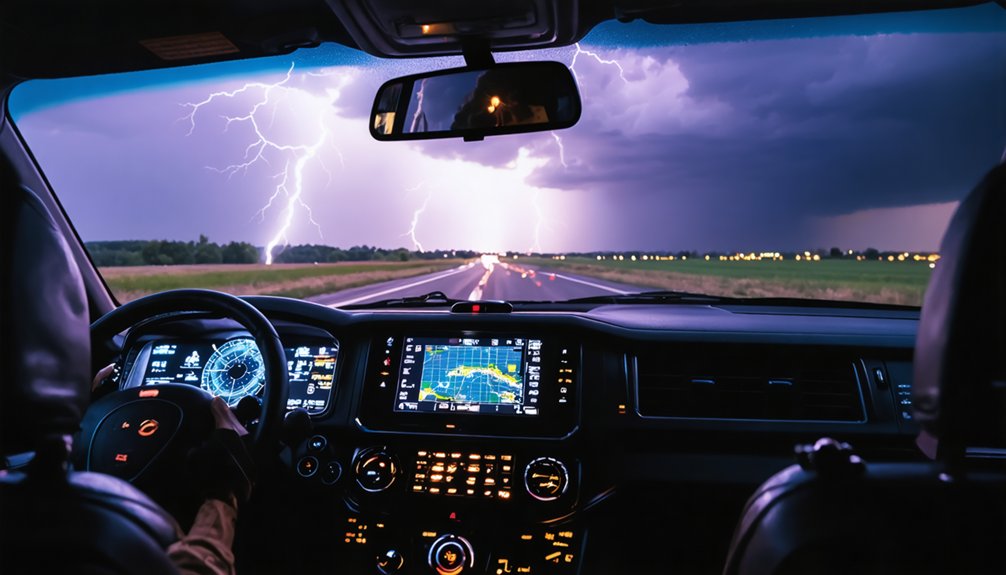
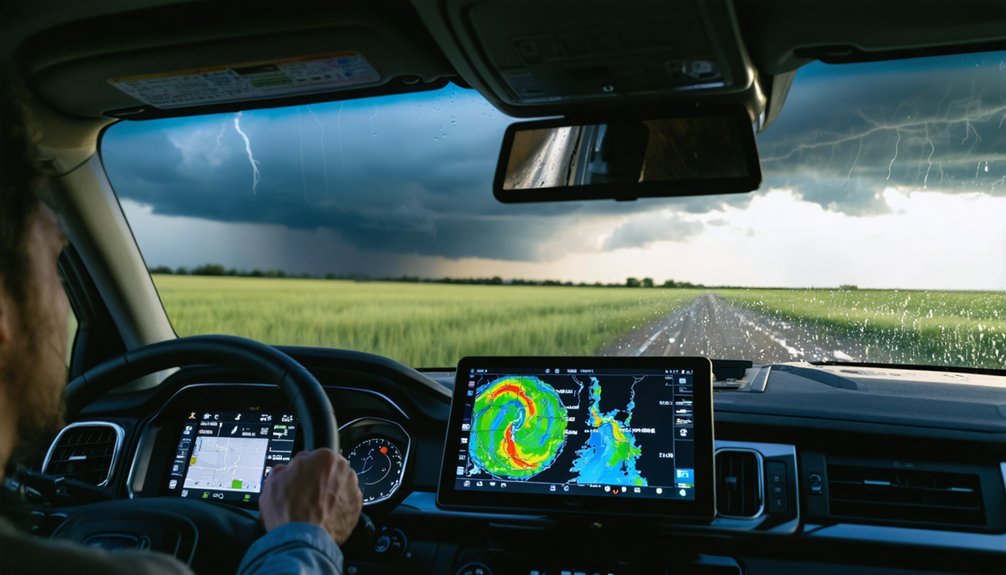
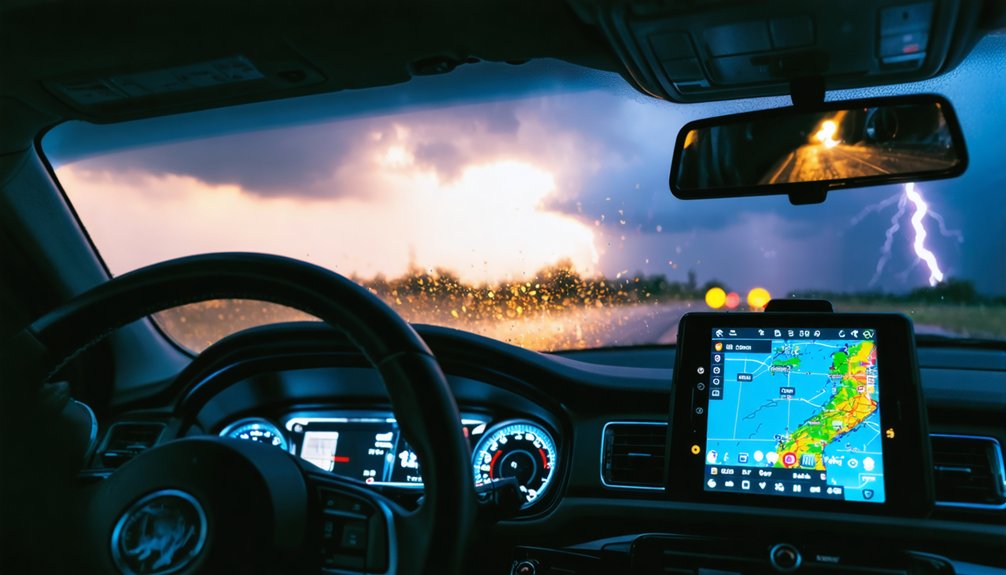
To track storms effectively, you need three essential tools. First, use a high-resolution radar app like RadarScope for precise storm positioning and intensity data. Second, carry a two-way radio or satellite communicator like the Garmin inReach Mini 2 to maintain coordination when cellular networks fail. Third, deploy a weather-sealed camera like the Nikon Z9 for reliable field documentation. Each tool serves a critical function—and the right configuration makes all the difference.
Key Takeaways
- RadarScope and Baron Mobile Threat Net provide high-resolution, real-time storm tracking data essential for precise positioning and anticipating directional shifts.
- Two-way radios like the Midland MXT575 ensure reliable communication when cellular networks fail in remote storm-chasing areas.
- Satellite communicators like the Garmin inReach Mini 2 maintain connectivity and transmit SOS signals in deep dead zones.
- Weather-sealed cameras like the Nikon Z9 or Canon EOS R5C capture professional storm footage while withstanding harsh conditions.
- Extra batteries, memory cards, and video stabilization tools are critical accessories to ensure uninterrupted storm documentation in the field.
Best Radar Apps for Storm Chasing
When it comes to storm chasing, your radar app can mean the difference between a successful chase and a dangerous miscalculation. RadarScope from DTN delivers high resolution radar data that outperforms most competing applications, giving you precise storm positioning and intensity readings.
Your radar app can mean the difference between a successful chase and a dangerous miscalculation.
Baron Mobile Threat Net adds real-time tracking capabilities, letting you anticipate directional shifts before they compromise your safety.
For maximum operational flexibility, apps like Radar Omega offer customizable displays, allowing you to configure data layers that match your specific pursuit strategy. You’re not locked into a one-size-fits-all interface — you control what information you see and how you see it.
Combining multiple apps creates redundancy, ensuring you’re never caught without critical storm data when conditions escalate rapidly.
Two-Way Radios and Satellite Communicators for Dead Zones
Cellular networks collapse precisely when you need them most — during peak storm activity in rural corridors where towers are sparse or damaged.
That’s where two-way radios and satellite communicators become non-negotiable. The Midland MXT575 MicroMobile and Yaesu FT-991A deliver communication reliability across channels unaffected by overwhelmed cellular infrastructure.
You’ll coordinate with fellow chasers and emergency services without interruption.
For deeper dead zones, the Garmin inReach Mini 2 and ZOLEO satellite communicators maintain your connectivity globally.
Both devices transmit GPS coordinates and activate SOS signals when emergency coordination demands immediate response.
These systems operate independently of compromised networks, giving you autonomous communication capability — exactly the freedom you need when conditions deteriorate fastest and decisions matter most.
Camera Gear Storm Chasers Actually Use
Three camera systems dominate serious storm chasing work: the Nikon Z9, Sony A7S III, and Canon EOS R5C. Each delivers professional weather sealing you’ll genuinely need in the field.
Dial in your camera settings before storms develop—you won’t have time mid-pursuit.
Essential gear you can’t skip:
- Sony CX900 for 1080p60 fps video stabilization in turbulent conditions
- Canon EOS R5C for 4K resolution storm documentation
- Fluid video head tripod for precise structural photography
- Extra batteries and memory cards to avoid missing critical moments
Weather-sealed bodies protect your investment when conditions deteriorate fast.
Video stabilization becomes non-negotiable when you’re shooting from a moving vehicle or wind-battered position. Your footage is only valuable if the equipment survives to capture it.
Frequently Asked Questions
What GPS Systems Work Best for Navigating Unfamiliar Storm-Chasing Terrain?
For unfamiliar terrain, you’ll want the Garmin Overlander 2025 Edition, which combines reliable handheld devices with satellite mapping for rerouting during road closures. Offline Google Maps guarantees you’re maneuvering confidently even when cellular networks fail completely.
Which Weather Monitoring Instruments Are Essential for Measuring Storm Intensity Accurately?
You’ll capture a million data points with an anemometer measuring wind speed and a barometer tracking pressure drops—both are critical measurement techniques that’ll give you unmatched storm intensity accuracy during active chasing.
What Vehicle Equipment Is Most Critical for Safe Storm Chasing Pursuits?
You’ll want tires with ideal traction as your most critical safety gear, since they maintain control on compromised roads. Complement these vehicle modifications with RAM laptop mounts and dedicated hotspots for continuous radar data access.
How Do Storm Chasers Maintain Navigation When Cellular Networks Become Unavailable?
You’ll maintain navigation using dedicated GPS systems with satellite navigation capabilities and offline maps downloaded via Google Maps, ensuring reliable routing even when cellular networks fail during intense storm pursuit operations.
What Atmospheric Pressure Tools Help Predict Storm Development During Active Chasing?
Barometers, pressure sensors, and barometric altimeters are your storm-predicting lifeline — they’ll detect atmospheric shifts a universe before the sky turns violent, letting you track pressure drops that signal intensifying storm development with razor-sharp precision.
References
- https://store.sirui.com/blogs/guides/essential-equipment-for-storm-chasing-guide-for-2025
- https://svinews.com/2024/featured/97765/things-every-storm-chaser-needs-in-their-truck/
- https://www.benholcomb.com/storm-chasing/equipment/
- https://www.youtube.com/watch?v=Sr2lz72ZYwM
- https://stormtrack.org/threads/equipment-for-the-newbie.32134/
- https://www.frankverderosa.com/single-post/be-ready-for-anything-weather-emergencies-storm-prep-must-have-gear