Electric vehicles are practical for storm chasing, but you’ll need to manage their limitations carefully. Instant torque enables rapid repositioning, while massive battery reserves power scientific instruments without generators. However, you can expect real-world range to drop from 271 miles to roughly 225 miles under storm conditions, with wind resistance alone cutting range by 20-30%. Understanding battery drain dynamics and infrastructure planning separates successful intercepts from dangerous situations—and the full picture gets more compelling from here.
Key Takeaways
- EVs offer instant torque for rapid storm repositioning and silent operation for authentic acoustic tornado research, making them scientifically advantageous.
- Real-world EV range drops from 271 to roughly 225 miles under storm conditions due to wind resistance and wet roads.
- Large EV battery reserves power scientific instrument arrays cleanly and reliably, eliminating dependence on cumbersome diesel generators.
- Maintaining 80% battery capacity preserves cell integrity, while continuous energy monitoring ensures safe operational planning during storm chasing.
- Top storm-chasing EVs include the Cybertruck, Rivian R1T, and Tesla Model Y, though gas vehicles still excel in rural adaptability.
Why Storm Chasers Are Switching to Electric Vehicles
Storm chasers are increasingly turning to electric vehicles because the technology’s core characteristics align with the unique operational demands of severe weather pursuit.
Electric vehicle benefits emerge immediately when you consider instant torque delivery, which enables rapid repositioning during fast-moving storm systems.
Instant torque delivery transforms storm chasing, giving pursuers the rapid repositioning power that fast-moving weather systems demand.
Battery technology innovations now power extensive scientific instrument arrays for hours, eliminating traditional generator dependencies.
Silent operation removes engine interference, letting you conduct authentic acoustic studies of tornado formation.
Storm tracking advancements integrate directly with EV platforms, supporting real-time GPS overlays and ruggedized communication systems.
Storm chasing efficiency improves through regenerative braking, which harvests kinetic energy during deceleration, extending operational range across long pursuit phases.
The armored battery floor-pan delivers an extraordinarily low center of gravity, enhancing vehicle stability when high-wind conditions threaten your safety.
How Heat, Rain, and Wind Affect Electric Motor Performance
Extreme weather conditions directly challenge electric motor performance in ways you’ll need to account for during storm chase operations.
Heat impact reduces battery efficiency, forcing thermal management systems to work harder and pulling power away from drive motors. You’ll see measurable performance metrics drop when ambient temperatures exceed ideal operating ranges.
Rain effects introduce additional resistance through wet road surfaces, increasing energy consumption beyond baseline calculations.
Wind resistance creates the most significant drain on your range — driving into 50 mph headwinds can reduce efficiency by 20-30% compared to calm conditions. Your rated 271-mile range might realistically deliver 225 miles under combined storm conditions.
Understanding these variables lets you make precise, data-driven decisions about when to reposition and when to hold your intercept location.
How Far Can an EV Actually Go During a Storm Chase?
When planning a storm chase, you’ll want to account for the gap between rated and real-world range — a vehicle rated at 271 miles typically delivers closer to 225 miles under aggressive driving and continuous climate control demands.
Battery drain accelerates at highway speeds above 70 mph, but stop-and-go traffic near storm intercept zones actually works in your favor, as regenerative braking recaptures kinetic energy and feeds it back into the battery pack.
You can extend your operational range by monitoring energy consumption in real time and factoring regenerative recovery into your route calculations, particularly during the repositioning phases that define most active chase sequences.
Real-World Range Expectations
How far can an electric vehicle realistically travel during an active storm chase? Setting realistic expectations matters more than manufacturer specs. A vehicle rated at 271 miles delivers closer to 225 miles under real-world conditions.
Aggressive driving, continuous climate control, and high winds compound that reduction further. Range anxiety becomes a genuine operational concern when you’re repositioning rapidly across unpredictable terrain.
Cold weather amplifies efficiency losses, mirroring fuel consumption increases in combustion engines. You can’t afford to miscalculate.
However, battery capacity remains sufficient for extended chase operations when you actively monitor consumption and plan accordingly. Understanding the gap between rated and actual performance isn’t a weakness—it’s tactical intelligence.
Know your vehicle’s real numbers before you’re 40 miles from the nearest charger with a supercell accelerating toward you.
Battery Drain During Chases
Battery drain during an active storm chase isn’t linear—aggressive repositioning, sustained highway speeds above 70 mph, and continuous climate control stack against you simultaneously.
A vehicle rated at 271 miles realistically delivers closer to 225 miles under standard conditions, but active chase scenarios compress that figure further. Battery efficiency drops sharply when you’re pushing hard through wind shear and precipitation while running radar equipment continuously.
Your charging strategies need to account for this degradation before wheels roll. Pre-mission charging to 80% capacity optimizes battery chemistry for sustained output rather than peak storage.
Regenerative braking partially offsets losses during stop-and-go intercept phases, but highway repositioning eliminates those gains quickly.
Monitor consumption rates continuously—you can’t afford to miscalculate your operational envelope when repositioning windows close fast.
Regenerative Braking Range Benefits
Regenerative braking flips the energy equation during storm chase operations, converting kinetic losses into measurable range gains that partially offset aggressive repositioning costs. Your braking technology captures deceleration energy, converting it directly back into battery storage rather than dissipating heat through friction.
Counterintuitively, congested evacuation routes actually work in your favor. Stop-and-go traffic patterns trigger continuous regenerative efficiency cycles, extending your operational range beyond baseline calculations.
Slower speeds combined with frequent deceleration events compound these gains systematically.
Highway repositioning at 70+ mph consumes battery reserves aggressively, but urban gridlock surrounding severe weather zones reverses that drain equation entirely.
You’re fundamentally harvesting free range from traffic you’d otherwise consider a tactical liability, transforming infrastructure congestion into a measurable operational advantage during extended chase sequences.
Does Regenerative Braking Help EV Range in Evacuation Traffic?
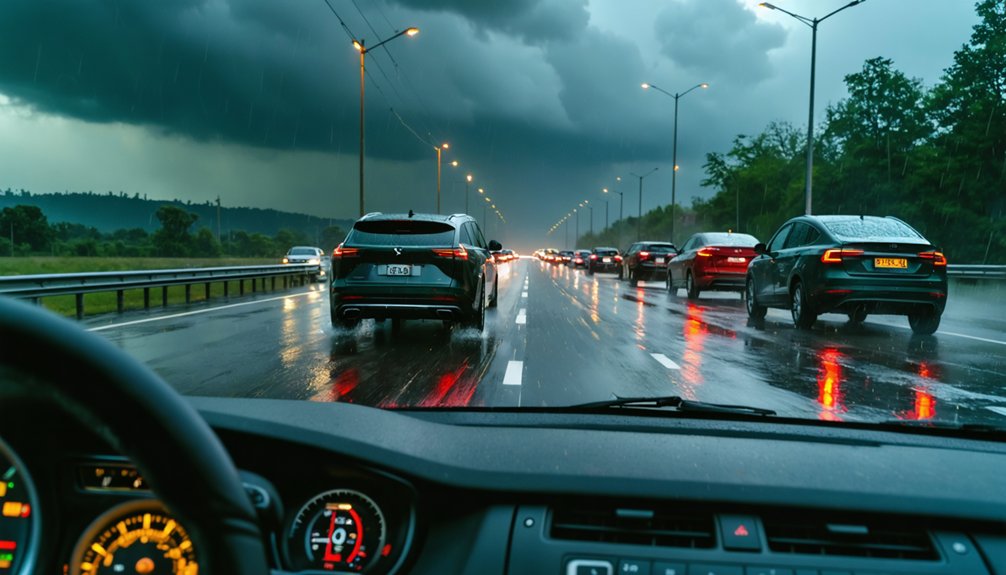
When you’re stuck in bumper-to-bumper evacuation traffic, your EV’s regenerative braking system actually works in your favor. Unlike combustion engines that burn fuel idling in congestion, your electric drivetrain converts deceleration energy back into stored battery charge, directly improving battery efficiency during stop-and-go patterns.
Bumper-to-bumper evacuation traffic actually works in your EV’s favor, converting every deceleration into recovered battery charge.
The traffic dynamics of evacuation scenarios paradoxically extend your operational range beyond highway calculations. At slower speeds, aerodynamic drag decreases considerably, reducing energy consumption rates.
Every braking event feeds kinetic energy back into your battery pack rather than dissipating it as heat through friction brakes.
A vehicle rated at 271 miles under standard conditions can realistically achieve closer to 225 miles at highway speeds, but congested evacuation routes measurably close that gap, giving you more usable range precisely when you need it most.
How to Charge Your EV Before a Storm Chase
Charging your EV to 80% capacity before a storm chase mission delivers the ideal balance between range availability and battery longevity.
Your charging strategies should prioritize Level 2 or DC fast charging at efficient voltages before severe weather impacts local infrastructure. Gas stations experience insane lines during evacuations, while charging stations remain comparatively accessible during pre-storm windows.
Charge early — don’t wait until peak evacuation periods create infrastructure bottlenecks. Maintaining 80% rather than 100% preserves battery cell integrity during the aggressive driving patterns that storm chasing demands.
Monitor your vehicle’s consumption data continuously, accounting for climate control loads that reduce real-world range below rated specifications. A vehicle rated at 271 miles realistically delivers approximately 225 miles under active chase conditions — plan accordingly.
Can EVs Power Scientific Instruments During Storm Intercepts?
Electric vehicles carry massive battery reserves that power extensive scientific instrument arrays for hours during active storm intercepts, eliminating the operational constraints traditional diesel generators impose on mobile meteorological platforms.
You’re no longer tethered to fuel supplies or noisy combustion systems that contaminate acoustic data collection. Modern EV platforms deliver clean, stable electrical output directly to your scientific equipment, supporting radar arrays, atmospheric sensors, and communication systems simultaneously.
Effective power management becomes your operational advantage—you can allocate battery resources precisely across instrument priorities without compromise. Unlike diesel alternatives, EV systems maintain consistent voltage delivery regardless of engine load variations.
Your instrument suite runs independently from propulsion demands, giving you complete tactical flexibility to reposition rapidly while keeping critical data collection systems fully operational throughout extended intercept missions.
How Storm Chasers Use V2H Power to Run Field Base Operations
Beyond powering your chase vehicle, V2H-capable platforms like the Cybertruck transform into mobile field base stations capable of sustaining operations for up to 4 days, depending on appliance load requirements.
These V2H applications eliminate your dependency on fixed infrastructure, letting you establish autonomous base operations anywhere storm intercept positioning demands.
You’re running communication arrays, meteorological data processors, and navigation systems directly from your vehicle’s battery reserves. No generator. No fuel logistics. No external grid dependency.
When traditional infrastructure collapses during severe weather events, your V2H-equipped platform keeps base operations running independently.
You’re analyzing real-time weather data, maintaining command center contact, and coordinating tactical repositioning without interruption.
That operational continuity isn’t a convenience — it’s a critical field advantage that separates effective intercept missions from compromised ones.
The Best Electric Storm Chase Vehicles Available Right Now
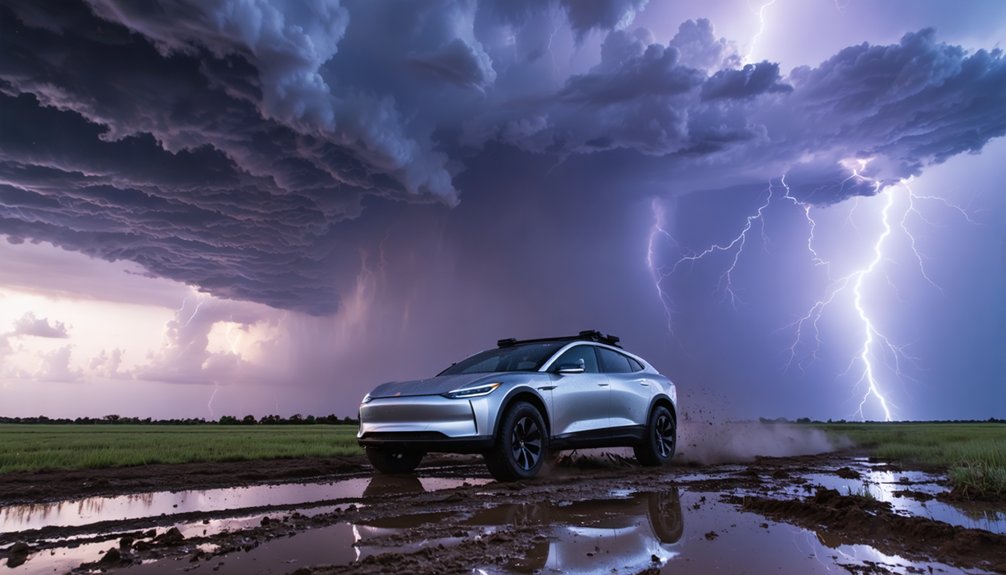
Three electric platforms currently stand out as purpose-aligned options for serious storm chase operations, each delivering distinct capability profiles worth evaluating against your specific mission requirements.
The Cybertruck’s armored battery floor-pan, V2H functionality, and 4-day backup power capacity make it a compelling field command platform.
The Rivian R1T delivers long-travel suspension geometry and rapid torque delivery critical for storm chasing safety during split-second repositioning.
Tesla’s Model Y provides surgical precision in intercept approaches with proven 225-mile real-world range under aggressive driving conditions.
Electric vehicle innovations continue reshaping what’s operationally possible—silent acoustic monitoring, regenerative range extension through stop-and-go traffic, and instrument arrays running independently of combustion limitations.
Your mission profile determines which platform’s capability set aligns with your operational priorities.
Electric vs. Gas-Powered Storm Chase Vehicles: Which Wins?
When you stack electric against gas-powered storm chase vehicles across core operational metrics, the comparison reveals distinct capability trade-offs rather than a clear universal winner.
Electric Performance delivers measurable torque advantages, enabling instant repositioning that combustion engines can’t match off the line. Silent operation gives you authentic acoustic data collection during intercept approaches. Armored battery protection systems simultaneously lower your center of gravity, improving stability against high-wind forces.
However, gas-powered vehicles retain weather adaptability advantages during extended rural operations where charging strategies become logistically complex. Vehicle durability under extreme conditions remains comparable across both platforms.
Energy efficiency actually favors electrics in stop-and-go evacuation traffic, where regenerative braking recaptures kinetic energy continuously. Your best choice ultimately depends on your specific operational theater and mission parameters.
Frequently Asked Questions
Can Lightning Strikes Damage an Ev’s Battery or Electrical Systems?
Yes, lightning strikes can damage your EV’s battery and electrical systems. Modern lightning protection measures and battery resilience engineering reduce risk, but you’re never fully immune—always seek shelter and avoid exposure during active electrical storms.
Are EV Charging Stations Available in Rural Storm Chasing Regions?
Rural infrastructure presents real charging accessibility challenges you’ll face. Pre-storm charging at 80% capacity before entering sparse regions is your smartest strategy, since fast-charging networks remain considerably less dense across tornado-prone Great Plains corridors.
How Does Hail Damage Affect EV Performance and Battery Integrity?
Like a knight’s armor, EV battery packs withstand hail impact effectively. You’ll find battery resilience remains intact, as armored floor-pans protect cells. Performance stays consistent; however, exposed sensors and charging ports risk cosmetic and functional damage.
Can Flood Waters Compromise an Electric Vehicle’s Battery Safety?
Floodwaters can compromise your EV’s battery immersion safety, but modern water resistance ratings (IP67+) protect sealed battery packs during short submersion events. You’ll want to avoid deep, prolonged flooding, as sustained exposure risks electrical system failures.
What EV Insurance Considerations Apply Specifically to Storm Chasing Operations?
Like Ahab chasing his whale, you’ll need specialized storm chasing insurance beyond standard EV coverage options—securing policies that address flood damage, battery replacement costs, and high-risk operational liability for your pursuit missions.
References
- https://www.accio.com/blog/next-gen-tornado-chase-vehicles-redefining-storm-intercept
- https://cleantechnica.com/2025/07/30/why-electric-vehicles-are-better-in-hurricanes/
- https://www.youtube.com/watch?v=t5zuTPpzOGw
- https://abc30.com/post/look-how-electric-vehicles-perform-extreme-weather/18457652/
- https://www.youtube.com/watch?v=bUOlmkk5moA