When measuring wind speed, you’ll choose from several core technologies: cup anemometers convert rotational speed to velocity, ultrasonic models use sound wave transit times, vane anemometers align propellers with airflow, and hot-wire units detect resistance changes for ultra-precise lab measurements. Each type balances accuracy, durability, and cost differently—hot-wire achieves ±0.1–0.5% precision while cup and vane models run ±2–5%. Matching the right instrument to your environment is everything, and there’s considerably more to unpack.
Key Takeaways
- Cup and vane anemometers are cost-effective for standard meteorological use, while ultrasonic models suit harsh environments with minimal maintenance needs.
- Hot-wire anemometers achieve ±0.1–0.5% precision, making them ideal for high-sensitivity laboratory airflow measurements.
- Calibration using wind tunnel testing establishes accurate relationships between rotation speed and wind velocity for reliable measurements.
- Specialized tools like radar profilers map wind profiles up to 17 km high, while Pitot tubes measure airspeed in aviation.
- Standard deployment height of 10 meters ensures anemometers capture representative atmospheric wind speeds across applications.
How Anemometers Measure Wind Speed
Anemometers measure wind speed through several distinct physical principles, each suited to different environments and precision requirements.
Cup anemometers convert rotational speed to velocity using calibration factors, while vane anemometers align propellers directly with airflow for electronic conversion.
Rotating cups and spinning propellers both convert the invisible force of wind into measurable, actionable velocity data.
Ultrasonic anemometer technology eliminates moving parts entirely, using sound wave transit times between transducers to calculate speed and direction with refresh rates reaching 3 Hz.
Hot-wire anemometers detect resistance changes in heated wires, delivering exceptional measurement accuracy for controlled laboratory settings.
Each method translates a specific physical response—rotation, pressure, sound, or heat transfer—into quantifiable wind data.
Understanding these mechanisms lets you select the right instrument for your application, whether you’re monitoring weather stations, conducting flux measurements, or operating in demanding industrial environments.
How to Choose the Right Anemometer for Your Needs
Choosing the right anemometer depends on four key factors: your environment, required precision, maintenance capacity, and budget.
Different anemometer technologies suit different conditions. In harsh or remote environments, ultrasonic models eliminate moving parts, reducing environmental impact and maintenance demands.
Cup and vane anemometers offer reliable, cost-effective solutions for standard meteorological stations. If you’re conducting laboratory research requiring high sensitivity, hot-wire anemometers deliver precise low-speed measurements.
For portable field use, pocket wind meters give you instant readings anywhere you need them. Wind profilers and sonic anemometers serve complex, high-altitude or flux measurement applications.
Match your choice to your specific operational context: assess exposure conditions, acceptable error margins, and long-term upkeep requirements before committing.
Selecting correctly the first time maximizes accuracy and operational freedom.
Cup Anemometers: The Meteorological Standard
When you use a cup anemometer, you’re working with three or four hemispherical cups mounted on horizontal arms that rotate around a vertical axis, with rotation speed directly proportional to wind velocity through a calibration factor.
You must install the instrument at the standard height of 10 meters above ground to guarantee consistent, comparable measurements across meteorological stations.
Your calibration data converts the mechanical rotation into precise wind speed readings, making cup anemometers the backbone of environmental monitoring networks worldwide.
How Cup Anemometers Work
Cup anemometers are the workhorses of meteorological measurement, relying on a deceptively simple mechanical principle to quantify wind velocity. Among anemometer types, they stand out for their straightforward measurement principles:
- Cup Capture: Hemispherical cups mounted on horizontal arms catch wind, creating rotational drag differentials.
- Axis Rotation: The asymmetrical drag forces spin the vertical axis at speeds directly proportional to wind velocity.
- Calibration Factor: A precise conversion factor translates rotation rate into accurate wind speed readings.
- Standardized Placement: Instruments mount at exactly 10 meters above ground, ensuring consistent, comparable data collection.
You’ll find these devices deployed across meteorological stations worldwide because they’re durable, reliable, and require minimal technical oversight — giving you dependable wind data without complex infrastructure.
Calibration And Rotation Speed
The mechanical simplicity described above only delivers accurate wind data when you back it with rigorous calibration.
You’ll establish a direct proportional relationship between rotation speed and wind velocity through controlled wind tunnel testing, where engineers expose the cups to known airspeeds and record corresponding rotation rates. These calibration techniques generate instrument-specific conversion factors you’ll apply to raw rotation data during field measurements.
Rotation mechanics determine your measurement accuracy markedly. Each cup design produces a unique drag differential between its concave and convex surfaces, driving consistent unidirectional rotation.
Your calibration factor accounts for bearing friction, cup geometry, and arm length variations. Standard deployment at 10 meters above ground guarantees you’re capturing representative atmospheric wind speeds, free from surface-level turbulence that would otherwise compromise your dataset’s integrity.
Meteorological Station Applications
Across meteorological stations worldwide, cup anemometers serve as the primary instrument for continuous wind speed monitoring, owing to their mechanical reliability and standardized calibration protocols. They collect meteorological data that helps you understand environmental impacts on climate systems, infrastructure, and aviation safety.
Stations deploy cup anemometers following four standardized operational protocols:
- Mounting height — positioned at exactly 10 meters above ground level
- Exposure requirements — installed away from obstructions affecting airflow accuracy
- Data logging — electronically recording continuous wind speed readings
- Maintenance scheduling — regular inspections ensuring mechanical integrity and calibration consistency
These protocols guarantee data reliability across global networks.
You’re working with instruments that feed into broader atmospheric models, empowering researchers, engineers, and policymakers to make informed decisions about energy, safety, and environmental management.
Vane Anemometers: The Go-To for HVAC and Field Measurements
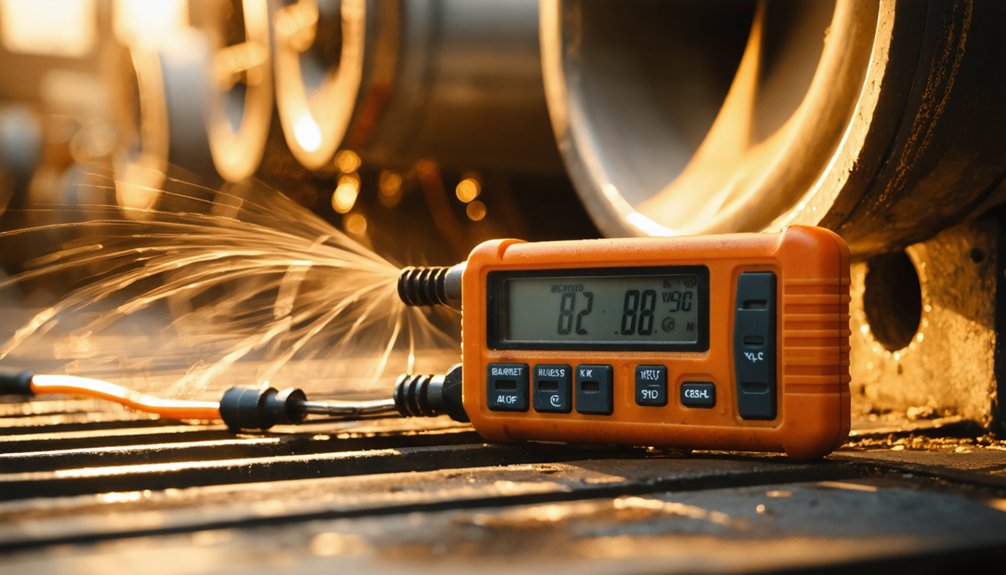
Vane anemometers combine a propeller and tail vane on a single axis, aligning automatically with wind direction while an electronic revolution counter converts fan speed into precise wind speed readings. This vane design eliminates the need for manual repositioning, giving you uninterrupted data capture during field operations.
Measurement accuracy remains consistent across HVAC systems and environmental monitoring applications, making it your most versatile single-instrument solution. You can also calculate volumetric flow rates by pairing wind speed readings with a known cross-sectional area, expanding the tool’s utility beyond basic meteorological tasks.
Whether you’re commissioning ventilation systems or conducting outdoor environmental assessments, vane anemometers deliver both speed and direction data simultaneously. That dual capability means you’re carrying one instrument instead of two, streamlining your workflow wherever conditions demand it.
Ultrasonic Anemometers: High Precision Without Moving Parts
Ultrasonic anemometers use sound waves transmitted between transducers to measure both wind speed and direction without a single moving part, eliminating the mechanical wear that limits other instruments.
Ultrasonic technology delivers high refresh rates up to 3 Hz, making it ideal for wind turbine monitoring and eddy covariance flux measurements.
Key measurement advantages and installation tips you’ll want to know:
- Environmental durability — Deploy confidently in harsh, remote conditions where mechanical sensors fail.
- Calibration techniques — Apply wind tunnel correction data to compensate for airflow distortion around the sensor housing.
- Dimensional flexibility — Choose two-dimensional models for weather stations or three-dimensional units for precise flux analysis.
- Low maintenance — Eliminate downtime associated with rotating components, freeing you from frequent field servicing.
Hot-Wire Anemometers for Lab and Low-Speed Work
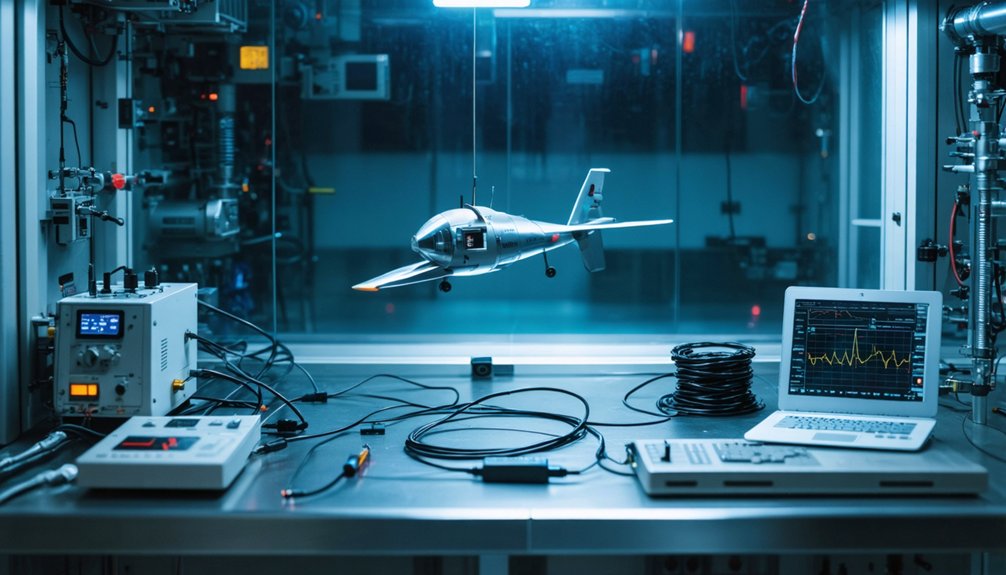
Where ultrasonic anemometers excel in field deployments, hot-wire anemometers dominate controlled laboratory environments demanding precise, low-speed airflow measurement.
You’ll find hot wire applications concentrated in research settings where detecting minute velocity fluctuations is non-negotiable.
The operating principle is straightforward: electrical current heats a thin wire, and passing airflow cools it, altering its resistance. That resistance change correlates directly with wind velocity, giving you highly sensitive, real-time data unavailable through conventional mechanical sensors.
In any sensitivity comparison, hot-wire anemometers outperform cup and vane instruments at low speeds, capturing subtle turbulence structures that broader-range tools simply miss.
However, their fragile construction limits them to controlled conditions. You’re trading field durability for exceptional resolution, making them indispensable tools when laboratory-grade airflow precision is your primary requirement.
Pocket Anemometers for On-the-Go Wind Speed Readings
When you need instant wind data in the field, a pocket anemometer delivers exactly that — a compact, handheld device with a small fan or impeller, digital screen, and control buttons that capture and display wind speed on the spot.
You’ll find these tools relied upon by kitesurfers, paragliders, and other outdoor enthusiasts who can’t afford to guess at wind conditions.
Before you choose one, you’ll want to evaluate measurement range, display readability, and durability against the specific demands of your intended application.
Pocket Anemometer Basic Features
Pocket anemometers are compact, handheld devices that resemble voice recorders, featuring a built-in screen, control buttons, and a small fan or impeller to capture wind speed data instantly. Their pocket anemometer portability lets you carry reliable wind measurement anywhere without restriction.
Here’s what you’ll find in most models:
- Display screen — shows real-time wind speed readings clearly
- Control buttons — let you switch units, log data, or reset readings
- Built-in impeller — rotates to capture wind velocity directly
- Battery compartment — pocket anemometer battery life typically supports extended field sessions
These core features make pocket anemometers genuinely practical tools.
Whether you’re paragliding, kitesurfing, or evaluating site conditions, you get immediate, accurate data without carrying bulky equipment.
Field Applications And Uses
Those built-in features serve a clear purpose once you take a pocket anemometer into the field.
Field usage spans multiple real-world applications where portability determines success. You’ll deploy these portable solutions for environmental monitoring across construction zones, coastal areas, and open terrain without lugging heavy equipment.
For sports activities, kitesurfers and paragliders rely on instant readings before launching, making accurate measurement techniques crucial for safety.
Wind energy prospecting also benefits, letting you conduct preliminary data collection across potential turbine sites efficiently.
You’re fundamentally carrying a compact instrument that delivers reliable wind speed values wherever conditions demand assessment.
Whether you’re logging sequential readings across survey points or capturing single spot-checks, the device integrates smoothly into any systematic field protocol requiring fast, accurate wind data.
Choosing Your Pocket Anemometer
Selecting the right pocket anemometer requires matching device specifications to your specific measurement demands.
You’ll want a device that delivers reliable data wherever your activities take you, whether you’re kitesurfing, paragliding, or conducting field assessments. Portability advantages make these compact instruments essential for mobile professionals.
Evaluate pocket anemometer features using these four criteria:
- Display clarity – Ascertain readings are visible in direct sunlight
- Measurement range – Verify the device covers your expected wind speeds
- Refresh rate – Faster updates provide more accurate real-time data
- Durability rating – Weather-resistant construction protects against field conditions
You’re investing in operational independence when you choose a pocket anemometer.
Prioritize units with long battery life and intuitive button controls for seamless on-site deployment.
When You Need More: Radar Profilers, Pitot Tubes, and Sonic Sensors
When standard anemometers fall short, specialized tools like radar profilers, pitot tubes, and sonic sensors fill the gap. Each targets scenarios where conventional instruments can’t deliver.
Radar profilers use SODAR or radar technology to map wind profiles up to 17 km high, giving you atmospheric data no ground-based tool can match. You’ll find them essential for large-scale meteorological research and wind energy site assessments.
Pitot tubes measure pressure differentials to calculate airspeed, making them indispensable in aviation applications where precision directly affects safety.
Sonic sensors operate across one to three dimensions, capturing eddy covariance flux measurements with zero moving parts. They’re your go-to for turbulence research and complex flow studies in demanding environments.
Choose the tool that matches your operational scope and precision requirements.
Accuracy Ranges Across Anemometer Types
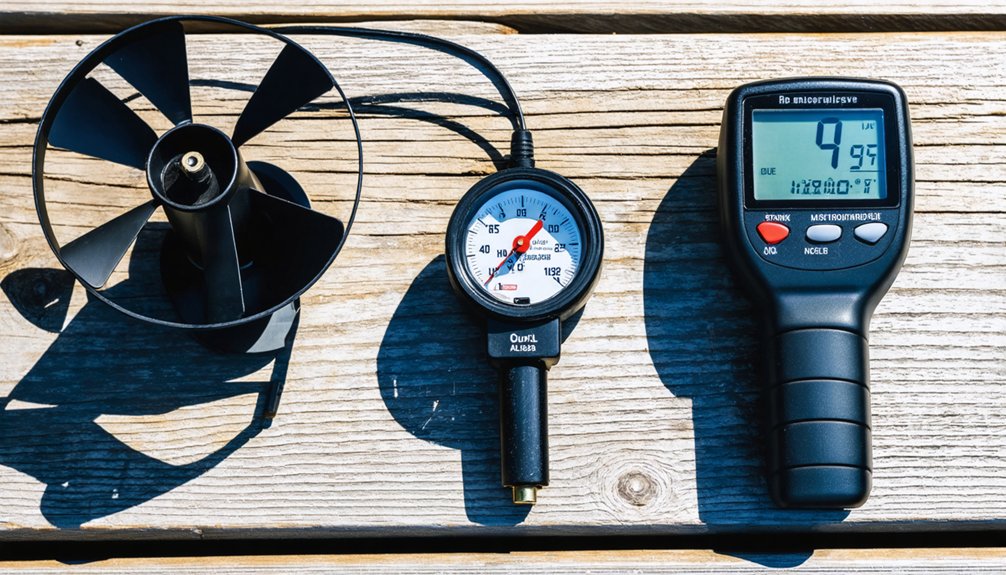
Understanding which tool fits your application means little without knowing how accurately each one performs.
Here’s a direct accuracy comparison to guide your decisions on measurement reliability:
- Cup Anemometers – Typically accurate within ±1–3% under standard conditions, though mechanical friction affects low-speed readings.
- Ultrasonic Anemometers – Deliver ±1–2% accuracy with no moving parts degrading performance over time.
- Hot-Wire Anemometers – Achieve ±0.1–0.5% accuracy in controlled lab environments, making them the most precise option available.
- Vane Anemometers – Operate within ±2–5% accuracy, adequate for HVAC and field applications but less suited for research-grade work.
You’ll want to match precision requirements directly to your environment, budget, and the consequences of measurement error.
How to Calibrate and Maintain Your Anemometer
Accurate readings depend entirely on how well you calibrate and maintain your anemometer, so establishing a routine protocol is non-negotiable.
Apply calibration techniques by comparing your instrument against a certified reference standard in controlled wind tunnel conditions. Document deviation percentages and apply correction factors accordingly.
For cup and vane models, inspect bearings and rotating components quarterly. Hot-wire anemometers require frequent wire integrity checks due to fragility. Ultrasonic units need transducer surface cleaning to prevent signal distortion.
Build maintenance schedules around your deployment environment — harsh outdoor conditions demand monthly inspections, while laboratory settings allow quarterly reviews.
Always recalibrate after physical impacts, extreme weather exposure, or firmware updates. Keep detailed calibration logs, as regulatory compliance and data integrity both depend on traceable, timestamped maintenance records you control completely.
Frequently Asked Questions
What Is the Historical Origin of the Word “Anemometer”?
Like roots anchoring a tree, anemometer etymology traces to Greek: “anemos” (wind) and “metron” (measure). You’ll find ancient wind devices inspired this term, reflecting humanity’s enduring drive to quantify nature’s invisible, untameable force.
Can Wind Speed Measurements Affect Insurance Claims or Legal Disputes?
Yes, wind speed measurements can directly impact your insurance claims and carry significant legal implications. You’ll find that precise, calibrated anemometer data strengthens dispute resolutions, validates storm damage assessments, and supports liability determinations in court proceedings.
Are There International Standards Governing Anemometer Data for Climate Records?
Yes, you’ll find that WMO and ISO set anemometer standards governing climate monitoring data. They specify calibration protocols, measurement heights, and data quality requirements, ensuring you’re collecting reliable wind speed records for global climate analysis.
How Do Extreme Temperatures Affect Anemometer Battery Life and Performance?
Battery efficiency drops 50% at -20°C! Temperature extremes severely impact your anemometer’s performance—cold slows chemical reactions, reducing battery efficiency, while heat accelerates discharge. You’ll need insulated housings or heated enclosures to maintain reliable, uninterrupted wind measurements in harsh conditions.
What Certifications Do Professional Meteorologists Need to Operate Anemometers?
No universal anemometer certifications exist for meteorologist qualifications. You’ll typically need a meteorology degree and agency-specific training. Organizations like WMO set operational standards, but you’re free to operate most anemometers without formal licensing requirements.
References
- https://windy.app/blog/wind-measurement-instruments.html
- https://en.wikipedia.org/wiki/Anemometer
- https://www.comptus.com/products/wind-measurement/anemometer/
- https://scarlet-tech.com/types-of-anemometer/
- https://www.theweatherstore.com/collections/wind-speed-direction
- https://scientificsales.com/collections/wind-monitors-alarms-sensors-ultrasonic-anemometer
- https://www.davisinstruments.com/collections/anemometers