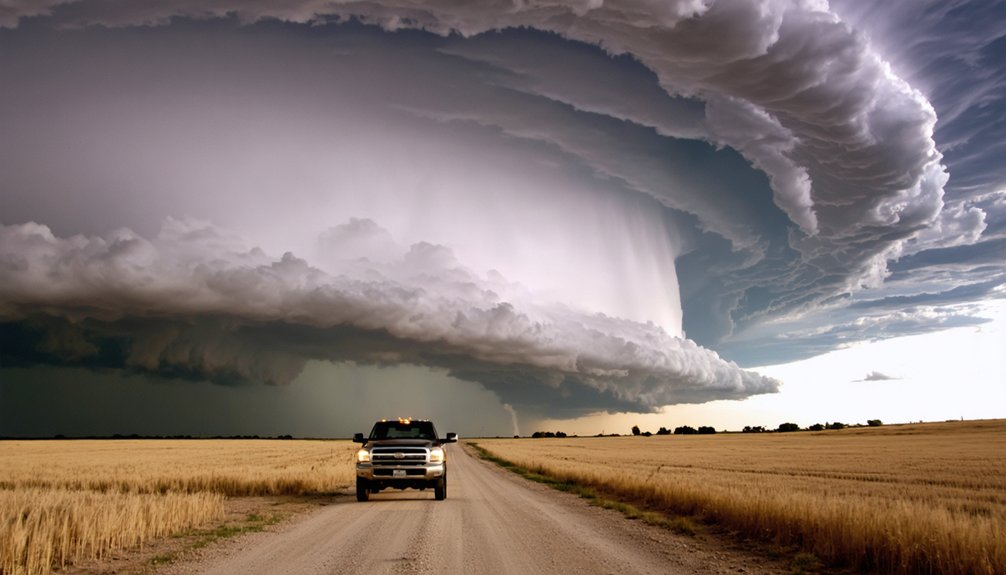
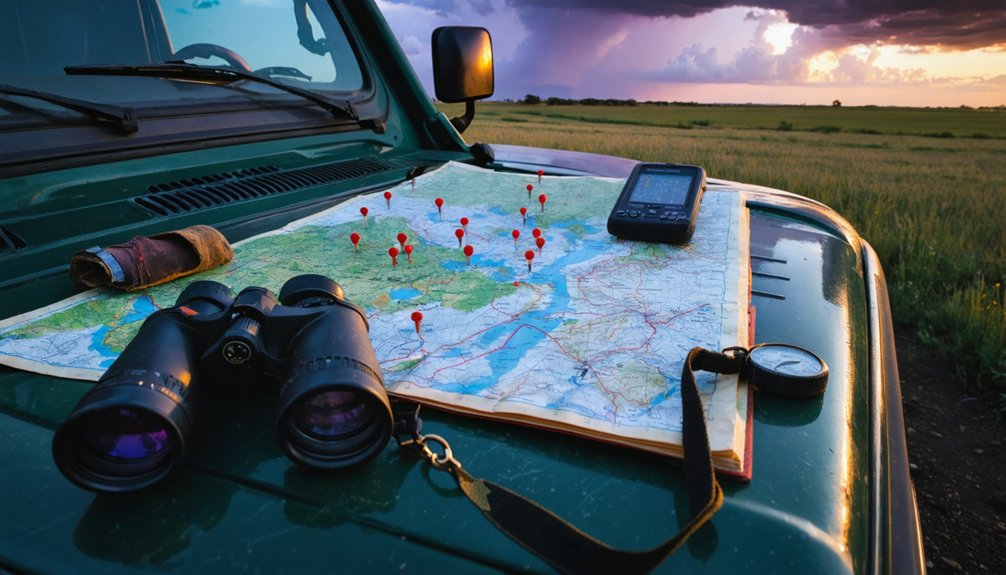
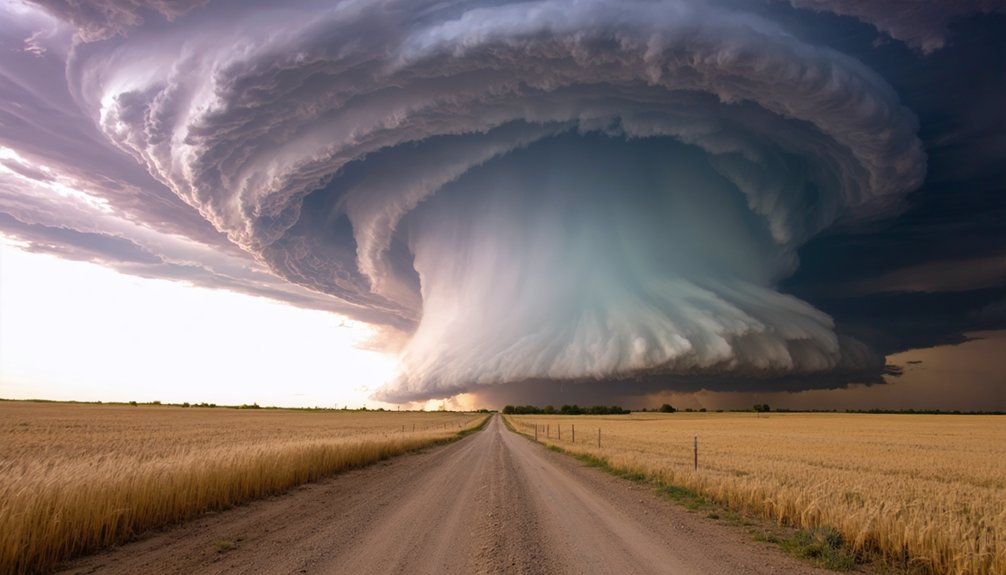
If you’re chasing storms internationally, your top destinations include the Great Plains in May, Canada’s Prairie Provinces in June–July, Argentina’s Pampas from November through December, Australia’s Outback during summer, and Europe’s central and southern corridors in late spring. Each region delivers distinct phenomena — supercells, cyclones, or dust storms — with unique logistical and forecasting demands. Understanding seasonal timing, terrain, and equipment requirements is what separates a successful intercept from a missed window.
Key Takeaways
- The Great Plains, USA, is the world’s storm chasing capital, with peak tornado and supercell activity occurring in May.
- Canada’s Prairie Provinces offer supercells, dramatic hail storms, and unobstructed flat terrain views during June and July.
- Argentina’s Pampas region features intense supercells and thousands of lightning strikes per event during November through December.
- Australia’s Outback delivers cyclones, dust storms, and spectacular nighttime lightning opportunities, especially in Queensland during summer.
- Europe is an underrated destination for supercells, large hail, and tornadoes, particularly across central and southern regions in summer.
How to Choose a Storm Chasing Destination: Frequency, Visibility, and Access
Choosing the right storm chasing destination comes down to three measurable variables: storm frequency, atmospheric visibility, and physical access. You’ll want to cross-reference historical severe weather data against real-time weather forecasts before committing to any region.
High storm intensity alone doesn’t guarantee a productive chase — flat, open terrain dramatically improves your sightlines and reaction time. Regions like the Great Plains deliver both frequency and visibility, while more remote zones demand stronger logistical planning.
You should also evaluate road network density; gridded rural roads give you lateral repositioning freedom when storms shift unpredictably. Factor in seasonal windows, since peak activity compresses into weeks, not months.
Prioritizing all three variables together — not individually — consistently separates productive chases from wasted fuel and missed supercells.
Great Plains: The World’s Storm Chasing Capital
When you’re targeting the highest concentration of tornado and supercell activity on Earth, the Great Plains delivers an unmatched combination of storm frequency, open sightlines, and road grid density. Spanning Texas north through Oklahoma, Kansas, Nebraska, and South Dakota, this corridor dominates historical weather patterns with more recorded tornadoes than any comparable landmass globally.
May represents peak operational tempo, when atmospheric instability, wind shear, and moisture convergence align most aggressively. Local storm legends like Tornado Alley’s notorious outbreak corridors aren’t mythology — they’re data-backed benchmarks that seasoned chasers use for route planning.
Colorado, Oklahoma, and Kansas offer the clearest storm structure visibility, letting you track wall clouds and mesocyclones without terrain obstruction. If you chase anywhere once, chase here.
Canada’s Prairie Provinces: Supercells, Hail, and a June–July Season
Just north of the Great Plains corridor, Canada’s Prairie Provinces deliver prolific supercell activity concentrated into a tighter June–July operational window. Meteorological patterns here favor intense convective development across an expansive, open landscape—ideal for storm photography and unobstructed visual access.
- Hail frequency: The region logs over 100 significant hail days annually, making it a high-yield target.
- Supercell structure: Prairie storms consistently produce well-defined mesocyclones with dramatic visual organization.
- Season window: You’ll want to position yourself between June and July for peak severe-weather output.
- Terrain advantage: Flat, wide-open geography gives you unimpeded sightlines across multiple storm cells simultaneously.
You’re operating in a condensed but data-rich chase environment that rewards precise timing and disciplined positioning.
Argentina’s Pampas: Storm Chasing in the Southern Hemisphere
Argentina’s Pampas reposition your operational calendar entirely—peak season runs November through December, aligning with Southern Hemisphere spring and early summer.
Chasing the Pampas means resetting your calendar—peak season kicks in November, riding Southern Hemisphere spring into early summer.
You’re chasing supercells capable of producing thousands of lightning strikes per event, demanding precise tornado prediction protocols adapted to Southern Hemisphere rotational dynamics, where mesocyclone circulation reverses relative to Northern Hemisphere norms.
The Pampas deliver dramatic convective structure, giving you unobstructed sightlines across flat agricultural terrain—ideal conditions for storm photography that captures full supercell architecture, including wall clouds, anvil structures, and lightning cascades simultaneously.
You’ll want high-capacity storage and fast-glass lenses here.
Data integration remains critical. Local radiosonde data and regional NWP models vary in resolution, so cross-referencing multiple forecast tools sharpens your targeting accuracy before committing to a chase vector across the Pampas corridor.
Australia’s Outback: Cyclones, Dust Storms, and Flash Floods
Australia’s Outback repositions your threat matrix entirely—instead of tornadoes and supercells, you’re tracking cyclones across Queensland and the Northern Territory, dust storms that reduce visibility to near zero, and desert flash floods that develop faster than most forecast models resolve.
The Australian summer delivers unrestricted access to rapidly evolving systems across vast, ungated terrain. Storm tracking apps become critical here—standard radar latency can cost you positioning.
Four operational realities define Outback chasing:
- Cyclone landfall windows compress decision-making to hours, not days.
- Dust storms advance at 60+ mph, demanding immediate repositioning.
- Desert flash floods overtake dry riverbeds with minimal upstream warning.
- Lightning photography opportunities peak during isolated nocturnal convection, where strike frequency and dark skies create unobstructed compositional conditions.
You’re operating on nature’s schedule, not yours.
Europe’s Underrated Storm Chasing Corridor
While most chasers default to the Great Plains, Europe’s severe-weather corridor delivers supercells, large hail, and mesocyclone-driven tornadoes across a geography that remains operationally underutilized.
Historical storm patterns confirm that late spring and summer yield the highest convective output, particularly across central and southern Europe. You’ll encounter localized storm development driven by complex terrain interactions rather than broad synoptic outbreaks, demanding tighter forecasting precision.
Local weather variations tied to alpine topography—especially near Switzerland’s Lausanne—generate rapid storm intensification and strong wind events that reward disciplined positioning.
Unlike the Plains, chase corridors here are compressed, making real-time storm-scale analysis critical.
If you’re chasing freedom from crowded setups while pursuing legitimate severe weather, Europe’s corridor offers an analytically demanding, high-reward alternative worth serious operational consideration.
Iceland and Other Storm-Watching Alternatives to Traditional Chasing
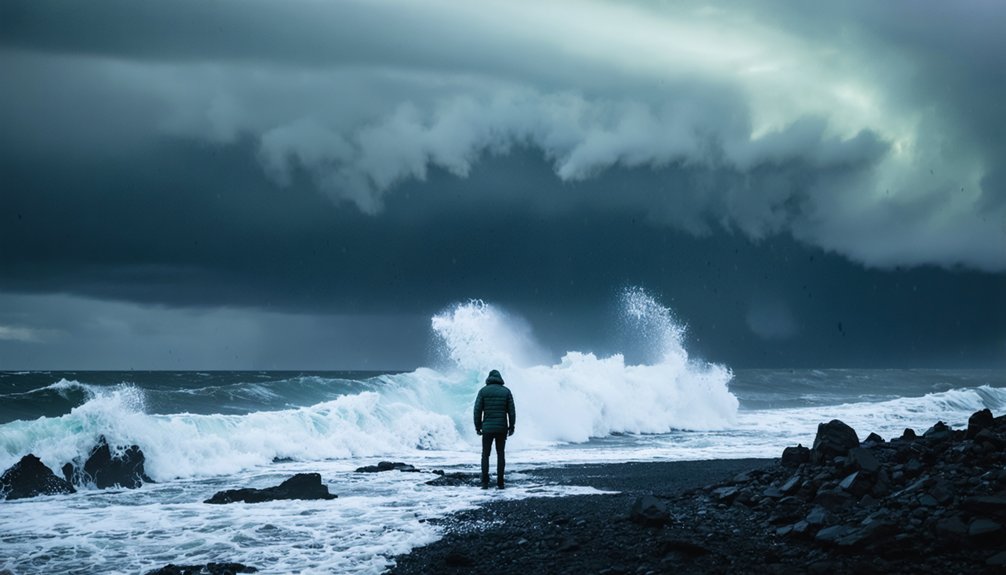
Not every high-impact atmospheric pursuit demands a tornado intercept or supercell positioning. Storm-watching alternatives deliver raw atmospheric power without chase logistics. You’ll access dramatic conditions through targeted destination selection:
- Reynisfjara Beach, Iceland – Lightning photography opportunities during violent coastal storms; peak season aligns with winter atmospheric instability.
- Tofino, British Columbia – Pacific storm-watching corridor active November through March; sustained high-wind and heavy precipitation events.
- Iceland’s Aurora Belt – Aurora viewing peaks during geomagnetic activity windows, combining electromagnetic spectacle with severe atmospheric conditions.
- North Berwick, Scotland – Exposed North Sea positioning delivers persistent storm-force winds and dramatic wave-surge events.
Each location rewards disciplined observation over intercept tactics, giving you direct access to high-energy atmospheric systems on your own terms.
Storm Chasing Seasons Compared: When to Go and Where
Timing your chase deployment against regional peak seasons directly determines your probability of intercepting high-impact events. Historical storm patterns confirm May dominates U.S. Great Plains activity, while Canada’s Prairie Provinces peak June through July.
Align your deployments with peak seasons — May owns the U.S. Plains, June and July belong to Canada.
You’ll find Argentina’s Pampas most productive November through December, aligning with Southern Hemisphere spring. Australia’s Queensland and Northern Territory demand summer scheduling, where rapidly developing cyclones and severe thunderstorms define the threat matrix.
Regional weather variations require you to cross-reference synoptic climatology before committing resources. Europe’s severe-weather corridor activates late spring through summer, offering supercell opportunities across an underrated chase environment.
Stack your deployments strategically — chase the U.S. Plains in May, shift to Canada by late June, then reposition to the Southern Hemisphere come November. Disciplined seasonal rotation maximizes your annual intercept count considerably.
Vehicles, Radar Tools, and Safety Protocols for International Chasing
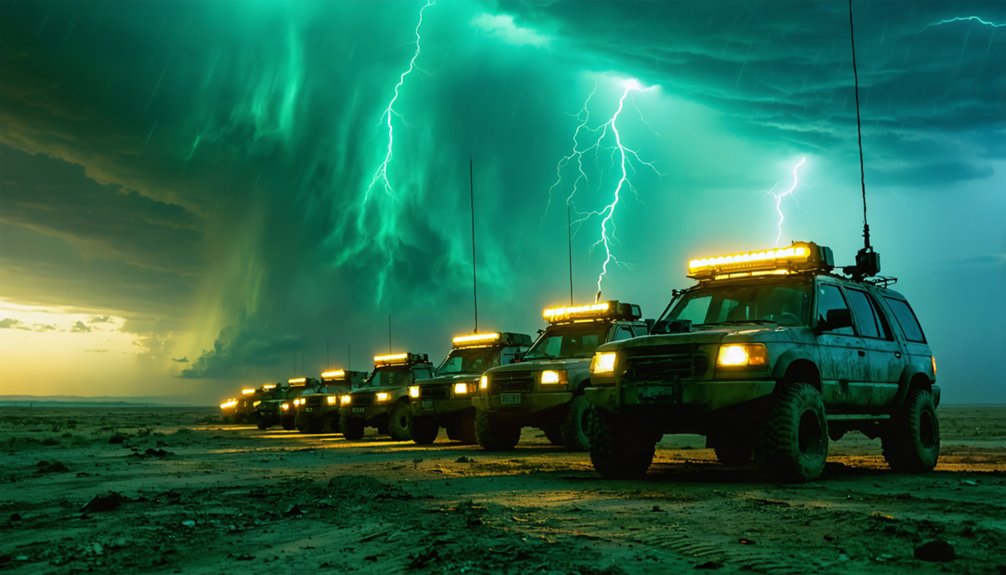
Deploying internationally demands a hardened vehicle platform, calibrated radar access, and a safety protocol stack that accounts for unfamiliar terrain and jurisdiction. You’re operating outside familiar networks, so precision matters more than ever.
- Vehicle: Run a 4WD platform with reinforced underbody clearance for Pampas mud or Outback desert tracks.
- Meteorological models: Cross-reference GFS, ECMWF, and regional NWP outputs to validate convective triggers across target zones.
- Radar tools: Carry mobile Doppler units and integrate country-specific radar feeds where available; coverage gaps are common internationally.
- Drone photography: Deploy UAVs under local airspace regulations to capture storm structure data without breaching safe distance thresholds.
Always pre-file emergency egress routes and maintain satellite communication independent of cellular infrastructure.
Planning Your First International Storm Chasing Trip
When planning your first international storm chase, you’ll need to match your target destination to its peak severe-weather window—May for the U.S. Great Plains, June–July for Canada’s Prairie Provinces, or November–December for Argentina’s Pampas.
You’ll want to pack calibrated radar access tools, a GPS-enabled chase vehicle, and region-specific safety protocols before you commit to any chase corridor.
Analyzing historical storm-frequency data for your chosen region sharpens your tactical decisions and reduces exposure to unnecessary risk.
Choosing Your Chase Destination
Selecting the right destination shapes every other variable in your chase plan, so match your target region to storm type, peak season, and logistical complexity before committing. Analyze meteorological patterns specific to each zone before booking anything.
- Great Plains (USA): Peak tornado frequency hits May; prioritize Kansas, Oklahoma, and Nebraska for supercell visibility and road grid accessibility.
- Canada’s Prairies: June–July delivers prolific hail-producing supercells across an open, navigable terrain.
- Argentina’s Pampas: November–December aligns with Southern Hemisphere spring; expect intense convection and thousands of lightning strikes per event.
- Australia’s Outback: Queensland and Northern Territory produce rapidly developing cyclones and severe thunderstorms during Australian summer.
Factor in cultural considerations—language barriers, permit requirements, and local emergency protocols—when finalizing your target region.
Essential Gear And Safety
Once you’ve locked in your destination and packed your gear loadout and safety framework become the variables that determine whether you complete a chase or become a casualty statistic.
Weather forecasting tools are non-negotiable — run multiple models, cross-reference SPC outlooks or regional equivalents, and track mesoscale discussions in real time.
Your mobile setup should include a GPS unit, dash-mounted camera, portable power bank, and a paper map as a backup when cell networks fail.
Emergency preparedness means carrying a first-aid kit, a 72-hour supply of food and water, and a pre-planned escape route before you position.
Never chase solo in unfamiliar terrain. Know local emergency frequencies.
Your margin for error shrinks dramatically when you’re operating in a foreign country with limited infrastructure and language barriers.
Best Season To Go
Timing your first international storm chase correctly separates a high-yield trip from a wasted deployment. Study historical storm patterns before committing to any destination—peak windows are narrow and unforgiving.
- Great Plains (USA): Target May for maximum tornado frequency; local weather variations shift activity between Oklahoma and Nebraska weekly.
- Canadian Prairies: Deploy June–July when supercell and hail events peak across the prairie belt.
- Argentina’s Pampas: Book November–December to intercept Southern Hemisphere spring convection cycles.
- Australia’s Outback: Chase Queensland and Northern Territory during austral summer for rapidly developing cyclones and severe thunderstorms.
Cross-reference historical storm patterns with real-time synoptic setups once you’re in-country. Local weather variations can compress or extend your viable chase window considerably—stay flexible, stay mobile.
Frequently Asked Questions
What Insurance Coverage Do Storm Chasers Typically Need for International Trips?
When chasing storms internationally, you’re playing with fire—so you’ll need specialized coverage. Prioritize risk assessment with medical evacuation, equipment, and liability insurance. Your emergency preparedness plan must include adventure travel policies that cover high-risk meteorological pursuits abroad.
Are There Storm Chasing Communities or Clubs That Organize International Group Expeditions?
Yes, you’ll find active communities organizing international expeditions. They’ll coordinate your storm chase gear, enforce safety protocols, and use data-driven routes across the Great Plains, Pampas, and beyond—giving you structured yet free-spirited chasing experiences.
What Photography Equipment Is Best Suited for Capturing International Storm Systems?
Like a soldier gearing up for battle, you’ll need camera gear built for chaos—use a weather protection housing, fast 70-200mm lens, and high-ISO body to capture international storm systems with precision and freedom.
Do Storm Chasers Need Special Visas or Permits in Certain Countries?
You don’t always need special visas, but you’ll want to research local regulations before chasing internationally. In Argentina or Australia, travel safety protocols and equipment permits can vary—always verify entry requirements specific to your destination.
How Do Language Barriers Affect Storm Chasing Coordination in Non-English Speaking Countries?
Lost in translation? Language barriers create real communication challenges when you’re coordinating with local meteorologists abroad. You’ll want pre-translated storm terminology, bilingual contacts, and real-time translation apps to maintain seamless, accurate data-sharing during rapidly evolving severe weather events.
References
- https://crazystormchasers.com/top-storm-chasing-expeditions-around-the-globe/
- https://travel.nine.com.au/recommended/worlds-best-storm-chasing-destinations/8a508419-6a9e-4d2d-8c30-92112ec5dc2d
- https://en.wikipedia.org/wiki/Storm_chasing
- https://savoteur.com/storm-watching-around-the-globe/
- https://collectiveweather.com/storm-chasing-destinations-around-the-world-exploring-natures-fury/
- https://www.tornadotitans.com/p/the-best-places-to-storm-chase
- https://www.stormchasingusa.com/where-do-you-chase/
- https://extremetornadotours.com/
- https://stormchasing.com/
- https://climatecosmos.com/world-weather/10-places-where-extreme-weather-is-the-biggest-tourist-attraction/