On May 31, 2013, you’re witnessing the deadliest day in storm chasing history. The El Reno tornado stretched 2.6 miles wide, shifted direction unpredictably, and exceeded 50 mph ground speed — eliminating every escape route for the TWISTEX team. Tim Samaras, Paul Samaras, and Carl Young were recovered near Reuter Road after their vehicle was overtaken by the rain-wrapped circulation. Their final chase permanently reshaped how researchers approach tornado fieldwork, and the full story reveals just how quickly everything changed.
Key Takeaways
- The TWISTEX team—Tim Samaras, Paul Samaras, and Carl Young—died on May 31, 2013, when the El Reno tornado overtook their vehicle.
- The El Reno tornado was the widest ever recorded at 2.6 miles, with erratic, rain-wrapped behavior that defied standard safety protocols.
- The tornado’s unpredictable speed surges and northward direction reversal at over 40 mph eliminated the team’s escape route on Highway 81.
- Tim Samaras was recovered inside the mangled Chevrolet Cobalt, while Paul Samaras and Carl Young were found half a mile away.
- The disaster prompted storm chasing community reforms, including stricter escape-route planning and reinforced real-time radar monitoring protocols.
Who the TWISTEX Team Was and What They Did
The TWISTEX team—short for Tactical Weather Instrumented Sampling in Tornadoes Experiment—wasn’t your typical storm chasing outfit.
Led by Tim Samaras, alongside his son Paul and researcher Carl Young, the team operated under strict Storm Chaser Ethics, prioritizing scientific data collection over spectacle. Their mission involved deploying instrument pods directly in a tornado’s path to capture pressure, temperature, and wind measurements scientists couldn’t obtain otherwise.
Tim Samaras led his team with one priority: science over spectacle, deploying instruments where few dared to go.
Working with the Discovery Channel gave them visibility, but their core purpose remained research-driven. You’d find them methodically positioning equipment along calculated intercept routes, not recklessly chasing for footage.
Their decades of combined experience made Tornado Safety a non-negotiable operational standard. The storm chasing community regarded them as role models—professionals who understood that responsible data collection required disciplined, calculated decision-making at every stage.
What Made the El Reno Tornado So Dangerous?
The El Reno tornado‘s 2.6-mile width made it the widest ever recorded, exceeding anything storm chasers had previously encountered in the field.
You’d have found its erratic behavior equally dangerous, as it shifted speed and direction unpredictably, accelerating to over 50 mph while abruptly changing course from southeast to north.
Heavy rain wrapping around the vortex further stripped away visual reference points, leaving chasers with severely degraded situational awareness at the moment the tornado altered its track.
Unprecedented Width And Size
Measuring 2.6 miles across at its peak, the El Reno tornado shattered every previously recorded width measurement in meteorological history.
Traditional tornado formation models hadn’t anticipated a vortex capable of expanding this rapidly or dramatically. Standard storm preparedness protocols assumed predictable sizing patterns — El Reno invalidated those assumptions completely.
To put this in perspective, you’re looking at a tornado wider than Manhattan’s entire length.
Conventional escape calculations become meaningless when a single vortex consumes that much horizontal space simultaneously. The storm’s circulation extended far beyond its visible condensation funnel, meaning dangerous winds existed well outside what you’d visually identify as the tornado itself.
Meteorologists recorded the width expanding by over a mile within minutes, demonstrating rotational dynamics that fundamentally challenged existing classification systems and safety distance recommendations.
Erratic Speed And Direction
Beyond its extraordinary width, El Reno’s erratic speed and directional shifts transformed it into a nearly inescapable trap. Understanding its tornado dynamics reveals why even seasoned chasers couldn’t outrun it.
The storm behavior defied standard prediction models. Initially tracking southeast, the tornado abruptly pivoted north, accelerating past 40 mph near Highway 81. That directional reversal gave drivers virtually no reaction window.
Simultaneously, the rain-wrapped circulation obscured visual tracking, stripping you of critical situational awareness.
Speed fluctuations compounded the danger further. The vortex surged beyond 50 mph at certain intervals, outpacing most escape routes on surrounding roads.
When you’re operating on pre-calculated exit paths, a tornado that rewrites its trajectory mid-pursuit doesn’t just challenge your strategy — it eliminates it entirely. El Reno proved that decisively.
Rain-Wrapped Limited Visibility
Rain-wrapped tornadoes strip you of the one tool that matters most in a dynamic chase environment: visual confirmation.
The El Reno tornado’s rain-wrapped structure buried its circulation inside dense precipitation walls, creating limited visibility that eliminated any reliable distance assessment. You couldn’t track rotation visually, couldn’t gauge true width, and couldn’t confirm directional shifts until the vortex was already repositioning toward you.
At speeds exceeding 50 mph, that information gap becomes fatal. The TWISTEX team’s instruments detected the tornado, but rain-wrapped conditions masked the rapid northern turn until escape windows closed.
Standard escape protocols assume visual contact. El Reno denied that completely.
When a tornado moves faster than your vehicle and hides inside precipitation, your margin for error doesn’t shrink — it disappears entirely.
How the El Reno Tornado Changed Course Without Warning?
The El Reno tornado‘s erratic behavior on May 31, 2013, defied standard meteorological patterns, making it nearly impossible to predict.
Tornado unpredictability at this scale cost experienced chasers their lives. Here’s what made this storm uniquely dangerous:
- Speed surge: The tornado exceeded 50 mph, outpacing standard escape calculations.
- Direction reversal: It pivoted northward at over 40 mph, trapping vehicles in its path.
- Rapid expansion: It widened to 2.6 miles within minutes, eliminating safe positioning zones.
- Rain-wrapping: Dense precipitation concealed the vortex’s true movement.
Storm chaser safety protocols assume some behavioral consistency.
Safety protocols are built on predictable patterns. When a tornado breaks every rule, those protocols become meaningless.
El Reno violated every assumption. You couldn’t visually track it, you couldn’t outrun it, and you couldn’t anticipate its next move.
The TWISTEX team had no viable escape window.
The Final Moments of the El Reno Tornado Chase
When the TWISTEX team attempted their southbound turn on Highway 81, they’d already lost their margin of safety.
The tornado’s behavior had shifted catastrophically — accelerating past 50 mph while rain-wrapping its visible boundaries, stripping the team of critical positional data during this final chase.
The vortex turned north at over 40 mph, closing distance faster than the Chevrolet Cobalt could compensate.
The tornado then made direct contact, pulling Paul Samaras and Carl Young from the vehicle while Tim remained inside. Their bodies were recovered near Reuter and Radio Roads — Paul and Carl found half a mile from Tim’s position.
You can’t outrun unpredictable tornado behavior at those parameters.
The data confirmed what the community already understood — experience alone couldn’t neutralize a 2.6-mile-wide, erratically moving storm.
Where Tim, Paul, and Carl Were Each Found
When you examine the recovery data, you’ll find that Tim Samaras remained inside the mangled Chevrolet Cobalt, while Paul Samaras and Carl Young were pulled from the vehicle and found approximately half a mile away.
All three were recovered east of Reuter Road near Radio Road, placing the impact site roughly three miles from where two other men had been killed earlier that same day.
These precise geographic markers now anchor the memorial dedicated to the team, standing at the edge of Reuter Road as a fixed reference point for the storm chasing community.
Tim’s Final Resting Location
After the tornado dissipated, recovery teams located each TWISTEX member in distinct positions relative to the strike zone. Tim Samaras remained inside the mangled Chevrolet Cobalt, recovered in a farmer’s field. His position told a precise story:
- The vehicle sustained catastrophic structural failure yet retained Tim inside
- Recovery teams found him east of Reuter Road near Radio Road
- The Cobalt’s location confirmed the tornado carried it significant distance
- His final position became ground zero for discussions around storm chaser ethics
Tim’s legacy isn’t diminished by where he died — it’s defined by decades of disciplined, data-driven fieldwork.
You can trace his influence through every researcher who now deploys instrumentation responsibly. He stayed committed to science until the tornado made escape impossible.
Paul And Carl’s Whereabouts
Three distinct recovery locations defined the spatial outcome of the El Reno strike on the TWISTEX team.
You’ll find Tim Samaras’s recovery point inside the mangled Chevrolet Cobalt, where he remained during impact.
Paul’s last moments ended approximately half a mile from that vehicle, placing him well outside any protective structure.
Carl’s final actions similarly concluded half a mile from the Cobalt, recovered near Paul’s position east of Reuter Road, close to Radio Road.
The tornado’s vortex had physically extracted both Paul and Carl from the vehicle before Tim’s confirmed in-vehicle recovery.
These three separate coordinates — one vehicular, two ground-level — document precisely how a single tornado interaction produced divergent ejection outcomes across measurable distances, giving researchers critical spatial data tied directly to the storm’s violent, erratic ground movement.
Recovery Site Landmarks
Each recovery site tied to the El Reno disaster carries specific geographic identifiers that anchor the event to measurable terrain.
Recovery site significance becomes clear when you map the exact coordinates against the tornado’s documented path.
Key landmarks defining where each victim was found:
- Tim Samaras recovered inside the mangled Chevrolet Cobalt in a farmer’s field
- Paul Samaras and Carl Young located approximately half a mile from the vehicle
- All three recovered east of Reuter Road near Radio Road
- Impact zone sat roughly three miles from two earlier fatalities south of El Reno
The local community response shaped how these landmarks became permanent reference points.
A memorial now stands at the Reuter Road edge, east of Radio Road, honoring Tim, Paul, and Carl where the storm claimed them.
What Dan Robinson’s Dashcam Showed in the Final Seconds
Among the most critical pieces of evidence from the El Reno disaster, Dan Robinson’s rear-facing dashcam captured what investigators and storm researchers consider the clearest visual record of the TWISTEX team’s final seconds.
The footage shows the TWISTEX vehicle getting completely engulfed by the tornado’s circulation. Robinson’s dashcam analysis confirms the tornado’s erratic northward pivot exceeded any reasonable escape calculation. You’d recognize immediately how little reaction time existed once the vortex shifted course.
Robinson hasn’t released the footage, citing storm chaser ethics and respect for the deceased families. That decision reflects a broader standard within the chasing community — raw documentation of colleagues dying isn’t public content.
The footage remains privately held, serving researchers who’ve accessed it through proper channels rather than circulating freely online.
Why the El Reno Tornado Footage Was Never Released to the Public?
Robinson’s decision to withhold his dashcam footage didn’t exist in isolation — it reflected a documented pattern across all visual records from the El Reno event.
Every available recording remained sealed, shaping a clear stance on footage ethics within the storm chasing community.
Here’s what defined that decision:
- The TWISTEX vehicle’s internal camera captured the final moments but stayed unreleased.
- Robinson’s rear-facing dashcam showed the vehicle’s engulfment yet remained private.
- Families of Tim, Paul, and Carl weren’t consulted for public distribution.
- Storm chaser safety advocates supported suppression to prevent sensationalism.
You’re looking at a community that chose dignity over virality.
No authority mandated silence — chasers self-regulated.
That collective restraint demonstrated that storm chaser safety extends beyond the field and into how tragedy gets documented and shared.
How El Reno Changed the Storm Chasing Community
When the El Reno tornado killed Tim, Paul, and Carl on May 31, 2013, it didn’t just claim three experienced chasers — it forced the entire storm chasing community to reexamine its operational protocols.
You’ll notice that post-El Reno, storm chaser ethics shifted dramatically. Organizations began enforcing stricter escape-route planning, mandatory exit thresholds, and real-time radar monitoring standards. The disaster exposed critical vulnerabilities in rain-wrapped, multi-vortex tornado engagements.
Despite the tragedy, tornado research advancements accelerated. The data TWISTEX collected informed updated intercept models, helping researchers better predict rapid directional shifts.
If you’re operating near violent, erratic tornadoes today, the protocols protecting you exist partly because El Reno proved that experience alone doesn’t guarantee survival — strategic discipline does.
The Memorial Left for Tim, Paul, and Carl
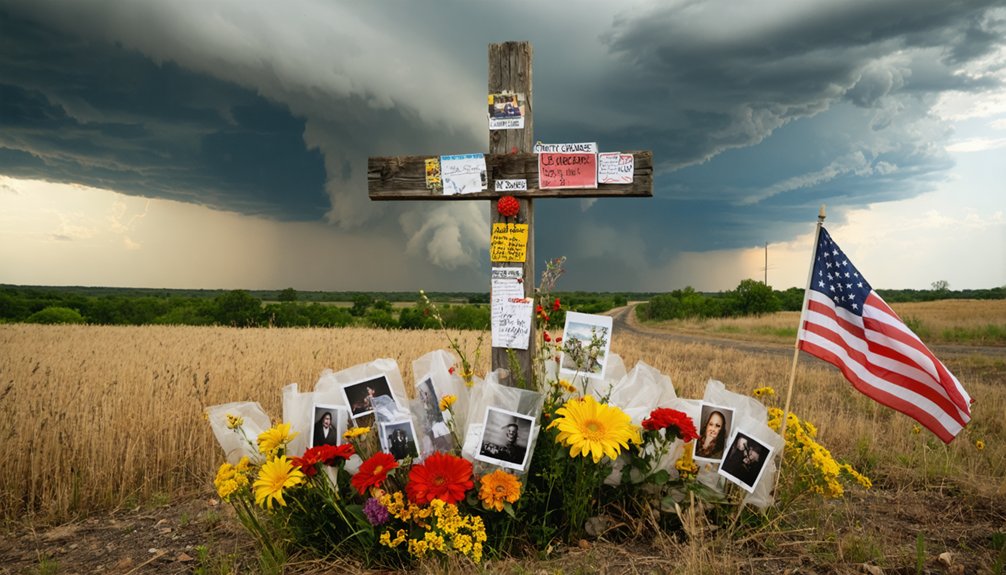
A roadside memorial stands at the edge of Reuter Road, east of Radio Road — the precise coordinates where the El Reno tornado claimed Tim Samaras, Paul Samaras, and Carl Young on May 31, 2013.
The memorial significance extends beyond grief. It marks a documented shift in how chasers assess risk. The community impact reshaped operational protocols industry-wide.
When you visit, you’ll find the site honors:
- Tim Samaras – veteran researcher, found inside the mangled Cobalt
- Paul Samaras – Tim’s son, recovered half a mile away
- Carl Young – experienced field partner, found alongside Paul
- TWISTEX’s legacy – decades of combined field research cut short
The storm chasing community gathered here in tribute, acknowledging that experience alone can’t override a tornado’s unpredictable, violent capability.
Frequently Asked Questions
What Research Pods Did TWISTEX Deploy During Tornado Chasing Missions?
Straight from the horse’s mouth, the knowledge doesn’t detail TWISTEX’s specific research pods. You’d need additional sources to pinpoint their exact storm tracking tools and research techniques used during tornado chasing missions.
How Fast Did the El Reno Tornado Grow to Its Record Width?
The knowledge doesn’t specify how fast the El Reno tornado reached its record 2.6-mile width. You’d need additional storm formation data and tornado dynamics research beyond what’s provided to get that precise measurement.
Were Any Survivors Present Near the TWISTEX Vehicle During the Incident?
At 50+ mph, the tornado’s vortex engulfed the TWISTEX vehicle instantly. You’d find no survivor accounts confirming nearby witnesses during the vehicle impact — Dan Robinson’s rear-facing dashcam captured the event, but he wasn’t directly beside them.
What Highway Were the TWISTEX Team Traveling on When Caught?
You’re looking at Highway 81, where the TWISTEX team’s storm chasing operation turned deadly. They’d attempted a southbound escape maneuver, but the tornado’s unpredictable shift compromised all highway safety calculations, engulfing their vehicle within seconds.
How Many Total Fatalities Occurred During the El Reno Tornado Overall?
When all’s said and done, you’re looking at five total fatalities from tornado impacts. Fatality statistics include Tim Samaras, Paul Samaras, Carl Young, plus two other men killed roughly four miles south of El Reno earlier.
References
- https://lostmediawiki.com/TWISTEX_(lost_unreleased_El_Reno_tornado_footage;_2013)
- https://extras.denverpost.com/stormchaser/chapter6.html
- https://okcfox.com/news/local/twistex-memorial-dedicated-to-3-killed-in-el-reno
- https://www.youtube.com/watch?v=4KPnqetzYGs