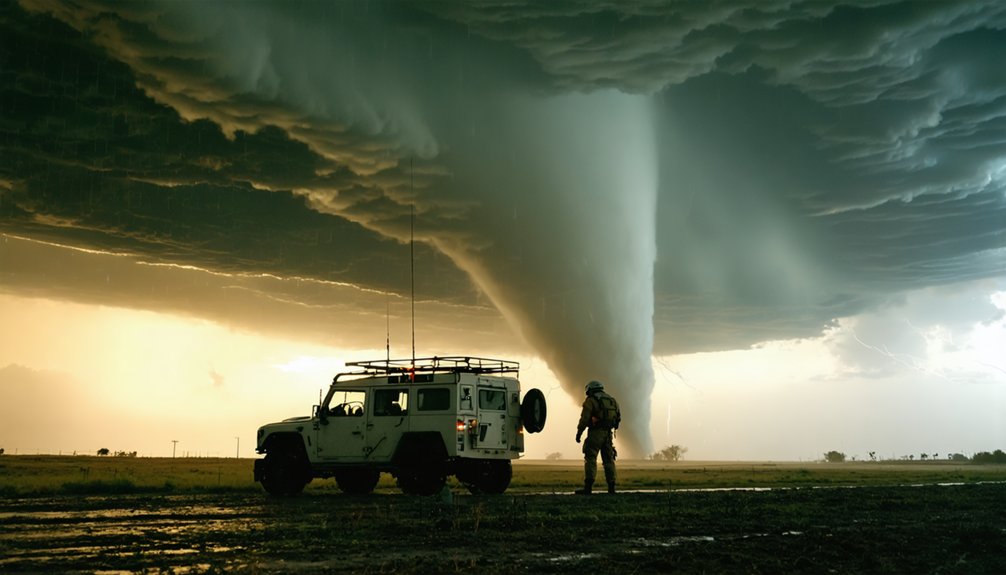
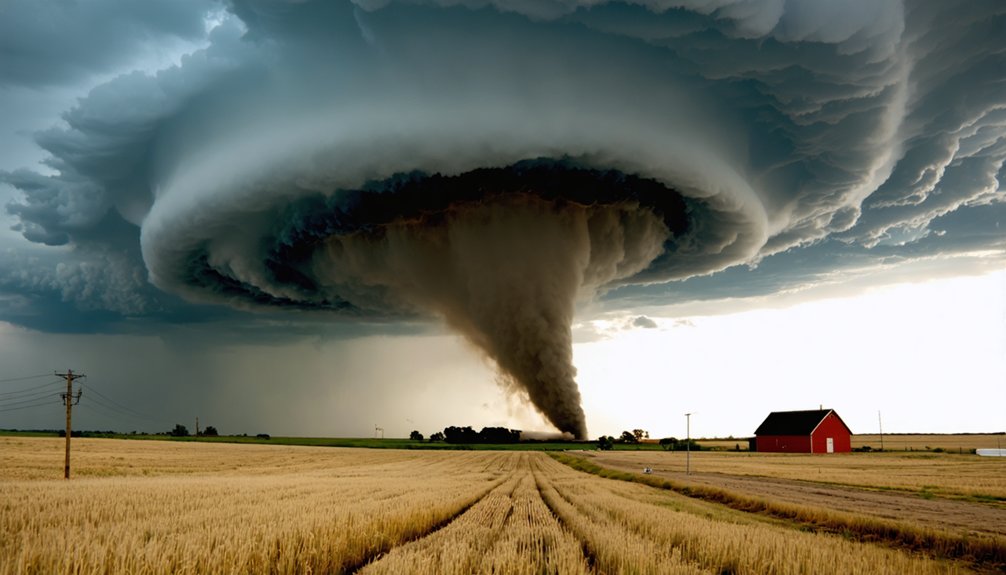
When you chase tornadoes, your brain’s dopamine system activates the same neurological pathways as gambling and video game addiction. Unpredictable storm encounters trigger variable reward responses, conditioning you to return despite the danger. Your adrenal glands flood your system with epinephrine, sharpening senses while narrowing judgment. Mastery doesn’t reduce the pull—it intensifies it by raising your reward threshold. The psychological, neurological, and social forces driving this behavior run far deeper than simple thrill-seeking.
Key Takeaways
- Unpredictable tornado encounters trigger dopamine surges, reinforcing thrill-seeking behavior through variable reward schedules stronger than consistent outcomes.
- Adrenal glands release epinephrine during chases, spiking heart rate, sharpening senses, and creating intense focus on the storm.
- Mastery of storm patterns raises the adrenaline threshold, driving chasers to seek increasingly dangerous encounters for the same rush.
- Social bonding within chaser communities normalizes risk perception, reducing hesitation and reinforcing the cycle of thrill-seeking behavior.
- Storm chasing activates neurological pathways similar to gambling addiction, where uncertainty and unpredictability make the pursuit psychologically compelling.
The Psychology Behind Tornado Chasing Addiction
Storm chasing operates on the same neurological pathways as gambling and video game addiction. Unpredictable storm encounters trigger dopamine release, reinforcing thrill seeking behavior through variable reward cycles. Your brain can’t distinguish between hitting a jackpot and intercepting a violent tornado.
Pattern recognition develops through repeated exposure, transforming complex meteorological data into intuitive risk assessment. You’ll process atmospheric variables faster than conscious thought allows, creating a self-reinforcing expertise loop.
But psychological triggers don’t operate without cost. Witnessing destruction creates genuine emotional conflict, forcing a moral dilemma between personal excitement and human suffering. That tension defines the community bonding experience — shared guilt and shared exhilaration simultaneously.
Adrenaline feedback during active chasing produces tunnel vision, collapsing time perception and generating flow states identical to extreme sports. Freedom feels chemical here.
What an Adrenaline Rush Actually Feels Like Mid-Chase?
When a tornado forms within your line of sight, your adrenal glands release epinephrine within seconds, spiking your heart rate, sharpening your senses, and locking your attention onto the rotating column ahead.
You’ll notice tunnel vision setting in almost immediately — peripheral threats like power lines, debris fields, or shifting wind vectors effectively vanish from your conscious awareness.
This neurological narrowing isn’t a malfunction; it’s your brain executing a threat-prioritization protocol that, paradoxically, creates its own danger by filtering out critical environmental data mid-chase.
Peak Adrenaline Moments
Chasing a tornado triggers a cascade of neurochemical responses that fundamentally alter how your brain processes information in real time.
Adrenaline triggers flood your system within seconds of a storm encounter, sharpening sensory input while simultaneously narrowing your cognitive focus. Your emotional responses compress into pure present-moment awareness — fear management becomes instinctive rather than calculated.
Environmental factors like rotating wall clouds and ground-scraping debris fields produce sensory overload that paradoxically increases decision-making clarity. Thrill seeking dynamics activate dopamine pathways identical to extreme sports and high-stakes gambling.
Risk taking behavior escalates as tunnel vision eliminates peripheral threat awareness. Collective experiences among chasers confirm this neurological pattern consistently.
Time distortion, heightened perception, and euphoric goal-completion combine into a self-reinforcing feedback loop that fundamentally rewires your relationship with danger.
Tunnel Vision Effects
Mid-chase, your brain enters a neurologically distinct state that strips away everything except the rotating column of air directly in front of you. This tunnel vision triggers acute focus enhancement while simultaneously executing distraction minimization across competing sensory inputs.
Your risk perception recalibrates dangerously. Decision making accelerates beyond conscious deliberation, operating on pattern recognition rather than rational analysis. Emotional detachment from surrounding hazards isn’t weakness—it’s your nervous system managing cognitive overload by prioritizing the primary threat.
Situational awareness paradoxically narrows. You’re achieving complete environmental immersion within a shrinking perceptual field, processing meteorological data while filtering out peripheral dangers.
This is adrenaline management in its rawest form: your neurochemistry optimizing performance by sacrificing broad awareness for surgical precision.
That trade-off defines what separates exhilarating chasing from catastrophic outcomes.
Why Unpredictable Rewards Keep Chasers Coming Back
When you spend hours scanning an empty sky and suddenly lock onto a violent wedge tornado, your brain registers that unpredictable payoff through a dopamine surge disproportionate to what a guaranteed reward would produce.
Research on variable reward schedules—the same mechanism driving slot machine behavior—shows that intermittent reinforcement generates stronger behavioral conditioning than consistent outcomes, which explains why you’ll endure dozens of failed chase days without abandoning the pursuit.
Your brain fundamentally encodes each successful intercept as evidence that the next chase could deliver the same hit, creating a self-sustaining cycle that mirrors documented patterns in compulsive behavior.
Variable Reward Schedules
Consider how these mechanisms reinforce thrill seeking behavior:
- Inconsistent tornado encounters amplify adrenaline feedback loops, strengthening risk tolerance over time.
- Successful chase days trigger social validation within community dynamics, reinforcing return behavior.
- Failed expeditions maintain variable motivation by preserving uncertainty’s psychological pull.
- Storm forecasting accuracy improvements create cognitive dissonance between growing expertise and persistent unpredictability.
You’re fundamentally running the same neurological pathways as a slot machine player. Each chase represents a calculated bet where the odds shift constantly, keeping you locked into one more expedition, one more season.
Dopamine-Driven Chase Cycles
Experienced chasers report compulsive early-morning forecast checking—a measurable behavioral indicator of dopamine-primed anticipation.
The chase itself becomes secondary. Your brain’s already rewarded you for showing up.
Why Experienced Chasers Still Miscalculate Danger
Even the most seasoned storm chasers miscalculate danger, and the mechanics behind that failure are well-documented.
Repeated exposure builds desensitization, quietly expanding your risk tolerance past rational thresholds. Pattern recognition becomes overconfidence, and that gap between intellectual danger misjudgment and emotional perception gets you killed.
Four documented failure points drive miscalculation:
- Tunnel vision eliminates peripheral threat awareness during active engagement.
- Desensitization erodes instinctive fear responses after repeated close encounters.
- Pattern overreliance causes experienced chasers to discount anomalous storm behavior.
- Emotional-intellectual disconnect separates what you know intellectually from what you actually feel.
Your expertise creates a self-reinforcing blind spot. The better you get, the more you trust your read—and that trust, unchecked, becomes the precise mechanism that compromises your survival.
Why Mastering Storm Patterns Makes the Addiction Worse
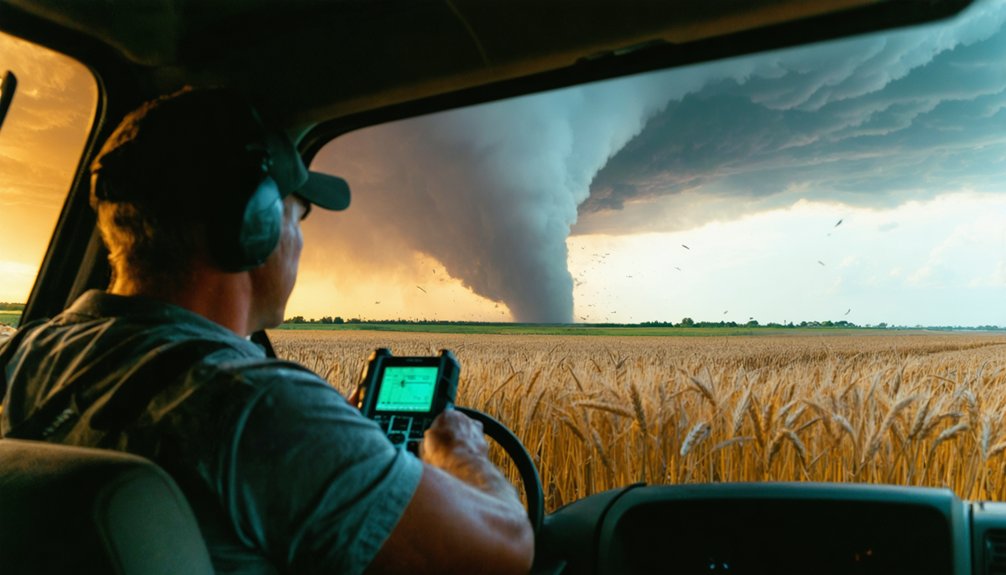
Mastering storm patterns doesn’t reduce the addiction—it accelerates it. As your storm forecasting sharpens and pattern intuition becomes second nature, your brain recalibrates its reward threshold upward. You need bigger, closer, more extreme encounters to trigger the same adrenaline feedback you once got from distant wall clouds.
Experience accumulation creates a dangerous paradox: expert decision making lowers perceived risk while actual danger remains constant. Your emotional desensitization convinces you that tighter positioning is justified, and your elevated risk tolerance quietly normalizes decisions that would paralyze beginners.
Meanwhile, social bonding within chaser networks reinforces thrill seeking behaviors through collective validation. Ethical dilemmas—excitement versus human suffering—get compartmentalized rather than resolved.
Mastery doesn’t give you control over the addiction. It just makes the addiction more sophisticated.
The Emotional Weight of Witnessing a Killer Tornado
Sophistication in storm pattern mastery sharpens your forecasting edge, but it doesn’t immunize you against the psychological weight of a killer tornado. Witnessing confirmed fatalities triggers a distinct emotional aftermath that contradicts the rush you’ve been chasing.
Four documented psychological responses emerge:
- Gut-punch shock — Intellectual danger awareness collapses into visceral reality.
- Moral dilemmas — Your excitement becomes ethically entangled with others’ suffering.
- Desensitization gaps — Repeated exposure doesn’t neutralize high-casualty event impact.
- Lasting emotional weight — Specific killer tornadoes remain psychologically anchored in memory.
The gap between understanding risk intellectually and processing human loss emotionally is significant. Your freedom to chase doesn’t eliminate accountability for what you witness.
That tension becomes its own psychological variable, permanently reshaping how you evaluate your next pursuit.
Why Chasers Lose All Sense of Time Mid-Storm

When you’re locked onto a rotating supercell, your brain shifts into a neurological state that systematically dismantles normal time perception. Sensory overload from wind, rotation, and atmospheric pressure floods your neural pathways, forcing cognitive resources toward immediate threat assessment rather than temporal tracking.
Your brain’s time distortion response activates through deep immersion in high-stakes environments. Thrill anticipation triggers dopamine cascades that compress hours into minutes. Focus engagement narrows your attention bandwidth so completely that peripheral awareness—including time awareness—simply drops offline.
Dopamine floods your system, time collapses, and the world narrows to a single, electrifying point of focus.
Emotional intensity amplifies this effect. Risk perception demands constant recalibration, creating cognitive dissonance between intellectual danger recognition and pure experiential absorption. Your nervous system fundamentally reclassifies time-tracking as non-essential processing.
The result? You’re operating in pure present-state consciousness—maximum freedom from everything except the storm directly in front of you.
The Community That Keeps Chasers Coming Back
Beyond the neurological pull of the storm itself, there’s a powerful social infrastructure that locks chasers into the lifestyle long-term. Chaser networks create community bonding through shared experiences that reinforce continued participation.
The social dynamics driving retention include:
- Collective knowledge sharing accelerates your pattern recognition skills, compressing years of learning into single chase seasons.
- Emotional connections formed during high-stakes encounters create psychological anchors stronger than solo experiences.
- Group support systems normalize risk perception, reducing hesitation through camaraderie benefits among experienced peers.
- YouTube streaming communities expand your social reach beyond physical chase partners, creating global accountability networks.
These interconnected forces explain why chasers rarely quit independently. The community fundamentally becomes a second addiction layer, operating parallel to the neurochemical rewards the storms themselves deliver.
Frequently Asked Questions
Can Storm Chasing Trigger Long-Term PTSD or Other Mental Health Conditions?
Yes, you can develop PTSD from witnessing killer tornadoes and human suffering. These trauma responses require active coping strategies, as repeated exposure desensitizes your emotional perception while creating lasting psychological tension between excitement and moral distress.
Do Storm Chasers Carry Specialized Insurance Coverage for Tornado-Related Incidents?
You’ll find that storm chaser insurance isn’t standardized—you’re responsible for securing specialized tornado damage coverage independently. Most standard policies exclude high-risk pursuits, so you’ll need custom commercial or adventure-sport riders to protect your equipment and liability.
What Legal Liabilities Do Storm Chasers Face When Blocking Emergency Response Routes?
When you block emergency response routes, you’re exposing yourself to serious legal consequences, including obstruction charges, civil liability, and potential criminal negligence claims. Authorities can cite you, impound your vehicle, and hold you financially responsible for delayed rescue operations.
How Does Storm Chasing Financially Impact the Local Economies of Affected Regions?
Like a double-edged sword, storm chasing delivers economic benefits through tourism boost—you’re injecting local revenue via lodging, fuel, and food purchases, yet simultaneously straining infrastructure and emergency resources, creating complex fiscal consequences for affected communities.
Are There Age Restrictions or Licensing Requirements for Professional Storm Chasers?
You’ll find no formal storm chasing regulations or licensing requirements restricting your entry into this field. You’re free to pursue tornado chasing at any age, though professional organizations recommend meteorological training to sharpen your pattern recognition and safety skills.
References
* https://www.youtube.com/watch?v=cNkPWEoQtAc