When you study hurricanes through expert research, you uncover how climate change has doubled the proportion of major Atlantic hurricanes since 1980, generating over $1.4 trillion in U.S. damages. You’ll find that rapid intensification affects roughly 80% of major hurricanes, compressing your evacuation window dangerously. Storm surge alone causes nearly half of all tropical cyclone fatalities. The deeper you go into the science, the more critical this knowledge becomes.
Key Takeaways
- Climate warming has doubled the proportion of major Atlantic hurricanes since 1980, intensifying wind speeds, rainfall, and storm surge devastation.
- Approximately 80% of major hurricanes undergo rapid intensification, compressing preparation time and overwhelming community evacuation strategies significantly.
- Storm surge causes nearly half of all U.S. tropical cyclone fatalities, as rapidly rising waters trap residents with little escape time.
- Researchers like David O. Prevatt identify roof-to-wall connections and corner zones as critical structural failure points during extreme wind events.
- Experts including Maitane Olabarrieta and Katy Serafin provide actionable data helping communities strengthen coastal resilience against compound flooding events.
How Climate Change Is Making Hurricanes More Dangerous
As the climate warms, hurricanes are becoming measurably more destructive. Rising ocean temperatures amplify climate feedbacks, fueling heavier rainfall, stronger winds, and slower storm movement. Since 1980, the proportion of major Atlantic hurricanes has doubled, while warmer atmospheric patterns are accelerating rapid intensification near landfall, compressing your disaster preparedness window dramatically.
Warmer oceans are supercharging hurricanes — heavier rain, fiercer winds, and faster intensification are reshaping the storms we thought we understood.
These shifts carry direct consequences. Coastal ecosystems face compounding surge and erosion damage. Infrastructure planning must now account for intensification timelines that forecasters struggle to model accurately.
Hurricane forecasting improvements remain critical, yet gaps persist. Insurance implications are mounting—U.S. tropical cyclones have exceeded $1.4 trillion in damages since 1980.
Public awareness drives policy pressure. Understanding these dynamics lets you advocate for smarter recovery strategies, reinforced infrastructure, and data-backed decisions that protect your community’s long-term freedom and resilience.
Rapid Intensification: The Window That Closes Before You Can Evacuate
Within that narrowing window of preparation time lies one of the most dangerous phenomena in modern meteorology: rapid intensification. It’s defined as a minimum 30-knot wind increase within 24 hours — and it’s reshaping evacuation timing entirely.
Consider the data: roughly 80% of major hurricanes undergo rapid intensification. Nearly one-quarter of 186 landfalling Atlantic tropical cyclones between 1980 and 2024 experienced extreme rapid intensification — a 50-knot surge. Hurricanes Michael and Otis exemplify this threat.
Warmer ocean waters accelerate this strengthening, compressing your decision window dangerously. By the time updated forecasts reach you, roads are already congested or flooded.
Your preparedness strategies must account for this reality. Don’t wait for Category 4 confirmation — act when conditions favor rapid intensification, because that window closes faster than forecasters can track it.
Why Storm Surge Kills More People Than Wind
When a hurricane makes landfall, you’re far more likely to die from storm surge than from wind—storm surge historically accounts for nearly half of all tropical cyclone fatalities in the U.S.
Hurricane Ian’s 2022 surge reached 15 feet in Fort Myers Beach, flooding and destroying homes faster than residents could escape.
Unlike wind damage, which you can often survive by sheltering in place, rapidly rising water traps you, leaving little margin for error if you haven’t evacuated.
Storm Surge’s Deadly Impact
Storm surge, not wind, is the deadliest force a hurricane produces, yet it’s consistently underestimated by those in its path. Coastal vulnerability amplifies this threat dramatically.
Consider these critical facts:
- Hurricane Ian’s 2022 storm surge reached 15 feet in Fort Myers Beach, obliterating entire neighborhoods.
- Hurricane Katrina’s surge overwhelmed levees, devastating New Orleans beyond recovery for years.
- Storm surge renders homes structurally unlivable, compounding economic damage far beyond wind destruction.
- Slower-moving hurricanes intensify surge duration, trapping floodwaters longer in vulnerable coastal zones.
You can’t outrun rising water the way you can brace against wind. Understanding storm surge means recognizing that your coastal vulnerability isn’t just about structural strength—it’s about elevation, proximity, and evacuation timing.
Flooding Versus Wind Fatalities
Despite the destruction that hurricane-force winds cause, flooding consistently claims more lives—storm surge alone accounts for nearly half of all U.S. tropical cyclone fatalities.
When you examine flood dynamics, you’ll find that rapidly rising water traps people who underestimate its speed and force. Unlike wind vulnerability, which primarily damages structures, floodwaters physically overwhelm human bodies, vehicles, and evacuation routes simultaneously.
Storm surge compounds this danger by combining tidal forces with hurricane-driven water walls, as Hurricane Ian demonstrated with its 15-foot surge in Fort Myers Beach.
Inland flooding extends fatality risks far beyond coastal zones, as Hurricane Helene’s record rainfall proved. You can’t outrun what you can’t see coming.
Understanding these mechanics isn’t just academic—it directly informs whether your evacuation decisions save your life.
Why Hurricane Forecast Errors Cost Lives and Billions
Forecast errors in hurricane intensity and track carry devastating consequences — tropical cyclones have accounted for over $1.4 trillion in U.S. damages since 1980, making them the nation’s costliest disasters.
When forecast reliability breaks down, your evacuation strategies fail, costing lives and billions.
Four critical failure points drive these losses:
- Rapid intensification surprises — 80% of major hurricanes intensify rapidly, catching unprepared communities off guard.
- Track uncertainty — misplaced cone projections trigger either mass evacuations or dangerous complacency.
- Rainfall underestimation — slower-moving storms dump prolonged rainfall, amplifying inland flooding beyond predicted zones.
- Surge miscalculations — Ian’s 15-foot surge devastated Fort Myers Beach, exposing dangerous modeling gaps.
Every forecasting improvement directly translates into stronger personal decision-making and measurable reductions in economic destruction.
The Researchers Reshaping How We Predict Hurricane Damage

Behind every improved hurricane prediction is a researcher solving a specific failure point in how we model, measure, and communicate storm damage. These scientists aren’t working in isolation—they’re targeting precise vulnerabilities in hurricane forecasting and damage assessment systems.
David Prevatt analyzes residential structure performance under high winds, directly informing building codes that protect your home.
Maitane Olabarrieta models coastal erosion and flooding under extreme storms, predicting shoreline changes before they occur.
Katy Serafin investigates compound coastal flooding events and extreme sea levels, quantifying risks that single-variable models miss.
Yan Wang uses urban analytics to model how populations respond to hurricanes, revealing behavioral patterns that shape evacuation efficiency.
Each researcher addresses a distinct gap—collectively, they’re building the integrated framework that turns raw storm data into actionable protection.
How Scientists Measure Hurricane Behavior From Inside the Storm
To understand what drives hurricane intensity and behavior, scientists fly directly into the storm. Using hurricane measurement techniques, researchers collect real-time storm data analysis that reveals what satellite imagery can’t capture.
To understand hurricanes, scientists fly directly into the storm — collecting real-time data that satellite imagery simply can’t capture.
Here’s what they measure:
- Wind speeds — Dropsondes record sustained winds and gusts from flight level to the surface.
- Sea surface temperatures — Warmer waters fuel rapid intensification, sometimes exceeding 30 knots in 24 hours.
- Pressure gradients — Lower central pressure indicates stronger storm intensity and potential surge height.
- Moisture content — Atmospheric water vapor measurements explain rainfall rates, which climate change continues amplifying.
You now have access to the raw intelligence driving forecast models. That data directly reduces your vulnerability window before landfall.
Why Homes and Roads Fail When Major Hurricanes Hit
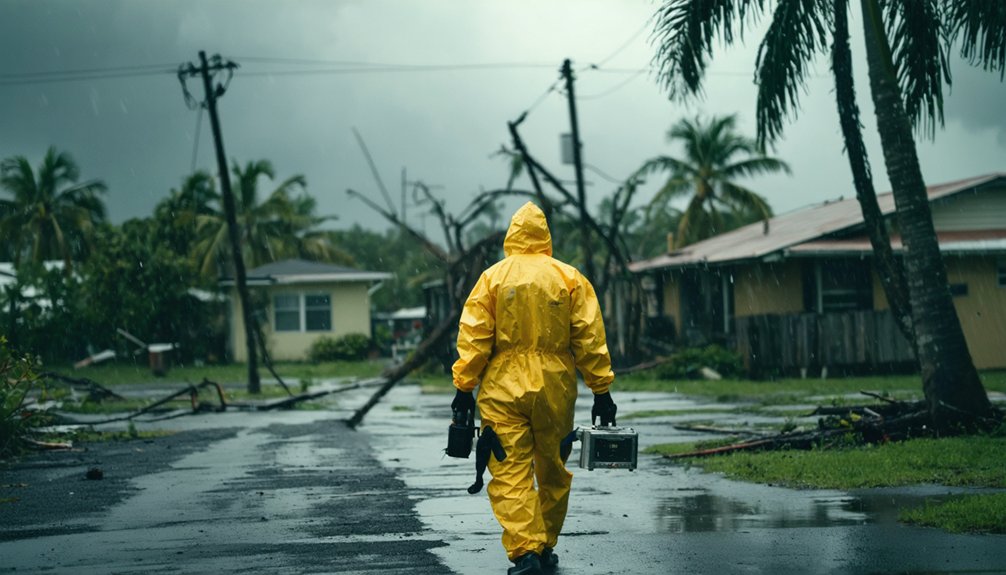
When a major hurricane strikes, you’re looking at wind forces that can exceed 130 mph, generating dynamic pressures capable of peeling roofs, shattering windows, and collapsing walls not engineered for extreme lateral loads.
Researchers like David O. Prevatt study how residential structures perform under these high-wind conditions, identifying failure points that compromise entire communities.
Simultaneously, sustained flooding from storm surge and rainfall saturates road sub-bases, eroding the granular foundation layers that give pavement its load-bearing strength, ultimately causing cracking, sinking, and structural collapse.
Wind Forces On Structures
Hurricane-force winds don’t just push against structures — they create complex, competing pressure differentials that systematically exploit weaknesses in design and construction.
Understanding wind pressure helps you recognize why structural integrity fails during major hurricanes:
- Windward walls face direct positive pressure, pushing inward and stressing connection points.
- Leeward walls and roofs experience negative pressure (suction), pulling materials outward simultaneously.
- Corner zones concentrate the highest wind pressure coefficients, accelerating structural failure.
- Roof-to-wall connections represent critical vulnerability points where uplift forces separate structures violently.
These competing forces attack your home from multiple directions at once.
David Prevatt’s research on residential performance in high-wind events confirms that construction quality and design choices determine whether your structure survives or catastrophically fails under hurricane conditions.
Flooding Weakens Road Foundations
Floodwaters don’t just sit on road surfaces — they actively infiltrate and destabilize the subgrade layers beneath pavement, triggering a structural collapse sequence that’s nearly identical to what undermines residential foundations.
When saturation reaches critical levels, load-bearing capacity drops sharply, causing asphalt to crack, buckle, and fragment under even routine traffic weight.
Your community’s flood vulnerability compounds when slower-moving hurricanes — a documented trend in warmer climates — deliver prolonged rainfall over concentrated areas.
Extended inundation strips away the cohesive strength that keeps road bases intact.
Infrastructure resilience demands engineered drainage systems, permeable materials, and elevated road beds that redirect water before saturation occurs.
Without these interventions, you’re left with compromised evacuation routes precisely when residents need them most — during active storm conditions.
Building Coastal Resilience Before the Next Storm Hits
As hurricanes grow more intense and storm surges increasingly threaten coastal communities, building resilience before a storm strikes isn’t just prudent — it’s essential.
Researchers like Maitane Olabarrieta and Katy Serafin model coastal infrastructure vulnerabilities, giving you actionable data to strengthen community preparedness now.
Prioritize these four resilience strategies:
- Reinforce flood barriers and drainage systems before rapid intensification eliminates response windows.
- Audit coastal infrastructure annually, identifying erosion-prone zones using predictive modeling.
- Develop community preparedness plans that account for compound flooding and storm surge events.
- Invest in residential structural upgrades, reducing the $1.4 trillion cumulative U.S. hurricane damage trajectory.
You don’t wait for the storm to act — you build defenses while the skies are still clear.
Frequently Asked Questions
How Do Hurricanes Affect Mental Health in Impacted Communities?
Hurricanes can devastate your mental health through hurricane trauma, triggering anxiety, PTSD, and depression. You’ll find that community resilience helps you recover faster, as social networks and shared resources actively reduce long-term psychological impacts post-disaster.
What Role Does Social Media Play During Hurricane Evacuations?
When the chips are down, social media’s a double-edged tool: it amplifies evacuation communication, helping you act fast, but social media misinformation can cloud your judgment, delaying critical decisions when forecast accuracy and infrastructure data matter most.
How Do Hurricanes Disproportionately Impact Low-Income and Marginalized Communities?
Hurricanes hit you hardest when you’ve got limited resource access. Low-income communities face compounded vulnerabilities—weaker infrastructure, fewer evacuation options, and slower recovery. Building community resilience isn’t optional; it’s your strongest defense against disproportionate economic and social devastation.
Can Hurricanes Influence Political Decisions About Climate Change Policy?
Ironically, it takes billion-dollar disasters to spark policy shifts. Hurricanes boost climate awareness—Twitter data confirms spikes in climate discourse post-storm. You’d think $1.4 trillion in U.S. damages since 1980 would’ve already driven decisive climate action.
How Do Insurance Companies Respond to Increasing Hurricane Damage Costs?
As hurricane costs surpass $1.4 trillion since 1980, you’ll find insurance companies continuously revising insurance risk models and conducting rigorous damage assessment analyses, often raising premiums, restricting coverage, or withdrawing from high-risk coastal markets entirely.
References
- https://www.edf.org/climate/how-climate-change-makes-hurricanes-more-destructive
- https://news.ucar.edu/132956/hurricane-experts-available-explain-storm-behavior-potential-impacts
- https://www.youtube.com/watch?v=cL9Wh757QAY
- https://www.climatecentral.org/climate-matters/hurricanes-and-climate-change-2025
- https://experts.ufl.edu/hurricanes/experts/
- https://journals.plos.org/climate/article?id=10.1371/journal.pclm.0000277
- https://www.gfdl.noaa.gov/global-warming-and-hurricanes/