The EF Scale rates tornado damage across six tiers, from EF0 at 65–85 mph to EF5 exceeding 200 mph, giving you a standardized framework for interpreting destruction severity. It doesn’t directly measure wind speeds — it matches observed structural damage against 28 specific indicators, each carrying eight degrees of destruction. Construction quality, debris density, and tornado path location all influence what you’ll see at each rating. The full picture gets more precise when you examine each category closely.
Key Takeaways
- The EF Scale rates tornadoes from EF0 to EF5 based on observed structural damage, not directly measured wind speeds.
- EF0 tornadoes produce 65–85 mph winds causing minor damage, while EF5 tornadoes exceed 200 mph causing catastrophic destruction.
- Ratings are determined using 28 damage indicators, each assessed across eight degrees of destruction severity.
- Construction quality, debris density, and tornado path location can cause damage variability within the same EF rating.
- EF4 and EF5 tornadoes cause disproportionate fatalities, leveling homes and throwing vehicles hundreds of meters.
What the EF Scale Measures and Why It Matters
When you hear that a tornado received an EF2 rating, that number reflects observed structural damage, not a direct wind measurement. The Enhanced Fujita Scale classifies tornadoes from EF0 to EF5 using meteorological data tied to 28 damage indicators and 8 degrees of damage per indicator.
Surveyors conduct post-storm damage assessment by matching observed destruction to specific structures, including homes, trees, and utility infrastructure.
You should understand that EF ratings represent estimated 3-second wind gusts, not confirmed speeds from direct instrumentation. The National Weather Service replaced the original Fujita Scale with this system in 2007 to better connect wind estimates to structural outcomes.
That distinction matters because two tornadoes sharing the same EF rating can produce different damage patterns depending on construction quality and path location.
EF Scale Wind Speed Ranges: EF0 Through EF5
Each EF rating carries a specific estimated 3-second gust wind range that separates one damage tier from the next. You can reference these ranges to understand tornado safety risks and anticipate damage repair costs after a storm.
Each EF rating defines a wind range that separates damage tiers, helping you assess storm risks and plan repairs.
- EF0: 65–85 mph — minor damage
- EF1: 86–110 mph — moderate damage
- EF2: 111–135 mph — considerable damage
- EF3: 136–165 mph — severe structural loss
- EF4: 166–200 mph — extreme destruction
- EF5: Over 200 mph — incredible, catastrophic damage
These aren’t precise measurements from every tornado. They’re engineering-based wind estimates tied to observed damage indicators.
As the rating climbs, structural survival odds drop sharply. Knowing where each threshold falls lets you make smarter decisions about construction standards, preparedness, and post-storm damage repair planning.
The 28 Damage Indicators Every EF Rating Depends On
Behind every EF rating is a standardized framework of 28 damage indicators (DIs) that surveyors use to anchor wind-speed estimates to real-world structural and environmental evidence. These DIs span houses, commercial buildings, trees, utility poles, and other structures, each carrying eight degrees of damage (DOD) ranging from threshold damage to complete destruction.
When surveyors assess a tornado’s path, they match observed destruction to the appropriate DI and DOD, producing a defensible wind-speed estimate.
Historical case studies have validated this methodology, confirming that consistent application improves rating accuracy across varied terrain and construction types.
You benefit directly from this system because it drives community preparedness planning. Local officials use EF-rated damage data to refine building codes, allocate resources, and design sheltering strategies that protect your infrastructure and your freedom to rebuild quickly.
EF0 to EF2: What Lower-Rated Tornado Damage Actually Looks Like
Though they occupy the lower tier of the EF Scale, EF0 through EF2 tornadoes still produce damage that’s structurally meaningful and, in some cases, life-threatening. Understanding each rating helps you make smarter tornado safety decisions and plan realistic damage repair budgets.
- EF0 (65–85 mph): Expect broken branches, damaged shingles, and downed signs.
- EF1 (86–110 mph): Roofs sustain moderate loss, windows shatter, and mobile homes take serious hits.
- EF2 (111–135 mph): Roofs tear off completely, mobile homes are destroyed, and large trees uproot entirely.
- Construction quality matters: Two EF2 tornadoes can leave dramatically different damage repair scopes depending on structural integrity.
You’re never truly outside risk territory until you understand what these wind speeds actually do to real structures.
EF3 to EF5: What the Highest Tornado Ratings Actually Mean
When you look at EF3 tornadoes, you’re seeing 136–165 mph gusts capable of stripping entire walls from well-built structures and leaving only partial frames standing.
At EF4, winds of 166–200 mph level well-constructed homes, generate massive debris fields, and destroy most of what they strike.
EF5 tornadoes exceed 200 mph and produce incredible damage, obliterating even reinforced structures and often leaving concrete slabs completely bare.
EF3 Severe Structural Damage
Once a tornado reaches EF3 intensity, wind speeds range from 136–165 mph, and the damage shifts from significant to severe structural loss. At this rating, well-built structures don’t just lose roofs — they lose walls. Debris impact becomes a lethal force multiplier, turning ordinary materials into high-velocity projectiles.
You’re facing conditions where:
- Exterior walls collapse on entire floors
- Large vehicles overturn and relocate significant distances
- Most trees in the path are snapped or uprooted
- A storm shelter becomes your most critical survival asset
EF3 tornadoes expose every vulnerability in standard construction. Surveyors classify this rating when buildings retain only partial framing.
If you live in tornado-prone regions, understanding EF3 damage patterns directly informs your preparedness decisions.
EF4 Extreme Destruction Explained
EF3 damage is severe — but EF4 intensity, with wind speeds between 166–200 mph, moves destruction into a categorically different range. At this level, well-constructed homes don’t just lose roofs — they’re leveled to their foundations. You’re looking at vehicles thrown hundreds of meters, large trees completely debarked, and entire structural frames obliterated.
Tornado climatology data confirms EF4 events are statistically rare, comprising roughly 1% of all recorded tornadoes, yet they account for disproportionate fatality and economic loss figures. That statistical rarity shouldn’t breed complacency.
Emergency preparedness at the EF4 threshold demands reinforced shelters, not interior rooms alone. Standard framing offers no meaningful resistance. If you’re in a tornado-prone region, understanding EF4 destruction benchmarks directly informs what infrastructure choices and shelter investments actually protect your life.
EF5 Incredible Wind Devastation
Beyond EF4’s already-catastrophic threshold, EF5 tornadoes — defined by wind gusts exceeding 200 mph — represent the scale’s upper bound of documented destruction. At this level, even engineered structures fail completely. Understanding EF5 mechanics strengthens your tornado safety decisions.
Key EF5 damage characteristics include:
- Well-built homes are swept entirely off foundations, leaving bare concrete slabs
- Reinforced structures suffer catastrophic structural failure beyond repair
- Vehicles and heavy debris become high-velocity projectiles traveling hundreds of feet
- Vegetation is stripped, altering local terrain and reflecting broader climate impact on land surfaces
EF5 events remain statistically rare but disproportionately deadly. Surveyors confirm ratings through 28 damage indicators, matching destruction patterns to established degrees of damage. Your best protection remains early warning response and purpose-built shelter.
How the EF Scale Differs From the Original Fujita Scale
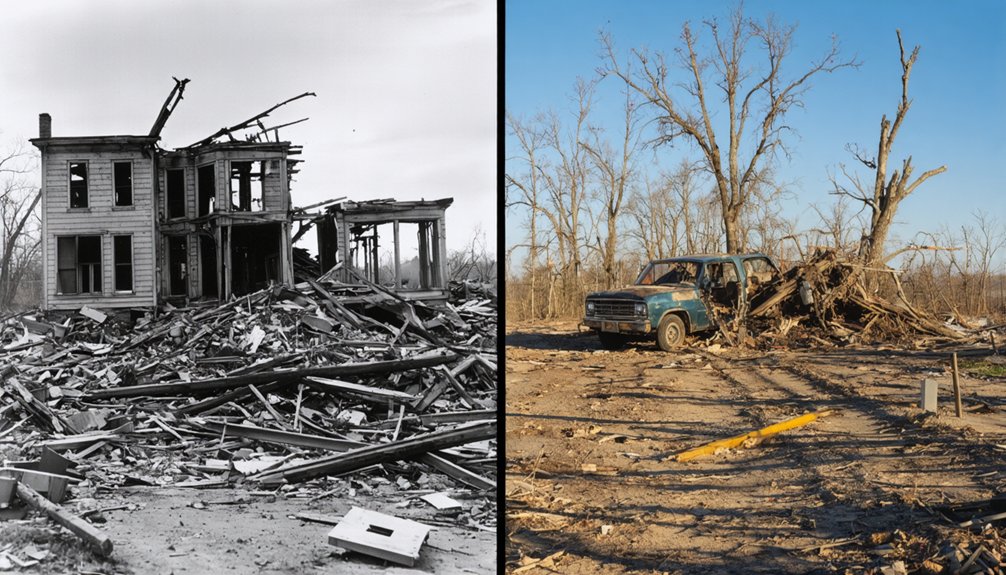
When the Enhanced Fujita Scale replaced the original Fujita Scale in 2007, it brought meaningful changes to how meteorologists estimate tornado wind speeds and assess damage.
Historical differences between the two systems matter because the EF Scale adjusted wind-speed ranges to better reflect real-world structural damage patterns. EF0 starts at a higher minimum wind speed than the original F0, and EF5 is defined as over 200 mph, whereas the old F5 extended considerably higher.
These revisions improved rating consistency by anchoring each category to 28 specific damage indicators, each carrying eight degrees of damage. You can trust that EF ratings deliver more accurate, engineer-validated assessments than their predecessors, giving you a clearer picture of what each tornado actually did to the structures in its path.
Why the Same EF Rating Can Mean Very Different Damage
Knowing that the EF Scale anchors each rating to specific damage indicators helps explain something that surprises many people: two tornadoes sharing the same EF rating can leave behind strikingly different destruction.
Historical tornado patterns confirm this variability. Four key factors drive these differences:
- Construction quality — poorly built structures sustain heavier damage at lower wind speeds.
- Path location — a tornado striking open fields versus dense neighborhoods produces vastly different wreckage.
- Available debris — debris density amplifies destruction beyond what wind speed alone causes.
- Climate change effects — shifting atmospheric conditions may alter how damage manifests across similar-rated storms.
You should treat EF ratings as comparative damage benchmarks, not precise wind guarantees. Each rating reflects estimated 3-second gusts matched against observed structural failures, making context essential for accurate interpretation.
Frequently Asked Questions
Can a Tornado’s EF Rating Change After the Initial Post-Storm Survey?
Yes, it can. Imagine the 2011 Joplin case—you’d see how updated damage assessment procedures and refined tornado wind speeds data can prompt NWS meteorologists to revise an EF rating post-survey when new structural evidence emerges.
Who Is Legally Responsible for EF Scale Damage Assessments After a Tornado?
The National Weather Service handles EF scale damage assessments. They don’t assign legal liability—that’s outside their scope. For tornado safety and emergency response, you’ll need local authorities, insurers, and engineers to determine any legal responsibility.
How Long Does It Typically Take to Assign an Official EF Rating?
Within 24–48 hours post-storm, you’ll typically see an official tornado classification issued. Damage assessment surveys, conducted by National Weather Service meteorologists, drive that rating—it’s a precise, data-driven process you can track publicly.
Are EF Scale Ratings Used Outside the United States for Tornado Classification?
You’ll find that the EF Scale isn’t universally adopted for international tornado classification. Other nations use independent global storm severity systems, like Canada’s adapted EF Scale, while many countries develop their own sovereign classification frameworks.
Do Insurance Companies Use EF Ratings to Determine Storm Damage Claims?
When the dust settles, insurance claims rely on independent damage assessment, not EF ratings directly. You’ll find insurers evaluate structural loss through their own adjusters, though EF data can inform broader catastrophe modeling decisions.
References
- https://www.weather.gov/oun/efscale
- https://en.wikipedia.org/wiki/Enhanced_Fujita_scale
- https://atlassaferooms.com/what-is-the-ef-scale-for-tornados/
- https://www.weather.gov/lsx/enhancedfujitascale
- https://www.spc.noaa.gov/faq/tornado/ef-scale.html
- https://www.allstate.com/resources/home-insurance/how-tornadoes-are-rated-fujita-scale
- https://en.wikipedia.org/wiki/Fujita_scale
- https://www.depts.ttu.edu/nwi/Pubs/EnhancedFujitaScale/EFScale.pdf
- https://learn.weatherstem.com/courses/wxstem_meteorology_01/module-03/02/15.html
- https://www.tornadopath.com/intensity-scales