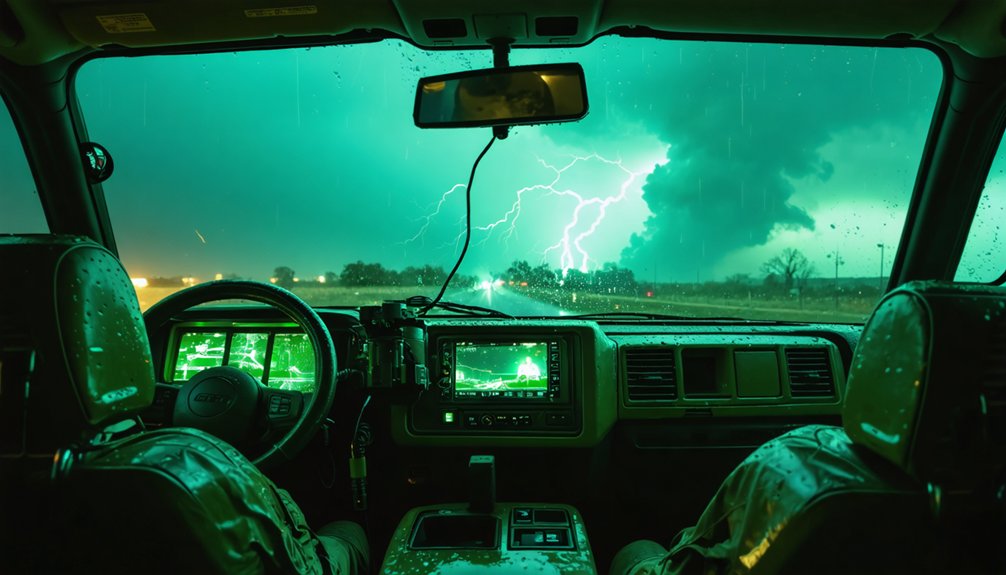
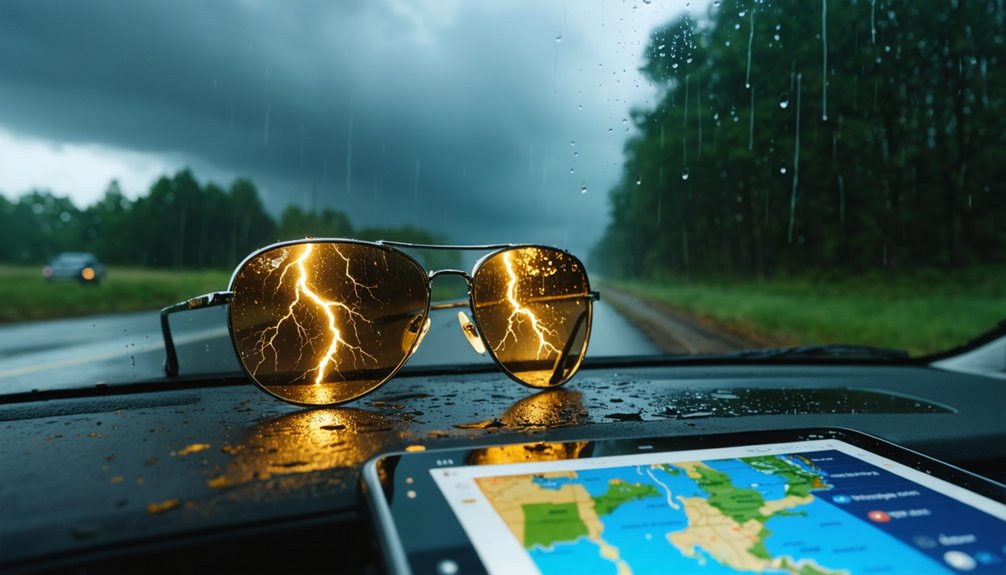
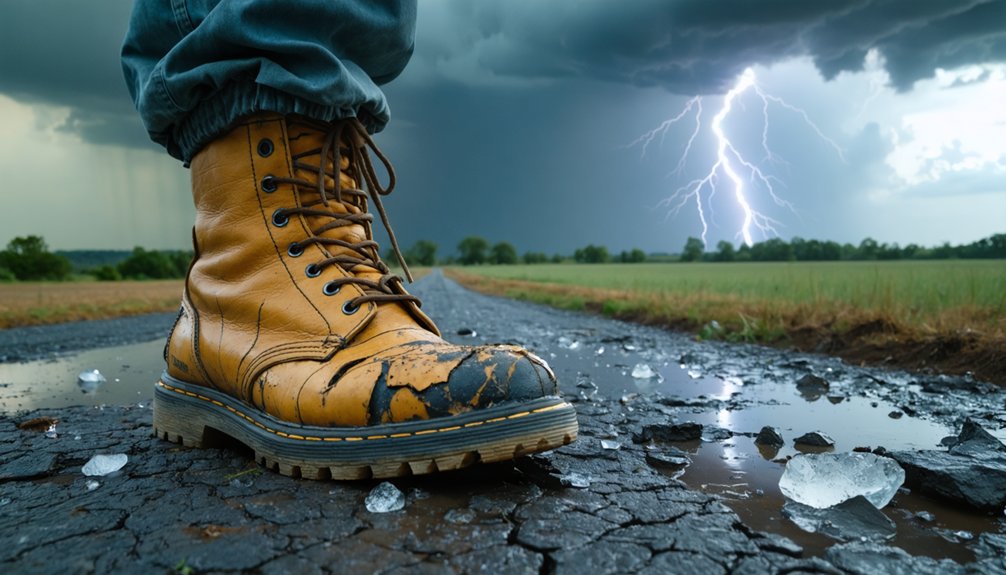
Storm chasing requires purpose-built gear to keep you safe and operational. You’ll need a 4WD vehicle stocked with recovery straps, a tire repair kit, and a trauma bag containing tourniquets and hemostatic gauze. Pair a dedicated GPS unit with dual-pol radar apps like RadarScope, and carry a SAME-coded weather radio for filtered alerts. Layer your comms with cellular boosters, two-way radios, and satellite devices. Keep power banks above 20,000 mAh, pack two liters of water, and store dry backup clothes in sealed bags—there’s far more to each item than meets the eye.
Key Takeaways
- A dedicated GPS unit ensures reliable navigation and storm interception in remote areas with degraded or nonexistent cell service.
- Power banks (minimum 20,000 mAh) and vehicle inverters keep essential devices charged during 10–14 hour chase days.
- A fully stocked trauma kit with tourniquets, hemostatic gauze, and bandages addresses medical emergencies in remote locations.
- Layered communication tools—two-way radios, satellite devices, and cellular boosters—prevent dangerous communication failures during active chasing.
- Radar apps like RadarScope with dual-pol data allow accurate, real-time storm tracking and informed positioning decisions.
A Reliable Vehicle Built for Storm Chasing
Because storm chasing demands long-distance driving across wet roads, muddy terrain, and debris-strewn paths, your vehicle is your most critical piece of equipment. Neglecting vehicle maintenance before a chase creates unnecessary risk and limits your operational freedom in the field.
Your vehicle isn’t just transportation — it’s your lifeline. Neglect it, and you’ve already lost the chase.
Your storm chasing gear should include a complete tire management system: a repair kit, fix-a-flat solution, tire iron, and bottle jack.
Traction failures on compromised roads can end a chase instantly. A tow strap and recovery strap handle extraction when conditions push you off-road.
Prioritize 4WD capability if you’re operating in remote areas.
Inspect fluids, brakes, and belts before each deployment. A mechanically sound vehicle keeps you mobile, independent, and positioned to chase without depending on outside assistance when it matters most.
Tires, Tow Straps, and Roadside Recovery Gear
Tires are your first line of defense against road failure during a chase, and no amount of vehicle capability compensates for compromised rubber on wet or debris-covered asphalt. Prioritize tire maintenance before every deployment — check pressure, tread depth, and sidewall integrity.
Carry a fix-a-flat kit and a full-size spare with a tire iron and bottle jack for rapid field swaps.
Don’t rely on roadside assistance in remote chase corridors — response times are unpredictable and coverage is thin. A tow strap and recovery strap let you self-extract from mud, ditches, or soft shoulders without waiting on outside help.
These tools cost little, weigh less, and give you operational independence when conditions deteriorate and every minute of repositioning counts.
When storm structure shifts in minutes, your navigation and radar tools determine whether you intercept or get left chasing exhaust. A dedicated GPS unit keeps routing reliable when cell service degrades, letting you reposition fast without fumbling through apps.
For storm tracking, RadarScope and RadarOmega deliver dual-pol data, velocity products, and base reflectivity at refresh rates that matter operationally. Pair those with mesoscale analysis tools to read the broader convective environment before committing to a target.
Radar calibration awareness is equally critical—knowing your tilt angle, range folding limitations, and scan intervals prevents misreading storm motion or hail cores. Don’t rely on a single data source.
Cross-reference products, trust your positioning tools, and you’ll spend more time in the right place at the right time.
Weather Radio for Alerts on the Road
Even with radar apps running and GPS locked, a dedicated weather radio fills a critical gap—NWS broadcasts deliver statement updates, tornado warnings, and severe thunderstorm alerts independent of cell infrastructure.
Even with apps and GPS running, a dedicated weather radio delivers NWS alerts independent of cell infrastructure.
When you’re operating in rural terrain where signal drops, emergency broadcasting keeps you informed without relying on tower-dependent data streams.
Choose a SAME-coded weather radio that filters storm alert notifications by county, so you’re only receiving warnings relevant to your operational area. Units like the Midland WR120 or Uniden BC75XLT offer programmable SAME codes, alarm tones, and battery backup—critical when your vehicle power is compromised.
Mount it within direct sight and earshot of your driver’s position. In fast-moving chase scenarios, you can’t afford to miss a polygon update because your phone lost signal.
Cell Service, Boosters, and Two-Way Radios
Your carrier choice directly impacts your ability to pull real-time radar data and communicate during a chase, so prioritize a provider with the strongest rural Great Plains coverage and an unlimited data plan.
When signal drops in remote areas, a cellular booster mounted in your vehicle can recover weak signals and keep your data stream stable.
For situations where cell coverage fails entirely, two-way radios give you a reliable backup communication channel with your chase partners or team.
Choosing A Reliable Carrier
Staying connected during a storm chase isn’t just convenient—it’s operationally critical. Carrier coverage varies markedly across rural storm corridors, so you can’t afford to commit to a single provider without first auditing their network maps against your typical chase regions.
Signal reliability degrades fast in the Plains and intermountain zones where severe weather concentrates. Cross-reference coverage maps from at least two major carriers before selecting your primary plan.
Many experienced chasers run dual-SIM setups or carry a secondary device on a different network entirely. Prioritize carriers with strong LTE and 5G penetration in low-density areas.
Unlimited data plans with deprioritization thresholds above 50GB give you operational flexibility during multi-day deployments. Don’t let a dead signal dictate your positioning decisions.
Boosting Weak Signal Areas
Selecting the right carrier gets you only so far—rural Plains corridors and intermountain zones will still hand you dead zones that no plan tier fixes. Signal amplification closes that gap promptly. Equip your vehicle with a cellular booster and reclaim connectivity where towers are sparse.
When boosters aren’t enough, satellite connectivity via Starlink or inReach keeps your data pipeline alive. Two-way radios fill any remaining communication voids instantly.
Don’t let dead zones ground your chase:
- Mount a cellular booster to amplify weak tower signals markedly
- Deploy satellite connectivity for zero-coverage terrain
- Carry two-way radios as your hardened backup channel
- Test all systems before departure—never assume coverage exists
Your freedom to chase depends on redundant, layered communication. Build it deliberately.
Backup Radio Communication
When cell service falters mid-chase, you need a layered communication stack that doesn’t collapse with a single dead zone. Two-way radios operate independently of carrier infrastructure, giving you reliable voice contact with your chase team across rural corridors where LTE disappears entirely.
VHF/UHF handheld units or vehicle-mounted radios cover short-range coordination effectively.
For remote operations beyond radio range, satellite communication devices like Garmin inReach provide two-way messaging and SOS capability without any cellular dependency. These aren’t optional upgrades—they’re operational insurance.
Your backup radio strategy should stack three layers: cellular primary, two-way radio secondary, and satellite communication as the failsafe. Each layer compensates for the previous one’s coverage gap, keeping you connected, coordinated, and mobile regardless of where the storm pulls you.
Power Banks and Inverters to Keep Devices Running
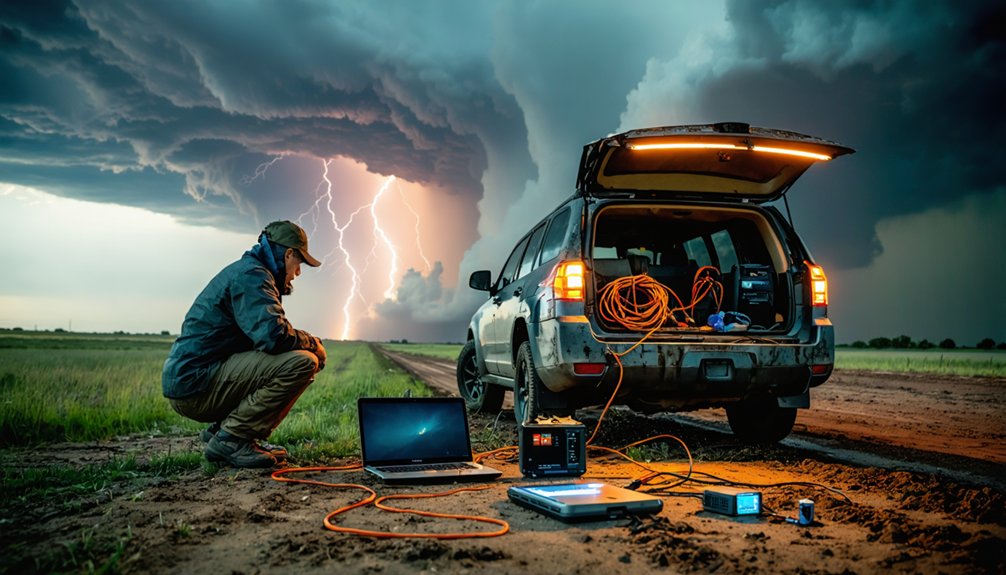
When you’re running radar apps, a laptop, dashcam, and GPS simultaneously across a 10-hour chase day, a power bank under 10,000 mAh won’t cut it.
You’ll want a vehicle power inverter rated for your total wattage load so you can charge high-draw devices like laptops without tripping a fuse or draining your alternator.
Managing battery life effectively means prioritizing which devices stay live during repositioning versus active intercept, keeping your most critical tools charged when it matters most.
Choosing The Right Power Bank
Few pieces of gear matter more on a long chase day than a capable power bank, and the spec that deserves the most attention is capacity. For portable charging that keeps you mobile and untethered, target at minimum 10,000 mAh of battery capacity.
Choose your power bank using these four criteria:
- Capacity: 10,000 mAh minimum; 20,000 mAh for multi-device days
- Output ports: Multiple USB-A and USB-C ports for simultaneous charging
- Wattage: 18W+ fast-charging output to recover device power quickly
- Durability: Water-resistant housing rated for field conditions
A weak power bank means dead devices mid-chase, and dead devices mean blind decisions. You’re operating in dynamic, fast-moving environments where power failure isn’t an inconvenience — it’s a genuine safety risk.
Vehicle Power Inverter Basics
A vehicle power inverter converts your car’s 12V DC current into standard 120V AC output, letting you run laptops, camera chargers, and other AC-dependent gear directly from your vehicle’s electrical system.
For storm chasing, target a pure sine wave inverter rated between 400W and 1,000W to handle simultaneous device loads without signal interference.
Plug directly into your battery terminals rather than the cigarette lighter for higher wattage draws.
Inverter safety requires inline fusing within 18 inches of the battery to prevent wire fires during surges.
Monitor your battery maintenance closely—running an inverter on a parked vehicle drains your battery fast.
Keep a jump-start battery pack accessible.
Pair your inverter with a voltmeter to track draw and avoid dropping below 12.2V under load.
Managing Battery Life Effectively
Managing battery life across multiple devices during a full chase day requires deliberate planning, not improvisation. You’re accountable for every watt you consume in the field.
Run battery calibration on all devices before departing—this guarantees accurate charge readings when you’re 200 miles from the nearest outlet. Then audit your power consumption ruthlessly:
- Disable unnecessary background apps draining power silently
- Dim screens on laptops and tablets to reduce load
- Prioritize charging sequences—radar devices before cameras
- Carry a minimum 10,000 mAh power bank as your last failsafe
Uncontrolled power consumption ends chases prematurely. Your radar goes dark. Your GPS dies. You lose the storm. Treat battery management like route planning—precise, intentional, and executed before conditions force your hand.
Laptops, Chargers, and In-Vehicle Power Setup
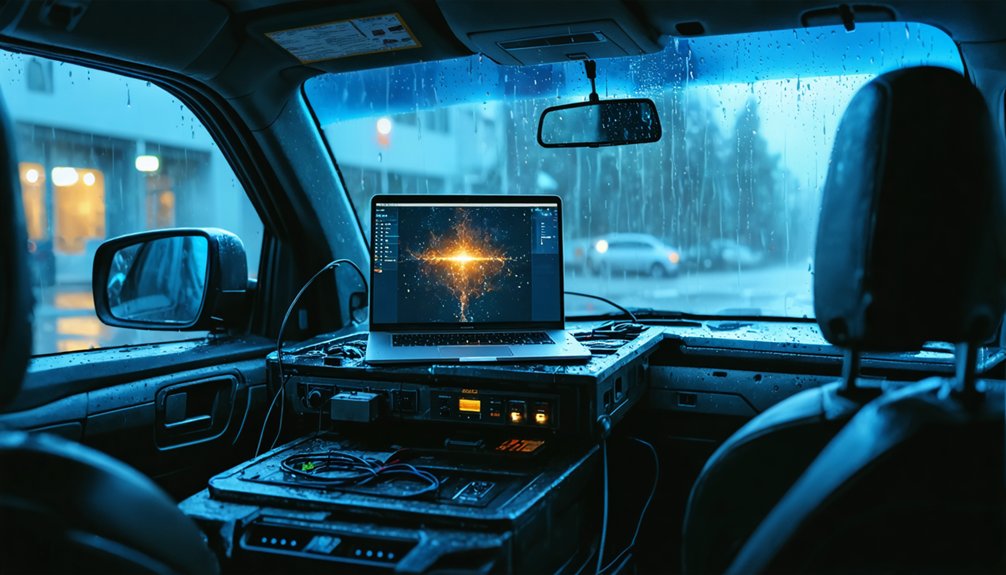
Storm chasers rely heavily on laptops for real-time data analysis, radar interpretation, and model viewing, making a stable in-vehicle power setup non-negotiable. You’ll need a quality power inverter to convert your vehicle’s DC power to AC, letting you run your laptop and peripherals without interruption. Pair it with a surge protector to guard against voltage spikes during engine fluctuations.
Prioritize laptop cooling by ensuring adequate airflow inside your vehicle, since heat buildup degrades processing performance during critical decision windows. Keep your data backup system active by syncing chase footage and weather data to an external drive or cloud storage regularly.
Always carry your laptop charger and device-specific cables so you’re never caught powerless during fast-moving storm setups.
First Aid Kits, Road Flares, and Visibility Gear
Your storm chasing kit must include a well-stocked emergency medical kit containing trauma essentials like tourniquets, hemostatic gauze, bandages, and a CPR mask—because accidents on remote roads can put you miles from immediate medical help.
Pair that with road flares, LED emergency triangles, and a reflective vest to keep you visible to passing traffic during roadside stops in low-light or severe weather conditions.
These aren’t optional accessories; they’re core safety systems that protect you when conditions deteriorate fast.
Emergency Medical Kit Essentials
When you’re chasing storms across remote highways and open plains, a fully stocked emergency medical kit isn’t optional — it’s non-negotiable. Medical emergencies don’t wait for cell service or nearby hospitals. Your first aid kit should cover serious field scenarios fast.
Stock yours with these four critical components:
- Trauma supplies — tourniquets, pressure bandages, and hemostatic gauze for severe bleeding
- Wound care — antiseptic wipes, closure strips, and sterile dressings for lacerations
- Airway and breathing tools — CPR mask and emergency rescue breather
- Medications — pain relievers, antihistamines, and personal prescriptions
Each item earns its place by addressing real injury risks — flying debris, vehicle accidents, and exposure. You’re operating outside safety nets, so your kit becomes your first line of defense.
Roadside Visibility Safety Gear
Roadside breakdowns during a chase don’t just cost time — they create serious collision risks, especially in low-visibility conditions like heavy rain, hail cores, or nighttime operations. Equip your vehicle with roadside flares and deploy them immediately when stopped on or near active roadways.
Space them at 10-foot intervals behind your vehicle to give approaching traffic adequate reaction distance.
Reflective vests are non-negotiable when you’re outside the vehicle. Standard ANSI Class 2 vests provide 360-degree visibility at distances exceeding 1,000 feet.
Pair these with a quality headlamp rated at minimum 300 lumens for hands-free nighttime work.
Keep all visibility gear in a single, clearly labeled bag within immediate reach — not buried in your trunk.
Seconds matter when you’re stopped on a rural highway during a severe weather event.
Waterproof Gear, Sturdy Footwear, and Sun Protection
Storm chasing exposes you to a full spectrum of environmental hazards, so your clothing and footwear choices directly affect both safety and field performance. Pack strategically and you’ll stay mobile, focused, and ready:
- Waterproof jacket – Reliable rain gear blocks wind-driven rain and keeps your core temperature stable during rapidly evolving conditions.
- Slip-resistant boots – Muddy, debris-covered terrain demands footwear with aggressive traction and ankle support.
- Sun protection kit – Sunscreen (SPF 30+), polarized sunglasses, and a wide-brim hat defend against prolonged UV exposure during multi-hour outdoor deployments.
- Dry backup clothing – Extra socks and a spare shirt restore comfort and function after soaking conditions.
Each item directly supports your ability to operate independently and effectively across unpredictable environments.
Snacks, Water, and Dry Clothes for Long Chase Days
Gear protects your body from the outside, but sustaining performance across a 10- to 14-hour chase day also depends on what you put into it. Pack energy boosting snacks with measurable caloric density — nuts, jerky, and protein bars deliver sustained output without requiring refrigeration or preparation time. Avoid high-sugar options that spike and crash your focus mid-chase.
Hydration strategies matter equally. Carry at least two liters of water per person, minimum, and supplement with electrolyte packets to offset sweat loss during high-exertion repositioning.
Dry clothes aren’t optional comfort — they’re functional. Wet clothing accelerates fatigue and hypothermia risk during night chases. Pack dry socks, a spare shirt, and a compact towel in a sealed bag. You’ll use them.
Frequently Asked Questions
Do Storm Chasers Need Special Insurance for Their Chase Vehicles?
You’ll need specialized insurance requirements beyond standard policies since storm chasing increases your liability exposure. Make certain your vehicle coverage includes off-road use, high-risk conditions, and commercial riders if you’re monetizing your chase operations.
Are There Legal Permits Required to Chase Storms Professionally?
Like open roads with no speed limits, storm chasing regulations are largely unwritten—you don’t need formal permits. However, legal compliance still matters: respect traffic laws, private property, and local emergency directives while chasing professionally.
How Do Beginners Find Experienced Storm Chasers to Learn From?
You’ll find mentors by joining the storm chasing community through platforms like Spotter Network, attending SLS or Vortex tours, and enrolling in mentorship programs where experienced chasers actively guide beginners through real deployments and data interpretation.
What Certifications or Training Should New Storm Chasers Pursue First?
Start with Skywarn certification, then master weather forecasting tools like RadarScope. You’ll sharpen storm chasing safety by studying meteorology fundamentals, NWS training modules, and hands-on field experience alongside seasoned chasers who’ll accelerate your technical decision-making skills.
Is Storm Chasing Covered Under Any Professional Meteorology Organizations?
You’ll find that storm chasing regulations aren’t formally governed by a single body, but meteorology certifications from the AMS or NWA can validate your expertise and align you with recognized professional standards in the field.
References
- https://www.benholcomb.com/storm-chasing/equipment/
- https://www.reddit.com/r/meteorology/comments/f0o9p1/storm_chasers_of_reddit_what_are_your_essentials/
- https://www.stormtours.com/information/must-bring-items/
- https://www.facebook.com/groups/2454081528094611/posts/3092696097566481/
- https://svinews.com/2024/featured/97765/things-every-storm-chaser-needs-in-their-truck/
- https://www.youtube.com/watch?v=Sr2lz72ZYwM
- https://store.sirui.com/blogs/guides/essential-equipment-for-storm-chasing-guide-for-2025
- https://www.benholcomb.com/storm-chasing/equipment/items-in-my-storm-chase-vehicle/
- https://crazystormchasers.com/essential-storm-chasing-gear-list/
- https://crazystormchasers.com/top-storm-chasing-backpack-must-haves/