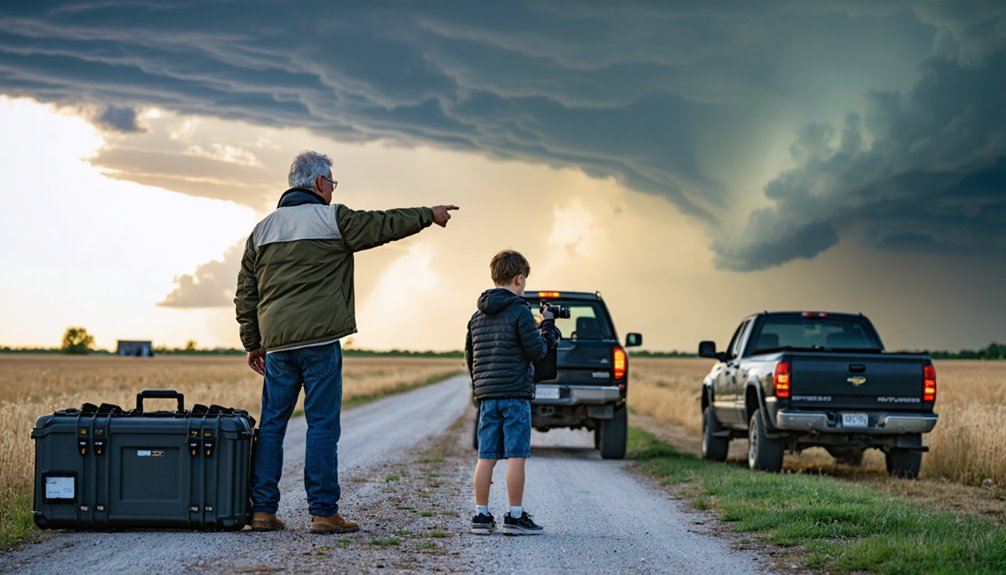
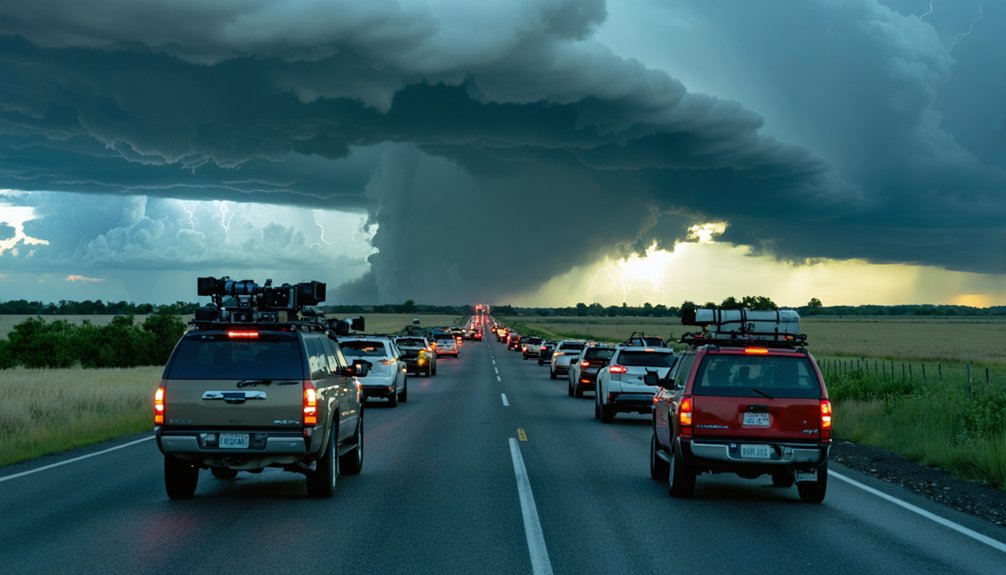
Storm chasing isn’t federally illegal in the U.S., but you’re still bound by all standard traffic laws, property rights, and state-level regulations. You must obey speed limits, avoid trespassing on private land, and carry appropriate vehicle insurance. Some states are introducing mandatory licensing requirements for professional chasers. Drone operations fall under FAA jurisdiction, adding another layer of compliance. The full legal landscape is more complex than most chasers realize, and every detail matters.
Key Takeaways
- No federal law explicitly bans storm chasing, but chasers must comply with all standard traffic laws, including speed limits and traffic signals.
- Unauthorized entry onto private property can result in trespassing charges, so explicit landowner permission is always required.
- Some states are considering mandatory licensing for professional storm chasers, with proposed fees of $500 initially and $250 annually.
- Standard auto insurance policies may not cover storm-chasing activities, making specialized tracking-vehicle insurance essential in certain states.
- Drone operations during storm chasing are governed by FAA regulations, and unauthorized flights can result in confiscation and fines.
Is Storm Chasing Actually Legal in the U.S.?
Storm chasing isn’t explicitly banned under any federal U.S. law, meaning you can legally pursue severe weather as long as you comply with the traffic, property, and emergency statutes already governing everyone on public roads.
Your freedom to chase depends entirely on your conduct. Legal consequences arise not from chasing itself, but from related violations: speeding, trespassing on private land, ignoring evacuation orders, or bypassing road closures.
Law enforcement officers in some jurisdictions issue citations more aggressively toward chasers, even for minor infractions.
Storm chasing ethics reinforce your legal standing. When you respect property boundaries, obey traffic laws, and honor emergency directives, you reduce exposure to fines, arrest, or civil liability.
Disregarding these standards doesn’t just create legal risk — it undermines the broader credibility of responsible, data-driven severe weather observation.
What Traffic Laws Apply When You’re Chasing?
When you’re chasing severe weather, every standard traffic law that applies to any other driver applies equally to you — speed limits, stop signs, traffic signals, and safe-driving protocols don’t suspend themselves because a supercell is nearby.
Speeding penalties apply fully: excessive speed while repositioning can result in tickets, fines, license suspension, or revocation. You can’t run red lights or bypass barricades simply because you’re gathering weather data — law enforcement won’t accept that justification.
No badge, title, or weather emergency exempts you from speeding laws — enforcement doesn’t negotiate with storm chasers.
Road safety also extends to other drivers you’re sharing the road with; reckless maneuvering creates genuine hazards and legal exposure. Driving on officially closed roads invites citations or arrest.
Your freedom to chase depends entirely on respecting these boundaries — violate them, and you risk losing the ability to chase legally at all.
Do You Need a License to Chase Storms?
Currently, no federal law requires a license to chase storms — but that landscape is shifting at the state level. Oklahoma’s Senate Bill 158 and House Bill 2426 propose mandatory licensing for professional trackers affiliated with media outlets or accredited universities.
To qualify, you’d need a criminal background check, valid tracking-vehicle insurance, and endorsement from a certified meteorologist. Licensing fees run approximately $500 initially, plus $250 annually.
In exchange, licensed trackers gain recognition as emergency responders, including authorized flashing lights and conditional access to closed roads.
These frameworks reflect growing concern over storm chasing ethics and inconsistent safety protocols among civilian chasers. If you chase professionally, monitoring your state’s legislative developments isn’t optional — staying ahead of emerging requirements protects both your operational freedom and legal standing.
Can You Drive Onto Private Land While Chasing?
Licensing clarifies your status on public roads, but it doesn’t resolve one of storm chasing’s most persistent legal friction points — private land access.
You can’t legally enter private property without explicit landowner permissions, regardless of your credentials or urgency. Private property rights are firmly protected under state law, and storm chasing doesn’t create an exemption.
Rural farm lanes, driveway entrances, and unpaved access roads frequently cross private land. Using them without authorization exposes you to trespassing charges — criminal misdemeanors in many jurisdictions.
Blocking agricultural operations or ignoring posted “no trespassing” signs compounds your liability considerably.
Your safest strategy is securing verbal or written permission before approaching any gate or fence line.
Without it, you’re legally exposed the moment your wheels leave the public right-of-way.
What Insurance, Drone, and Equipment Rules Apply to Chasers?
Beyond trespassing risks, you’ll face a separate layer of compliance obligations tied to your vehicle, insurance coverage, and any aerial equipment you deploy.
Standard auto policies often don’t cover storm-chasing operations, so verify your coverage explicitly addresses tracking activities. Oklahoma’s proposed licensing framework mandates valid tracking-vehicle insurance as a condition of licensure. If you cause an accident or obstruct emergency responders, your insurer bears liability for resulting damages.
For drone regulations, FAA rules govern every flight, prohibiting unauthorized operations near airports, restricted airspace, or emergency zones.
Flying near active storms or over closed roads risks equipment confiscation, substantial fines, and federal enforcement action. Always check temporary flight restrictions before deploying aerial equipment. Violations compromise not only your gear but your legal standing as a chaser.
Frequently Asked Questions
Can Storm Chasers Legally Operate Across Multiple States Simultaneously?
Yes, you can legally chase across multiple states, but you must comply with each state’s traffic laws. Storm chasing ethics and interstate liability vary by jurisdiction, so guarantee your insurance and permits cover every state you’re operating in.
Are Minors Legally Allowed to Participate in Storm Chasing Activities?
“Better safe than sorry” — you can involve minors in storm chasing, but you must prioritize minors’ safety and secure parental consent. No federal law explicitly bans it, though local regulations may apply.
Can Law Enforcement Forcibly Remove Storm Chasers From Public Roads?
Yes, law enforcement can forcibly remove you from public roads during declared emergencies or road closures. You must comply with storm safety directives and vehicle regulations, or you’ll face citations, arrest, or liability consequences.
Do Storm Chasers Need Special Permits to Film and Sell Footage?
Like a free bird riding the wind, you don’t typically need special permits to film and sell storm footage—but drone use triggers FAA permit requirements, so always verify local regulations before filming.
Are There Legal Consequences for Sharing Inaccurate Storm Data Publicly?
You can face legal liabilities if you’re sharing inaccurate storm data that causes public misinformation, endangers lives, or obstructs emergency response. Negligence or fraud claims may apply, especially if authorities prove your false reports directly caused measurable harm.
References
- https://crazystormchasers.com/legal-aspects-of-storm-chasing-regulations/
- https://www.findlaw.com/legalblogs/legally-weird/is-storm-chasing-illegal/
- https://www.reddit.com/r/stormchasing/comments/1if5q3h/a_bill_is_being_proposed_to_require_licensing_to/
- https://www.yahoo.com/news/bill-targets-storm-chasers-licensure-223038734.html
- https://www.okhouse.gov/posts/news-20250206_2
- https://www.fox23.com/news/state-lawmakers-to-further-study-storm-chasing-licensing-bill/article_a71b6d76-e343-11ef-9379-8f976e339a5c.html
- https://www.facebook.com/TornadoChasing/posts/oklahoma-trying-to-pass-a-law-requiring-storm-chasers-to-have-a-license-lol-but-/1141147900732731/
- https://www.youtube.com/watch?v=AKN78EFp3xE
- https://www.facebook.com/MyRadar/videos/oklahomas-proposed-storm-chasing-bill/1543935642938159/
- http://www.ndtornado.com/primary/thechase.htm