Media outlets profit from volunteer chasers’ dramatic tornado footage without compensating them, creating safety-over-profit incentives that networks refuse to acknowledge. You’ll find broadcasters amplifying reckless behavior through sensationalized compilations while deflecting accountability for normalizing dangerous risk-taking. The American Meteorological Society urges collaborative approaches, yet media prioritizes viral content over responsible reporting. Critics argue this economic model—where networks gain revenue from footage requiring life-threatening proximity—fuels the distinction between legitimate research and thrill-seeking tourism. The solutions involve credential systems and data-sharing protocols that address these ethical tensions.
Key Takeaways
- Media outlets profit from volunteer chasers’ dramatic footage while avoiding accountability for incentivizing dangerous risk-taking behavior.
- Networks amplify irresponsible behavior through Hollywood sensationalism and near-death compilations, prioritizing viral content over responsible reporting.
- Media refuses to examine their role in normalizing dangerous storm chasing despite professional meteorologists urging collaborative approaches.
- Media creates chaser-spotter divisions without consulting professionals or proposing solutions to address safety concerns.
- Professional meteorologists challenge whether sensationalized media coverage genuinely advances scientific understanding or merely promotes thrill-seeking.
Media’s Reluctance to Address Storm Chasing Problems
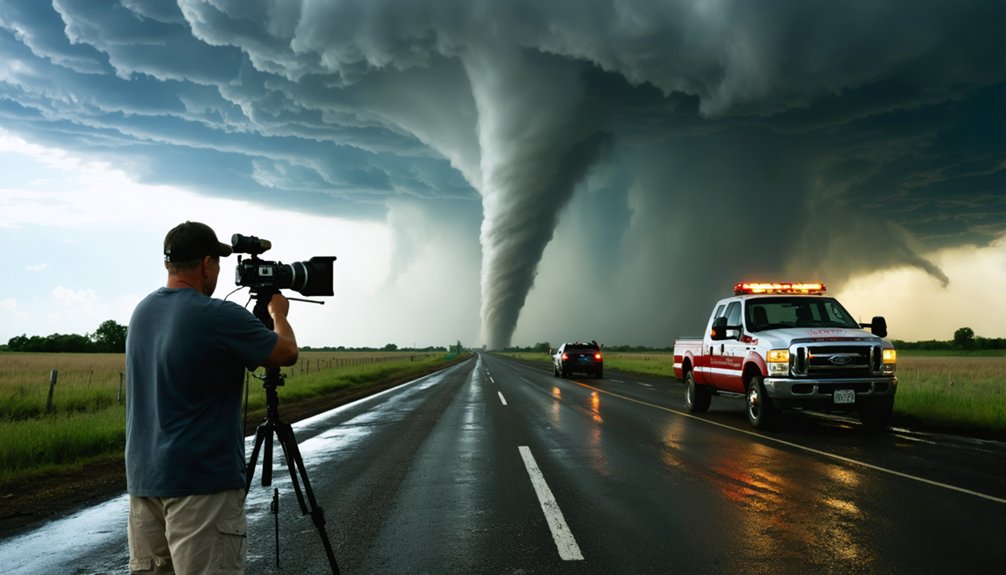
While media outlets regularly feature storm chasing content to drive ratings, they’ve systematically avoided addressing the ethical implications of their coverage practices.
You’ll notice broadcast stations rely on volunteer chasers for dramatic footage while refusing to acknowledge how this profit over safety incentives structure encourages dangerous proximity. The media narrative oversight extends beyond simple omission—networks actively create chaser-spotter divisions without consulting professionals or proposing solutions.
They’ve amplified irresponsible behavior through Hollywood sensationalism and near-death compilations, yet won’t examine their role in normalizing risk-taking. The American Meteorological Society has urged collaborative approaches with the National Weather Service, but stations prioritize viral content over responsible reporting. You’re watching an industry that profits from dangerous footage while deflecting accountability for the behaviors it incentivizes.
Reckless Driving and Public Endangerment Concerns
Though storm chasers face inherent meteorological dangers, vehicular recklessness constitutes their primary mortality risk—a reality starkly demonstrated when Weather Channel contractors Kelley Williamson and Randy Yarnall ran a stop sign at 70 mph near Spur, Texas, killing themselves and National Weather Service spotter Corbin Lee Jaeger on March 28, 2017.
You’ll find documented examples include illegal passing, roadway obstruction, and ignoring traffic controls—behaviors amplified when pursuing 50-60 mph tornadoes. Distracted driving protocol failures, tracked via social media accountability platforms like Spotter Network GPS, reveal how technological documentation exposes professional misconduct.
Since 2005, thirteen chaser deaths occurred primarily from vehicular incidents rather than direct tornado strikes, with fatality rates comparable to whitewater rafting. Massive convergences in Oklahoma during peak May periods create traffic jams endangering evacuating residents and emergency responders, particularly straining rural law enforcement resources.
The “Doing It for Science” Narrative Under Scrutiny
Beyond the physical dangers storm chasers create on roadways, they frequently invoke scientific legitimacy to justify their pursuit activities—a rationale that professional meteorologists increasingly challenge.
You’ll find researchers questioning whether sensationalized motivations truly advance understanding, particularly since scientists believe advance warning from tornado probes has plateaued. Professional meteorologists employ phased array radars and sophisticated instrumentation for three-dimensional wind data—tools far beyond what entertainment-focused chasers utilize.
The risk benefit tradeoffs become questionable when comparing methodical research on temperature, precipitation particles, and hail sizes against amateur pursuits. While Tim Samaras’ Twistex team conducted legitimate research before their fatal incident, distinctions between professional systematic study and thrill-seeking remain critical.
You deserve transparency about whether chasers genuinely contribute scientific value or merely exploit research narratives for personal adventure.
Oklahoma’s Controversial Chaser Restriction Bill
How should state legislatures balance storm chaser access against public safety imperatives during severe weather events? Oklahoma’s House Bill 2426 demonstrates regulatory challenges inherent in this question.
You’ll find the legislation creates optional licenses for media and research professionals, granting emergency responder privileges during Storm Prediction Center slight risk days or higher. Despite passing committee unanimously and the House 53-45, it’s paused pending stakeholder review. The storm chasing community misunderstood the bill’s scope, believing it restricted recreational chasers—highlighting critical public education efforts needed.
You retain full chasing rights; the bill exclusively targets credentialed professionals. Law enforcement concerns about road closure access prompted the interim study. This legislative approach attempts balancing professional operational needs against traffic congestion impeding first responders, while preserving your freedom to chase storms independently.
Chaser Convergence and Emergency Response Challenges
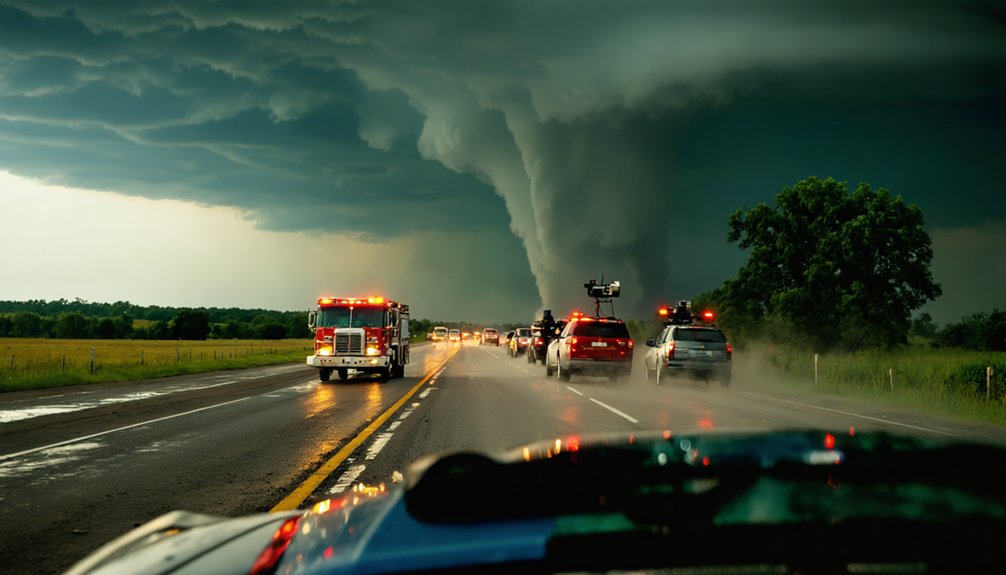
When tornadic supercells develop in Oklahoma during mid-May high-risk periods, massive traffic jams form near storm locations, creating life-threatening obstacles for residents evacuating, emergency responders accessing disaster scenes, and the chasers themselves. You’ll find photographed examples showing gridlock directly in tornado paths, with swarms blocking primary escape routes during warnings.
The convergence problem stems from multiple sources:
- Storm observation websites and spotter platforms fueling unprecedented chaser influx
- Chase tours, media crews, research projects, and individual pursuers simultaneously occupying limited road networks
- Dangerous positioning violations by armored vehicles and groups creating illegal obstructions
- Impulsive decisions by locals worsening existing traffic overload
Effective solutions require convergence management procedures and local authority coordination. You must relocate from saturated zones, cease illegal behaviors, and pursue storms in less over-chased regions to reduce responder burdens.
The Ethics Debate: Who Belongs on the Roads?
You’ll find the ethics debate centers on defining legitimate storm chasing through operational standards rather than participant credentials. Research-oriented chasers argue their data collection justifies road access, yet the TWISTEX team’s fatalities demonstrate that scientific intent doesn’t guarantee safety or mitigate traffic obstruction.
The question isn’t whether you’re a researcher or hobbyist—it’s whether your pursuit methodology adheres to traffic laws and minimizes public risk during active operations.
Legitimate vs. Reckless Chasers
Two distinct categories of storm chasers have emerged on America’s tornado-prone highways: those who operate within established safety parameters and document severe weather responsibly, and those whose reckless pursuit of dramatic footage endangers everyone in their vicinity.
Legitimate chasers maintain accountability through objective documentation:
- Recording each chase via video or audio logs establishes verifiable conduct records
- Operating within legal speed limits and respecting private property boundaries
- Contributing meteorological data rather than exploiting disasters for ratings
- Accepting moral obligations to challenge dangerous behavior regardless of perpetrator status
Unfortunately, media’s “above the law” mentality contaminates public perception. When journalists homogenize negative coverage, they implicate all chasers instead of specific offenders, creating widespread misconceptions.
Responsible chasers must actively differentiate themselves through documented professionalism, mitigating misconceptions that threaten this legal activity’s future.
Research Justification and Safety
While critics question whether storm chasers belong on public roads during severe weather events, the data reveals a more nuanced ethical framework than sensationalized media coverage suggests. You’ll find government agencies allocate millions annually for tornado warning systems—investments that depend heavily on chaser-collected field data. With 800-1,200 tornadoes causing 80 deaths and $229 million in damages yearly, research justification remains compelling.
Storm chasers’ fatality rates prove lower than whitewater rafting, contradicting public risk perceptions shaped by sensational television coverage. Institutional support mechanisms exist through Spotter Network coordination, where veteran chasers contribute critical real-time observations that stationary spotters can’t provide. The ethical calculus shifts when you consider that only 20% of supercells produce tornadoes—research requiring experienced field observers who respect nature’s destructive potential while advancing meteorological understanding.
Legitimate Research vs. Thrill-Seeking Tourism
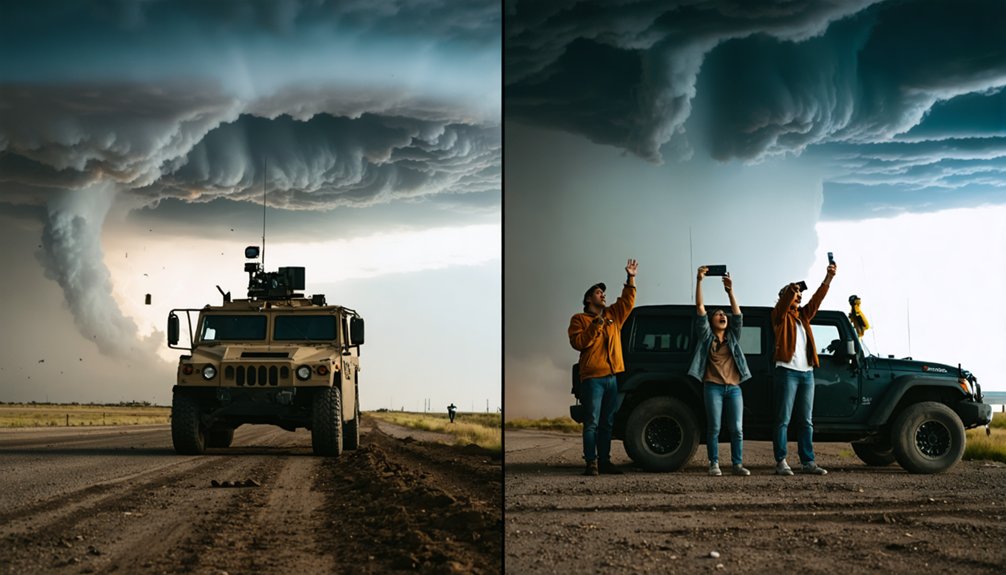
You’ll find storm chasing operates along a contested spectrum between legitimate meteorological research and recreational risk tourism. Chasers who collect systematic data fill critical gaps in tornadogenesis research, contributing insights that reduce government warning system costs by millions to billions annually.
However, the proliferation of sensation-seeking participants—drawn by adrenaline rushes and cultural quests for danger—threatens to undermine the credibility of data collection efforts and raises questions about road access priorities during severe weather events.
Scientific Data Collection Value
Since the mid-1990s, mobile Doppler weather radar intercepts have formed the foundation of legitimate storm chasing science, establishing a clear demarcation between research-driven fieldwork and thrill-seeking tourism. You’ll find storm chaser cooperation essential for accurate data analysis through:
- Thermodynamic probe deployments: 13-gram balloon-launched instruments drift 90 minutes through supercells, filling critical data voids that explain why only 10-15% of mesocyclones produce tornadoes
- Drone-based observations: RAAVEN aircraft with 7½-foot wingspans penetrate storm cores for targeted measurements 10-15 miles downwind
- Multi-institutional collaboration: TORUS and VORTEX projects unite universities, NOAA, and research centers for systematic data collection
- Surface-based rotation analysis: Probes measure storm relative helicity in the lowest kilometer, revealing tornadogenesis failure points
This rigorous approach increases forecast skill and severe storm database reliability.
Reckless Tourism Undermines Credibility
Commercial storm chasing tours have proliferated into a $2.5 million annual industry that often prioritizes client entertainment over atmospheric science protocols. You’ll find media sensationalism amplifying the spectacle while minimizing the distinction between credentialed meteorologists conducting fieldwork and recreational operators pursuing dramatic footage.
This conflation creates public safety risks when untrained participants congest evacuation routes or position vehicles in hazardous locations. The tourism sector’s emphasis on proximity to tornadic events contradicts established research methodologies that maintain safe observation distances.
Your understanding of legitimate atmospheric research becomes compromised when entertainment-driven coverage dominates public perception. Professional storm researchers increasingly advocate for certification standards and operational guidelines that separate scientific data collection from commercial thrill-seeking ventures, yet regulatory frameworks remain minimal in protecting both public welfare and meteorological credibility.
Finding Solutions Through Broadcaster-Chaser Cooperation
Three distinct pathways have emerged for resolving tensions between broadcast meteorologists and independent storm chasers while maintaining public safety standards. Warren Faidley’s advocacy demonstrates that cooperative frameworks benefit both parties without compromising your operational independence.
You’ll find these approaches establish positive community standards while preserving individual liberty:
- Credential verification systems that distinguish trained spotter responsibilities from recreational participation
- Data-sharing protocols enabling real-time ground observations to reach broadcasters and emergency managers simultaneously
- Accountability mechanisms addressing reckless behavior without restricting legitimate research activities
- Communication networks coordinating chaser movements to prevent roadway convergence
These solutions acknowledge your valuable meteorological contributions while addressing legitimate safety concerns. Professional standards emerge through voluntary participation rather than legislative restriction, ensuring scientific advancement continues alongside responsible field operations.
Frequently Asked Questions
How Do Insurance Companies Handle Claims From Storm Chasers Who Damage Rental Vehicles?
Why risk your financial freedom? Insurance companies typically deny your claims, treating storm chasing as intentional risk-taking. You’ll face full rental vehicle damage costs under chaser reimbursement policies, as agencies reject LDW coverage for deliberate severe weather pursuit.
What Specific Penalties Do Chasers Face for Reckless Driving During Severe Weather?
You’ll face standard reckless driving charges, potential license suspension, and liability for property damage during severe weather. Traffic violations aren’t waived for storm chasers, ensuring professional accountability while maintaining your freedom to chase responsibly under existing legal frameworks.
Do Storm Chasing Tours Require Special Licenses or Safety Certifications?
You won’t need professional certification requirements or special safety training—no federal mandates exist. However, operators voluntarily maintain rigorous protocols: CPR certifications, SKYWARN training, insurance-approved drivers, and all-encompassing safety orientations ensuring you’re protected through professional accountability.
How Much Revenue Do Media Networks Generate From Storm Chasing Content?
Networks don’t publicly disclose storm content advertising revenue, but you’ll find viewer engagement metrics demonstrate significant value. Individual creators like Dan Robinson lost over $1 million to platforms capturing 95% of their legitimate revenue streams.
What Legal Liability Exists When Chaser Reports Lead to Incorrect Public Warnings?
You’ll face legal obligations for negligence, duty of care breaches, and foreseeable harm if your incorrect warnings cause injury. Public safety concerns demand professional accountability—courts assess whether you exercised reasonable judgment under emergency conditions and ethical frameworks governing meteorological reporting.