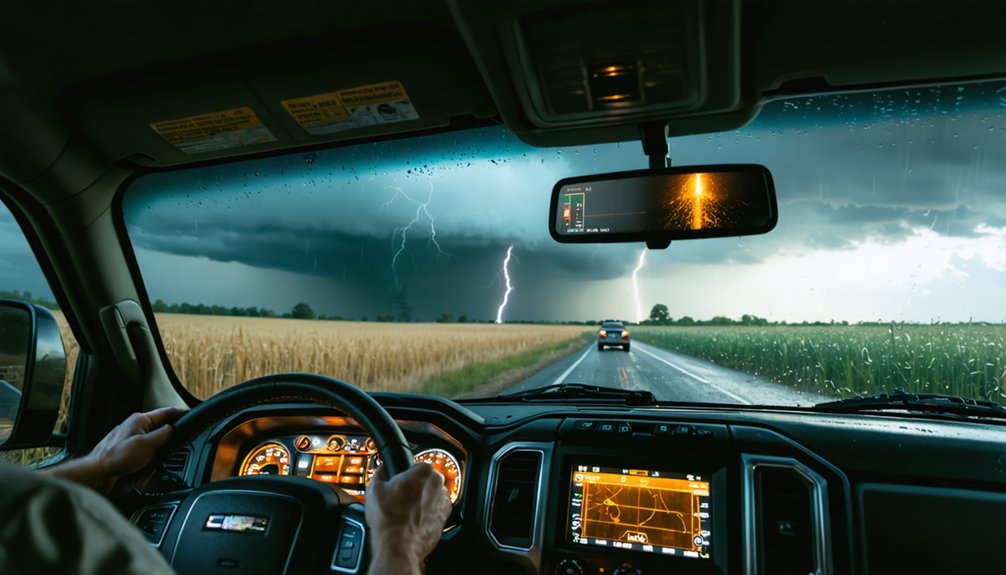
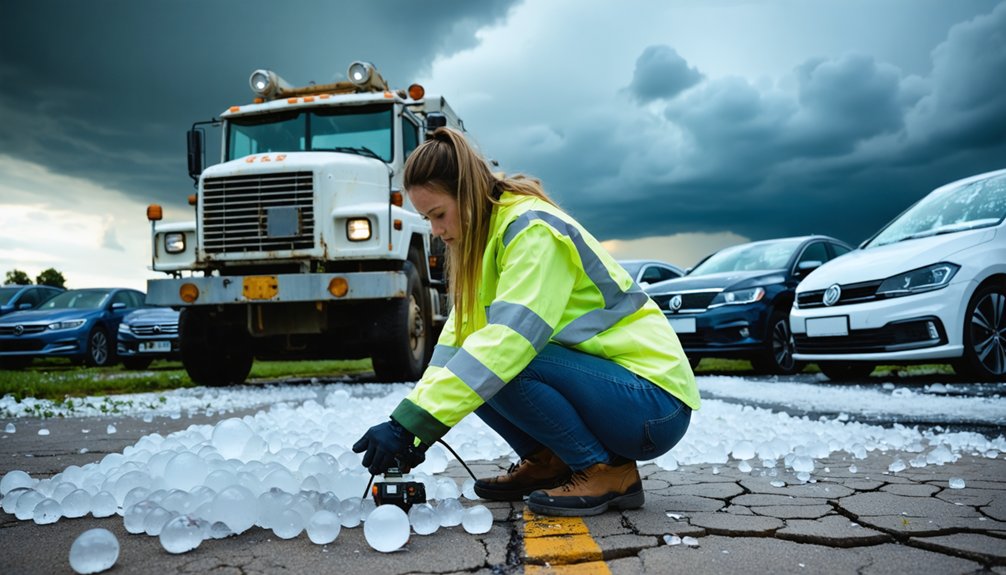
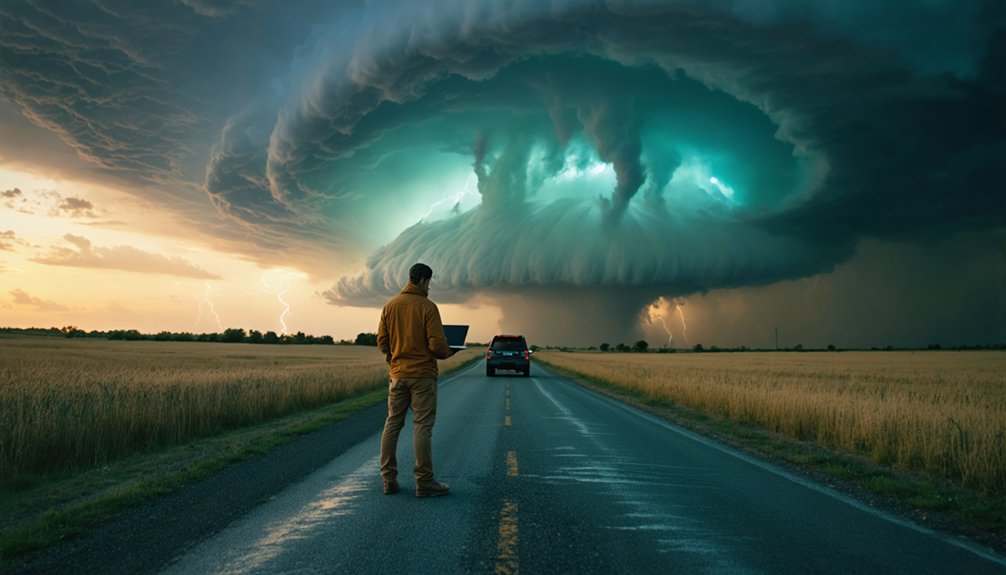
When intercepting severe thunderstorms, you’ll want to reassess radar every 2–3 minutes, position southeast of northeast-moving storms, and pre-plan escape routes using four-way intersections. Abort immediately if hail cores drift toward your vehicle, visibility collapses, or rotation tightens. You should never rely on instinct over real-time radar data. Keep your safety gear organized and accessible. The strategies that separate successful intercepts from dangerous ones go much deeper than these fundamentals.
Key Takeaways
- Reassess radar every 2–3 minutes to track storm motion, intensity changes, and rotation signatures before and during intercept.
- Position southeast of northeast-moving storms to keep the updraft base visible while maintaining safe distance from hazards.
- Use four-way intersections over dead ends, ensuring multiple debris-free escape routes are confirmed before committing to a position.
- Abort immediately if hail cores shift toward your vehicle, visibility collapses, or escape routes become compromised.
- Maintain a well-equipped, mechanically sound vehicle with safety gear stored in fixed, quickly accessible locations.
How to Read Radar Before You Commit to an Intercept
Before committing to an intercept, you’ll want to pull up radar and reassess it every 2–3 minutes—storm structure, speed, and direction can shift faster than your positioning allows.
Track reflectivity gradients, hail cores, and any tightening rotation signatures. If those indicators intensify, your risk calculus changes immediately.
Meteorological literacy isn’t optional here; it’s your primary decision-making tool. You need to distinguish between a disorganized cell and a supercell exhibiting a hook echo or bounded weak echo region. That distinction determines whether you commit or abort.
Storm chasing ethics also factor into radar interpretation. Accurate reads protect not just you, but emergency responders and civilians sharing the roads.
Misreading storm motion and committing to a bad position creates cascading hazards. Read the data precisely, then act decisively.
How Often Should You Check Radar Once You’re Moving?
Once you’re moving, you should check radar every 2–3 minutes to maintain an accurate picture of storm structure, reflectivity shifts, and core position.
Storms can accelerate, turn, or intensify faster than your situational awareness can compensate for if you rely on stale data.
Treat each radar update as a decision point — if rotation tightens or the hail core drifts toward your position, you must reassess your intercept immediately.
Recommended Radar Check Frequency
When you’re actively moving toward a developing storm, radar checks every 2–3 minutes aren’t optional—they’re operationally necessary. Storm intensity metrics—reflectivity gradients, rotation signatures, and hail core positioning—shift faster than most drivers anticipate.
Historical storm patterns confirm that supercells can accelerate, pivot, or reorganize within minutes, collapsing your margin for safe repositioning.
Each radar sweep gives you updated positional intelligence. You’re cross-referencing current storm movement against your vehicle’s location, recalculating intercept angles, and verifying escape routes remain viable.
If reflectivity spikes or the hook echo tightens, that 2–3 minute interval is the difference between a controlled repositioning and a reactive scramble. Don’t treat radar as background noise—treat it as your primary decision-making instrument, continuously informing every directional choice you make while moving.
Adapting To Storm Changes
Storms don’t wait for convenient check-in intervals—so neither should your radar discipline. Once you’re mobile, treat every 2–3 minutes as your maximum refresh threshold—not a guideline. Weather pattern shifts can compress your decision window dramatically, turning a manageable intercept into a dangerous commitment within a single radar cycle.
Storm forecasting gives you the trajectory baseline, but real-time radar confirms whether that trajectory holds. Storms accelerate, wobble, and reorganize without warning. You need to cross-reference velocity data, reflectivity gradients, and rotation signatures continuously.
If hail cores shift toward your position or rotation tightens, abort immediately—don’t wait for the next scheduled check.
Treat radar as a live conversation, not a periodic briefing. Your positioning decisions are only as accurate as your most recent data.
Where to Position Yourself Relative to a Moving Storm
Positioning yourself correctly relative to a storm’s movement is the single most controllable variable in safe interception. For a northeast-moving storm, place yourself southeast of the updraft base — this offset keeps you outside the projected path while maintaining clear sightlines.
Historical storm patterns confirm that most severe cores track northeast, so defaulting to a southeast position buys you time and options.
Use radar to refine storm size estimation continuously, checking every 2–3 minutes. A larger storm demands greater lateral offset.
Never position yourself directly in front of the core or within the hail swath. Stay ahead of the updraft base, not beneath it.
This geometry preserves your two perpendicular escape routes and keeps the storm’s most dangerous elements at a calculable, manageable distance.
How to Pick the Safest Intercept Position on the Road
Road selection turns intercept safety from theory into practice: prioritize four-way intersections over T-intersections or dead ends, since they preserve exits in all four cardinal directions. You’ll want perpendicular escape routes confirmed before committing to any position—not after the storm shifts course.
Storm chasing ethics demand that your vehicle placement never compromises public safety. Avoid parking on narrow rural roads where emergency responders or civilian traffic can’t pass.
For a northeast-tracking storm, position yourself southeast, keeping the updraft base visible while staying offset from the projected path.
Check radar every 2–3 minutes. If rotation tightens or the hail core shifts toward your vehicle, abort immediately. Your freedom to chase depends entirely on disciplined positioning decisions that protect both yourself and the surrounding community.
What Gear Every Storm Intercept Vehicle Should Carry
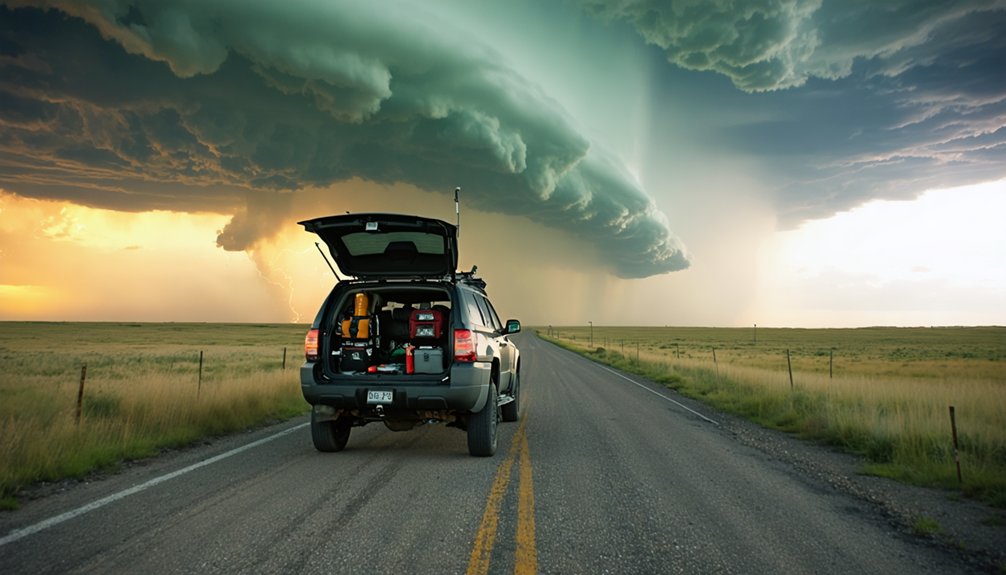
Before you commit to any intercept, your vehicle needs a verified equipment loadout—not a mental checklist reviewed after departure. Storm safety depends on redundant systems, not optimism. Carry NOAA Weather Radio, a GPS unit, and a dedicated lightning detection device as core electronics.
Supplement those with flares, a tow rope, and high-visibility gear for roadside emergencies. Hail-rated goggles protect you when you’re outside the vehicle during a core shift.
Vehicle maintenance isn’t optional—inspect tires, brakes, wipers, and fuel levels before departure, since degraded road conditions amplify every mechanical deficiency. Keep a battery-powered flashlight accessible in case a power disruption forces a roadside stop.
Every item should have a fixed storage location so retrieval under pressure stays fast and deliberate.
Why Escape Routes Matter More Than the View
When you select an intercept position, your escape routes carry more operational weight than your sightlines or camera angles.
NWS spotter guidance requires you to identify two perpendicular exit paths before committing to any location, giving you options regardless of which direction the storm shifts.
If either route becomes compromised by flooding, hail accumulation, or blocked roads, you abort the intercept immediately—no data point or visual is worth a closed exit.
Escape Routes Save Lives
Every second you spend chasing a better camera angle is a second you’re not spending on your exit strategy. Storm chasing ethics demand you prioritize survival over footage.
Weather forecasting gives you probabilistic data, not guarantees, so your positioning must account for rapid storm deviation.
The NWS ACES framework is non-negotiable: identify two perpendicular escape routes before committing to any intercept position. Four-way intersections aren’t suggestions—they’re tactical requirements that preserve your options when storm motion shifts. If either route becomes compromised, abort immediately.
Rotation tightening, hail cores drifting toward your vehicle, or visibility collapsing are hard thresholds—not negotiable data points. You’re free to chase, but only if you’re disciplined enough to retreat the moment conditions demand it.
Two Perpendicular Routes Required
Storm deviation invalidates any intercept position that lacks two perpendicular escape routes, and that’s not a stylistic preference—it’s an operational requirement.
When you’re storm chasing, a single exit road leaves you trapped the moment the storm shifts course or accelerates unexpectedly.
Safety protocols demand geometry here, not instinct. Two perpendicular routes mean that regardless of which direction the storm pivots, you retain a viable exit vector.
Four-way intersections satisfy this requirement structurally, which is why spotter guidance specifically recommends them as observation points.
Before you commit to any position, confirm both routes are open, passable, and clear of debris or traffic.
If either route becomes compromised mid-intercept, abort immediately.
The view is irrelevant if your exit is gone.
Abort When Routes Compromise
Having two perpendicular routes confirmed before you commit to a position is only half the equation—you also need a hard rule for what happens when those routes degrade mid-intercept.
When the weather pattern shifts and storm reflection intensifies on radar, your exit window shrinks fast.
Abort immediately when any of these conditions appear:
- Hail cores drift toward your vehicle, cutting off your primary route
- Visibility collapses below safe driving thresholds
- Rotation tightens, signaling rapid storm reorganization
- Road flooding blocks your secondary escape corridor
- Storm motion shifts unexpectedly, trapping you inside the projected path
No intercept position is worth a compromised exit. Your freedom to observe depends entirely on your freedom to leave.
The moment your routes are questionable, the decision’s already made—you’re done.
Storm Signals That Tell You to Abort Right Now
Knowing when to abort an intercept is as critical as knowing how to position for one. Certain storm signals demand immediate withdrawal, regardless of storm photography objectives or storm chaser ethics.
Aborting an intercept isn’t failure—it’s the same critical skill as positioning for one.
When rotation tightens visually or on radar, treat it as a hard abort trigger—not a cue to reposition closer. If hail cores shift toward your vehicle, you’ve lost your safety buffer. Visibility collapse removes your ability to navigate escape routes effectively.
Check radar every 2–3 minutes; a rapidly intensifying reflectivity signature or mesocyclone tightening means conditions have crossed your threshold. You’re not retreating from the storm—you’re exercising the disciplined judgment that keeps you operational for the next intercept.
Freedom in storm chasing comes from knowing your limits, not ignoring them.
Driving Through Rain and Hail During an Intercept
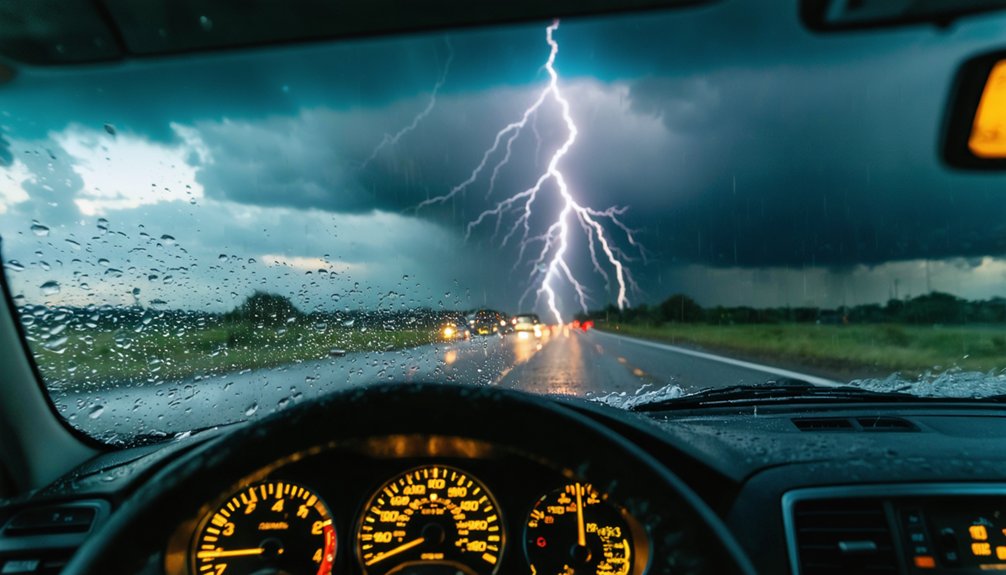
Even when you’re staying ahead of the storm’s path, driving through rain and hail remains one of the fastest ways to forfeit your escape options. Your storm chasing gear and weather safety protocols mean nothing if reduced visibility and damaged roads trap you inside the core.
Never enter these zones:
- Heavy rain corridors that collapse sight lines to near zero
- Hail cores shifting toward your vehicle, signaling repositioning is already too late
- Flooded roadways that eliminate your perpendicular escape routes instantly
- Low-visibility intersections where navigation becomes guesswork under pressure
- Core penetration zones where hail and wind combine to neutralize vehicle control
Driving into the core doesn’t make you bold—it makes you stationary. Keep routes open, speed reduced, and following distance extended. Freedom demands discipline.
When You Should Skip the Storm Intercept Entirely
Staying out of the core is one layer of discipline—but sometimes the right call is skipping the intercept altogether. If rotation tightens, hail cores shift toward your vehicle, or visibility collapses, abort immediately. Storm chaser ethics demand honest self-assessment over trophy storm photography.
Specific thresholds justify a full abort: compromised escape routes, no perpendicular exit options, or a storm accelerating beyond your road network’s capacity. Aviation guidance applies a 20-mile avoidance buffer around severe storms—a useful benchmark for ground operators reassessing commitment.
You retain full autonomy over your intercept decisions, but that freedom carries accountability. No image or data point justifies a position with zero escape margin. Recognize the threshold early, pull back, and reassess from a position where your options remain open.
Frequently Asked Questions
How Do You Legally Film Storms on Private Land During an Intercept?
You’ll need explicit written permission from landowners before filming on private land. Address privacy concerns upfront, secure legal permissions in advance, and document your authorization. Trespassing undermines your freedom and credibility as a storm intercept operator.
Can Storm Intercept Experience Qualify You for Professional Meteorology Certifications?
Your storm chase training can bolster meteorology certifications like NWS SKYWARN, but it won’t replace formal academic credentials. You’ll need documented field data, verified hours, and institutional validation to leverage intercept experience professionally.
How Do You Coordinate Intercepts Safely With Other Chasers in the Field?
You’ll coordinate intercepts by establishing clear communication protocols before deployment—assign radio frequencies, share GPS positions every 2–3 minutes, and confirm safety gear selection collectively. Continuously reassess storm rotation data together, keeping escape routes mutually agreed upon and uncompromised.
What Insurance Coverage Should Storm Chasers Carry for Vehicle Damage?
You’ll want extensive coverage plus a specialized off-road or high-risk rider to meet storm chasing insurance requirements. Confirm your policy explicitly covers hail and flood damage for full vehicle protection before each intercept operation.
How Does Nighttime Storm Interception Differ From Daytime Chasing Strategies?
Nighttime navigation demands stricter radar dependence since visual visibility drops to near zero. You’ll check radar every 2–3 minutes, maintain two perpendicular escape routes, and avoid storm cores more aggressively, as darkness eliminates critical visual threat assessment.
References
- https://www.weather.gov/bmx/sps_svrsafetyrules
- https://www.redcross.org/get-help/how-to-prepare-for-emergencies/types-of-emergencies/thunderstorm.html
- https://uwc.211ct.org/how-to-prepare-and-safely-weather-a-thunderstorm/
- https://stormtrack.org/threads/how-to-successfully-intercept-a-tornado-and-how-to-determine-tornado-vs-no-tornado.23604/
- https://crazystormchasers.com/tips-for-intercepting-severe-thunderstorms-successfully/
- https://faraim.org/faa/aim/chapter-7/section-7-1-27.html
- https://www.cfinotebook.net/notebook/weather-and-atmosphere/thunderstorms
- https://www.weather.gov/spotterguide/safetyfirst
- https://crazystormchasers.com/storm-intercept-safety-guide-for-chasers/