If your vehicle gets stuck during a storm chase, stay inside and run the engine for 10 minutes every hour to maintain heat. Crack a window to prevent carbon monoxide buildup, and check your exhaust pipe for blockages first. Activate your hazard lights, tie a bright cloth to your antenna, and call 911 with your GPS coordinates. Every decision you make in the next few minutes determines your outcome, and there’s more critical protocol to cover.
Key Takeaways
- Stay inside the vehicle for shelter from wind, debris, and precipitation, keeping your seatbelt fastened during high winds.
- Run the engine for 10 minutes every hour to maintain heat, cracking a window to prevent carbon monoxide buildup.
- Check the exhaust pipe for blockages before running the engine to avoid dangerous gas accumulation inside the cabin.
- Signal rescuers using hazard lights, emergency flares, a bright red cloth on the antenna, and interior dome lights at night.
- Call 911 immediately with your GPS coordinates, nearest mile marker, road name, and visible landmarks for faster rescue.
What to Check the Moment You’re Stranded in a Storm
When your vehicle becomes stranded during a storm chase, your first priority is a rapid systems check before conditions deteriorate further. Assess your fuel level, engine status, and exhaust pipe clearance immediately. A blocked exhaust creates lethal carbon monoxide buildup inside the cabin.
Next, inventory your emergency supplies. Confirm you have blankets, warm clothing, a charged cell phone, and a backup battery pack. Your vehicle maintenance history directly impacts your options here — properly maintained tires and a functioning engine give you tactical flexibility that a neglected vehicle won’t.
Check your visibility to other drivers and potential rescuers. Activate parking lights and assess your position relative to the roadway. Knowing exactly what you have and what’s operational lets you make precise, informed decisions fast.
When Staying in Your Vehicle Is Safer Than Getting Out
When severe weather surrounds your vehicle, staying inside provides critical shelter that greatly reduces your exposure to dangerous wind, debris, and precipitation.
Run the engine for approximately 10 minutes every hour to maintain heat, but crack a window slightly and verify your exhaust pipe remains unobstructed to prevent carbon monoxide buildup.
To signal rescuers, activate your hazard lights, turn on interior dome lights at night, and tie a bright red cloth to your antenna or door handle to maximize your visibility.
Shelter From Severe Weather
During severe weather, staying in your vehicle is often the safest decision you can make. Your vehicle acts as a functional storm shelter, providing structural protection against wind, debris, and precipitation.
Weather preparedness means recognizing when exiting poses greater risk than remaining inside. Keep your seatbelt fastened and position yourself below window level if high winds or flying debris become a threat. Avoid parking under trees, overpasses, or power lines that could collapse onto your vehicle.
If a tornado approaches, don’t attempt to outrun it on foot — your vehicle offers considerably more protection than open ground.
Stay alert to changing conditions by monitoring your weather radio or mobile device. Your vehicle’s reinforced frame gives you a measurable survival advantage when severe weather strikes unexpectedly.
Carbon Monoxide Safety Measures
Staying in your vehicle keeps you safer during severe weather, but it introduces a silent threat you can’t afford to ignore: carbon monoxide poisoning. Running your engine for heat generates this odorless, colorless gas, which accumulates rapidly in enclosed spaces.
Prioritize vehicle ventilation by cracking a window slightly. This simple action creates airflow that disperses dangerous gas concentrations without greatly compromising interior warmth.
Before running your engine, physically inspect your exhaust pipe. Snow, mud, or storm debris blocking it forces carbon monoxide back into your cabin.
Run your engine approximately ten minutes per hour rather than continuously. This disciplined approach balances heat retention against toxic gas buildup.
Recognize symptoms—dizziness, headache, confusion—as immediate warnings. If you experience them, exit your vehicle immediately and call 911.
Signaling For Emergency Rescue
Once you’ve made the decision to remain in your vehicle, making yourself visible to rescuers and passing motorists becomes your primary tactical objective.
Deploy every available rescue signal systematically. Activate your hazard lights immediately, then switch on interior dome lights after dark to increase your vehicle’s visual profile.
Emergency flares positioned strategically around your vehicle create a visible perimeter that alerts approaching traffic and rescue personnel.
Tie a bright red cloth to your antenna or door handle as a passive daylight signal. Raise your hood once conditions permit — it’s a universally recognized distress indicator.
Keep your cell phone charged and call 911, providing precise location details. These layered signaling methods maximize your detection probability without requiring you to leave the vehicle’s protective environment.
When your signal’s weak, try calling 911 multiple times from different positions, as even a single bar can complete an emergency call on any available carrier’s network.
Once connected, immediately relay your GPS coordinates, nearest mile marker, road name, and visible landmarks, since dispatchers need precise data to route responders efficiently.
Conserve your phone’s battery by enabling low-power mode, disabling Wi-Fi and Bluetooth, and keeping the screen dark between critical communications.
Reaching 911 With Weak Signal
Calling 911 with a weak signal requires a deliberate approach, but your phone can still connect even when signal bars are low. Move to higher ground or open areas to improve reception. Keep your message brief and location-specific.
- State your GPS coordinates immediately — don’t wait for a dispatcher to ask; every second of connection matters.
- Text 911 if available in your area — texts transmit more reliably than voice calls on degraded networks.
- Deploy signal flares and emergency whistles simultaneously — visual and audible signals work when technology fails you.
If your call drops, stay put and redial repeatedly. Emergency networks prioritize 911 calls, cycling through available towers.
Your persistence combined with physical signal tools dramatically increases your rescue probability.
Sharing Your Exact Location
Sharing your exact location with a 911 dispatcher can mean the difference between a timely rescue and hours of uncertainty.
Don’t rely solely on verbal descriptions. Instead, use multiple location accuracy strategies simultaneously. Pull your GPS coordinates directly from your phone’s mapping app and read them aloud clearly. Reference visible landmarks, mile markers, or road intersections to reinforce your position.
If signal drops mid-call, text your coordinates to 911 where available, since texts often transmit successfully when voice calls fail. Screenshot your GPS position before signal deteriorates entirely.
Your sharing strategies should also include tying a bright red cloth to your antenna, raising your hood, and activating hazard lights, giving rescuers visual confirmation of your precise position independent of electronic communication.
Conserving Battery During Emergencies
A dying phone battery during a weather emergency compounds an already dangerous situation, so managing power consumption strategically becomes as critical as the emergency call itself. Your emergency supplies should always include a portable battery pack, giving you autonomy when infrastructure fails.
Implement these battery management priorities immediately:
- Kill non-essential apps and lower screen brightness — every percentage point preserved could sustain your 911 connection longer.
- Enable airplane mode between location transmissions — you’ll extend battery life considerably while still sending periodic GPS coordinates.
- Text rather than call when signal’s weak — texts transmit successfully on weaker signals, conserving power while maintaining your lifeline to rescuers.
Your preparation before the chase determines your survival options during it. Don’t surrender that control.
How Storm Chasers Signal Rescuers From a Stranded Vehicle
When your vehicle is stranded during a storm chase, making yourself visible to rescuers and other motorists is a critical priority.
Deploy multiple signaling techniques simultaneously to maximize detection probability. Activate your hazard lights immediately, supplementing them with parking lights for enhanced roadside visibility.
At night, turn on your dome or interior lights to increase your visual signature. Tie a bright red cloth to your antenna or door handle as a passive daytime visibility tactic.
After snow stops, raise your hood to signal distress to passing responders. These visibility tactics work collectively, ensuring rescuers identify your position faster.
Call 911, providing your precise location and situation details. Don’t abandon these signals prematurely — maintaining consistent visibility dramatically increases your chances of a swift, successful rescue.
How Storm Chasers Manage Heat When Stranded for Hours
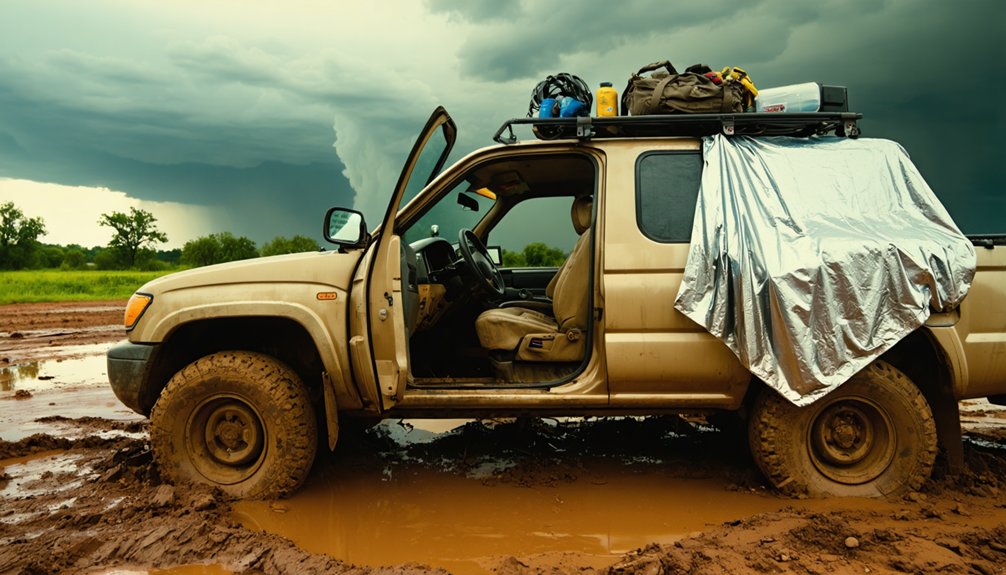
Stranded for hours in a storm-chased vehicle, you’ll face a critical heat management challenge that demands disciplined resource control.
Systematic engine cycling preserves fuel while maintaining vehicle comfort in brutal conditions.
Execute this survival protocol:
- Run your engine exactly 10 minutes per hour — strategic cycling prevents fuel exhaustion while generating sufficient cabin heat, protecting your autonomy when rescue timelines remain uncertain.
- Crack your window slightly — carbon monoxide silently eliminates your freedom permanently; fresh air circulation isn’t optional, it’s non-negotiable.
- Verify your exhaust pipe stays unobstructed — blocked pipes redirect lethal gases inward, transforming your shelter into a death trap within minutes.
Between cycles, exercise your arms, legs, fingers, and toes aggressively.
Blood circulation generates natural warmth, extending your operational endurance until rescue arrives.
How to Stop Carbon Monoxide Poisoning While Your Engine Runs
While running your engine for warmth, you must crack your window slightly to allow fresh air circulation and prevent toxic carbon monoxide buildup inside the cabin.
Before starting the engine, check that your exhaust pipe isn’t blocked by snow, mud, or debris, as a blocked pipe forces deadly CO gas back into the vehicle.
You’ll want to inspect the exhaust periodically throughout your wait, particularly after heavy snowfall accumulates around the rear of the vehicle.
Cracking Windows For Ventilation
Keeping your engine running for heat introduces a serious risk: carbon monoxide (CO) buildup inside the vehicle. CO is odorless and colorless, making it lethal before you detect it. Proper ventilation techniques and window safety measures are non-negotiable:
- Crack a window slightly — even one inch creates sufficient airflow to prevent dangerous CO concentration from overwhelming the cabin.
- Check your exhaust pipe regularly — snow or debris blocking it forces CO directly into your vehicle, turning your only heat source into a silent killer.
- Monitor yourself and passengers for symptoms — dizziness, headache, or confusion means CO is already affecting you; exit immediately.
Don’t underestimate this threat. One small window gap preserves your freedom to keep chasing storms another day.
Checking Exhaust Pipe Blockages
Even a small exhaust blockage redirects carbon monoxide directly into your cabin, so checking the pipe isn’t optional — it’s a survival step.
Before running your engine, exit and inspect the tailpipe for mud, snow, ice, or debris. Any obstruction forces toxic exhaust backward through your vehicle’s seals.
Exhaust inspection requires only seconds but eliminates a life-threatening risk. Press your hand near — not against — the pipe opening to feel airflow after starting the engine. Restricted airflow signals a blockage you haven’t fully cleared.
Blockage prevention means rechecking periodically, especially after drifting snow accumulates. Storm environments shift rapidly, and a clear pipe at startup can become obstructed within minutes.
Your freedom to survive this situation depends entirely on maintaining that unobstructed path.
What to Do If Your Tires Hydroplane on Wet Roads?
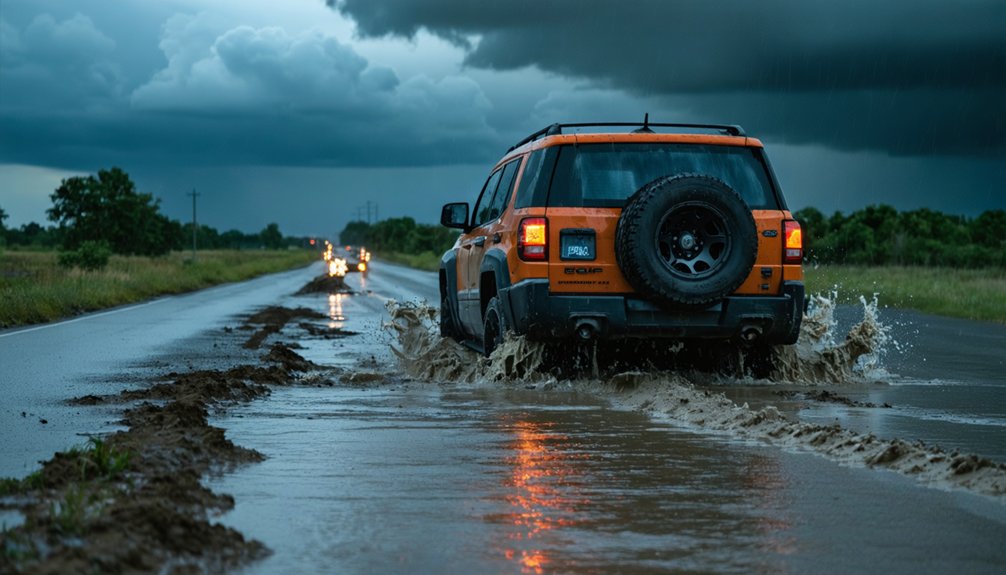
Hydroplaning occurs when your tires lose contact with the road surface and ride on a thin film of water, reducing your ability to steer or brake effectively.
Proper tire maintenance and hydroplaning techniques keep you in control when conditions deteriorate fast.
Follow these critical steps immediately:
- Release the accelerator gradually — don’t slam the brakes; sudden braking spins you out completely.
- Steer straight or gently into your intended path — overcorrecting sends your vehicle into an uncontrollable skid.
- Wait for traction to return — you’ll feel the steering respond again before making any directional adjustments.
Worn tires dramatically increase hydroplaning risk. Replace them before chasing.
Your freedom on the road depends entirely on your preparation beforehand.
Never Drive Into Flooded Roads During a Storm Chase
Flooded roads present one of the most immediate threats to a storm chaser’s survival, yet drivers consistently underestimate the danger. Just 12 inches of moving water can carry most vehicles off-course, stripping you of control instantly.
Just 12 inches of moving water can sweep most vehicles off-course—yet drivers consistently underestimate the threat flooding poses.
Storm safety protocols are unambiguous: turn around, don’t drown.
You can’t accurately gauge road depth or current strength from your windshield. What appears shallow often conceals eroded pavement, debris, or dangerous drop-offs beneath the surface.
Flooded roads also compromise your brakes and electrical systems, leaving you vulnerable mid-crossing.
Your freedom to chase depends on making calculated decisions. Attempting a flooded crossing isn’t bold—it’s a tactical error that ends your chase permanently.
Identify alternate routes before entering storm zones, and treat every flooded road as impassable.
How to Use Your Emergency Kit When You’re Already Stuck
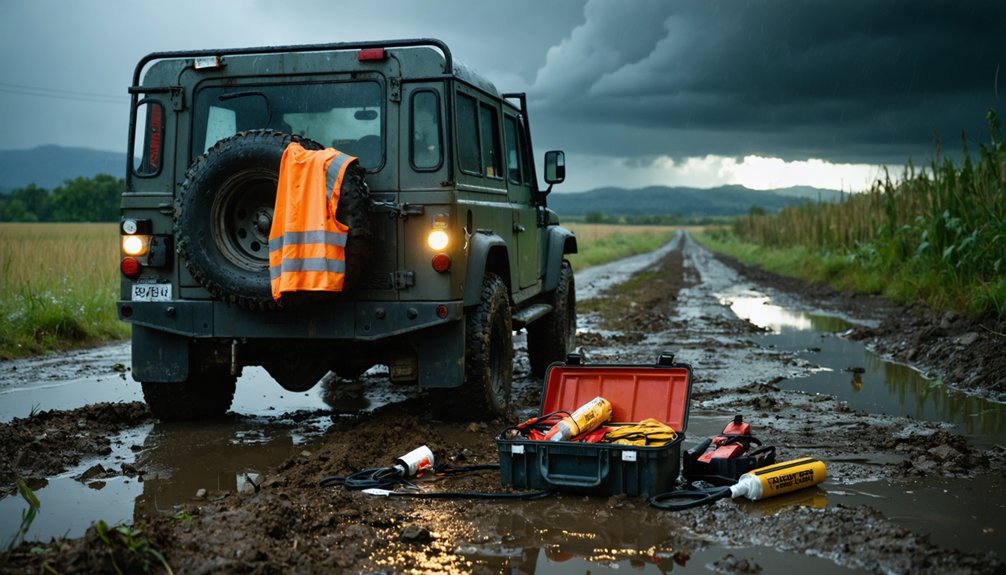
When avoiding flooded roads keeps you moving, getting physically stuck demands a completely different response—one that shifts your focus from navigation to survival. Your emergency supplies become your lifeline, and deploying them correctly determines your outcome.
- Generate heat immediately — Run your engine ten minutes every hour, crack a window slightly, and verify your exhaust pipe stays unblocked to prevent carbon monoxide poisoning.
- Signal your position aggressively — Tie red cloth to your antenna, activate hazard lights, and turn on interior dome lights after dark.
- Call 911 without hesitation — Provide your exact location and conditions; your freedom depends on rescuers finding you fast.
Consistent vehicle maintenance beforehand—functional heaters, charged battery packs, stocked blankets—transforms a dangerous situation into a manageable one.
When Storm Chasers Should Leave Their Vehicle or Stay Put
Deciding whether to stay or leave your vehicle is one of the most critical choices you’ll face when stuck during a storm chase. In most scenarios, your vehicle offers the best vehicle safety—it’s shelter, visibility, and your communication hub.
Stay put unless a safe destination is clearly within walking distance. Abandoning your vehicle in poor visibility or extreme weather dramatically increases your risk exposure.
Storm preparation dictates that you assess your surroundings before stepping outside. If floodwaters are rising around your vehicle, exit immediately and move to higher ground—water is the exception to the stay-put rule.
Otherwise, run the engine periodically for heat, signal rescuers using lights or a colored cloth, and call 911 with your precise location. Your vehicle remains your strongest asset.
Frequently Asked Questions
How Do Worn Tires Increase Hydroplaning Risk Before a Storm Chase?
Worn tires lack sufficient tire tread depth, reducing your vehicle’s ability to channel water away effectively. On wet roads, you’ll lose grip faster, dramatically increasing hydroplaning risk. Replace them before chasing to maintain full vehicular control.
What Emergency Supplies Should Storm Chasers Pack Before Leaving Home?
Pack an emergency kit including warm blankets, gloves, hats, and a charged cell phone with a backup battery. You’ll also need a solid communication plan ensuring you’re always reachable, maintaining your operational independence during unpredictable storm conditions.
How Far off the Roadway Should Storm Chasers Park Their Vehicle?
When push comes to shove, you’ll want to master safe parking techniques: pull completely off the right-of-way, maintaining safety distances far enough that your door’s swing won’t reach oncoming traffic.
Should Storm Chasers Always Chase Alone or With an Experienced Mentor?
If you’re new, you shouldn’t chase solo — mentor benefits far outweigh solo chaser pros. An experienced mentor helps you navigate dangerous decisions, refine technical skills, and avoid critical mistakes that could compromise your safety and freedom.
How Do Parking Lights Improve Visibility During Dangerous Storm Conditions?
When you’re pulled off-road, parking light benefits include signaling your position to other motorists in low-visibility conditions. These storm visibility tactics let you conserve battery while ensuring rescuers and passing drivers can detect your vehicle’s exact location.
References
- https://www.flame.org/~cdoswell/chasesums/Chase_safety.html
- https://www.foxweather.com/weather-news/how-survive-your-car-stuck-during-winter-storm
- https://www.nhtsa.gov/road-safety/driving-in-severe-weather
- https://www.youtube.com/watch?v=pWQPxT-7CoQ
- https://will.illinois.edu/weatherrealness/episode/storm-chasing-can-be-deadly-heres-how-to-stay-safe
- https://www.aceable.com/blog/how-stay-safe-if-youre-stuck-your-car-winter/
- https://www.stormchase.us/Articles/VehiclePrep.html