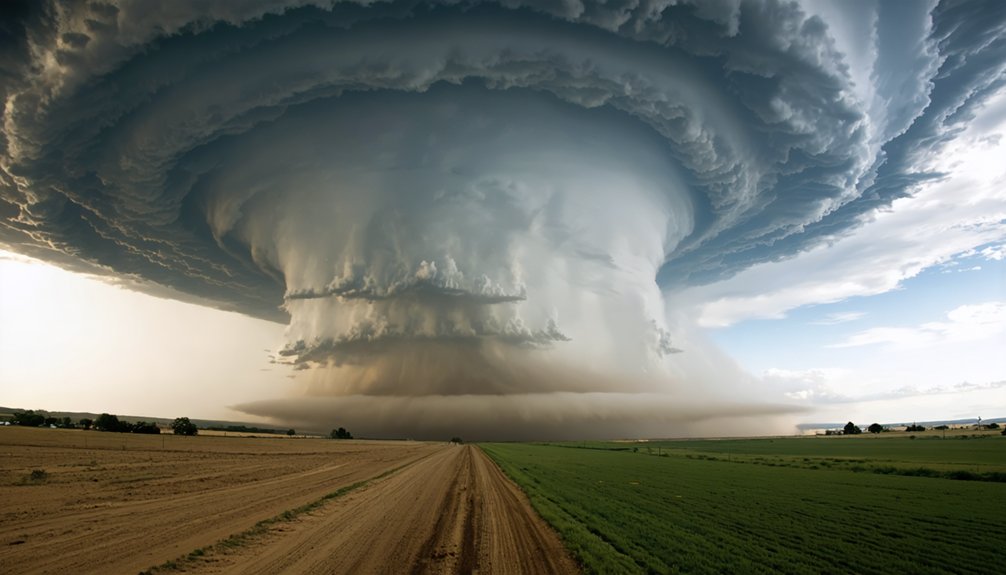
Climate change is transforming storm chasing because you’re no longer working with predictable patterns. Tornado corridors have shifted over 500 miles eastward, pulling activity into Tennessee, Alabama, and Mississippi. Storm seasons now extend beyond traditional windows, and by 2050, tornado frequency could climb 20% above current baselines. A warmer atmosphere holds 7% more moisture per °C, intensifying every system you track. The full operational and technological implications run much deeper than these numbers suggest.
Key Takeaways
- Rising temperatures extend storm seasons beyond traditional windows, forcing chasers to operate year-round rather than within predictable seasonal timeframes.
- Tornado activity is shifting 500 miles eastward, pushing chasers into unfamiliar terrain with limited road networks and dense forests.
- Storms are intensifying due to increased atmospheric moisture, making conventional risk calculations and safety protocols unreliable for chasers.
- AI-driven radar systems and dual-polarization technology are now essential tools for tracking increasingly unpredictable storm trajectories in real-time.
- By 2050, a projected 20% increase in tornado frequency makes storm chasing a critical operational necessity with significantly heightened risks.
How Climate Change Is Rewriting the Rules of Storm Season?
As global temperatures rise, climate change is fundamentally rewriting storm season’s traditional boundaries. You’re now witnessing storm seasons stretching well beyond historical norms, with tornado outbreaks clustering into larger, more destructive events.
Warmer atmospheric temperatures hold more moisture, fueling intensified severe thunderstorms that challenge urban resilience infrastructure previously untested by such extremes.
Warmer air holds more moisture, unleashing storms that push urban infrastructure far beyond its tested limits.
You can’t rely on traditional seasonal windows anymore. Projections indicate a 20% increase in tornado frequency by 2050, compressing your decision-making timelines and demanding faster, more precise responses.
Rising global heat adds approximately 0.07 watts per square meter, amplifying every extreme weather event you’ll encounter.
Ecosystem impacts accelerate alongside these shifts, disrupting established environmental patterns and creating unprecedented volatility.
Nighttime storms are increasing, forcing you to adapt your tracking strategies continuously.
How a Warmer Atmosphere Is Making Every Storm Bigger and More Dangerous?
When you examine the mechanics behind intensifying storms, you’ll find that a warmer atmosphere holds considerably more moisture, which acts as direct fuel for severe thunderstorm development.
Climate change adds approximately 0.07 watts per square meter to land and water surfaces, amplifying the energy available to every extreme weather event you track.
You’re now dealing with storms that draw on higher moisture loads and greater atmospheric heat simultaneously, pushing intensity levels beyond what historical data once predicted.
Moisture Fuels Storm Intensity
Warmer air holds more moisture, and that single physical reality is reshaping the severity of every storm you track. For every degree Celsius of atmospheric warming, air retains roughly 7% more water vapor. That moisture accumulation directly amplifies precipitation patterns, accelerating the energy transfer that drives convective storm systems beyond historical benchmarks.
When you’re positioning for intercept, you’re no longer calculating against baseline storm metrics. You’re operating inside systems carrying considerably higher latent heat energy. That surplus moisture doesn’t just increase rainfall totals — it intensifies updraft velocity, expands hail production zones, and extends the destructive lifespan of supercells.
Climate science confirms warmer atmospheric temperatures act as direct fuel for severe thunderstorm intensification. Every storm you chase today carries more thermodynamic potential than storms tracked a generation ago.
Heat Amplifies Extreme Weather
Moisture loading explains part of why today’s storms hit harder — but it’s only one variable inside a much larger thermodynamic equation. Rising global heat adds approximately 0.07 watts per square meter across land and water surfaces, and that energy doesn’t dissipate — it amplifies.
Thermal expansion of the lower atmosphere increases pressure gradients, forcing storm systems to intensify faster and sustain longer. Heat waves compound this effect by pre-conditioning the atmosphere with excess energy reserves before storms even develop.
You’re no longer tracking isolated severe weather events — you’re tracking systems supercharged by accumulated thermal debt. Every degree of warming tightens the thermodynamic engine driving extreme precipitation, wind shear, and rotational velocity.
Ignoring this variable means you’re fundamentally misreading the storms you’re chasing.
Why Tornadoes Are Spreading Far Beyond Traditional Tornado Alley?
If you’ve been tracking severe weather trends, you’ll notice that tornado activity is no longer concentrated in the traditional Tornado Alley corridor spanning Texas, Oklahoma, and Kansas.
NOAA data confirms a measurable eastward migration, with Tennessee, Alabama, and Mississippi now recording markedly higher tornado frequencies as shifting atmospheric conditions redefine historical impact zones.
You’re fundamentally watching climate change redraw the map of tornado risk in real time, pushing extreme weather into regions that lack both the infrastructure and the preparedness frameworks historically developed across the Great Plains.
Tornado Alley’s Geographic Shift
Traditional “Tornado Alley”—spanning Texas, Oklahoma, Kansas, and Nebraska—is losing its monopoly on severe tornado activity, and climate change is the driving force. Shifting atmospheric conditions are pushing tornadoes into Tennessee, Alabama, and Mississippi, disrupting urban expansion plans and threatening agricultural impacts across unprepared regions.
- NOAA confirms tornado frequency is increasing in historically unaffected southeastern states.
- Shoulder seasons now replace traditional spring peak months for major outbreak clusters.
- Warmer moisture-laden air masses penetrate deeper into previously stable geographic zones.
- Communities lacking historical tornado infrastructure face amplified destruction risks.
- Trajectory unpredictability forces storm chasers to abandon traditional route strategies entirely.
You’re now tracking storms in regions where warning systems, emergency protocols, and public preparedness remain critically underdeveloped—making data collection and personal safety exponentially more complex.
Climate-Driven Regional Expansion
As climate change reshapes atmospheric dynamics, tornadoes are spreading well beyond their historical boundaries—driven by measurable shifts in temperature gradients, moisture transport, and jet stream behavior.
Warmer Gulf moisture now penetrates deeper into previously unaffected regions, including Tennessee, Alabama, and Mississippi, fundamentally altering where you’d expect severe weather to strike.
This regional expansion demands you rethink ecosystem impact—communities, forests, and watersheds that never historically absorbed tornado forces now face unprecedented structural stress.
Infrastructure wasn’t engineered for these events, and ecosystems lack the adaptive capacity traditional tornado zones developed over decades.
Regional resilience becomes your critical framework here.
Data confirms tornado outbreaks increasingly clustering in shoulder seasons outside historical windows, compressing preparation timelines.
You’re witnessing a permanent geographic redistribution, not an anomaly—and adaptation strategies must reflect that reality precisely.
How Shifting Tornado Corridors Are Forcing Chasers to Rebuild Their Route Maps?
For decades, storm chasers built their route maps around a reliable geographic anchor: the Great Plains corridor stretching from Texas to South Dakota. Today, route recalibration isn’t optional—it’s survival. Shifting tornado corridors into Tennessee, Alabama, and Mississippi create navigational challenges that demand completely rebuilt operational frameworks.
You’re now chasing in terrain that’s historically unfamiliar, with different road networks, population densities, and escape routes.
The terrain is unfamiliar. The roads are unknown. The escape routes don’t exist on your old maps.
- Tornado activity migrating 500+ miles eastward from traditional corridors
- Shoulder-season outbreaks replacing predictable spring peak windows
- Dense southeastern forest terrain limiting visual storm tracking
- Unfamiliar regional road infrastructure complicating rapid repositioning
- NOAA-confirmed tornado appearances in previously unaffected geographic zones
Your old maps are obsolete. Precision adaptation determines whether you collect critical data—or get caught unprepared.
How Climate Change Rewrote the Storm Chaser Safety Playbook?
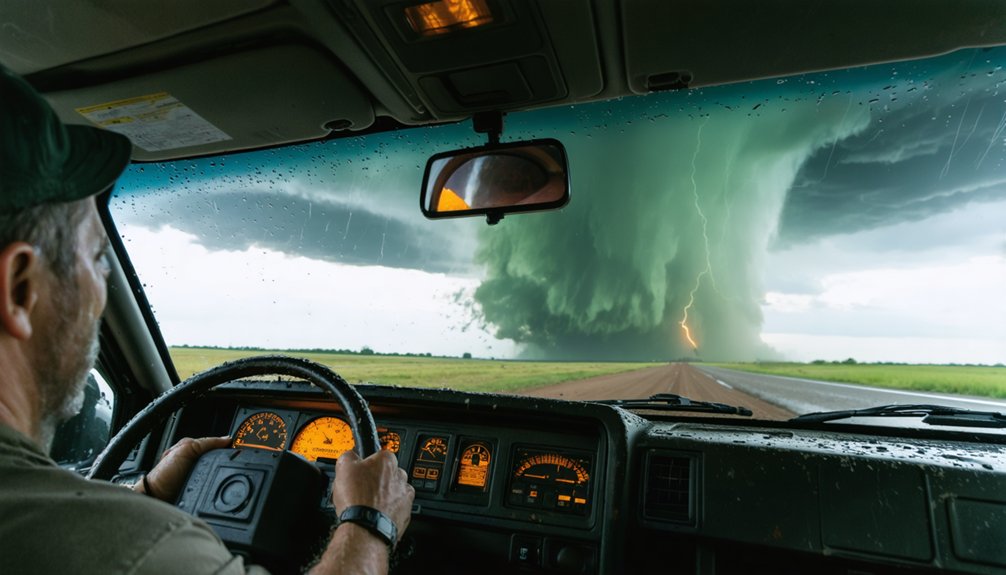
Climate change didn’t just shift where tornadoes strike—it dismantled the foundational assumptions storm chasers built their safety protocols around. You’re no longer operating within predictable seasonal windows or established geographic corridors.
Nighttime storm surges, shoulder-season outbreaks, and tornadoes penetrating previously untouched regions have shattered conventional risk calculations.
Climate adaptation isn’t optional—it’s operationally critical. Your safety protocols must now account for compressed decision timelines, degraded visibility conditions, and equipment strain from intensifying storm systems.
Mental health assessments have entered standard pre-deployment checklists, recognizing that sustained exposure to escalating danger degrades judgment.
Real-time communication infrastructure and redundant emergency response systems aren’t enhancements anymore—they’re baseline requirements.
The chasers who survive and succeed are those who’ve rebuilt their entire operational framework around volatility, not stability.
The Technology Storm Chasers Now Can’t Operate Without
Rebuilding your operational framework around volatility demands more than revised protocols—it demands hardware and software capable of matching storm systems that no longer follow historical scripts. Meteorological innovations and data integration aren’t optional upgrades—they’re survival infrastructure.
- High-resolution radar systems deliver real-time positioning data, cutting response lag during rapid storm intensification
- AI-driven machine learning algorithms process historical patterns, generating trajectory predictions traditional models can’t match
- Advanced satellite networks maintain communication continuity when ground-based infrastructure fails during extreme events
- Collaborative data platforms aggregate multi-source inputs, giving your team unified situational awareness across shifting geographic zones
- Ruggedized mobile equipment withstands harsher atmospheric conditions that standard hardware wasn’t engineered to survive
You’re operating in an environment where tornadoes appear outside historical boundaries and seasons. Your technology stack must reflect that reality precisely.
How Storm Chasers Are Using AI and Radar to Predict the Unpredictable?
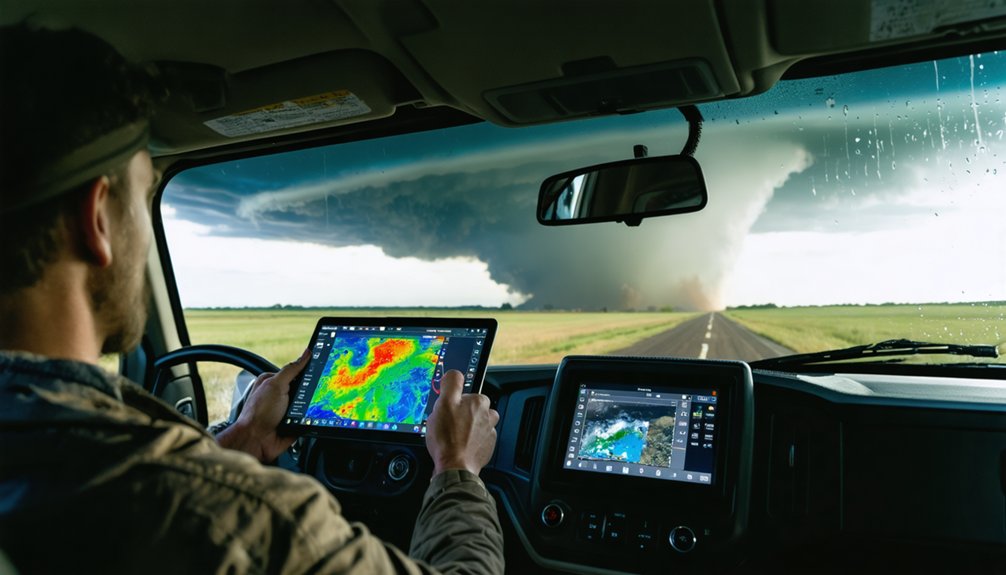
When storm systems abandon historical patterns, static prediction models collapse under the weight of their own assumptions. You’re now operating in an environment where AI-driven data analytics process terabytes of atmospheric variables in real time, identifying rotation signatures hours before traditional radar detects rotation.
When storms rewrite the rules, AI rewrites the forecast — in real time, before the sky gives warning.
Machine learning algorithms cross-reference historical tornado data against current atmospheric conditions, generating predictive modeling outputs that update every few minutes.
High-resolution dual-polarization radar distinguishes precipitation types, debris fields, and wind shear layers with unprecedented precision.
You’re no longer guessing trajectory — you’re calculating probability corridors.
AI platforms integrate satellite feeds, surface observations, and upper-atmosphere soundings simultaneously, compressing decision windows from hours to minutes.
That computational advantage isn’t luxury — it’s survival infrastructure in an era where tornadoes strike harder, faster, and further from expected zones.
Why Storm Chasing Becomes More Essential: and More Dangerous: by 2050?
By 2050, storm chasing won’t be an optional scientific pursuit — it’ll be a critical operational necessity driven by hard atmospheric physics. Tornado frequency is projected to rise 20%, seasons will stretch unpredictably, and traditional safe zones won’t exist. Urban resilience and environmental policy depend on the real-time data chasers collect.
Here’s what you’re facing by 2050:
- Tornado activity migrates into previously unaffected regions, nullifying historical safety assumptions
- Shoulder-season outbreaks demand year-round operational readiness
- Nighttime storm clustering reduces visual tracking windows considerably
- Equipment failures increase under harsher, more frequent severe weather conditions
- Mental health strain intensifies as unpredictability compounds physical risk
You’re not chasing storms for adventure — you’re building the data infrastructure that keeps communities free from preventable catastrophe.
Frequently Asked Questions
How Does Climate Change Specifically Alter the Physics of Storm Formation?
Climate change supercharges atmospheric dynamics by loading warmer air with excess moisture, fundamentally altering thunderstorm mechanics. You’re seeing intensified updrafts, stronger wind shear, and increased rotational energy driving more frequent, severe tornado formations globally.
What Role Do Carbon Emissions Play in Disrupting Long-Term Weather Patterns?
Your carbon footprint’s drowning entire weather systems—carbon emissions trap heat endlessly, warping jet streams and storm seasonality. Emission reduction directly limits atmospheric moisture overload, preventing the long-term pattern disruptions that’ve made storm prediction increasingly unreliable.
How Are Mental Health Challenges Affecting Storm Chasers in Modern Operations?
You’re facing growing emotional stress as unpredictable storm patterns demand constant adaptation. Mental resilience isn’t optional—it’s operationally critical. Teams now integrate mandatory psychological assessments, ensuring you maintain peak cognitive performance while steering increasingly volatile, high-risk severe weather environments.
What Bandwidth Limitations Hinder Real-Time Data Transmission During Extreme Storms?
You’ll face satellite interference and signal degradation during extreme storms, as dense precipitation and atmospheric turbulence disrupt bandwidth capacity, corrupting real-time data streams precisely when you need reliable transmission most for accurate, life-saving storm analysis.
How Do Collaborative Data Platforms Improve Storm Chasing Equipment Transmission Barriers?
You’ll overcome equipment transmission barriers when you leverage collaborative data platforms that prioritize data sharing and equipment compatibility, enabling seamless integration across diverse systems, ensuring real-time storm data flows efficiently, and eliminating the bottlenecks that compromise your operational effectiveness.
References
- https://climatecosmos.com/climate-news/i-chased-tornadoes-for-a-decade-heres-what-i-learned-about-natures-fury/
- https://atmos.earth/science-and-nature/warming-skies-have-triggered-a-new-era-of-unpredictable-storms/
- https://www.pbs.org/newshour/science/inside-the-dangerous-and-unpredictable-science-of-storm-chasing
- https://www.edf.org/climate/how-climate-change-makes-hurricanes-more-destructive
- https://crazystormchasers.com/climate-change-and-the-future-challenges-for-storm-chasers/
- https://www.youtube.com/watch?v=uFGdZeKtYnI
- https://www.diva-portal.org/smash/get/diva2:1716701/FULLTEXT01.pdf
- http://www.firstscience.com/SITE/ARTICLES/carter.asp
- https://earthzine.org/storm-chasing-chaos-and-climate/
- https://jasonherbert.substack.com/p/twisters-and-the-history-of-modern