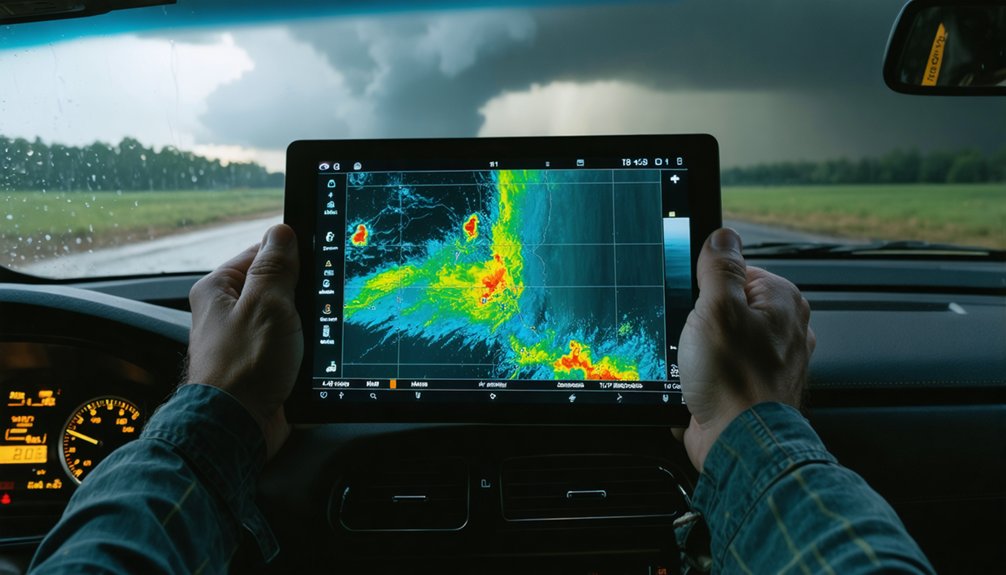
The 5 best AI tools for advanced storm prediction are GraphCast, Pangu-Weather, FourCastNet, Aurora, and AIFS. GraphCast delivers 10-day forecasts in under 60 seconds, while FourCastNet runs ~45,000× faster than conventional models. Pangu-Weather cuts typhoon track errors by 12–15%, Aurora leads in 5-day tropical cyclone RMSE accuracy, and AIFS produces 15-day forecasts in just 2.5 minutes. Each tool offers distinct performance advantages worth exploring further.
Key Takeaways
- GraphCast delivers 10-day forecasts in under 60 seconds and accurately predicted Hurricane Lee’s landfall, outperforming ECMWF models.
- Pangu-Weather reduces typhoon track errors by 12–15% and operates 10,000× faster than traditional forecasting methods.
- FourCastNet runs approximately 45,000× faster than conventional NWP models, excelling at tropical and extra-tropical cyclone forecasting.
- Aurora leads in 5-day tropical cyclone RMSE accuracy and provides neighborhood-level precision, ideal for emergency response teams.
- AIFS generates operational 15-day forecasts in just 2.5 minutes, making it ideal for large-scale atmospheric pattern prediction.
The 5 Best AI Tools for Advanced Storm Prediction
Whether you’re an emergency responder, utility manager, or infrastructure planner, choosing the right AI storm prediction tool can directly impact how well you protect lives and assets.
Each tool below delivers measurable performance gains backed by historical case studies and rigorous benchmarking against traditional physics-based models.
- GraphCast – 10-day forecasts in under 60 seconds
- Pangu-Weather – 12–15% reduction in typhoon track errors
- FourCastNet – ~45,000× faster than conventional NWP methods
- Aurora – Leading 5-day RMSE for tropical cyclone accuracy
- AIFS – Operational 15-day forecasts in 2.5 minutes
As you evaluate these tools, ethical considerations matter—particularly around data transparency, equitable access, and accountability when AI-driven forecasts inform evacuation orders or critical infrastructure decisions.
How Each Tool Handles Hurricanes, Typhoons, and Extreme Weather
Knowing which tools perform best overall is one thing—understanding how they handle specific high-stakes weather events is another.
GraphCast accurately predicted Hurricane Lee’s landfall, outperforming ECMWF’s traditional models. Pangu-Weather reduced typhoon track errors by 12–15%, with up to 20% performance gains over physics-based cyclone models—critical for disaster resilience in vulnerable coastal regions.
Pangu-Weather slashed typhoon track errors by up to 20%—delivering life-saving precision where coastal communities need it most.
FourCastNet excels at forecasting tropical and extra-tropical cyclones, surpassing traditional models in precipitation detail. Aurora leads in 5-day tropical cyclone RMSE accuracy while simultaneously modeling ocean waves and air quality—directly supporting climate adaptation planning.
AIFS delivers 15-day forecasts in 2.5 minutes, strengthening large-scale atmospheric pattern prediction for extended storm windows.
Each tool addresses distinct forecasting needs, giving you precise, actionable data when extreme weather threatens lives and infrastructure.
Head-to-Head Performance: Speed, Accuracy, and Storm-Specific Metrics
When choosing the right AI storm prediction tool, raw performance numbers tell the clearest story. Speed, accuracy, and data integration capabilities separate these models meaningfully.
- GraphCast: 10-day forecasts in under 60 seconds; top-rated for hurricane landfall accuracy
- FourCastNet: ~45,000× faster than traditional NWP; matches ECMWF precision for wind and precipitation
- Pangu-Weather: 10,000× faster than legacy systems; reduces typhoon track errors by 12–15%
- Aurora: 5,000× faster than traditional methods; leads 5-day tropical cyclone RMSE benchmarks
- AIFS: Delivers 15-day forecasts in 2.5 minutes; strongest for large-scale atmospheric pattern prediction
Model interpretability varies across platforms, affecting how confidently you can act on outputs. Matching your operational priorities to each tool’s verified metrics gives you genuine forecasting independence.
Which AI Storm Prediction Tool Fits Your Use Case and Budget?
Performance metrics only matter if the tool matches what you’re actually trying to solve. If you’re a researcher prioritizing data privacy and open access, GraphCast’s free availability gives you full control without vendor lock-in.
The right tool means nothing if it doesn’t match your actual problem — start there.
Emergency response teams needing neighborhood-level accuracy should evaluate Aurora’s 5-day tropical cyclone RMSE leadership.
Utilities and ports requiring rapid deployment will benefit from FourCastNet’s 45,000× speed advantage.
For user customization at scale, Microsoft Azure AI’s pay-as-you-go model lets you tailor storm prediction pipelines to your exact infrastructure.
Governments managing disaster alerts can leverage AIFS’s 15-day forecasting window.
Budget-conscious SMBs can start with AccuWeather AI’s freemium tier.
Match your operational scope, data sovereignty requirements, and forecast lead-time needs before committing to any platform.
How to Access and Get Started With These AI Storm Prediction Tools
Once you’ve identified the right tool, getting started varies considerably by platform. Access methods range from open research repositories to enterprise APIs, so match your entry point to your technical capacity and predictive modeling requirements.
- GraphCast: Clone the open-source repository on GitHub; requires Python and historical data inputs for initialization.
- Pangu-Weather: Access via Huawei Cloud or download model weights from official research pages.
- FourCastNet: Available through NVIDIA Modulus; integrate directly into existing numerical weather pipelines.
- Aurora: Deploy via Microsoft Azure using pay-as-you-go compute for custom predictive modeling workflows.
- AIFS: Access through ECMWF’s data portal; requires institutional registration for full historical data retrieval.
Each platform documents API endpoints, data schemas, and initialization parameters—review technical specifications before committing resources.
Frequently Asked Questions
Can AI Storm Prediction Tools Integrate With Existing Emergency Management Software Systems?
Yes, you can integrate these tools seamlessly. Through data assimilation APIs, AI storm systems connect directly with emergency response platforms, giving you real-time, neighborhood-level storm data that empowers faster, autonomous decision-making without bureaucratic delays.
How Do AI Weather Models Handle Data Gaps or Incomplete Atmospheric Sensor Inputs?
When sensor gaps occur, AI models use data imputation techniques to fill missing inputs. They’ll leverage ensemble learning and pattern recognition to reconstruct atmospheric variables, ensuring you’re still receiving accurate, reliable storm forecasts without compromising predictive integrity.
Are AI Storm Prediction Tools Accurate Enough for Legal or Insurance Liability Purposes?
Like a double-edged sword, AI storm tools aren’t yet fully reliable for legal implications or insurance liability. You’ll find ethical considerations arise since models like Aurora and GraphCast, while precise, still lack courtroom-validated, standardized accuracy benchmarks.
How Frequently Are These AI Storm Prediction Models Retrained With New Weather Data?
You won’t find standardized data retraining schedules across these models. Model update frequency varies—GraphCast and Aurora continuously integrate new observational data, while operational systems like AIFS update regularly to maintain forecast accuracy and reliability.
Can Individuals or Small Businesses Afford AI Storm Prediction Tools for Personal Use?
If you’re a small farm owner bracing for hail, you can access Tomorrow.io’s hyperlocal AI forecasts for $99/month. Cost considerations remain manageable, and user accessibility means you don’t need enterprise budgets to protect what matters.
References
- https://www.visualcrossing.com/resources/blog/ai-powered-weather-forecasting-how-machine-learning-is-transforming-accuracy-and-speed/
- https://cake.nano-gpt.com/blog/best-ai-models-weather-forecasting
- https://www.devopsschool.com/blog/top-10-ai-weather-prediction-systems-tools-in-2025-features-pros-cons-comparison/
- https://www.restack.io/p/neuromorphic-computing-answer-best-ai-tools-weather-prediction-cat-ai
- https://nano-gpt.com/blog/best-ai-models-weather-forecasting
- https://www.scmgalaxy.com/tutorials/top-10-ai-weather-prediction-systems-tools-in-2025-features-pros-cons-comparison/