When a storm hits, you can’t separate ethical care from clinical care—they’re the same thing. You prioritize salvageable patients through triage, allocate blood products and resources based solely on medical response potential, and protect every patient’s privacy despite the chaos. You treat flood-contaminated wounds immediately, manage fractures and bleeding with urgency, and address psychological trauma alongside physical injuries. Ethical standards aren’t applied after the crisis—they drive every decision within it. Keep going to see exactly how.
Key Takeaways
- Allocate resources based solely on medical status and predicted treatment response, avoiding non-medical criteria to maximize lives saved.
- Prioritize salvageable patients while providing symptom relief to non-salvageable ones, ensuring no patient is abandoned.
- Immediately clean and cover flood-exposed wounds, monitoring for infection signs like redness, swelling, or fever.
- Respect cultural and religious customs during treatment planning, connecting patients with spiritual support resources as needed.
- Balance physician self-preservation with professional duty, ensuring ongoing capacity to serve the broader patient community ethically.
Why Ethical Standards Apply From the First Storm Casualty
When the first storm casualty arrives, ethical standards aren’t immediately optional—they’re immediately operational. You can’t defer ethical decision-making until conditions stabilize; triage, resource allocation, and care prioritization demand principled action from the outset.
National guidelines require you to maximize survival across the greatest number of patients while respecting individual medical needs and available resources.
Your early decisions carry consequences beyond the immediate crisis. Ethical lapses during initial response fracture trust, compromise long-term recovery, and weaken community resilience when populations need cohesion most.
You must document every patient encounter, maintain confidentiality, and allocate resources strictly on medical status—never personal bias.
Ethical care isn’t bureaucratic compliance. It’s the operational foundation that sustains your effectiveness throughout the disaster response and beyond.
Triage Principles That Identify Who Gets Care First
During mass casualty events, triage doesn’t slow your response—it directs it. Triage ethics demand that you identify patients with the highest survival potential and allocate care accordingly. You’re not choosing who matters—you’re choosing who can be saved with available resources right now.
Resource prioritization means you assess medical status and predicted treatment response only. Non-medical criteria have no place in your decision-making.
If resuscitation efforts don’t achieve return of spontaneous circulation in a MASCAL setting, you must terminate them immediately and redirect your capacity.
Non-salvageable patients still receive symptom relief—you don’t abandon them, but you don’t compromise salvageable lives for them either.
Triage isn’t a moral compromise. It’s the ethical framework that protects the greatest number of lives when resources are finite.
Treating Storm Wounds Exposed to Flood Water
Flood water carries bacterial, chemical, and biological contaminants that turn any open wound into an infection risk. If you’ve sustained a storm wound with flood exposure, act immediately to protect yourself.
Follow these critical steps:
- Avoid flood water contact with any open wound — keep it covered and protected until you’re clear of contaminated areas.
- Wash the wound thoroughly with soap and clean water, then apply a waterproof bandage to block further contamination.
- Seek immediate medical care if you notice redness, swelling, oozing, fever, or confusion — these signal dangerous infection.
Additionally, verify your tetanus immunization is current, especially with puncture wounds or fecal-contaminated injuries.
You control your recovery — don’t delay care when your body’s warning signs demand action.
Infection Prevention for Open Storm Injuries
Open storm injuries demand immediate, systematic infection prevention — exposure to contaminated floodwater transforms even minor wounds into serious infection risks. Environmental impact on water quality during storms introduces pathogens that rapidly colonize open tissue.
Even minor wounds exposed to floodwater become serious infection risks — act immediately.
Follow this protocol without delay:
- Wash thoroughly using soap and clean water immediately after exposure.
- Cover wounds with a waterproof bandage to block further contamination.
- Monitor continuously for redness, swelling, oozing, fever, or confusion — these signal active infection requiring immediate medical attention.
- Verify tetanus immunization status, particularly for puncture wounds or injuries contaminated with fecal matter.
Infrastructure resilience failures during storms mean clean water access isn’t guaranteed — you must act with whatever clean resources are available. Don’t wait. Early intervention preserves both your wound and your autonomy over your recovery.
Managing Fractures, Sprains, and Bleeding in Disasters
When managing fractures during disaster conditions, you must immobilize closed fractures immediately and arrange transport to a medical facility.
While open fractures—identified by broken skin or severe bleeding—require urgent EMS notification.
For sprains, apply intermittent ice packs during the first 24–48 hours, use supportive bandaging, and elevate the extremity to reduce swelling.
If you’re dealing with a bleeding wound, apply direct pressure for at least five minutes using standard precautions until hemorrhage is controlled.
Fracture Immobilization Protocols
Musculoskeletal injuries sustained during storm events demand prompt, structured intervention to prevent complications and preserve limb function. Proper immobilization techniques directly support fracture healing by minimizing movement, reducing pain, and preventing neurovascular compromise.
Follow these critical steps:
- Closed fractures — Immobilize the injury site immediately and arrange transport to a medical facility to rule out internal complications.
- Open fractures — Contact EMS without delay; broken skin combined with potential severe bleeding requires urgent professional intervention.
- Splinting — Secure the fracture above and below the injury site, avoiding excessive pressure that could restrict circulation.
Don’t attempt to realign bones yourself. Your role is stabilization, not correction. Acting swiftly and correctly protects your long-term mobility and keeps you in control of your recovery.
Sprain Care Management
Sprains may seem minor compared to fractures, but mismanaging them during a disaster can set back your recovery considerably. Environmental impact from storms creates logistical challenges that delay proper treatment, making early self-management critical.
Follow this protocol immediately:
- Rest the injured extremity — don’t push through pain.
- Apply ice intermittently for 24–48 hours to control swelling.
- Use supportive bandaging and elevate the limb above heart level.
- Switch to warm compresses after the initial 48-hour window.
Don’t ignore worsening symptoms. If swelling intensifies, pain becomes unbearable, or you can’t bear weight, you may have an undetected fracture requiring imaging.
You retain the right to control your recovery. Acting quickly and correctly protects that freedom when medical resources are stretched thin.
Controlling Bleeding Effectively
Bleeding from storm-related injuries demands immediate, decisive action — every second of uncontrolled hemorrhage increases your risk of shock. You can’t afford hesitation when blood loss escalates rapidly in disaster conditions.
Follow these three critical steps:
- Apply direct pressure to the wound using a clean cloth or bandage for five full minutes — don’t lift it prematurely.
- Prioritize wound decontamination by washing thoroughly with soap and clean water before bandaging, especially after floodwater exposure.
- Use remote monitoring tools if available to track vitals like heart rate and blood pressure while awaiting emergency responders.
If bleeding doesn’t stop, seek immediate medical care. Uncontrolled hemorrhage isn’t manageable alone — know your limits and call for help decisively.
How Physicians Ration Blood Products and Resuscitation During Storm Disasters?

When storm disasters create mass casualty situations, physicians must make immediate, high-stakes decisions about blood product use and resuscitation efforts. Blood rationing becomes essential when supplies are critically limited. You’ll find that protocols restrict blood product use unless a patient demonstrates a rapid return of a perfusing rhythm and has confirmed survivable injuries.
Resource prioritization drives every decision. If resuscitation efforts don’t achieve spontaneous circulation promptly, physicians must terminate those efforts immediately to redirect care toward salvageable patients. This isn’t abandonment — it’s a utilitarian obligation to maximize lives saved.
Patient selection relies strictly on medical status and predicted treatment response. No other criteria apply. These hard boundaries protect both patients and physicians, ensuring that every available resource reaches those with the highest survival potential.
How Storm Disasters Trigger Ethical Resource Allocation Decisions
When storm disasters escalate to mass casualty events, you must apply triage protocols that identify patients with the highest survival potential and direct resources toward them first.
You’ll prioritize salvageable patients over non-salvageable ones, though you’re still obligated to provide symptom relief to those beyond rescue.
Your patient selection decisions must rest solely on medical status and predicted treatment response, never on non-medical criteria.
Triage During Mass Casualties
Storm disasters overwhelm medical systems rapidly, forcing you and your team to make life-or-death allocation decisions under extreme resource constraints. Ethical decision making during mass casualties demands structured triage protocols grounded in storm preparedness and clinical evidence.
Prioritize care using these three principles:
- Identify survivable patients first — focus resources on those with the highest survival potential.
- Terminate non-responsive resuscitation immediately — if spontaneous circulation isn’t restored in MASCAL settings, discontinue efforts without delay.
- Restrict blood products strictly — use them only when a perfusing rhythm returns and injuries are confirmed survivable.
You must base every patient selection decision solely on medical status and predicted treatment response — never on non-medical criteria. Ethical care means saving the most lives possible.
Prioritizing Survivable Patient Care
Triage protocols give you the framework to act fast, but the harder ethical demand is deciding how to sustain care once you’ve sorted the salvageable from the non-salvageable. You must allocate blood products, analgesics, and interventions strictly to patients showing rapid return of perfusing rhythm with survivable injuries confirmed.
Non-salvageable patients aren’t abandoned—you’re obligated to provide symptom relief while redirecting critical resources where they’ll preserve the most lives. Your decisions directly influence community resilience; every life you successfully stabilize strengthens the collective capacity to recover.
While infrastructure repair restores physical systems over time, your immediate clinical choices determine who survives to see that recovery. Base every allocation decision on medical status and predicted treatment response alone—no other criteria ethically justifies prioritization.
How Physicians Balance Personal Risk and Patient Duty?
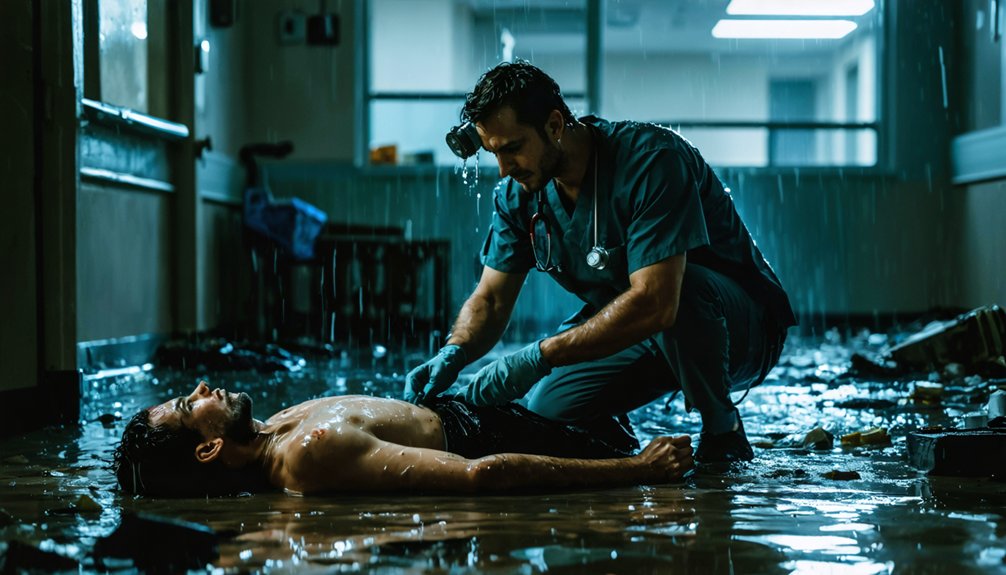
During disasters, physicians face a profound tension between their duty to treat patients and their obligation to protect themselves so they can continue providing care. Personal safety isn’t selfishness—it’s strategic.
In disasters, self-preservation isn’t selfishness—it’s strategy. Physicians who protect themselves protect every future patient.
Ethical dilemmas intensify when resources collapse and risks multiply. You must evaluate each situation using clear professional principles:
- Assess personal risk against your capacity to serve future patients if you remain safe and operational.
- Prioritize urgent care even under threat, recognizing your professional obligation extends into crisis conditions.
- Maintain disaster readiness through advance training, skill-building, and knowledge acquisition before emergencies strike.
You can’t serve anyone if you’re incapacitated. Balancing self-preservation with patient duty isn’t a contradiction—it’s a calculated, ethical commitment to maximizing care across the entire disaster response.
Why Emotional and Spiritual Support Belongs in Storm Injury Care
When you treat storm-related injuries, you must recognize that trauma extends far beyond physical wounds, as psychological distress and spiritual crisis are immediate clinical concerns requiring structured intervention.
You can offer genuine hope by framing treatment as a therapeutic process with measurable goals, but you must never substitute reassurance for honesty when outcomes remain uncertain.
You’re also obligated to identify and respect each patient’s cultural and religious customs, integrating those values directly into the care plan rather than treating them as secondary considerations.
Trauma Beyond Physical Wounds
Storm injuries fracture more than bone and tissue—they shatter routines, displace families, and strip survivors of their sense of safety and control. Ethical care demands you address this reality directly.
Psychological resilience doesn’t rebuild itself. Spiritual reconciliation doesn’t happen in silence. You must actively support both by integrating psychosocial care into every treatment encounter.
Prioritize these three interventions:
- Deliver honest updates about goals of care without offering false hope.
- Respect cultural and religious customs when discussing treatment plans and outcomes.
- Acknowledge uncertainty clearly while framing care as a therapeutic time trial.
You’re not just treating wounds—you’re treating whole persons under extreme duress. Withholding emotional and spiritual support isn’t neutral; it’s a clinical and ethical failure.
Hope Without False Promises
Survivors who’ve endured storm-related trauma carry wounds that no bandage can reach—and ignoring them isn’t a neutral clinical choice. You must integrate psychosocial and spiritual support into every care encounter.
Offer honest updates on treatment goals and measurable outcomes. When prognosis is uncertain, say so clearly—false certainty erodes trust and undermines emotional resilience.
You’re obligated to deliver hope grounded in reality, not comfort dressed as fact. Describe uncertain treatments as therapeutic time trials.
Respect cultural and religious customs without compromising clinical integrity.
Community engagement accelerates recovery. Connect survivors to peer networks, chaplaincy services, and mental health resources.
Families need regular, transparent communication—not silence or false reassurance.
Ethical storm care means treating the whole person, not just the presenting injury.
Honoring Cultural Spiritual Needs
Cultural and religious identity don’t disappear under clinical conditions—they intensify. During storm-related crises, cultural sensitivity isn’t optional—it’s clinically necessary. Spiritual resilience actively supports recovery, reducing psychological deterioration in compromised patients.
You must integrate the following into every care interaction:
- Respect rituals and customs — Ask directly about religious practices affecting treatment decisions and document them immediately.
- Describe treatment as a “therapeutic time trial” — This framing honors uncertainty without abandoning hope or misrepresenting outcomes.
- Coordinate spiritual support resources — Connect patients and families with chaplains, cultural liaisons, or community leaders available within your response infrastructure.
Ignoring these needs fractures trust and undermines compliance. Your patient’s identity demands the same urgent attention as their wounds.
How Physicians Protect Patient Privacy During Storm Disasters
During storm disasters, physicians must actively safeguard patient confidentiality even as clinical chaos unfolds around them. You’re entitled to privacy regardless of the emergency’s severity.
Physicians must restrict media access, prohibit unauthorized filming, and enforce strict confidential communication protocols when sharing your clinical information.
Media access must be restricted, unauthorized filming prohibited, and confidential communication protocols strictly enforced to protect your clinical information.
Data security remains non-negotiable even when digital infrastructure is compromised. Physicians must maintain detailed, discreet records covering patient identification, clinical difficulties encountered, and documentation of deceased individuals—all handled with rigorous discretion.
Social media use by care team members that exposes patient details is professionally prohibited.
Your autonomy and dignity don’t disappear during a disaster. Physicians bear an active obligation to protect your information, ensuring that emergency conditions never become justification for surrendering the privacy rights you inherently possess.
Frequently Asked Questions
Can Patients Refuse Treatment During a Disaster Despite Life-Threatening Injuries?
Yes, even as disaster turns medicine into a battlefield triage lottery, you retain the right to refuse treatment. Informed consent and autonomy preservation mean your decision stands, though physicians’ll urgently counsel life-threatening risks.
How Are Minors Triaged When Parents Are Unreachable During Storm Disasters?
When parents are unreachable, you must apply implied consent for minors, prioritizing life-saving triage immediately. Pursue parental contact actively while basing all child consent decisions solely on medical status and predicted survival response.
What Legal Protections Exist for Physicians Making Triage Decisions Under Disaster Conditions?
You’re protected by Good Samaritan and emergency statutes that shield you from liability concerns when you’re acting in good faith. Informed consent standards are relaxed under crisis conditions—prioritize saving lives without hesitation.
How Are Undocumented Individuals Identified and Recorded During Mass Casualty Storm Events?
Like an anchor in a storm, you must record undocumented individuals using medical status alone—never immigration standing. You’ll navigate language barriers with interpreters, uphold cultural sensitivity, and document identification details, difficulties, and care provided with urgent precision.
Who Oversees Ethical Compliance When Standard Medical Oversight Systems Are Disrupted?
When systems collapse, you oversee ethical compliance. You must navigate resource allocation and ethical dilemmas using established national frameworks, prioritizing lives saved, maintaining detailed records, and upholding professional obligations—your conscience and training become the governing authority.
References
- https://pmc.ncbi.nlm.nih.gov/articles/PMC7132512/
- https://www.ahcancal.org/Survey-Regulatory-Legal/Emergency-Preparedness/Documents/Ethical Guidelines for the Development of Emergency Plans.pdf
- https://tsaco.bmj.com/content/9/Suppl_2/e001389
- https://www.cdc.gov/disasters/hurricanes/pdf/woundcare.pdf
- https://www.vdh.virginia.gov/content/uploads/sites/144/2017/06/Disaster-Health-Services-Protocols-1.pdf
- https://pmc.ncbi.nlm.nih.gov/articles/PMC11029244/
- https://www.wma.net/policies-post/wma-statement-on-medical-ethics-in-the-event-of-disasters/
- https://www.ama-assn.org/delivering-care/ethics/southern-storms-tornadoes-and-ama-code-medical-ethics