For storm chasing, you’ll want 10x42mm binoculars with phase-corrected BAK-4 prisms, full waterproofing, and nitrogen-purged barrels to handle rapid weather shifts. The Swarovski NL Pure, Zeiss Victory SF, and Vortex Razor UHD lead the field with superior optical coatings and reliable low-light performance. Rubber armor protects against hail impacts, while a wide field of view keeps fast-moving storm structures in frame. The right choice depends on your budget and specific field conditions ahead.
Key Takeaways
- 10x42mm binoculars balance magnification, portability, and field of view, making them ideal for tracking dynamic storm systems in the field.
- Waterproofing and nitrogen-purged barrels prevent fogging and moisture damage, ensuring reliable performance in severe weather conditions.
- Top models include Swarovski NL Pure, Zeiss Victory SF, and Vortex Razor UHD, all offering exceptional optical clarity.
- Phase-corrected BAK-4 prisms and fully multi-coated optics maximize light transmission, improving visibility in storm-obscured or low-light conditions.
- Budget-conscious spotters can consider the Nikon Monarch M7 10x42mm, delivering sharp resolution and weather resistance under $500.
The Best Binoculars for Storm Chasers in 2025
Whether you’re tracking supercells across the Great Plains or monitoring wall clouds from a safe distance, having the right binoculars can make the difference between spotting a tornado’s formation early and missing it entirely.
Serious storm tracking demands optics that deliver sharp contrast, reliable waterproofing, and wide field-of-view performance under rapidly deteriorating conditions.
Reliable optics in storm tracking means sharp contrast, solid waterproofing, and wide field-of-view performance when conditions deteriorate fast.
In 2025, five models consistently outperform competitors: the Swarovski NL Pure 10x42mm, Zeiss Victory SF 10x42mm, Vortex Razor UHD 10x42mm, Leica Noctivid 10x42mm, and Nikon Monarch M7 10x42mm.
Each earns its place through optical clarity, durability, and field reliability.
Consistent binocular maintenance—cleaning lenses, checking nitrogen-purged seals, and inspecting rubber armor—keeps your equipment performing when atmospheric conditions turn violent and every second counts.
What Storm Chasers Actually Need From Binoculars
Storm chasing creates a brutally specific set of optical demands that casual birdwatching or hiking binoculars simply can’t meet.
You need optics engineered for punishment, not comfort.
For effective storm tracking, 10x magnification hits the ideal balance between detail resolution and image stability when you’re breathing hard or fighting wind.
Objective lenses at 42mm or 50mm gather enough light for weather observation during the rapidly darkening conditions that precede violent storms.
You’ll also need fully waterproof, nitrogen-purged construction — rain, hail, and humidity will destroy anything less.
Wide field of view matters too; 330 feet at 1,000 yards lets you scan developing wall clouds without constant repositioning.
Rubber armor absorbs the inevitable drops.
Every specification serves a functional purpose when conditions turn dangerous fast.
10X42MM Vs 10X50MM: Which Size Wins in the Field?
When you’re choosing between 10x42mm and 10x50mm binoculars for storm chasing, the core trade-off comes down to light gathering versus portability.
The 50mm objective lenses collect roughly 40% more light than 42mm lenses, giving you a measurable edge during dusk approaches or heavily overcast conditions.
However, you’ll carry that performance advantage at the cost of added bulk and weight during long field deployments.
Light Gathering Compared
Choosing between 10x42mm and 10x50mm binoculars comes down to one critical trade-off: portability versus light-gathering capacity. The 50mm objective lens produces a 5mm exit pupil, compared to the 42mm’s 4.2mm exit pupil. That difference directly impacts light transmission in overcast or dusk conditions—exactly when storm systems become most dangerous and visually complex.
You’ll notice the 10x50mm pulls ahead when scanning darkened supercell structures or twilight tornado formations. However, it adds noticeable weight and bulk during long field deployments.
The 10x42mm maintains superior optical clarity in daylight while remaining considerably more packable for mobile chasers who cover hundreds of miles daily.
If you’re frequently operating near dawn or dusk, the 10x50mm justifies its bulk. Otherwise, the 10x42mm delivers exceptional versatility without compromise.
Portability Versus Performance
For storm chasers covering long distances daily, the weight difference between a 10x42mm and 10x50mm binocular isn’t trivial—it’s a deployment decision.
The 10x42mm’s compact design sheds roughly 200–300 grams compared to 50mm variants, reducing fatigue during extended field operations. When you’re repositioning vehicles every 20 minutes ahead of a rotating supercell, that weight difference compounds quickly.
However, weight considerations cut both ways. The 10x50mm’s larger objectives deliver measurably better light transmission in storm-obscured, low-angle light—conditions you’ll regularly face.
If your chasing style prioritizes stationary observation posts over rapid intercept runs, the 50mm’s optical advantage outweighs its bulk.
Choose 42mm for mobility-dependent intercept chasing; choose 50mm when fixed positioning and low-light clarity define your operational priorities.
Which Field of View Actually Helps You Track a Storm?
Why does field of view matter more than magnification when you’re tracking a rotating supercell? Because you need spatial awareness, not just magnification power. A wider FOV lets you monitor storm structure shifts without constantly repositioning your optics.
Field of view beats magnification every time — spatial awareness keeps you ahead of a rotating supercell.
For storm tracking, 10x42mm binoculars deliver roughly 330 feet at 1000 yards — enough coverage to follow wall cloud rotation while maintaining sharp detail. Push to 15x magnification and your FOV drops below 250 feet, forcing you to continuously adjust as the storm evolves.
The binocular advantages of 8x42mm configurations become clear when you’re scanning broad, fast-moving systems — the Nikon Monarch M5 proves this.
But for detailed structure analysis, 10x42mm hits the functional sweet spot, balancing coverage width against the magnification you actually need in the field.
Low-Light Performance: Best Storm Chasing Binoculars at Dusk
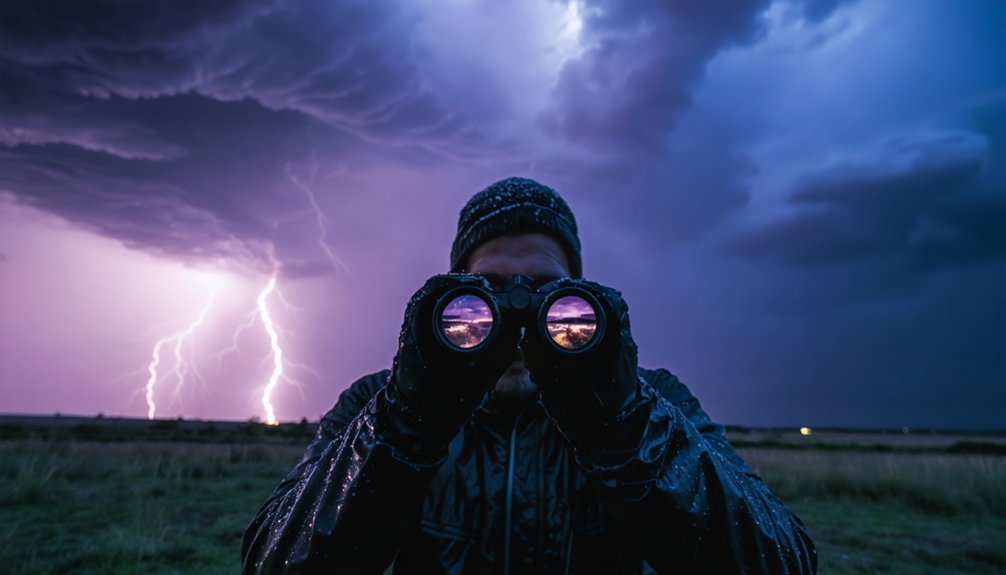
When you’re chasing storms at dusk or beneath heavy cloud cover, low-light performance becomes your most critical binocular specification.
The Vortex Razor UHD 10x50mm leads this category, with its larger 50mm objectives gathering considerably more light than standard 42mm models.
You’ll also find strong low-light capability in the Zeiss Victory SF and Leica Noctivid, both of which deliver superior light transmission through high-grade lens coatings.
Top Low-Light Models
Dusk and overcast skies strip away the contrast storm chasers rely on, making low-light optical performance a critical specification rather than a luxury.
You’ll find the Vortex Razor UHD 10x50mm delivers the strongest low-light advantages, with its larger objective lens maximizing light transmission during deteriorating conditions. The 50mm ideal lens diameter captures considerably more light than standard 42mm configurations, giving you a measurable edge when twilight compresses your observation window.
Zeiss Victory SF 10x42mm compensates through superior glass coatings and transmission efficiency, achieving near-equivalent performance despite the smaller objective.
Leica Noctivid rounds out the top tier, offering precision optics engineered for contrast retention in variable light.
Each model prioritizes nitrogen-purged, fully waterproof construction, ensuring reliable performance when weather conditions demand it most.
Dusk Visibility Features
Identifying which optical features drive low-light performance helps you move beyond brand reputation and evaluate what’s actually happening inside the glass.
At dusk, your binoculars’ exit pupil diameter determines how much light reaches your eye. Divide objective lens size by magnification—a 10x50mm yields a 5mm exit pupil, outperforming a 10x42mm’s 4.2mm in fading light.
Twilight clarity depends equally on glass quality and coatings. Phase-corrected BAK-4 prisms and fully multi-coated optics maximize light transmission across the entire optical path.
Zeiss Victory SF and Leica Noctivid achieve transmission rates exceeding 90%, translating directly into sharper dusk optics when storm structures are silhouetted against dim skies.
If you’re chasing into evening hours, prioritize larger objectives and premium coatings over magnification alone.
How Storm Chasing Binoculars Hold Up in Severe Weather
Severe weather puts storm chasing binoculars through punishing conditions—rain, hail, wind-driven debris, and rapid temperature swings all threaten optical performance and structural integrity.
Storm chasing exposes binoculars to rain, hail, debris, and temperature swings that destroy optical performance fast.
You need weather resistance built into every component, not just surface-level protection.
Top models like the Zeiss Victory SF, Vortex Razor UHD, and Swarovski NL Pure feature full waterproofing, nitrogen-purged barrels, and rubber armor that absorbs impact without compromising optical clarity.
Nitrogen purging eliminates internal moisture, preventing fogging when you move between a cold vehicle and humid outdoor air.
Rubber armoring shields the chassis from hail strikes and accidental drops on hard terrain.
These aren’t marketing features—they’re engineering necessities that keep your optics functional when conditions deteriorate fastest and accurate storm assessment matters most.
The Best Storm Chasing Binoculars at Every Price Point
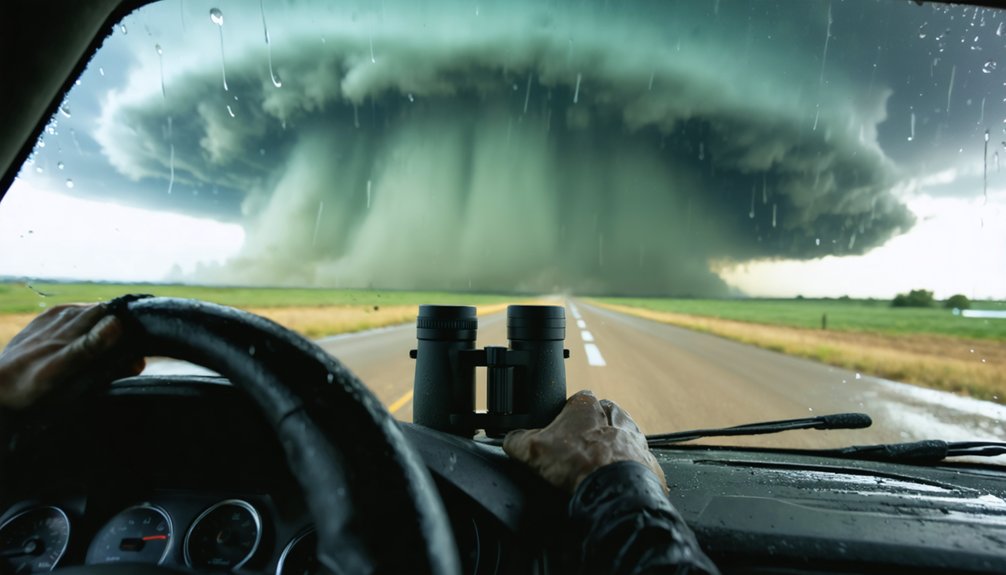
Storm chasing optics span a wide price spectrum, and matching your budget to the right model means you won’t sacrifice critical performance in the field.
For budget options, the Nikon Monarch M5 8x42mm at $339 delivers reliable waterproofing and solid low-light clarity. Step up to the Monarch M7 10x42mm under $500, and you gain sharper resolution with a wider field of view.
Mid-range buyers should consider the Meopta MeoPro Air 10x42mm near $1,000, which bridges value and optical precision.
Among premium choices, the Zeiss Victory SF 10x42mm offers superior light transmission, while the Swarovski NL Pure 10x42mm sits at the top, delivering unmatched image clarity.
Each tier gives you dependable storm-ready performance—you just choose how far you’re willing to invest.
Frequently Asked Questions
Can Storm Chasers Use Binoculars While Wearing Glasses or Goggles?
Yes, you can use binoculars while wearing glasses or goggles. Most top models feature adjustable eye relief and optical adjustments, while premium lens coatings guarantee you’ll maintain sharp, distortion-free clarity despite your eyewear.
How Do You Clean Binoculars After Exposure to Rain and Debris?
After field exposure, you’ll want to prioritize moisture removal first—pat dry with a microfiber cloth, then apply proper lens maintenance techniques: use a lens pen or solution to carefully remove debris without scratching optical coatings.
Should Storm Chasers Carry a Backup Pair of Binoculars?
Yes, you should carry backup binocular types—specifically a durable budget pair like the Nikon Monarch M5. Backup features guarantee you’re never without optics if your primary unit fails during critical storm observation.
Are Binocular Harnesses Better Than Neck Straps for Storm Chasing?
Harnesses distribute weight evenly, so you’ll notice binocular comfort improves precisely when storm visibility demands sustained observation. It’s no coincidence that freed hands and reduced neck strain let you react faster during critical chasing moments.
Can Binoculars Be Safely Used While Inside a Moving Vehicle?
You can use binoculars inside a stopped vehicle, but vehicle vibrations severely compromise binocular stability while moving. You’ll get blurred, unusable images. Always verify the vehicle’s stationary before attempting any storm observation through binoculars.
References
- https://fieldandstream.com/outdoor-gear/hunting-gear/optics/binoculars/best-binoculars
- https://www.firerescue1.com/off-duty/zoom-in-top-binoculars-for-safety-sightseeing-and-stargazing
- https://expertbinocular.com/news/123/7-Best-Tornado-Spotter-Optics-for-Storm-Chasing-in-2026.html
- https://www.space.com/26021-best-binoculars.html
- https://westernhunter.net/gear-reviews/the-versatility-of-12×50-binoculars/
- https://www.leupold.com/blog/post/choosing-the-right-binocular
- https://gearjunkie.com/technology/best-binoculars