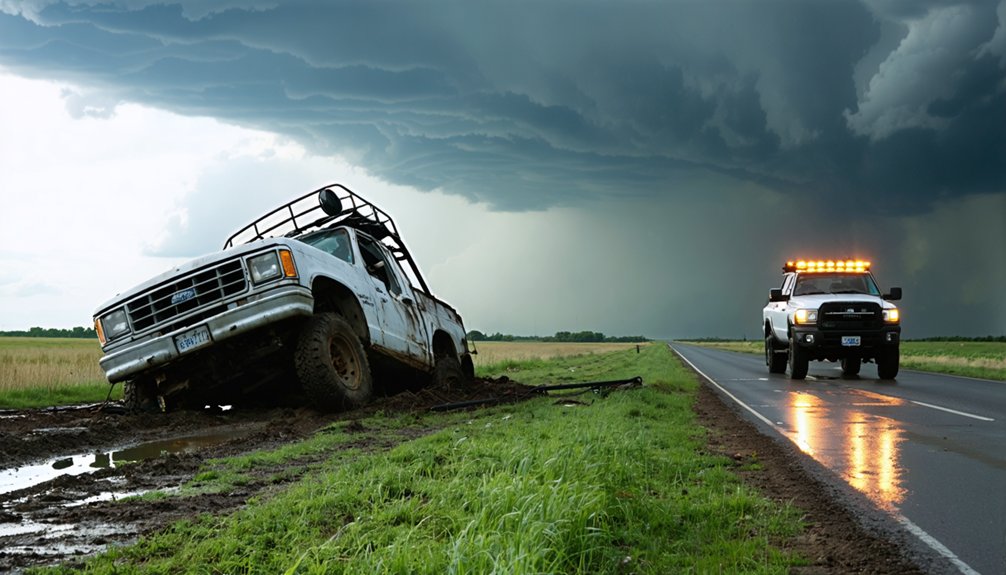
Storm chasing is far less deadly than you’d expect — fewer than one chaser dies per year since the 1950s, with roughly 17 total deaths recorded. Surprisingly, cars kill more chasers than tornadoes do, with vehicle incidents accounting for around 12 fatalities versus only 4 tornado-direct deaths. Hydroplaning, wrong-way collisions, and divided attention are your biggest threats on the road. The data reveals predictable failure patterns that, once you understand them, can dramatically change how you chase.
Key Takeaways
- At least 17 storm chasers have died since the 1950s, with vehicle-related incidents causing more deaths than tornadoes directly.
- The 2013 El Reno tornado killed three experienced chasers, highlighting how rapidly shifting tornadoes can trap even skilled professionals.
- Hydroplaning accounts for nearly half of indirect storm chasing fatalities, making tire inspection and reduced speeds critical safety measures.
- Despite its dangers, storm chasing’s death toll remains low compared to whitewater rafting, which averages 51 fatalities annually.
- Avoiding highway stops, staying right of a tornado’s path, and practicing defensive driving significantly reduce storm chasing risks.
How Many Storm Chasers Have Actually Died?
When you look at the raw numbers, the storm chasing death toll is surprisingly low. Since the 1950s, at least 17 chasers have died — 4 directly from tornadoes and 12 from vehicle-related incidents. That’s fewer than one fatality per year across a decades-long span.
Since the 1950s, only 17 storm chasers have died — fewer than one fatality per year across decades of pursuit.
Chaser safety statistics actually compare favorably against other high-risk outdoor activities. Whitewater rafting averages 51 fatalities annually, while storm chasing estimates roughly 1 death per 944,444 person-days in the field.
What these numbers reveal is that storm preparation and driving discipline matter more than proximity to the tornado itself. The El Reno event in 2013 accounts for all four direct tornado deaths on record.
You’re statistically far more likely to hydroplane leaving the chase than to get hit by the storm.
Why Cars Kill More Storm Chasers Than Tornadoes?
Car accidents have claimed 14 storm chaser lives compared to just 5 tornado-related deaths — a ratio that reflects how much time chasers spend on roads versus near actual storm systems.
You’re fundamentally a professional driver who occasionally observes tornadoes. Storm-amplified conditions, including rain-slicked highways, reduced visibility, and heavy traffic, transform routine repositioning into genuine hazards.
Hydroplaning alone accounts for nearly half of indirect fatalities, including three OU students who died on I-35 in 2022 after a Kansas chase.
Car safety isn’t secondary to meteorological awareness — it’s your primary survival skill. Mastering defensive driving techniques, recognizing hydroplaning conditions, and maintaining appropriate following distances directly determines your outcome.
The tornado rarely reaches you; the interstate frequently does.
What Road Hazards Are Killing Storm Chasers on the Road?
Hydroplaning, wrong-way collisions, and semi-truck impacts aren’t random bad luck — they’re predictable failure modes that emerge from specific road conditions storm chasers routinely create for themselves.
You’re operating in rain-soaked environments where hydroplaning becomes nearly inevitable at highway speeds. The 2022 I-35 deaths of three OU students and Martha Llanos Rodriguez’s semi-truck collision on I-90 illustrate two distinct but equally lethal patterns: loss of vehicle control and roadside exposure.
Driver awareness breaks down when your attention splits between navigation, radar feeds, and positioning. Road safety deteriorates further when you stop on active highways to photograph or reposition.
These aren’t freak accidents — they’re the direct consequence of divided attention, compromised road surfaces, and high-traffic corridors intersecting with extreme weather. Recognizing these patterns is your first defensive move.
How the 2013 El Reno Tornado Killed Three Professional Chasers
On May 31, 2013, the El Reno tornado shattered the statistical baseline that had made direct tornado deaths seem almost theoretical — killing Tim Samaras, his son Paul Samaras, and colleague Carl Young in a single event.
The El Reno tragedy accounts for all four known direct storm chasing fatalities in recorded history. The tornado’s extreme width and erratic motion trapped the experienced research team on a rural road, eliminating their escape window.
The El Reno tornado claimed all four recorded storm chasing deaths in history — width and chaos sealing every escape route.
Chaser safety protocols emphasize avoiding positions left of the tornado’s path, where opposing winds create unpredictable hazard zones — exactly the conditions that proved fatal that day.
You can’t outrun what you can’t predict. Even elite professionals with decades of field experience aren’t immune when a tornado behaves outside established behavioral models.
How to Chase Storms Without Becoming a Statistic
The data makes one risk category unmistakable: driving kills storm chasers far more reliably than tornadoes do, with 14 vehicle-related fatalities against only 5 tornado-direct deaths.
Storm chasing safety, consequently, starts with vehicle preparedness—not tornado avoidance tactics. You should inspect tires before every chase, since hydroplaning alone accounts for roughly half of indirect deaths.
After leaving a storm, slow down; wet roads remain lethal once the adrenaline fades. Avoid stopping on high-speed interstates—Martha Llanos Rodriguez died exactly that way in 2022.
Positionally, stay right of the tornado’s path. Tracking left exposes you to opposing inflow winds, a factor in the Greensburg near-miss.
The El Reno data confirms that even professionals misjudge rapid tornadoes. Discipline and preparation, not luck, separate productive chases from fatal ones.
Frequently Asked Questions
Has Any Storm Chaser Ever Survived a Direct Tornado Hit?
Yes, you’ll find tornado survival stories exist among storm chaser experiences, as the El Reno 2013 event killed only 3 chasers directly, meaning others nearby survived that unprecedented, deadly encounter.
Are Amateur Storm Chasers at Higher Risk Than Professional Meteorologists?
Yes, you face higher risk as an amateur due to limited professional training and unclear amateur motivations. Professionals apply structured protocols, reducing vehicle incidents that cause 12 of storm chasing’s recorded indirect deaths.
What Insurance Coverage Do Storm Chasers Typically Carry for Their Vehicles?
The knowledge base doesn’t cover vehicle insurance or coverage options for storm chasers. You’d need to consult specialized insurers directly, as your unique road time and weather exposure likely require tailored, non-standard automotive protection policies.
Have Any Storm Chasing Deaths Occurred Outside of the United States?
The knowledge base doesn’t confirm international incidents among storm chaser fatalities. You’ll find all documented deaths occurred in the U.S., with car accidents and the 2013 El Reno tornado dominating the data you should analyze.
Do Storm Chasing Tour Companies Have Better Safety Records Than Solo Chasers?
The data doesn’t confirm tour companies outperform solo chasers in safety records. You’ll find tour company regulations and safety training reduce risks, but individual skill, experience, and decision-making ultimately determine your survival outcomes equally.
References
- https://stormhighway.com/tornadoes__dangerous_storm_chasing_myth.php
- https://en.wikipedia.org/wiki/Storm_chasing
- https://www.youtube.com/watch?v=uCLaE6ELFik
- https://stormtrack.org/threads/how-does-storm-chasing-compare-to-other-high-risk-activities.30926/
- https://pmc.ncbi.nlm.nih.gov/articles/PMC7262986/
- https://www.psychologytoday.com/us/blog/extreme-fear/201105/is-storm-chasing-immoral