The 1965 Palm Sunday Outbreak‘s 271 deaths exposed how badly warning systems failed, pushing researchers out of labs and into the field. You can trace modern storm chasing directly to that institutional failure. By 1972, the University of Oklahoma and NSSL had deployed organized chase teams to collect what radar couldn’t yet capture. The 1973 Union City tornado then validated the entire field-based model—and the full story of how that data reshaped forecasting is worth exploring.
Key Takeaways
- The 1965 Palm Sunday Outbreak killed 271 people, exposing critical gaps in tornado forecasting and warning systems that demanded urgent research solutions.
- Institutional barriers, including a 1887 ban on tornado forecast terminology, had suppressed decades of research momentum before deadly outbreaks forced change.
- The 1973 Union City tornado provided unprecedented dual Doppler radar data, capturing a tornado’s complete lifecycle and revolutionizing scientific understanding.
- By 1972, the University of Oklahoma and National Severe Storms Laboratory deployed student-led chase teams to gather field-based tornado observations.
- Union City validated coordinated chase team models, directly shaping the design of structured programs like VORTEX and modern storm chasing protocols.
Why Some Tornado Outbreaks Changed Forecasting History
Certain tornado outbreaks didn’t just cause destruction—they exposed critical gaps in forecasting infrastructure and directly forced systemic change. The 1965 Palm Sunday Outbreak killed 271 people despite available satellite and radar imagery, proving that raw data alone couldn’t save lives without systematic tornado forecasting protocols. That failure accelerated institutional pressure toward better warning infrastructure.
You can trace today’s storm science directly to those deadly gaps. When the U.S. government banned the word “tornado” from forecasts in 1887, research stagnated for decades. It took documented mass casualties and mounting public pressure before the Weather Bureau reversed that ban in 1950.
Each outbreak fundamentally functioned as an uncontrolled field experiment, revealing exactly where forecasting methodology broke down and demanding measurable, structural reform.
The 1965 Palm Sunday Outbreak’s Deadly Warning System Failures
On Palm Sunday, April 11, 1965, a catastrophic tornado outbreak tore through the Midwest, killing 271 people across six states despite forecasters having access to both satellite imagery and radar data.
You can trace the disaster directly to a critical gap between available technology and operational warning protocols—the tools existed, but the systems for translating that data into timely public warnings did not.
That deadly disconnect drove urgent reforms in tornado warning infrastructure, ultimately accelerating the scientific storm chasing research that would redefine forecasting methodology throughout the following decades.
Outbreak’s Devastating Death Toll
Although satellite and radar imagery were already available by 1965, the Palm Sunday Outbreak still claimed 271 lives—a death toll that exposed critical gaps in the era’s warning infrastructure.
The outbreak impact revealed systemic failures that demanded immediate reform:
- 47 tornadoes touched down across six states within hours
- Warning dissemination systems couldn’t reach rural populations effectively
- Radar interpretation lacked standardized protocols among meteorologists
- Coordination between federal and local agencies remained fragmented
- Public education about tornado response was critically underdeveloped
You’re looking at a watershed moment where available technology simply wasn’t enough.
The data existed, but the infrastructure to translate it into life-saving action hadn’t caught up. This deadly gap between technological capability and practical application became the driving force behind systematic storm chasing research.
Available Technology’s Forecasting Failures
The 1965 Palm Sunday Outbreak exposed a critical paradox: forecasters had access to both satellite imagery and radar technology, yet 271 people still died. You’d think available tools would’ve prevented such devastation, but forecasting limitations ran deeper than equipment inventories suggested.
The technological constraints of 1965 reveal a sobering truth—possessing radar doesn’t guarantee effective interpretation or timely dissemination. Warning systems lacked the infrastructure to translate raw data into actionable public alerts fast enough.
Satellite imagery identified large-scale atmospheric instability, but pinpointing individual tornado tracks within outbreak clusters exceeded contemporary analytical capabilities.
This deadly gap between available technology and operational execution directly motivated researchers to pursue systematic storm interception. Scientists recognized that understanding tornado behavior required direct observation, not just remote sensing—a realization that fundamentally reshaped meteorological research priorities.
Inspiring Improved Warning Systems
271 deaths from the 1965 Palm Sunday Outbreak didn’t just represent a forecasting failure—they catalyzed a structural overhaul of America’s tornado warning infrastructure.
Policymakers and meteorologists recognized that existing systems couldn’t translate available radar and satellite data into actionable public alerts. Warning system innovations emerged directly from this tragedy:
- Expanded Doppler radar network deployment
- Standardized tornado watch versus warning classifications
- Community-level siren infrastructure investments
- Coordinated broadcast emergency alert protocols
- Accelerated tornado detection advancements through funded research programs
These reforms gave citizens genuine decision-making capacity during severe weather events—the kind of operational independence that saves lives.
The 1972 Tornado Intercept Project built upon this momentum, transforming chase-derived data into the warning science you now rely on when sirens activate across the plains.
How the 1973 Union City Tornado Transformed Historic Outbreak Research
When you examine the pivotal moments in tornado research, the Union City, Oklahoma tornado of May 11, 1973 stands apart as a scientific turning point.
Two University of Oklahoma chase teams intercepted the F-4 tornado at ideal observation ranges, positioning it squarely within range of two Doppler radars simultaneously—a data collection alignment that hadn’t occurred before.
The resulting dataset transformed how researchers analyze tornado outbreaks, with findings derived from that single storm still shaping warning methodologies today.
Union City’s Scientific Breakthrough
On May 11, 1973, an F-4 tornado near Union City, Oklahoma delivered what remains the most scientifically productive single-storm dataset in tornado research history.
Two intercept teams positioned at ideal ranges while dual Doppler innovations captured the tornado’s complete life cycle—unprecedented at the time.
The findings you still rely on today include:
- Full rotational wind field documentation
- Tornado genesis-to-dissipation sequencing
- Mesocyclone structural mapping
- Ground-truth validation of Doppler radar signatures
- Standardized intercept positioning protocols
Union City’s data didn’t just advance academic understanding—it restructured how researchers deploy resources during outbreaks.
Every warning improvement since 1973 traces partially back to this storm. You’re seeing its influence every time a modern tornado warning reaches you before touchdown.
Doppler Radar Data Collection
The dual Doppler network surrounding Union City didn’t just capture data—it redefined what storm researchers could extract from a single event. You’re looking at a system where two radar units triangulated wind velocity fields simultaneously, pushing data accuracy beyond anything previously achievable.
That triangulation enabled unprecedented storm visualization, revealing the tornado’s complete lifecycle from genesis through dissipation.
What makes this significant for your understanding of research methodologies is the positioning. One chase team operated close-range while the second maintained distance, giving researchers layered observational depth.
The F-4 tornado remained within both radar ranges throughout its existence—a statistically rare alignment. NOAA’s National Severe Storms Laboratory extracted findings that researchers still reference today.
Union City fundamentally became the benchmark against which all subsequent Doppler radar tornado documentation gets measured.
Transforming Tornado Research Methods
What the Union City tornado ultimately delivered wasn’t just cleaner data—it was a methodological reset that cascaded through every branch of tornado outbreak research. This research evolution redefined how you approach outbreak analysis today through tornado technology that didn’t previously exist.
Key transformations that emerged:
- Dual-team intercept positioning became standard protocol for spatial data triangulation.
- Doppler radar integration replaced visual-only documentation methods.
- Tornado lifecycle mapping enabled outbreak pattern recognition.
- Forecasting models incorporated real-time velocity signatures.
- Warning systems shifted from reactive to predictive frameworks.
Each advancement compounded the previous one. Union City’s F-4 intercept proved that coordinated positioning within radar range produces irreplaceable datasets.
The findings didn’t just improve single-storm documentation—they restructured how researchers reconstruct historical outbreak sequences with precision and scientific accountability.
Early Outbreaks That Broke Tornado Forecasting Wide Open
Before modern Doppler radar and systematic chase programs existed, several catastrophic tornado outbreaks forced meteorologists to confront the hard limits of their forecasting capabilities. Early tornadoes routinely caught communities unprepared, exposing critical gaps in detection and response infrastructure.
The 1965 Palm Sunday Outbreak killed 271 people despite available satellite and radar imagery—a devastating failure that accelerated forecasting evolution considerably. You can trace direct connections between that outbreak’s casualties and the policy reversals that followed.
The government’s 1887 ban on tornado forecast terminology had already cost decades of research momentum, and Palm Sunday proved that institutional hesitation carried a measurable human cost. These early outbreaks didn’t just reshape meteorological protocols—they dismantled the false confidence that existing tools were sufficient for protecting lives.
How Historic Outbreaks Revealed Supercell and Tornado Formation
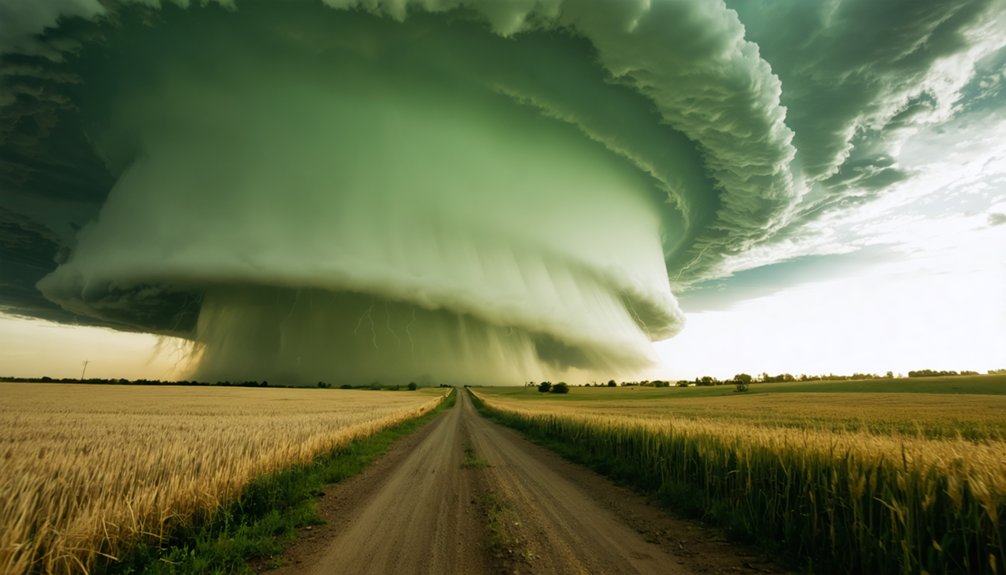
Each catastrophic outbreak added discrete data points to an emerging scientific framework that researchers couldn’t construct through controlled observation alone.
Historic events accelerated understanding of supercell dynamics and tornado genesis through raw, unfiltered atmospheric data.
Key discoveries driven by outbreak analysis:
- Low-precipitation supercells first documented near Chickasha, Oklahoma in June 1973
- Doppler radar captured tornado life cycles thoroughly for the first time between 1969-1973
- Union City’s F-4 tornado revealed internal rotation mechanics still referenced today
- Hook echo signatures confirmed radar’s diagnostic value for identifying supercell structure
- Palm Sunday’s 1965 outbreak exposed critical gaps between available technology and actionable warnings
You’re looking at a discipline built on tragedy converted into knowledge—each outbreak forcing meteorologists to refine tornado genesis models with precision that lab conditions simply couldn’t replicate.
How Historic Outbreak Data Built the First Organized Chase Teams
That accumulating outbreak data didn’t just refine tornado science—it created an operational demand for humans positioned in the field.
By 1972, the University of Oklahoma and the National Severe Storms Laboratory combined resources, deploying student-led chase teams to test emerging storm interception strategies alongside two new Doppler radar systems.
The Union City tornado of May 11, 1973, validated this model completely. Two teams operating at different distances produced a layered observational dataset that no single instrument could’ve generated alone.
You can see how chase team dynamics—coordinated positioning, tiered proximity, real-time communication—became scientifically essential rather than incidental.
Outbreak-scale events had exposed what labs couldn’t answer. Organized field teams weren’t optional; they were the missing variable that transformed raw radar returns into actionable tornado formation knowledge.
Why Palm Sunday and Union City Data Still Drive Tornado Research
The Palm Sunday Outbreak of 1965 and the Union City tornado of 1973 function as twin benchmarks in tornado research—one exposing the catastrophic gap between available forecasting technology and operational warning capability, the other producing the most detailed tornado lifecycle dataset ever collected from a single storm.
Both events continue shaping modern research because they established measurable failure points and validated methodologies you can still trace through current warning systems.
Key reasons both datasets remain foundational:
- Palm Sunday’s 271 fatalities quantified the cost of inadequate warning translation
- Union City’s F-4 intensity fell within dual Doppler radar range simultaneously
- Union City documented tornado lifecycle stages thoroughly for the first time
- Palm Sunday accelerated institutional pressure toward operational forecasting reform
- Both events directly informed VORTEX program design and data collection protocols
Frequently Asked Questions
What Equipment Did Early Storm Chasers Use Before Modern Technology Existed?
Early storm chasing relied on basic early equipment: you’d use paper maps, compasses, and standard cameras. You’d track storms visually, recording barometric pressure with handheld gauges while coordinating via radio communications—primitive tools that still yielded groundbreaking meteorological discoveries.
How Did the Government’s 1887 Tornado Forecast Ban Affect Public Safety?
The 1887 ban crippled public perception of tornado threats by silencing forecasters. You couldn’t receive timely warnings, gutting safety measures for decades. This policy paralyzed research until 1950, leaving communities dangerously uninformed about life-threatening storms approaching their locations.
Which Storm Chaser First Received Formal Scientific Funding for Tornado Research?
Imagine standing in a storm’s fury—Neil Ward first secured formal funding sources for tornado research, pioneering scientific storm chasing. You’d recognize his work shaped forecasting methods, thunderstorm structure analysis, and interception techniques that still drive modern discoveries.
How Many Lives Could Improved 1965 Warning Systems Realistically Have Saved?
Estimates suggest improved technology could’ve saved 50–150 of the 271 lives lost. You’d analyze historical data showing that better warning systems typically reduce fatalities by 20–55%, depending on lead time and public response effectiveness.
What Personal Motivations Drove Pioneers Like David Hoadley to Chase Storms?
You’d find that personal experiences with severe weather ignited Hoadley’s passion for meteorology, driving him to chase storms scientifically since 1956. He’s actively transformed that raw curiosity into Storm Track magazine, uniting chasers through shared data-driven discovery.
References
- https://www.rmets.org/metmatters/history-storm-chasing
- https://survive-a-storm.com/blog/the-history-of-storm-chasing/
- https://www.gabegarfield.com/blog
- https://www.stmweather.com/blog/a-history-of-tornado-chasing-and-upcoming-girls-who-chase-training
- https://www.mikesmithenterprisesblog.com/2024/08/pre-twisters-origin-of-storm-chasing.html
- https://uwm.edu/arts/event/experimental-tuesdays-a-brief-history-of-chasing-storms/
- https://www.youtube.com/watch?v=q1wjR_zK548