When cellular networks fail mid-chase, you can’t rely on a single device. Your best setup layers NOAA weather radios for alerts, two-way radios for convoy coordination, satellite communicators like the Garmin inReach Mini 2 for messaging and SOS, and satellite phones for real-time voice contact in remote areas. Each device covers another’s weaknesses. Back everything with portable power banks or solar chargers, and you’ll maintain communication no matter what the storm throws at you—there’s much more to unpack about each layer.
Key Takeaways
- NOAA weather radios like the Midland WR120B operate independently of cellular networks, providing reliable severe weather alerts as a first warning layer.
- Two-way radios, particularly GMRS and MURS models, enable effective vehicle-to-vehicle coordination during active storm chasing operations.
- Satellite communicators like the Garmin inReach Mini 2 offer two-way messaging, SOS signaling, and GPS tracking without cellular dependency.
- Satellite phones provide real-time voice communication in extremely remote areas where terrestrial networks and messaging devices prove insufficient.
- Combining all four device types with backup power sources ensures redundancy, preventing total communication failure during high-stakes storm intercepts.
Durability, Range, and Redundancy: What Storm Chasers Actually Need
When you’re operating in the field during a violent storm, your communication equipment needs to meet three non-negotiable standards: durability, range, and redundancy. Gear that fails under pressure isn’t gear worth carrying.
Durability means weather-resistant housings and shock-tolerant builds. Range depends heavily on antenna design—a poorly positioned or low-gain antenna collapses your communication window exactly when you need it most. Signal encryption matters too, particularly for coordinating sensitive team movements without interference or interception.
Redundancy is your safety net. No single device covers every scenario. Cellular networks drop, radios lose range, and satellite units require clear sky access. You need layered systems—two-way radios for local coordination, satellite communicators for remote zones, and a NOAA weather radio as your baseline alert source. Build your kit accordingly.
NOAA Weather Radios Every Storm Chaser Should Own
Before any satellite communicator or two-way radio earns a place in your kit, a NOAA weather radio should already be there. It operates independently of cellular networks, satellite encryption protocols, and internet infrastructure—delivering National Weather Service alerts directly to you during active severe weather.
A NOAA weather radio belongs in your kit before any satellite communicator or two-way radio ever does.
For weather forecasting accuracy in the field, you need real-time official data, not delayed app notifications. The Midland WR120B and Midland WR120 are reliable choices, offering programmable county-specific alerts and battery backup during power outages.
This device functions as your first warning layer. When infrastructure collapses around a developing storm, your NOAA radio keeps transmitting. It’s low-cost, maintenance-light, and operationally independent.
No serious storm chaser should deploy without one already mounted and powered in the vehicle.
Best Two-Way Radios for Storm Chase Convoys
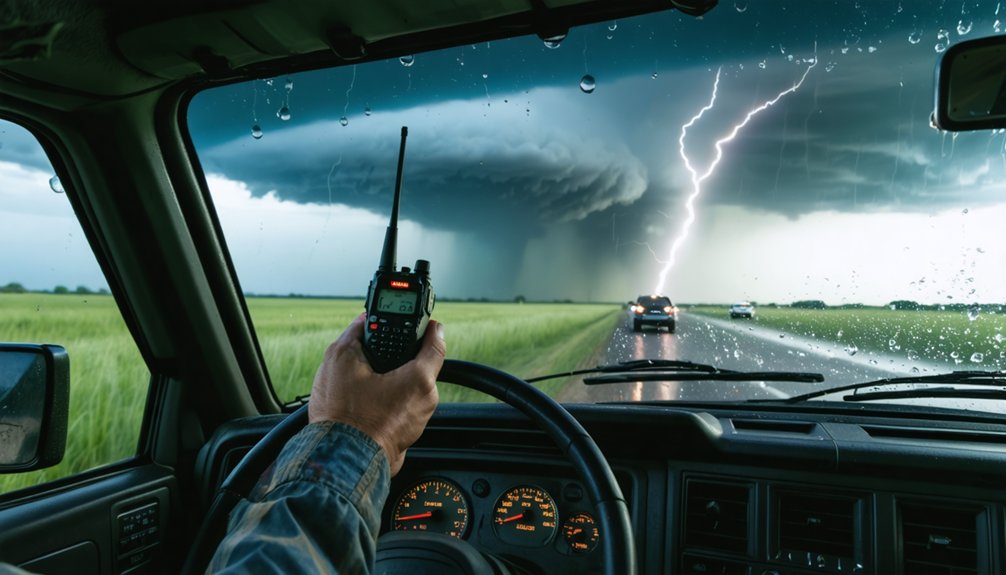
Once your NOAA radio establishes situational awareness, two-way radios handle the real-time tactical communication that keeps a convoy coordinated during an active chase. FRS radios work for casual teams, but GMRS and MURS offer stronger range and clearer transmission under demanding field conditions.
Ham radio remains the professional standard, giving you maximum flexibility through frequency selection across licensed bands. Mobile radios mounted in your vehicle outperform handheld units and support antenna upgrades that dramatically extend range in open terrain.
You’ll want weather-resistant housings and reliable battery systems rated for extended deployments. When cellular networks collapse and conditions deteriorate fast, your convoy depends on instant, infrastructure-free contact between vehicles.
Prioritize radios that your entire team can operate quickly under pressure without fumbling through complicated menus.
Top Satellite Communicators for Remote Chase Operations
Two-way radios keep your convoy connected across short distances, but they can’t reach emergency responders or outside contacts when you’re operating deep in remote terrain. Satellite communicators close that gap, giving you independent, infrastructure-free contact anywhere.
Top options worth deploying:
- Garmin inReach Mini 2 – two-way messaging, SOS monitoring, and GPS tracking with satellite encryption protecting your transmissions
- Garmin GPSMAP 66i – combines navigation with satellite messaging and signal amplification for stronger connectivity in rugged terrain
- SPOT Gen4 – dedicated SOS and location tracking with minimal power draw
- Garmin inReach Explorer+ – full two-way messaging plus onboard mapping for route decisions
Each device operates independently of cellular networks, keeping your team reachable and trackable when conditions eliminate every other option.
When Storm Chasers Need a Satellite Phone Over a Communicator
When voice communication is your priority, a satellite phone outperforms a two-way communicator by delivering real-time verbal coordination that text-based devices simply can’t match.
If you’re operating in extremely remote chase zones where terrestrial networks are completely absent, a satellite phone provides the reliability you need for high-stakes emergency contact with dispatch, medical personnel, or incident commanders.
You should treat a satellite phone as your primary fallback when the situation demands immediate, confirmed voice contact rather than delayed messaging.
Voice Calls Matter Most
Satellite communicators handle two-way messaging and SOS functions well, but they can’t replace a satellite phone when voice communication is critical. Voice clarity and signal stability determine whether you relay accurate storm data or lose critical coordination in the field.
When conditions demand real-time verbal contact, a satellite phone gives you direct, reliable communication that text-based devices can’t match.
Prioritize a satellite phone when:
- You’re coordinating multi-vehicle operations requiring instant verbal confirmation
- Emergency responders need real-time situation reports beyond SOS messaging
- Signal stability is non-negotiable during rapidly evolving tornado intercepts
- Voice clarity is essential for communicating precise GPS coordinates or road conditions
Keep your satellite phone accessible, antenna pointed toward open sky, and battery charged before every deployment.
Remote Areas Lack Coverage
Remote chase operations frequently push you into dead zones where cellular towers don’t exist and satellite communicators struggle to maintain reliable data links. When your weather pattern analysis demands real-time voice coordination, a satellite phone delivers what a messaging device can’t — immediate, clear voice contact with your team or emergency services.
Satellite communicators excel at GPS tracking and SOS alerts, but their data-dependent messaging introduces latency that’s unacceptable during fast-moving severe weather. Your storm tracking tools require instant coordination, not delayed text confirmations.
In truly remote terrain, a satellite phone gives you uninterrupted voice access regardless of infrastructure collapse. If you’re operating beyond reliable coverage zones, prioritize a satellite phone as your primary communication device, keeping your satellite communicator as a capable but secondary backup.
High-Stakes Emergency Contact
During high-stakes emergencies, you need voice contact — not a text confirmation that may arrive minutes late. Satellite phones deliver real-time verbal communication when emergency protocol demands immediate coordination. A satellite communicator’s messaging function won’t cut it when seconds matter.
Satellite phones outperform communicators in these specific scenarios:
- Injury response — relay precise medical details to emergency services instantly
- Team separation — confirm positions verbally when GPS pings feel insufficient
- Media or command coordination — communication etiquette requires live dialogue, not delayed texts
- Rapidly evolving storm tracks — adapt field decisions through direct voice confirmation
Keep your satellite phone charged, antenna clear, and sky access unobstructed. You’re operating outside the safety net — treat voice capability as non-negotiable infrastructure.
Do You Need Both a Satellite Communicator and a GPS Device?
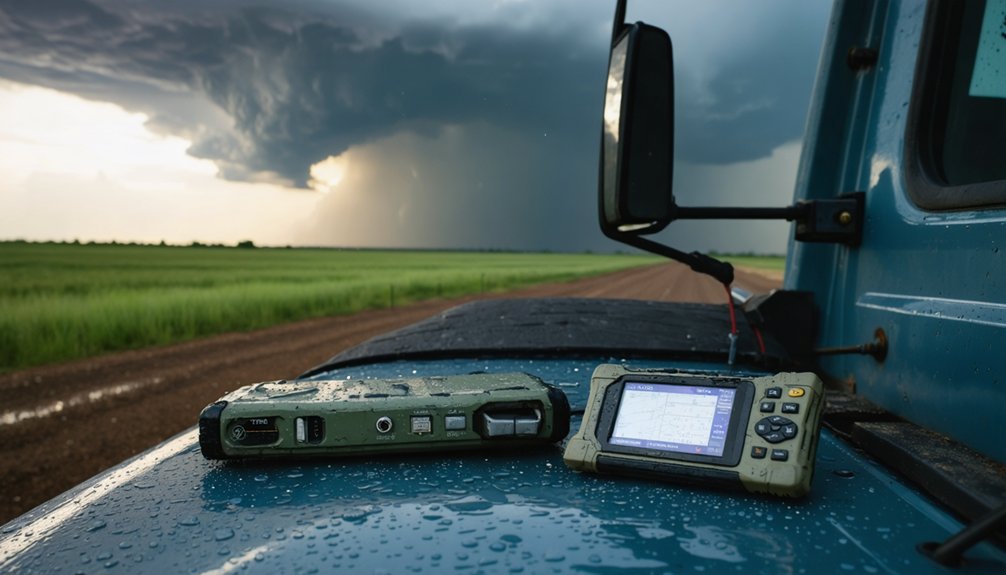
If you’re already carrying a Garmin inReach or GPSMAP 66i, you’ve got two-way messaging, SOS functionality, and GPS tracking in a single unit, which makes a standalone GPS device redundant in most chase scenarios.
However, a dedicated GPS unit like the Garmin Overlander offers a larger display, more robust mapping tools, and faster route recalculation that a satellite communicator can’t fully replicate under high-stress conditions.
When your operation demands precision navigation alongside reliable emergency communication, running both devices gives you a functional backup and eliminates the single-point-of-failure risk that comes with consolidating everything into one unit.
Overlapping Device Capabilities
When selecting storm-chasing gear, you’ll quickly notice that satellite communicators and dedicated GPS devices share significant functional overlap. Understanding where capabilities converge helps you make smarter, leaner loadout decisions.
Both device types commonly offer:
- Real-time GPS positioning — Garmin inReach and GPSMAP 66i both deliver accurate location tracking under demanding conditions.
- SOS emergency signaling — Redundant SOS functions exist across communicators and standalone GPS units.
- Track logging — Route recording supports post-storm analysis on either platform.
- Satellite encryption — Modern communicators protect transmitted data, reducing vulnerability to signal interference during active operations.
Where they diverge is two-way messaging and voice capability. If your operation demands both navigation precision and field communication, consolidating into a hybrid device like the GPSMAP 66i eliminates unnecessary redundancy without sacrificing capability.
When Separate Devices Help
Hybrid devices reduce loadout weight, but they don’t eliminate every scenario where carrying separate tools makes operational sense. If your team uses professional-grade tracking software requiring specific device compatibility, a dedicated GPS unit integrates more cleanly than a hybrid’s locked ecosystem.
Satellite encryption also factors in—some operational environments demand communication security that consumer-grade hybrids don’t support, making a standalone satellite communicator the stronger choice.
Dedicated devices typically offer deeper feature sets, longer battery endurance per function, and clearer failure isolation. When one device fails, the other keeps you operational. You’re not troubleshooting a single point of failure in the field.
If your chase operation involves coordinated teams, sensitive data, or extended remote deployments, running separate devices isn’t redundant—it’s disciplined risk management.
Best GPS and Tracking Devices That Hold Up in Severe Weather
Reliable GPS and tracking devices are non-negotiable when you’re steering through low-visibility conditions and rapidly shifting storm environments. Device integration across your communication stack keeps your team coordinated without switching between systems.
Top options built for severe weather include:
- Garmin Overlander – rugged navigation with topographic mapping and weatherproof construction
- Garmin GPSMAP 66i – combines GPS tracking, two-way messaging, and SOS with satellite encryption protocols
- SPOT Gen4 – delivers one-way tracking and emergency alerts via satellite networks
- Garmin inReach Mini 2 – compact, lightweight, and supports full device integration with smartphones and vehicle systems
Each device logs your track data, supports post-storm analysis, and maintains location awareness when cellular infrastructure collapses.
Choose hardware that survives rain, debris, and sustained field deployment.
How Storm Chasers Layer Communication Devices for Full Redundancy
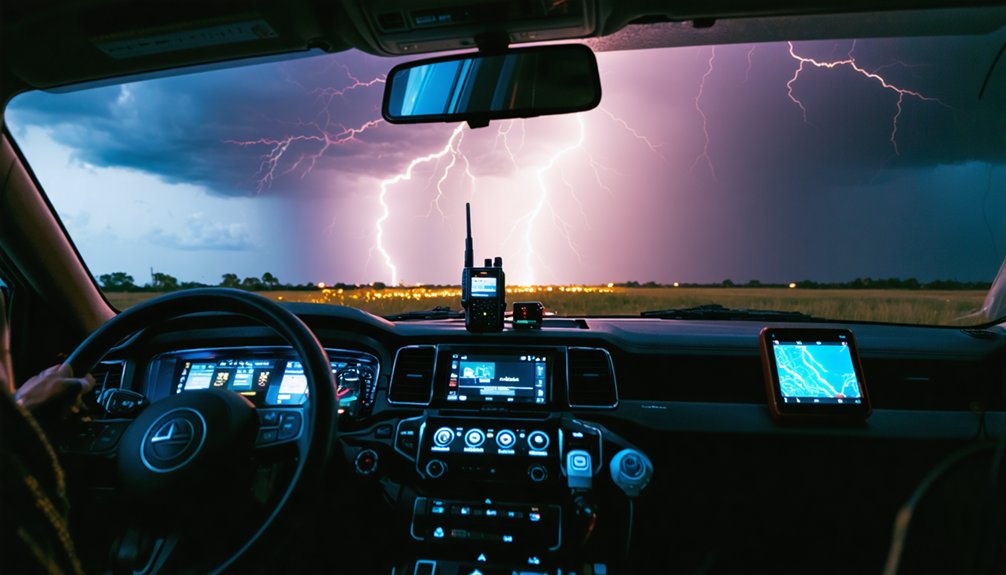
Tracking your position with a hardened GPS unit keeps your team oriented, but location data alone won’t sustain operations when infrastructure fails across multiple systems simultaneously. You need layered redundancy built intentionally.
Start with NOAA weather radio as your baseline alert layer. Add two-way radios for vehicle-to-vehicle tactical coordination. Deploy a satellite communicator like the Garmin inReach for two-way messaging and SOS capability when cellular networks collapse.
Keep a satellite phone available for voice communication during aerial reconnaissance support or remote coordination. Prioritize devices with data encryption where sensitive operational details transmit across networks.
Back every layer with power banks and solar chargers, because a dead device eliminates that layer entirely. Each system covers the failure points of the one before it.
Power Solutions That Keep Your Storm Chase Gear Running
Every layer of redundancy you’ve built collapses the moment your devices lose power. Battery longevity and antenna design mean nothing if your gear goes dark mid-chase. Build your power strategy as seriously as your communication stack.
- Power banks – Carry high-capacity units (20,000mAh+) to sustain radios, GPS units, and satellite communicators through extended deployments.
- Solar chargers – Deploy panel-based chargers during daylight operations to offset drain without relying on vehicle power.
- Portable generators – Support high-draw equipment like mobile hotspots and base radios when stationary in remote zones.
- Waterproof storage – Protect all power hardware from rain, debris, and moisture to maintain operational integrity.
You stay mobile and independent only when your power infrastructure holds. Plan it before you chase.
Frequently Asked Questions
Can Storm Chasers Legally Operate GMRS Radios Without a License?
You can’t legally operate GMRS radios without a license. Radio regulations require you to obtain an FCC GMRS license before transmitting. Legal licensing costs $35, covers your entire household, and guarantees you’re operating within lawful parameters.
How Do Satellite Communicators Perform Inside a Vehicle During a Chase?
Your vehicle’s roof and metal frame block satellite signals, reducing vehicle signal strength. You’ll need external antenna mounts for interference mitigation, ensuring your Garmin inReach maintains reliable two-way messaging and SOS connectivity during active chase operations.
What Communication Devices Do Professional Meteorologists Recommend for Beginners?
Like a soldier’s kit, you’ll need layered tools: start with a NOAA weather radio for emergency preparedness, add two-way radios for coordination, and use GPS devices to sharpen your weather forecasting situational awareness in the field.
Are There Subscription Fees Required for Satellite Communicators to Function?
Yes, you’ll need to pay subscription costs and satellite fees to activate two-way messaging and SOS functions on devices like Garmin inReach. Without an active plan, core communication features won’t operate in the field.
How Should Storm Chasers Store Communication Devices to Prevent Weather Damage?
Just as a storm strikes the moment your radio fails, you can’t afford that coincidence. Use weatherproof storage cases and sealed containers for device protection, keeping your communication gear dry, secure, and field-ready always.
References
- https://store.sirui.com/blogs/guides/essential-equipment-for-storm-chasing-guide-for-2025
- https://crazystormchasers.com/reliable-communication-devices-for-storm-chasers/
- https://prepare.blog/blog/emergency-communication-staying-connected-when-it-counts/
- https://crazystormchasers.com/best-tech-tools-for-storm-chasers-response-coordination/
- https://stormreadyhome.com/emergency-communication-tools/
- https://crazystormchasers.com/storm-chaser-gps-tracking-devices/