For storm spotting, you’ll want a mobile radio with 25–50W output over a 5W handheld—it gives you stronger repeater access and better simplex range when conditions deteriorate fast. Mount a 5/8-wave whip antenna with at least 3 dB gain on your vehicle’s roof for ideal coverage. Program your local SKYWARN repeater frequencies before activation season, and verify them with your regional NWS office. Everything from weatherproof gear to spotter training ties directly into how effectively you operate in the field.
Key Takeaways
- Mobile radios (25–50W) outperform 5W handhelds in severe weather, offering stronger repeater access and reliable communication during storm deployments.
- Mount 5/8-wave whip antennas with at least 3 dB gain using NMO mounts for maximum durability and signal performance.
- Program local SKYWARN repeater frequencies and net schedules into your radio before storm season begins.
- IP67-rated housings, sealed ports, and minimum 1,500 mAh batteries ensure field radios withstand harsh weather conditions.
- Ham radio operates independently of cell towers and internet, maintaining reliable two-way communication when commercial networks fail.
Mobile vs. Handheld Radios: Which Is Better for Storm Spotting?
When choosing between a mobile and handheld radio for storm spotting, the setup you pick directly affects your range, reliability, and operational endurance.
Mobile radios deliver 25–50 W of transmit power, giving you stronger repeater access and clearer signal propagation during active severe weather. Paired with a vehicle-mounted 5/8-wave whip offering 3 dB gain, antenna durability becomes a genuine advantage over handheld alternatives in harsh field conditions.
Mobile radios push 25–50 W of power, cutting through severe weather where handhelds simply cannot compete.
Handhelds work for short-range or repeater-dependent operations, but their 5 W output and limited battery optimization make extended deployments harder to sustain.
Mobile units connect directly to your vehicle’s 12-volt system, eliminating battery fatigue entirely. If you’re serious about dependable storm spotting, a mobile radio with an external antenna is the stronger, more capable choice.
How Much Transmit Power Do You Need for Storm Spotting?
When choosing a radio for storm spotting, transmit power directly affects your ability to hit repeaters and maintain reliable communications in the field.
Handheld radios typically output 5 watts, which may work for close-range or repeater-based operations but can fall short under demanding field conditions.
For vehicle-based spotting, you’ll want a mobile radio producing 25 to 50 watts, giving you a significant advantage in both repeater access and overall range.
Handheld Versus Mobile Power
Transmit power directly affects your ability to reach a repeater or work simplex during severe weather, so choosing between a handheld and a mobile radio isn’t a trivial decision.
Handhelds typically output 5 watts, which works for close repeaters but struggles under heavy precipitation or terrain interference.
Mobile radios deliver 25–50 watts, giving you a clear advantage when conditions deteriorate fast.
Mobile setups also support vehicle-mounted external antennas, where antenna durability matters because hail and wind stress connections and elements.
A 5/8-wave whip rated for field conditions outperforms any rubber duck.
Battery longevity is another factor—mobile radios run off your vehicle’s 12-volt system, eliminating the recharge pressure that handhelds create during multi-hour activations.
If you’re serious about reliable storm reporting, a mobile radio wins decisively.
Minimum Wattage Recommendations
Settling on the right radio is one thing—knowing exactly how much power you need behind it’s another. For handheld units, 5 W is the cited floor, but it’s marginal under real storm conditions. Mobile radios performing at 25–50 W give you reliable repeater access and stronger simplex range when it matters most.
Higher output also reduces strain on your setup. You won’t be pushing your antenna durability limits by compensating with poor signal, and you won’t drain reserves chasing retransmissions—protecting battery longevity across multi-hour activations.
If you’re vehicle-mounted, connect your mobile radio directly to your 12-volt system and run an external antenna. That combination—adequate wattage plus a proper antenna—keeps you transmitting clearly when the NWS net needs your report.
The Best Antennas for Vehicle-Based Storm Spotting
When you mount an antenna directly to your vehicle, you gain a significant performance advantage over using a handheld radio inside the cab.
A 5/8-wave whip with at least 3 dB of gain gives you improved range and more reliable repeater access during active storm operations.
Your mounting choice—whether a mag mount, lip mount, or NMO through-hole—affects both antenna stability in high winds and the quality of the ground plane beneath it.
Vehicle Antenna Mounting Options
Choosing the right antenna mount can make or break your vehicle-based storm-spotting setup. Your three main options are magnetic mounts, lip mounts, and permanent NMO mounts.
Magnetic mounts offer quick deployment but can shift during high winds or hail.
Lip mounts clip to door frames or trunk lids, giving you a more secure fit without drilling.
For serious field work, an NMO mount with a drilled roof installation delivers the most reliable antenna placement and the lowest feed-line loss.
Use quality mounting brackets rated for outdoor exposure, and route your coax carefully to avoid pinch points.
A center-roof NMO position maximizes your radiation pattern in all directions, which matters when you’re repositioning rapidly around a developing storm.
Gain And Coverage Benefits
Once you’ve locked down your mount, the antenna itself determines how far your signal travels. Antenna gain directly affects signal range, and for vehicle-based spotting, a 5/8-wave whip delivering at least 3 dB of gain outperforms a standard quarter-wave in most field conditions.
That extra gain concentrates your radiated power toward the horizon, which is exactly where repeaters and other spotters are located. You’re not wasting energy broadcasting skyward.
For dual-band operation, choose an antenna rated for both VHF and UHF. This lets you hit your local SKYWARN repeater on one band while maintaining APRS tracking on 144.390 MHz on the other.
A quality dual-band antenna gives you that flexibility without sacrificing performance on either frequency.
Key Frequencies Every Storm Spotter Should Program
Your local SKYWARN repeater frequency is equally critical — pull it from your regional ARES group or NWS-affiliated net before you deploy. Emergency protocols often require you to check in on a designated repeater, so having it ready eliminates fumbling under pressure.
Use dual VFO mode to monitor APRS and your local repeater simultaneously without switching channels manually.
How to Find Your Local SKYWARN Repeater Frequency
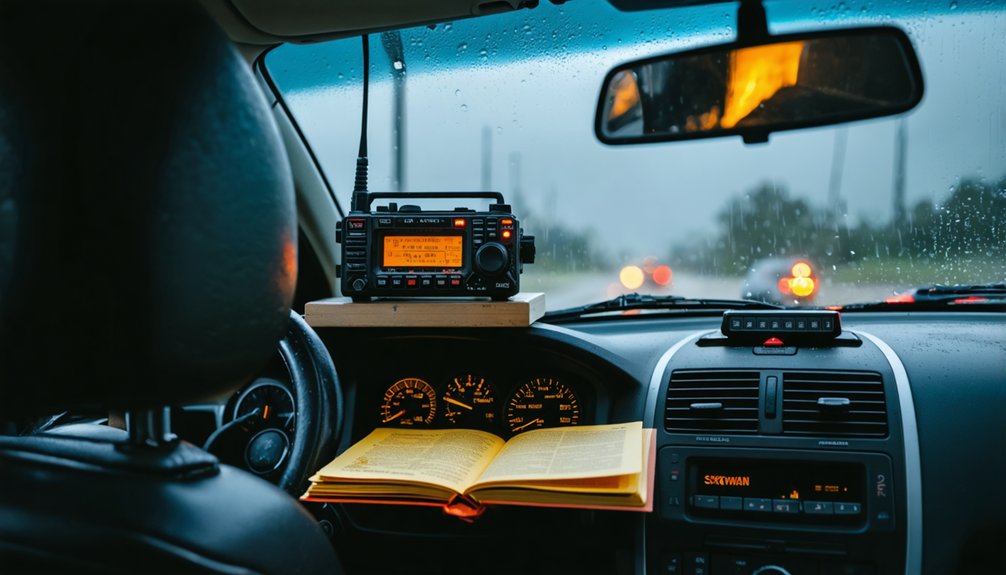
To find your local SKYWARN repeater frequency, contact your regional ARES group or amateur radio club, as they maintain current net schedules and frequency lists for your area.
You can also check with your nearest NWS office, which typically publishes affiliated net information for licensed spotters.
Once you’ve completed SKYWARN training and received your spotter ID, verify all local frequencies in advance and program them before the next activation.
Contact Local ARES Groups
Finding your local SKYWARN repeater frequency starts with contacting your regional ARES (Amateur Radio Emergency Service) group. ARES coordinators maintain updated repeater lists tied directly to NWS-affiliated nets in your area, giving you accurate, verified frequencies rather than outdated online sources.
Reach your local ARES group through the ARRL’s online directory or by checking with your nearest amateur radio club. Once you’ve confirmed your primary and backup repeater frequencies, program them before any activation.
While you’re coordinating, also verify your antenna durability for field deployment and review your battery management plan for extended operations. Activations can run several hours, so you’ll want a charged spare or a direct vehicle power connection ready before severe weather develops.
Check NWS-Affiliated Nets
Each NWS Weather Forecast Office sponsors or coordinates with local SKYWARN nets, so checking directly with your nearest WFO is one of the most reliable ways to get accurate repeater frequencies for your area. Visit the NWS website, locate your regional WFO, and look for SKYWARN or emergency preparedness contact pages listing affiliated nets and frequencies.
Many WFOs publish spotter program details, including net schedules and primary repeater inputs. You can also call the WFO directly to confirm current frequencies, since repeater coordination changes over time.
Some nets operate alongside meteorological sensors and data collection systems, integrating spotter reports with automated readings.
Program confirmed frequencies into your radio before activation season begins, and verify them annually to make sure you’re working with current, accurate net information.
Why Ham Radio Is the Backbone of SKYWARN Operations
When cell towers fail and internet infrastructure goes dark during severe weather, ham radio keeps SKYWARN operations running. You’re operating on independent RF infrastructure that doesn’t rely on commercial networks, which makes it uniquely resilient when those systems collapse under storm conditions.
Ham radio doesn’t depend on commercial networks — making it the last system standing when severe weather strikes.
Your emergency kit should include a programmed mobile or handheld radio capable of reaching local SKYWARN repeaters and simplex frequencies. Signal amplification through a vehicle-mounted external antenna extends your effective range well beyond what a handheld alone can deliver.
Licensed amateur operators form the direct link between ground-level observations and NWS forecasters. No other communication system gives spotters this combination of reliability, independence, and real-time two-way capability during active severe weather events.
That’s why NWS continues building SKYWARN around the amateur radio framework.
What to Look For in a Weatherproof Field Radio
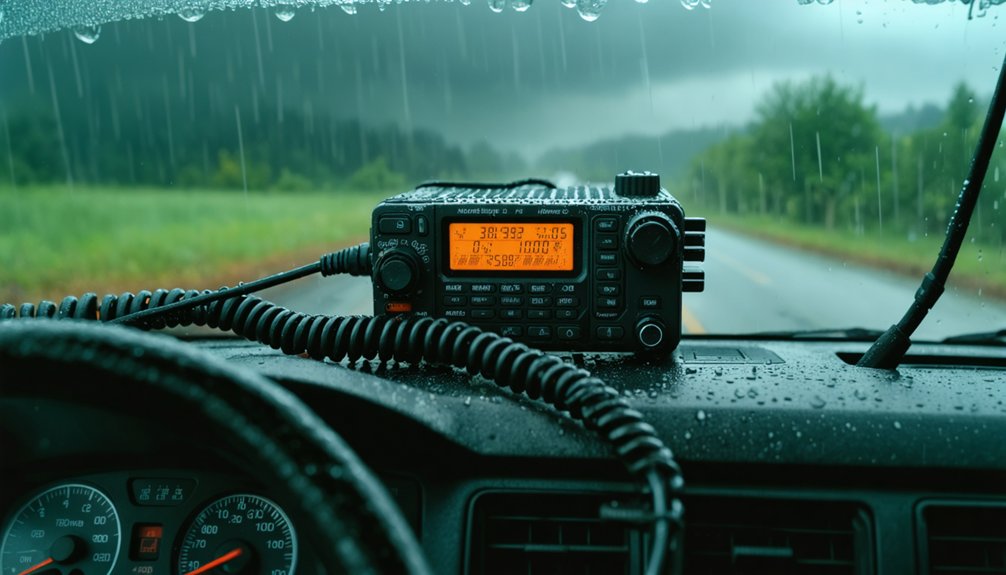
Choosing the right field radio starts with weatherproofing—look for IP67-rated housings and sealed port covers that can handle direct rain, hail, and wind-driven debris. Durability considerations don’t stop at the shell; internal components need to withstand repeated thermal stress and vibration from extended field deployments.
Battery longevity is equally critical. You’ll want a minimum capacity of 1,500 mAh for portable units, but longer activations demand spare batteries or a car charger connected to your vehicle’s 12-volt system. Don’t let a dead battery cut your reporting short during peak storm activity.
For mobile setups, power draw from higher-wattage radios is manageable when you’re running off your vehicle. Prioritize radios that balance output power, rugged construction, and sustained battery performance under real field conditions.
Reporting Tools That Complement Your Radio Setup in the Field
Your radio transmits the report, but the tools you carry determine its accuracy. Pack a calibrated anemometer to measure wind speed and gusts precisely. Use a hail card or ruler to size hailstones accurately before calling them in. A rain gauge gives you exact precipitation totals rather than estimates. Log every observation in a weather-resistant notebook, recording time, location, and measurement.
While aerial drones can extend your visual range beyond the roadside, check local airspace rules before deploying during active severe weather operations. Satellite imagery accessed through a mobile device helps you correlate ground-level observations with the broader storm structure.
Together, these tools transform your radio call from a vague report into verified, actionable data that forecasters and emergency managers can immediately trust and use.
How SKYWARN Spotter Training Works and Why It Matters
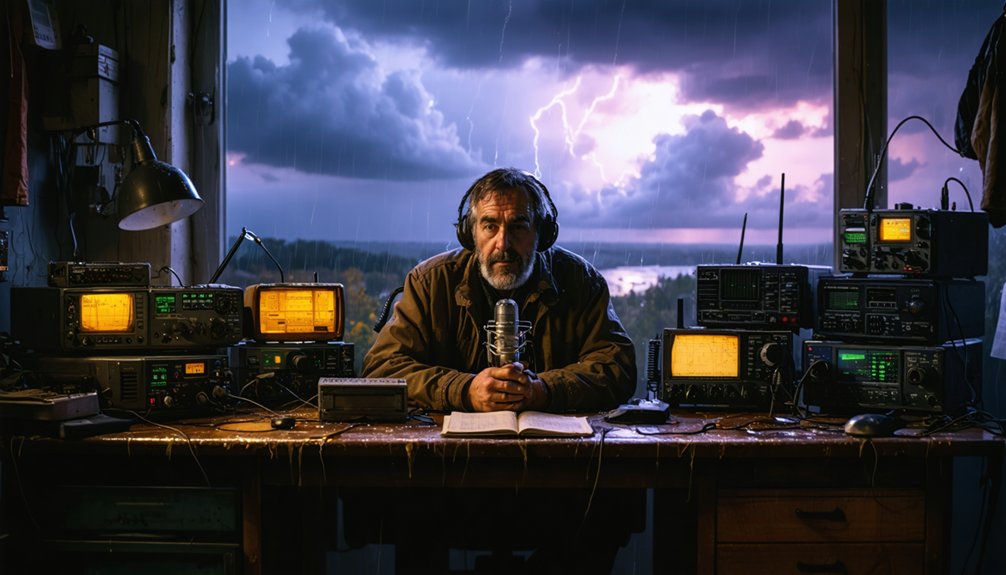
Before you key up on a SKYWARN net, you’ll need to complete spotter training through the National Weather Service. In-person classes typically run two to three hours and cover storm structure, damage indicators, and safe positioning. Online courses are also available if local sessions aren’t scheduled near you.
After completing training in some NWS warning areas, you’ll receive a spotter ID number to use when checking into nets. This credentials your reports and strengthens community involvement across the emergency preparedness network.
Program your local SKYWARN repeater frequencies before severe weather season starts. Verify those frequencies through your local ARES group or affiliated amateur radio club.
Training isn’t just a formality—it ensures your field reports are accurate, actionable, and trusted by NWS meteorologists when conditions deteriorate fast.
Vehicle Safety Rules Every Active Spotter Should Follow
Staying alive in the field depends as much on positioning as it does on your radio setup. You’re responsible for your own safety, so treat vehicle maintenance and emergency first aid as non-negotiable pre-deployment checks. A mechanical failure during active weather puts you directly in harm’s way.
- Never position your vehicle in a tornado’s projected path, even temporarily.
- Stay inside during hail or high winds—your vehicle provides critical protection.
- Keep emergency first aid supplies and a charged communication device accessible at all times.
Verify your brakes, tires, and fuel before every deployment. Poor vehicle maintenance eliminates your ability to reposition quickly when conditions deteriorate.
Your exit route matters more than your vantage point. Mobility is your primary safety tool.
Frequently Asked Questions
Can Unlicensed Individuals Legally Operate Ham Radios During Storm Spotting?
You can’t legally operate ham radios without a license—licensing requirements apply universally. Legal restrictions prohibit unlicensed transmission. Obtain your Technician license first; it’s your gateway to unrestricted storm-spotting communications and true operational freedom.
Do Storm Spotters Need to Register With Their Local NWS Office?
Imagine you’re deploying in Oklahoma’s Tornado Alley — you’ll want SKYWARN training first. You don’t legally have to register, but doing so optimizes your emergency preparedness, grants a spotter ID, and guarantees proper radio frequency allocation coordination with NWS nets.
What Spotter ID Number Format Is Typically Assigned After SKYWARN Training?
The knowledge base doesn’t specify exact Spotter ID Format Standards. After SKYWARN training, you’ll receive a unique ID from your regional NWS office—contact your local ARES group to confirm your assigned format.
Can APRS Tracking Replace Voice Radio Reporting During Active Storm Events?
APRS is a beacon, not a voice—it can’t replace voice radio reporting during active storm events. You’ll need real-time emergency communication through digital modes to supplement, but voice reporting remains your critical lifeline.
Are There Dedicated Ham Radio Nets That Operate Outside of Severe Weather Events?
Yes, you’ll find dedicated nets operating year-round, covering traffic nets, ARES training nets, and emergency communication protocols drills. They keep you sharp on amateur radio regulations and procedures, ensuring you’re ready when severe weather activates your local SKYWARN net.
References
- https://www.reddit.com/r/amateurradio/comments/1gmhp1n/best_radio_for_nws_weather_spotting_reports/
- https://www.jpole-antenna.com/2014/03/18/severe-weather-storm-spotter-equipment/
- https://www.youtube.com/watch?v=Kb_1ppyHIkA
- https://crazystormchasers.com/best-ham-radio-setup-for-storm-chasers-and-spotters/
- https://w9lw.farlowconsulting.com/tag/storm-spotters/
- https://www.hamradiobase.com/ham-radio-emcomm-skywarn/