For storm and tornado photography, you’ll want three core lenses: a wide-angle (14–24mm) for full supercell structures, a standard zoom (24–70mm) for shifting compositions, and a telephoto (70–200mm or longer) for distant funnels when proximity isn’t safe. Prioritize f/2.8 apertures, image stabilization, and weather sealing across your kit. Your lens choice isn’t just about image quality—it’s a safety decision. There’s much more to choosing the right glass for these extreme conditions.
Key Takeaways
- Wide-angle lenses (14–24mm) are ideal for capturing full storm structures like supercells and shelf clouds up close.
- Standard zoom lenses (24–70mm) offer versatility for rapidly shifting storm scenes without requiring lens swaps.
- Telephoto lenses (70–200mm or longer) safely isolate distant tornado funnels and debris clouds with atmospheric compression.
- A three-lens kit covering wide, standard, and telephoto ranges provides comprehensive coverage for diverse storm conditions.
- Essential lens features include f/2.8 aperture, image stabilization, weather sealing, and moisture-resistant coatings.
How Storm Distance Determines the Right Focal Length
How far you’re from the storm dictates everything about which lens belongs on your camera. At close range, a 14–24mm wide-angle captures the full supercell, wall cloud, and foreground in one frame.
Move farther out, and a 24–70mm standard zoom gives you flexible coverage as the scene shifts. When the tornado’s distant or unsafe to approach, a 70–200mm telephoto isolates funnel detail and debris clouds without closing the gap.
Lens material quality directly affects your results under pressure. Cheaper glass introduces chromatic aberration in high-contrast storm edges, softening critical detail exactly when you need sharpness most.
Match your focal length to your actual distance before the scene evolves—you won’t have time to second-guess your setup once the rotation tightens and the storm starts moving.
Wide-Angle Lenses for Supercells, Shelf Clouds, and Full Structure
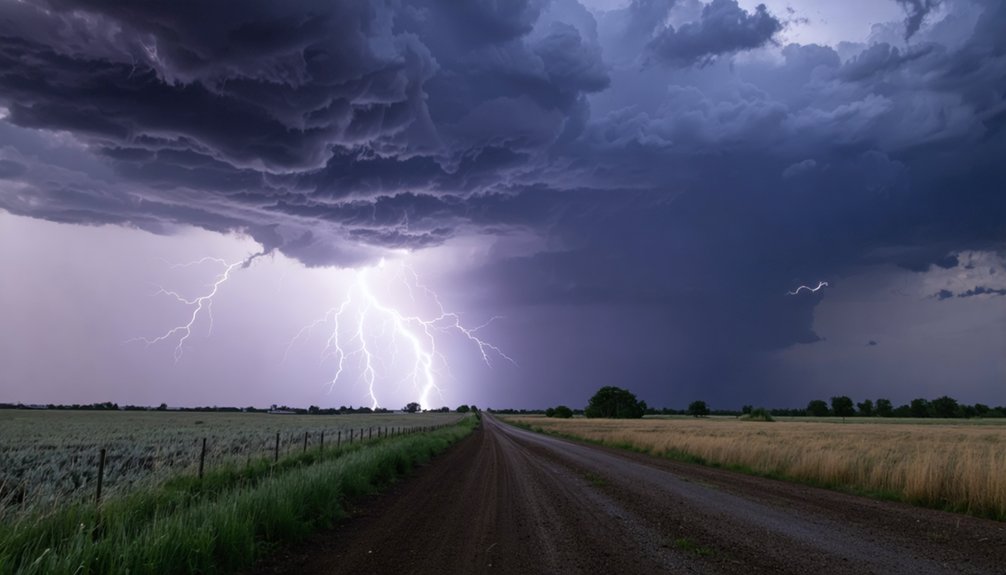
When you’re shooting a full supercell, shelf cloud, or sprawling inflow structure, you’ll want a focal length between 14mm and 35mm to capture the entire scene in a single frame.
The 14–24mm range gives you the most dramatic coverage when the storm is close and you need foreground terrain alongside the sky, while 24–35mm reduces distortion for cleaner storm architecture shots.
For real-world glass, the Nikon 14-24mm f/2.8, Tamron 15-30mm f/2.8, and the wide end of a Canon 24-105mm are proven field choices that balance optical quality with weather-exposed durability.
Ideal Focal Lengths Explained
Wide-angle lenses in the 14–24mm range give you the firepower to capture an entire supercell, wall cloud, and foreground landscape in a single frame—something no other focal length can deliver at close range.
At 14mm, you’re pulling dramatic inflow bands and turbulent skies into a single composition that communicates raw scale. Push toward 24–35mm when you want broader storm architecture with less distortion pulling at the edges.
Modern sensor technology maximizes what these focal lengths can deliver, especially in low-contrast storm light where detail lives in the shadows. Pair that with responsive autofocus systems and you’re not missing the moment when rotation tightens fast.
If the storm is close and the sky is everything, nothing matches a wide-angle lens for telling the full story immediately.
Best Wide-Angle Lens Picks
Choosing the right wide-angle lens for storm photography comes down to three real-world options that consistently prove themselves in the field. The Nikon 14-24mm f/2.8, Tamron 15-30mm f/2.8, and Canon 24-105mm wide end give you the full supercell, wall cloud, and terrain in one frame. Their weather sealing survives what storms throw at you, and their sharpness holds up through color grading and post processing.
- Stand beneath a rotating wall cloud and feel the pressure drop
- Capture inflow bands stretching across open plains
- Frame a shelf cloud swallowing the horizon
- Pull every shadow detail out in post processing
- Let color grading reveal the sickly green atmosphere you lived through
Standard Zooms for General Storm Coverage and Shifting Compositions
When a storm’s behavior shifts rapidly, you need a lens that keeps up without forcing a swap. A 24–70mm standard zoom gives you the range to move from full storm architecture to tighter environmental details in a single rotation of the barrel.
If your scene changes faster than you can predict, this focal range keeps you shooting instead of scrambling through your bag.
Versatile Range for Coverage
Standard zooms sit at the core of most storm photographers’ kits because they handle the widest variety of situations without a lens swap. When lighting conditions shift fast and the storm pivots direction, you don’t have time to dig through your bag. Camera compatibility with a reliable 24–70mm keeps you locked in and moving.
- You’ll capture a shelf cloud rolling overhead before it swallows the sky
- You’ll hold the full supercell structure without cropping out the tension below
- You’ll pivot instantly when a funnel drops without warning
- You’ll document the chaos without missing the moment that defines the chase
- You’ll own every frame between wide landscape and tight environmental detail
This range doesn’t compromise. It keeps you free, reactive, and in control.
Adapting to Shifting Compositions
Storm structure rarely holds still long enough for you to optimize a single focal length. A supercell that fills the frame at 24mm can shift within minutes, demanding tighter compression to isolate a rotating wall cloud. That’s where a 24–70mm earns its place. You move between broad context and focused detail without swapping glass in the rain.
Strong lens coatings matter here—water beading off the front element keeps your image clean when spray hits hard. Your autofocus systems need to track fast-moving inflow and debris without hunting. When the composition breaks open or collapses suddenly, you respond immediately rather than digging through your bag.
The standard zoom keeps you locked in, frame after frame, across the full life cycle of a developing storm.
Telephoto Lenses for Distant Tornadoes and Funnel Detail
For distant tornadoes and tight funnel detail, telephoto lenses are your primary tool. When closing the distance isn’t safe, reach is everything. A 70–200mm f/2.8 gives you speed, flexibility, and isolation. If the storm’s far out, push to 100–400mm for compressed atmospheric layers and debris clarity.
Prioritize weather-sealed glass with quality lens coatings to cut flare and maintain contrast in chaotic light. Watch for optical aberrations at maximum zoom — they’ll soften critical funnel edges when detail matters most.
- That rotating wall could become a wedge tornado in seconds
- Every frame may be the last clear shot before rain curtains close
- Distance keeps you alive to shoot another storm
- Image stabilization means sharper detail when your hands are shaking
- Missing focus on a funnel hurts long after the storm is gone
Aperture, Image Stabilization, and Weather Sealing for Storm Conditions
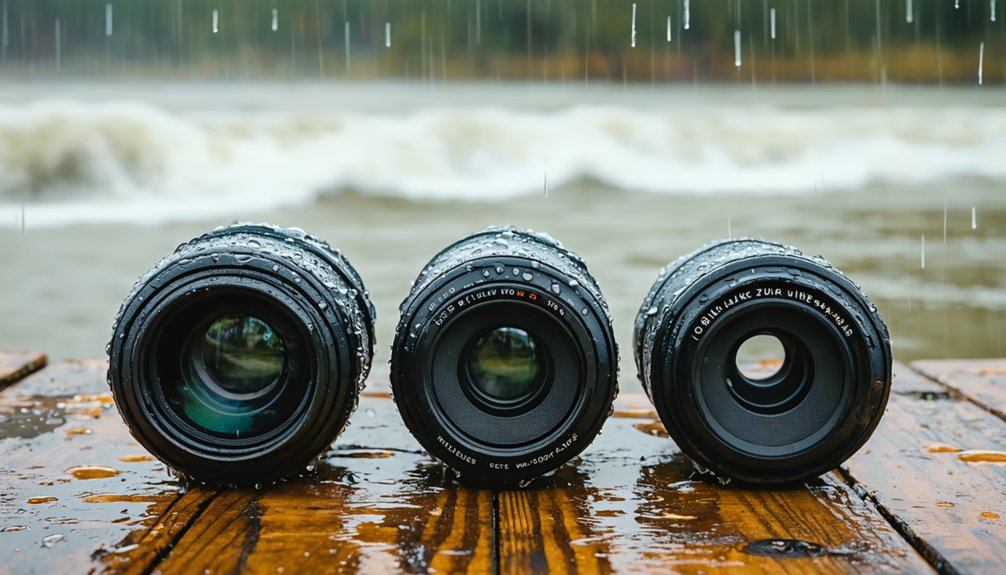
When conditions deteriorate fast, three lens specs determine whether you come home with usable frames: aperture, image stabilization, and weather sealing.
Shoot f/2.8 glass whenever possible — it keeps your shutter speed high enough to freeze rotation and funnel movement in fading light.
Image stabilization becomes critical during handheld telephoto work, where even minor hand tremor destroys sharpness at 200mm and beyond.
Weather sealing locks out rain, dust, and wind-driven debris that will kill an unsealed lens mid-chase.
Check that your lens coatings resist moisture and flare, since storm light shifts violently between dark and brilliant.
Autofocus accuracy also depends on clean front elements — wipe them often.
These three specs aren’t upgrades; they’re field requirements the moment you leave pavement.
The Three-Lens Kit Most Storm Photographers Carry
Most working storm photographers settle on three lenses: a wide-angle zoom in the 14–24mm range, a standard zoom around 24–70mm, and a telephoto zoom covering 70–200mm or longer. This kit gives you the freedom to chase any condition without being trapped by the wrong focal length.
Three lenses cover every storm: wide, standard, and telephoto. The right focal length is never a gamble.
Shooting ergonomics matter here—each lens should mount and dismount fast, even in wind and rain.
- Wide-angle captures the full supercell bearing down on open land
- Standard zoom shifts you between structure and environmental detail instantly
- Telephoto isolates the funnel when getting closer isn’t an option
- Lens maintenance keeps your glass reliable when conditions turn violent
- Three lenses mean three chances to tell the truth of what you’re witnessing
Lens Priorities When Safety Constraints Change the Shot
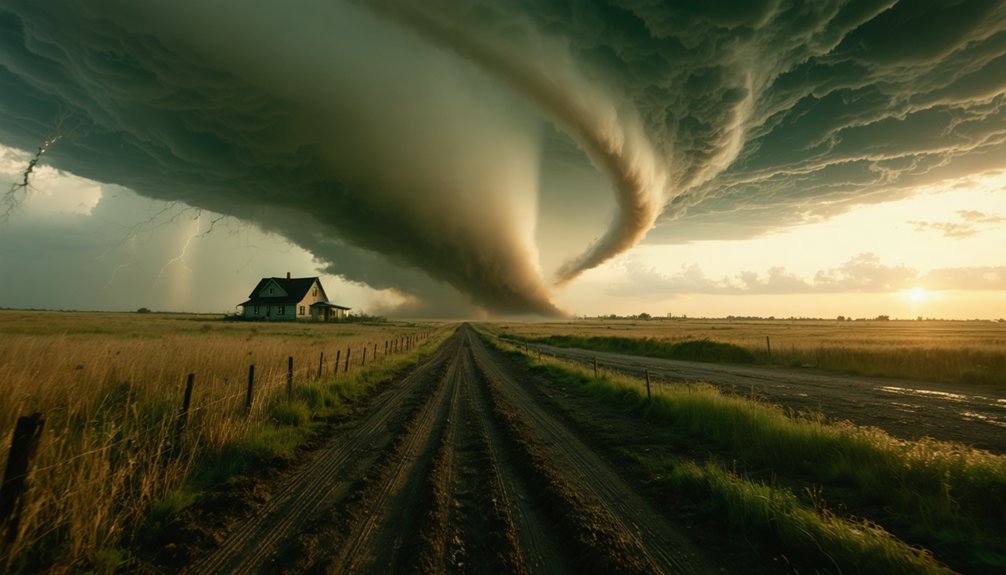
Safety changes everything about how you frame a shot. When a tornado shifts direction or accelerates, your first move isn’t reaching for a better angle—it’s creating distance. That distance drives your lens choice. A telephoto zoom, typically 70–200mm or longer, lets you keep shooting while staying far enough back to maintain an escape route.
Storm safety isn’t separate from your technical decisions; it’s embedded in them.
Switching to a longer focal length under pressure also means your gear takes more handling stress. Prioritize lens maintenance before you’re in the field—clean contacts, secured zoom rings, and weather-sealed bodies reduce failures when conditions deteriorate fast. You can’t afford a fogged element or a loose mount when the storm’s closing in and you’re already moving.
Frequently Asked Questions
Can Crop-Sensor Cameras Use the Same Focal Length Recommendations as Full-Frame?
No, you can’t directly apply the same focal length recommendations due to sensor size affecting focal length compatibility. Multiply by ~1.5x crop factor, so you’ll need a 10–16mm to match full-frame wide-angle storm coverage.
Are Prime Lenses Ever Practical for Fast-Moving Storm Photography Situations?
Ironically, yes — primes *can* work, but you’ll fight yourself. When a tornado shifts fast, motion blur kills your shot and slow recomposing costs you frames. Prioritize autofocus speed; zooms give you the freedom primes can’t.
How Do Storm Photographers Protect Lenses From Rain Without Slowing Shooting?
Use rain sleeves and lens hoods as your first rainproof gear accessories—they’ll keep you shooting fast. Master quick lens cleaning techniques with a microfiber cloth tucked in your pocket, so you’re never missing the moment.
Does Lens Weight Become a Serious Issue During Long Storm-Chasing Days?
Yes, lens weight strains you fast. You’ll feel it in your arms after hours of chasing. Prioritize lens ergonomics and camera grip durability—lighter f/2.8 zooms let you move freely without sacrificing speed when the tornado drops unexpectedly.
Which Lens Brands Offer the Best Weather Sealing at Lower Price Points?
Like armor built for battle, Tamron and Sigma deliver weather resistant gear with budget friendly options — their f/2.8 zooms seal out rain and dust, giving you dependable field performance without chaining you to premium price tags.
References
- https://www.prairiepictures.com/camera-news-reviews-techniques/2017/4/6/best-gear-for-storm-photography
- https://www.naturettl.com/how-to-photograph-storms-supercells-lightning-tornadoes/
- https://crazystormchasers.com/capturing-storms-a-researchers-guide/
- https://www.bhphotovideo.com/explora/photography/tips-and-solutions/the-travel-series-storm-photography-tips-with-mike-mezeul-ii
- http://willardsharpphotography.com/2019/03/my-storm-chasing-photography-gear/
- https://fixthephoto.com/how-to-photograph-storms.html
- https://www.tamron.eu/en/newsroom/blog/storm-chasing-in-tornado-alley
- https://electronics.alibaba.com/buyingguides/tornado-photography-gear-guide-2026
- https://www.severe-weather.eu/learnweather/photography-tutorials/storm-photography-mk/
- https://www.stormchasingusa.com/blog/choosing-camera-and-lenses-for-storm-chasing-my-thoughts/