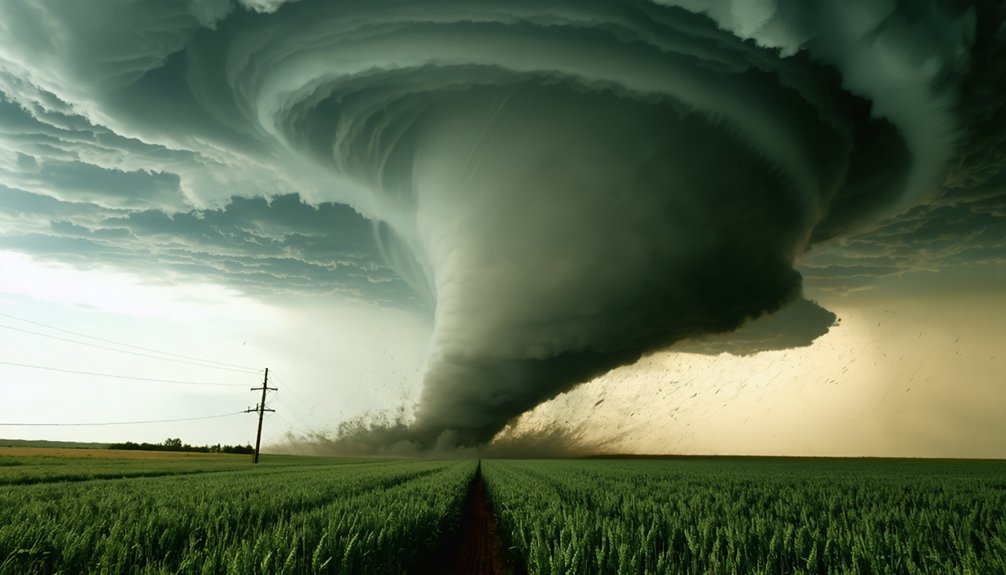
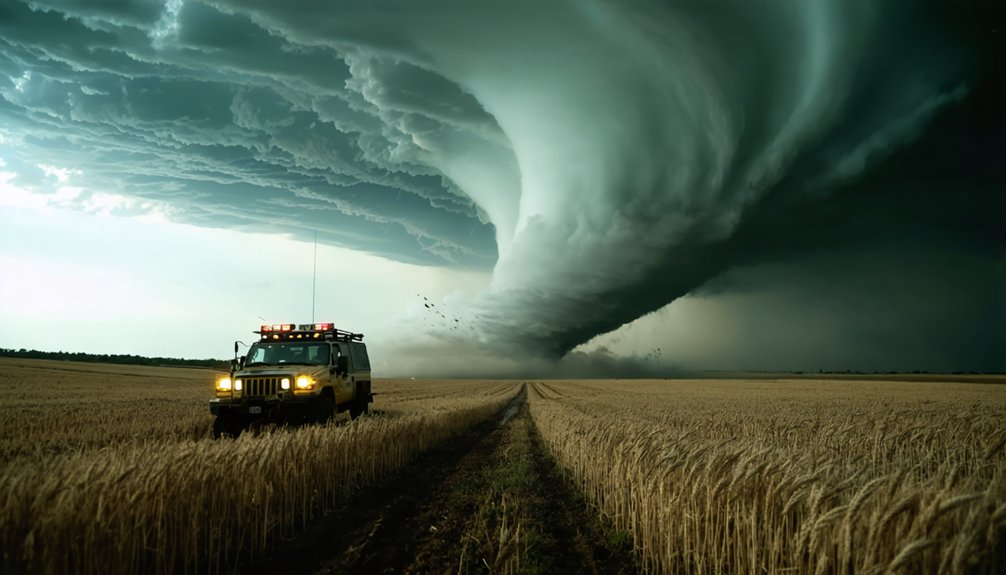
If you want storm chasing’s most gripping personal accounts, you can’t overlook Reed Timmer, Tim Samaras, and Mark Dillman. Timmer intercepts tornadoes within hundreds of meters using armored vehicles, capturing high-resolution pressure data. Samaras deployed ground-level sensor probes with laboratory-grade discipline, prioritizing data integrity over spectacle. Dillman translates raw atmospheric structure into precise visual documentation. Each account carries a distinct methodology, and the details behind their field decisions reveal far more than the headline numbers suggest.
Key Takeaways
- Reed Timmer’s accounts highlight armored vehicle intercepts within hundreds of meters of tornadoes, blending high-resolution data collection with extreme personal risk.
- Tim Samaras documented ground-level pressure drops and inflow structures through disciplined instrument deployment, prioritizing scientific accuracy over spectacle.
- Mark Dillman’s visual storytelling captures supercell evolution, wall clouds, and rotating updrafts, translating atmospheric behavior into compelling storm photography.
- Samaras’s field research approach resembled laboratory discipline, making his personal accounts uniquely valuable for understanding tornado instrumentation and data integrity.
- Timmer’s real-time radar integration and split-second route decisions make his personal chase accounts both scientifically significant and viscerally compelling.
Reed Timmer’s Storm Chasing Intercepts and Why He Gets So Close
Reed Timmer doesn’t just chase storms—he intercepts them at ranges most chasers actively avoid. You’re looking at close proximity deployments, often within a few hundred meters of confirmed tornadoes, where wind-load calculations and debris trajectories become immediate survival variables.
Reed Timmer intercepts tornadoes at ranges where debris trajectories and wind-load calculations become immediate survival variables.
Timmer uses armored intercept vehicles specifically engineered for extreme-pressure environments, which lets him push past thresholds where standard chase vehicles fail structurally.
The adrenaline rush he describes isn’t incidental—it’s embedded in the data-collection process itself. Closer intercepts produce higher-resolution pressure readings, inflow measurements, and visual documentation of tornado structure that remote positioning simply can’t replicate.
You get science and spectacle simultaneously. His accounts consistently emphasize rapid repositioning, real-time radar integration, and split-second route decisions that distinguish calculated intercept strategy from reckless exposure.
Tim Samaras: The Storm Chaser Who Brought Science Into the Field
Where Timmer prioritized intercept proximity, Tim Samaras built his chase methodology around instrument deployment—placing sensor probes directly in a tornado’s path to capture ground-level pressure, temperature, and wind-speed data that airborne or remote systems couldn’t retrieve. His storm research redefined what field-based tornado science could produce.
Reading his accounts, you’ll notice he framed every chase decision around data integrity, not spectacle. Target selection, positioning, and retreat timing all served scientific instrumentation objectives first.
He documented pressure drops, inflow structures, and debris fields with the same discipline a laboratory researcher applies to controlled experiments.
That precision makes his personal accounts distinctly valuable. You’re getting field observations filtered through scientific purpose—chasing as methodology rather than performance, with the danger fully intact and the data actually mattering.
Mark Dillman’s Storm Chasing Photography and What He Sees Up Close
While Samaras pursued data collection, Mark Dillman’s storm chasing centers on visual documentation—capturing tornado structure, lightning discharge, and supercell evolution from close range with a photographer’s precision. His work translates raw atmospheric textures into visual storytelling that communicates storm behavior without equations or instruments.
Dillman doesn’t measure storms—he photographs them, translating raw atmospheric fury into visual storytelling that needs no instruments to speak.
When you read Dillman’s accounts, you’re getting field-level observation distilled through a trained eye. He identifies wall clouds, rotating updrafts, and funnel formation by sight, positioning himself close enough to document structural detail while managing debris risk and visibility loss.
His decisions are fast and deliberate—repositioning based on storm motion, light angle, and intercept geometry.
His accounts offer you something rare: unfiltered storm proximity rendered through imagery and firsthand narrative, where what he sees becomes your clearest window into tornado-scale severe weather.
Frequently Asked Questions
How Do Storm Chasers Fund Their Expeditions Across Tornado Alley?
You’ll fund your expeditions through sponsorships, media contracts, and crowdfunding. You’re investing in storm chase gear and weather forecasting tools that generate sellable footage, research grants, and documentary deals driving financial independence across Tornado Alley.
What Legal Permits, if Any, Do Storm Chasers Need?
You don’t need formal permits to chase storms, but you’ll face insurance requirements if you’re operating professionally. Factor in ethical considerations — don’t block roads or endanger others while pursuing severe weather across Tornado Alley.
How Do Storm Chasers Communicate With Local Emergency Services During Chases?
Your radio’s your lifeline — you coordinate with emergency services using storm chasing gear like ham radios and weather prediction tools, transmitting real-time data, position updates, and storm reports directly to local dispatchers and National Weather Service offices.
What Physical Fitness Level Do Storm Chasers Typically Need to Maintain?
You don’t need elite athleticism, but you must maintain solid endurance. Your storm chaser gear demands quick deployment, and sharp weather prediction requires sustained mental focus—so cardiovascular fitness, fast reflexes, and physical readiness keep you operationally effective.
How Do Storm Chasers Handle Mental Health After Traumatic Weather Encounters?
You build emotional resilience through debriefing with fellow chasers, where peer support normalizes trauma responses. You’ll process acute stress by documenting encounters analytically, converting raw emotional data into structured field narratives that reinforce psychological recovery and operational readiness.
References
- https://www.facebook.com/melaniemetzstormchasing/posts/great-list-of-storm-chasers-here/1165437485585140/
- https://www.reddit.com/r/stormchasing/comments/rsdxg7/any_suggestions_for_good_storm_chasingtornado/
- https://stormtrack.org/threads/good-fiction-novels-about-storm-chasing.28153/
- https://www.nytimes.com/interactive/2024/07/19/magazine/tornado-alley-storm-chaser.html
- https://www.goodreads.com/shelf/show/storm-chasing
- https://www.reddit.com/r/tornado/comments/1mfcj4e/i_made_a_storm_chaser_tier_list_any_constructive/
- https://www.aip.org/inside-science/storm-chaser-firsthand-account
- https://www.nationalgeographic.com/environment/article/chasing-tornadoes
- https://www.youtube.com/watch?v=BqTGt0G_L4U
- https://www.nationalgeographic.com/magazine/article/the-last-chase