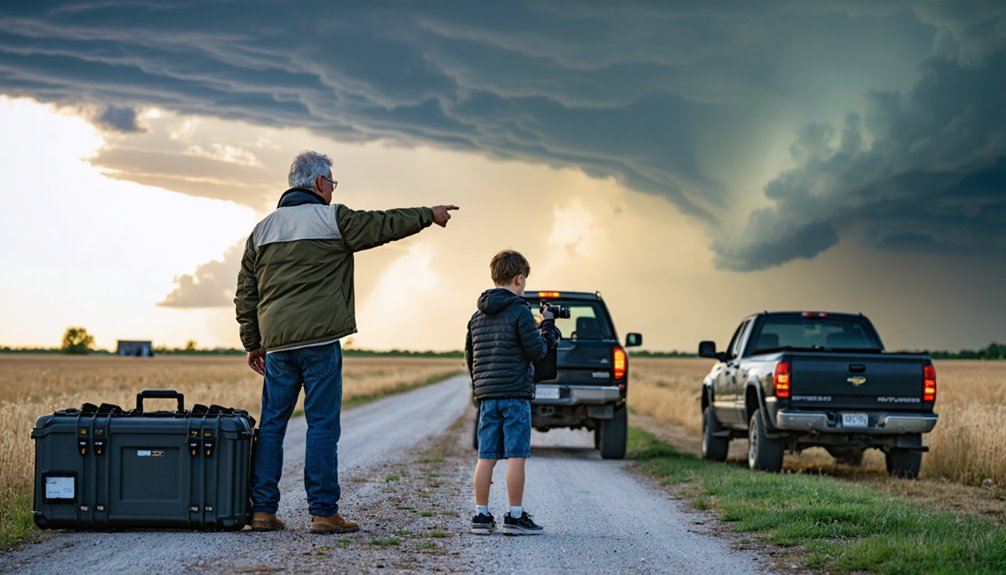
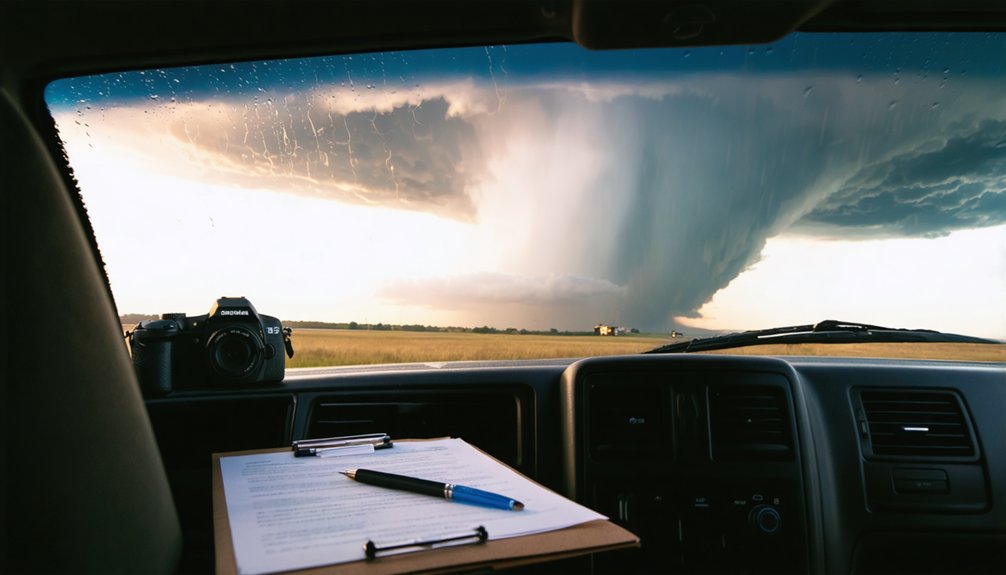
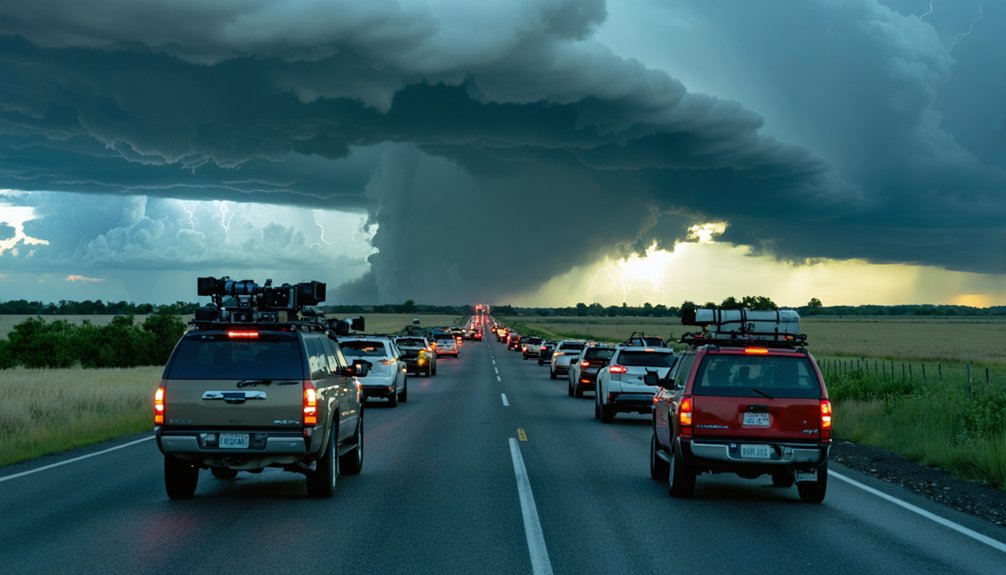
Storm chasing safety starts before you leave home. You’ll need to verify SPC convective outlooks, cross-reference NWS mesoscale discussions, and load real-time radar to confirm storm motion vectors. Inspect your vehicle thoroughly, assign defined team roles, and maintain at least a one-to-two mile buffer from confirmed tornadoes. Identify two independent escape routes before committing to any position, and recognize abort signs immediately. The best practices ahead break down every critical decision point you’ll face in the field.
Key Takeaways
- Consult Storm Prediction Center outlooks and cross-reference NWS mesoscale discussions before selecting target areas or committing to any chase route.
- Conduct pre-chase vehicle inspections covering tires, brakes, fluids, and fuel, while stocking emergency supplies for specific failure scenarios.
- Assign distinct team roles — Driver, Navigator, Communicator, Logger — and test all communication devices before entering the chase zone.
- Maintain at least one to two miles from confirmed tornadoes and always identify two independent escape routes before positioning.
- Recognize abort signs immediately, including storm motion reversal, flooded roads, nightfall, or loss of radar and GPS communication.
Plan Your Chase Before You Leave Home
Before you leave home, consult National Weather Service alerts, Storm Prediction Center outlooks, and real-time radar to verify storm timing, motion, and likely tornado-producing regions. Your chase strategy depends on accurate, pre-departure data—not assumptions made in the field.
Build your target area, fallback zones, and alternate routes before you enter the chase zone. Conduct a thorough risk assessment by mapping road closures, flood-prone corridors, and rural detours in advance.
Review state road conditions and anticipated traffic delays so congestion doesn’t compromise your positioning.
Preparation gives you options. When you’ve already identified your routes and variables, you’re free to respond to changing conditions decisively rather than reactively.
Solid pre-chase planning is what separates disciplined, effective chasers from those who improvise dangerously under pressure.
Check the Forecast, Radar, and SPC Outlooks First
Every chase begins with data. Before you leave, pull the Storm Prediction Center’s convective outlook to identify where storm dynamics favor tornado development. Cross-reference that with National Weather Service mesoscale discussions and current model runs to understand evolving weather patterns across your target region.
Load real-time radar and verify storm motion vectors, initiation timing, and likely track corridors. Don’t rely on a single data source — layer your inputs.
Check forecast soundings for CAPE values, wind shear profiles, and capping strength to assess whether the atmosphere will actually fire.
Timing matters as much as location. Storms that initiate late or track faster than modeled can invalidate your positioning plan entirely.
Verify everything, then build your route around what the data actually shows — not what you’re hoping it shows.
Prep Your Vehicle Like Your Life Depends on It
Given that your vehicle is your only guaranteed shelter and escape mechanism in the field, treat pre-chase inspection as a non-negotiable protocol, not a suggestion.
Before departure, verify tire pressure and tread depth, brake responsiveness, fluid levels, and all exterior lights. Don’t skip these checks — mechanical failure during active pursuit eliminates your escape options entirely.
Mechanical failure mid-chase doesn’t give warnings. Verify tires, brakes, fluids, and lights before you ever leave the driveway.
Fuel up to a full tank before entering the chase zone. Detours, congestion, and repositioning consume range faster than anticipated routes suggest.
Structured vehicle maintenance paired with stocked emergency supplies creates operational redundancy when conditions deteriorate. Your kit should include a first aid kit, flashlight, water, backup batteries, food reserves, and a charged communication device.
Each item addresses a specific failure point. Pack deliberately, not casually.
Give Everyone in the Vehicle a Specific Job Before You Leave
Assign roles before the vehicle leaves the driveway. Role assignment eliminates confusion during fast-moving situations where seconds matter. Every seat needs a defined function tied to your communication strategy.
Core positions to fill before departure:
- Driver – Operates the vehicle exclusively; zero storm-tracking responsibilities
- Navigator – Monitors radar, storm motion, and escape routes in real time
- Communicator – Manages radio traffic, relays NWS alerts, and coordinates with outside contacts
- Logger – Records storm data, timestamps, and position coordinates for post-chase analysis
You can’t afford role overlap when a tornado shifts direction unexpectedly. Brief your team using clear, pre-agreed terminology so transmissions stay precise under pressure.
Test your communication devices before leaving. When everyone owns a specific function, your team operates as a system rather than a group reacting to chaos.
Stay Far Enough Back to Keep Your Escape Options Open
Positioning your vehicle too close to a rotating storm compresses your reaction window to near zero. Maintain a storm distance of at least one to two miles from a confirmed tornado, accounting for translational speeds that can exceed 60 mph. That buffer preserves your freedom to maneuver before the storm overtakes your position.
Build your escape strategies around perpendicular movement. Tornadoes typically track northeast, so southbound or eastbound exits are often compromised. Prioritize paved roads running south or southeast that intersect at open four-way junctions. Avoid dead ends, single-lane farm roads, and terrain that limits lateral movement.
Reassess your position every few minutes. Storm motion shifts without warning, and a buffer that felt adequate at 1.5 miles can disappear within 90 seconds if forward speed accelerates.
Always Have Two Escape Routes Ready to Go
Maintaining a buffer zone only protects you if you have somewhere to go when that buffer starts collapsing. Solid escape route planning means you’ve already identified two independent exit paths before you commit to any position.
Your emergency exit strategies should prioritize:
- Perpendicular routes moving away from the storm’s tracked motion vector
- Paved roads that handle post-rain conditions without surface failure
- Four-way intersections providing directional flexibility if one route closes
- Updated radar checks every few minutes to catch unexpected storm acceleration
If one route floods, gets blocked by debris, or fills with chaser congestion, you execute the second immediately without hesitation.
Don’t wait to confirm the primary route is fully compromised. The moment uncertainty enters the equation, you move. Freedom on the road depends entirely on options you’ve already mapped.
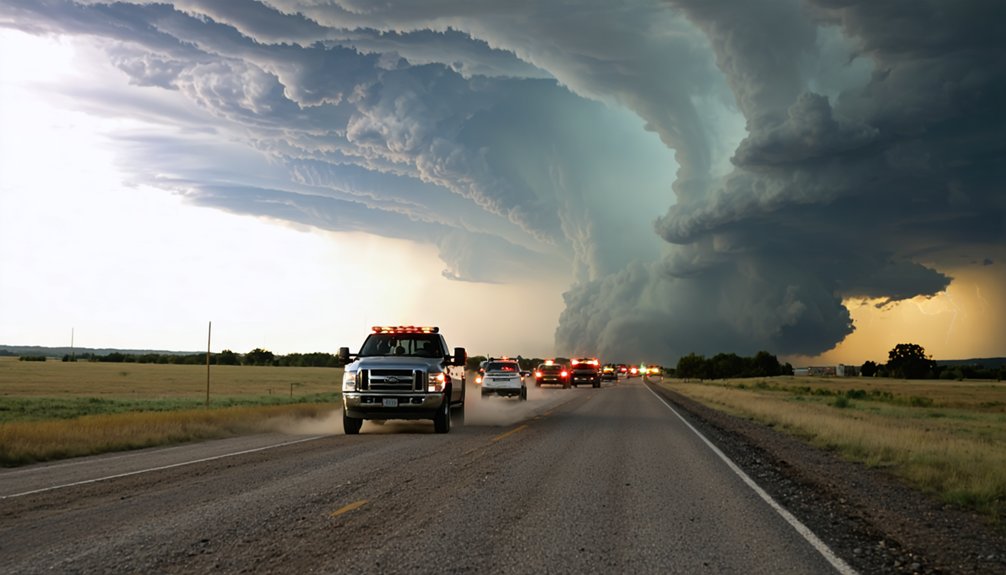
Chaser congestion degrades your situational awareness faster than almost any other field hazard, because slow-moving vehicle clusters force reactive driving instead of proactive repositioning.
Managing traffic dynamics requires you to monitor cluster density ahead and exit congested corridors before they lock your movement options. Use chaser communication strategies like shared frequency monitoring and real-time position broadcasting to identify where congestion is building before you reach it.
Maintain a minimum following distance that preserves your ability to turn or reverse without negotiating other chasers. Avoid popular core-punch corridors where traffic predictably stacks.
If you’re losing storm position because of congestion, choose a parallel road rather than forcing through the cluster. Your independence of movement is a tactical asset—protect it aggressively.
Lightning, Hail, Flash Flooding, and Wind: Secondary Hazards That Kill Chasers
Managing traffic flow keeps you mobile, but the storm itself generates hazards that kill chasers independent of positioning errors.
Traffic management keeps you mobile, but storms generate independent hazards that kill—regardless of how well you’ve positioned.
Lightning, hail, flash flooding, and wind operate outside your storm-positioning strategy and demand separate protocols.
Treat each hazard as a standalone threat:
- Lightning safety: Seek vehicle shelter immediately; a struck chaser outside the vehicle during a photo attempt is a preventable fatality.
- Hail protection: Golf ball-sized hail at 100 mph shatters windshields and disables vehicles instantly—never chase into the core.
- Flood risks: Six inches of moving water moves a person; two feet moves your vehicle—turn around, don’t drown.
- Wind dangers: Straight-line gusts exceeding 80 mph can overturn vehicles on exposed roadways.
Recognize these hazards early, respond decisively, and preserve your operational freedom.
Never Stop Under an Overpass When Storm Chasing
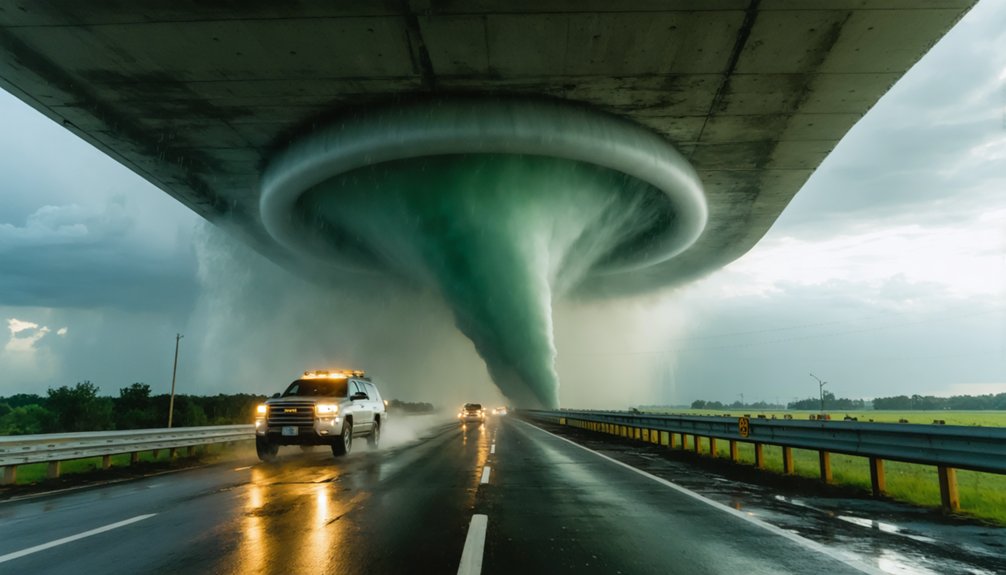
Despite appearing to offer protection, overpasses funnel and accelerate wind through their narrow understructures, increasing ground-level wind speeds by 20–30% compared to open terrain.
This structural reality dismantles overpass myths that have persisted since televised tornado footage normalized the behavior in the 1990s. These safety misconceptions have directly contributed to fatalities.
When you stop under an overpass, you’re also blocking emergency vehicle access, creating lane obstructions, and surrendering your most critical asset—mobility.
Your vehicle gives you directional freedom that a fixed concrete structure never can. Debris channeled through overpass columns travels faster and with greater lethality than debris in open air.
Keep moving. Maintain your escape route.
If shelter becomes necessary, a sturdy building below ground level is your only legitimate option.
Warning Signs That Mean It’s Time to Abort the Chase
Every chase has a threshold where continued engagement shifts from calculated risk to unacceptable danger, and recognizing that threshold in real time is what separates disciplined chasers from statistics.
Knowing your chase limits means acting on abort signs before options disappear.
Pull out immediately when you observe:
- Storm motion reversal or erratic path shifts that eliminate your escape vectors
- Blocked or flooded roads cutting off planned exit routes
- Nightfall reducing visibility below safe maneuvering thresholds
- Loss of GPS, radar, or communication leaving you operationally blind
When any of these conditions hit, you don’t negotiate with them. You move.
Your vehicle, your data tools, and your pre-mapped alternates exist precisely for this moment. Freedom in storm chasing isn’t recklessness — it’s the discipline to exit on your terms.
Frequently Asked Questions
How Do I Legally Report a Tornado Sighting to Local Authorities?
Speed saves lives—you’ll want to call 911 immediately, following tornado reporting protocols. Contact local authority contacts like your county’s emergency management office, and report precise GPS coordinates, direction, and movement data.
What Permits or Licenses Are Required for Professional Storm Chasing Activities?
No federal permits govern storm chasing regulations, but you’ll need a valid driver’s license and must comply with state traffic laws. Understand legal liabilities—carry insurance, respect private property, and avoid obstructing emergency responders during operations.
How Should Storm Chasers Handle Media or Press Inquiries in the Field?
Contrary to belief, you don’t need a publicist—you handle media etiquette directly. Designate one spokesperson, maintain press relationships professionally, share verified data only, avoid disclosing active positions, and never let interviews compromise situational awareness or team safety protocols.
What Insurance Coverage Is Recommended Specifically for Storm Chasing Vehicles?
You’ll want extensive vehicle insurance with collision, hail, and flood coverage options specifically endorsed for high-risk field use. Confirm your policy covers non-standard use, document equipment values, and carry proof of coverage during every chase.
How Do Storm Chasers Coordinate With Emergency Management Agencies During Active Events?
Like a well-oiled machine, you’ll sync storm tracking data with local emergency management through established communication protocols—radio frequencies, spotter networks, and real-time reports—keeping responders informed while you maintain situational freedom in the field.
References
- https://www.youtube.com/watch?v=nxPSFg2R8YY
- https://www.youtube.com/watch?v=h28hru7UhY8
- https://stormchaser.com/Storm-Chasing-Safety.pdf
- https://crazystormchasers.com/safety-measures-for-unexpected-weather-changes-during-storm-chasing/
- https://www.atms.unca.edu/cgodfrey/courses/swfex/pdf/ChasingSafety.pdf
- https://toreadgear.com/blogs/news/chasing-storms-safely-a-professional-guide-for-enthusiasts-with-toread-outdoor-gear-solutions
- https://www.weather.gov/spotterguide/safetyfirst
- https://meetingsmags.com/illinois/il_planning/il_checklist/safety-tips-from-a-storm-chaser/
- https://chasethestorms.org/topic/9/storm-chasing-safety-tips-keep-it-safe-keep-it-smart
- https://weather.cod.edu/chasing/assets/documents/safety.pdf