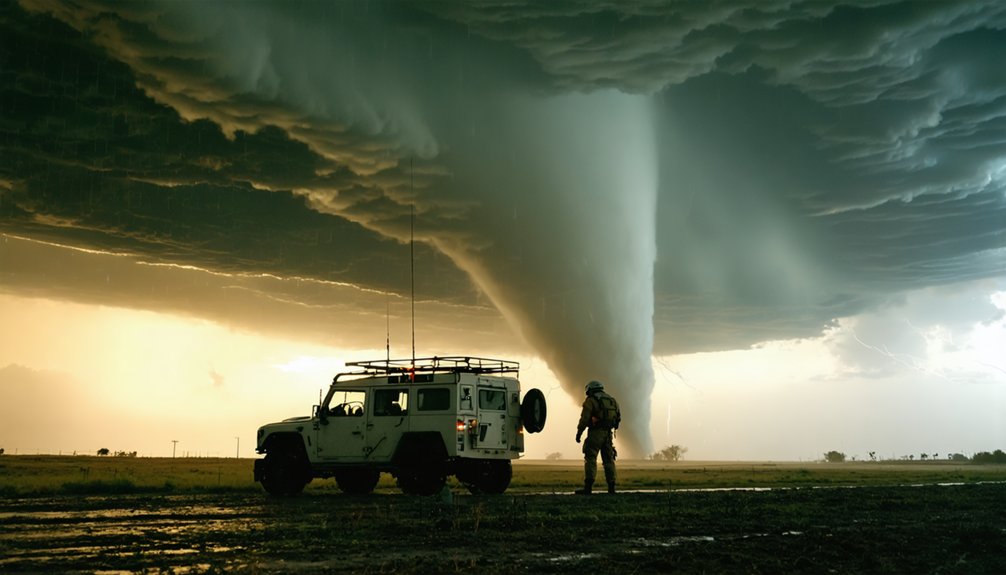
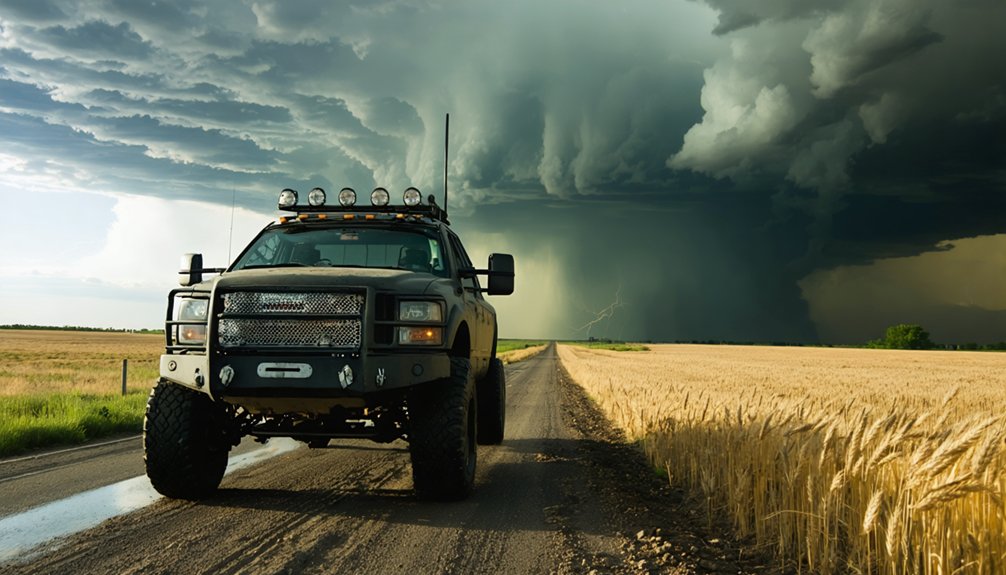
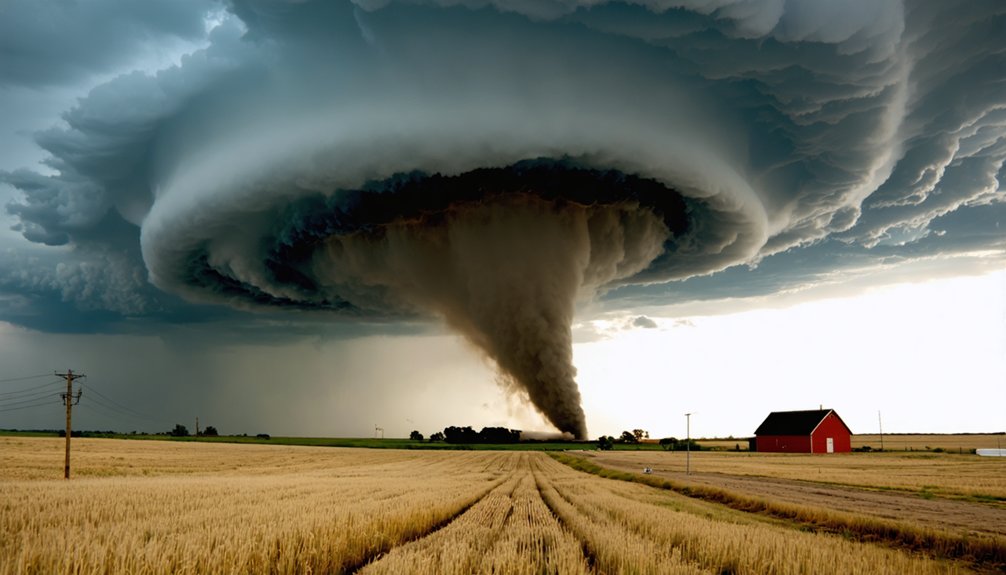
Safe storm chasing starts with thorough pre-departure preparation — check the Storm Prediction Center’s outlooks, map escape routes, and guarantee your vehicle is mechanically sound with a full tank. You’ll need to recognize dangerous storm features like rotating wall clouds, maintain safe positioning away from the storm core, and always pre-plan perpendicular escape routes. Know when to abort, respect legal boundaries, and never prioritize footage over your life. Keep exploring to sharpen every skill that keeps you alive out there.
Key Takeaways
- Before departing, review weather outlooks, plan primary and alternative routes, and prepare a safety kit with food, water, and communication devices.
- Analyze convective outlooks, wind shear profiles, and instability indices to accurately interpret forecasts and identify dangerous storm features.
- Maintain a safe distance from storm cores, avoid heavy precipitation, and pre-plan perpendicular escape routes on paved roads.
- Monitor for erratic storm motion, violent wall cloud rotation, and rapidly cycling storms, abandoning the chase immediately if conditions deteriorate.
- Follow all legal directives, respect property rights, avoid obstructing emergency responders, and travel in groups for enhanced safety.
Why Storm Chasing Safety Starts Before You Leave Home
Before you ever start your engine, the decisions you make at home can determine whether a storm chase ends safely or in disaster. Storm chasing psychology plays a critical role here — overconfidence kills.
Check the Storm Prediction Center’s severe weather outlooks, map primary and alternative routes, and identify shelter locations along your path.
Before you leave the driveway, know your routes, your backups, and exactly where safety waits along the way.
Prep your vehicle with a full tank, extra fuel, and a travel safety kit containing food, water, batteries, heating packs, and a charged prepaid cellphone.
Emergency communication strategies aren’t optional — they’re essential. A charged NOAA weather radio and real-time radar access via apps like Radarscope keep you informed when conditions shift fast.
Solid preparation isn’t restrictive; it’s what gives you the freedom to chase confidently and return home safely.
How to Read Severe Weather Forecasts Like a Storm Chaser
Once you’ve locked in your prep routine, knowing how to interpret severe weather forecasts separates calculated chasers from reckless ones.
Start your severe weather interpretation with the Storm Prediction Center‘s convective outlooks, mesoscale discussions, and watch products — these forecasting tools give you actionable intelligence before conditions develop.
Identify the target area by analyzing wind shear profiles, instability indices like CAPE, and moisture return.
Cross-reference surface analysis charts with upper-level maps to pinpoint where supercell development is most likely.
Timing matters — recognize when the cap breaks and convective initiation becomes probable.
Don’t rely on consumer weather apps with delayed radar.
Use professional-grade platforms that show real-time atmospheric data.
Reading these forecasts accurately lets you position strategically, anticipate storm motion, and maintain the exit options that keep you alive and free to chase again.
Your Storm Chasing Vehicle Kit: Gear, Tech, and Survival Supplies
Your storm chasing vehicle must be mechanically reliable and equipped with a full tank of gas, emergency supplies, and a first aid kit before you head out.
You’ll need real-time radar access through apps like Radarscope or RadarOmega, since delayed consumer apps can leave you dangerously behind on storm positioning.
Pair that tech with a charged NOAA weather radio, GPS navigation, and a survival kit containing food, water, batteries, and heating packs to handle whatever the chase throws at you.
Essential Vehicle Safety Gear
Equipping your chase vehicle with the right gear can mean the difference between a safe, productive outing and a life-threatening situation.
Prioritize vehicle maintenance before every chase — a mechanical failure near a supercell isn’t recoverable. Keep your tank full and carry extra fuel, since rural stations close after dark.
For emergency communication, pack a charged NOAA weather radio and a prepaid cellphone as backup. Real-time radar access through apps like RadarScope gives you situational awareness that delayed consumer apps simply can’t match.
Stock your vehicle with a first aid kit, food, water, batteries, heating packs, and matches. These aren’t optional extras — they’re operational essentials.
Every item you pack expands your operational range and keeps you self-sufficient when conditions deteriorate rapidly.
Must-Have Tech Tools
Beyond survival supplies, the tech you carry determines how well you read and react to a storm in real time. Your tech essentials start with a GPS navigation system for dynamic rerouting and a NOAA weather radio for ground-truth warnings when cell signals fail.
For mobile apps, skip delayed consumer radar platforms. Use professional-grade tools like RadarScope or RadarOmega, which deliver real-time, high-resolution radar imagery critical for reading storm structure and rotation.
These apps give you the situational awareness to make fast, informed decisions independently.
Keep your devices charged using a dedicated power bank or vehicle inverter. A prepaid cellphone as a backup guarantees you’re never without communication.
Reliable tech isn’t optional — it’s what separates a controlled chase from a dangerous one.
How to Position Yourself Safely Near a Supercell
When positioning near a supercell, you must maintain a safe distance from the storm core and never punch through heavy precipitation, as large hail and embedded tornadoes pose immediate threats.
You’ll want to plan escape routes that run perpendicular to the storm’s direction of motion, giving you a rapid exit if conditions deteriorate faster than anticipated.
Keep your eyes scanning the updraft base, flanking lines, and wall clouds at all times, since rotating wall clouds signal imminent tornado development and demand immediate repositioning.
Maintaining Safe Storm Distance
Positioning yourself safely near a supercell demands disciplined awareness of the storm’s structure and your surroundings at all times.
Never penetrate the storm core through heavy precipitation — core punching eliminates visual awareness and exposes you to large, damaging hail. Your distance strategy must account for rapid storm intensification and shifting motion.
Avoid stopping beneath rotating wall clouds, where hail threat spikes unpredictably. Recognize updraft bases along flanking lines and maintain adequate separation from close positioning.
When you stop to observe, keep your head on a swivel — scan overhead and all directions continuously for hidden tornadoes.
Always plan escape routes perpendicular to the storm’s direction of motion. If conditions deteriorate faster than expected, you’ll need immediate, unobstructed access to those routes without hesitation.
Planning Perpendicular Escape Routes
Escaping a rapidly intensifying supercell depends entirely on having a pre-planned route that runs perpendicular to the storm’s direction of motion. Most supercells track northeast, so your perpendicular planning should prioritize southbound or eastbound roads that give you maximum lateral clearance.
Never rely on outrunning a storm by driving parallel to its path—you’ll lose that race.
Effective escape strategies require you to study road networks before you’re in the field. Identify intersecting county roads, note dead ends, and mark flood-prone low-water crossings you’ll avoid under pressure.
When you’re positioned near a supercell, continuously reassess your route as conditions evolve. If a tornado develops suddenly, you need an immediate exit option—not a decision you’re making in real time under stress.
Recognizing Dangerous Storm Features
Knowing where to stand relative to a supercell is just as important as knowing how to get out. Study storm structure carefully before positioning yourself.
Rotating wall clouds signal intense updraft activity — never drive beneath them, since large hail can drop without warning. Recognize cloud formations along the flanking line, where new updraft towers develop rapidly, indicating an actively organizing storm.
Avoid core punching through heavy precipitation, as debris and hail become invisible hazards inside. Keep scanning overhead constantly; tornadoes can descend faster than you’d expect.
Position yourself to the storm’s southeast when possible, maintaining a clear visual on the updraft base. Your situational awareness must stay sharp — complacency near a supercell costs lives.
Read the storm’s signals, trust your instincts, and never sacrifice positioning discipline for a better shot.
Escape Routes: How to Plan Your Way Out Fast
When a supercell accelerates or shifts direction unexpectedly, you need a pre-planned escape route ready to execute immediately. Effective escape route planning keeps you mobile and in control, not reactive and trapped.
Follow these rapid exit strategies before positioning near any storm:
- Plot perpendicular routes to the storm’s primary motion vector, giving you a clear lateral exit path.
- Identify paved road networks in advance; dirt roads become impassable during heavy rainfall.
- Mark shelter locations along your route, including sturdy buildings and fuel stations.
- Avoid dead-end roads or routes crossing low-water bridges that flood rapidly.
Never assume your current position stays safe. Continuously reassess storm movement on real-time radar and execute your exit before conditions deteriorate beyond your control.
When to Abort the Chase and Get Out Alive
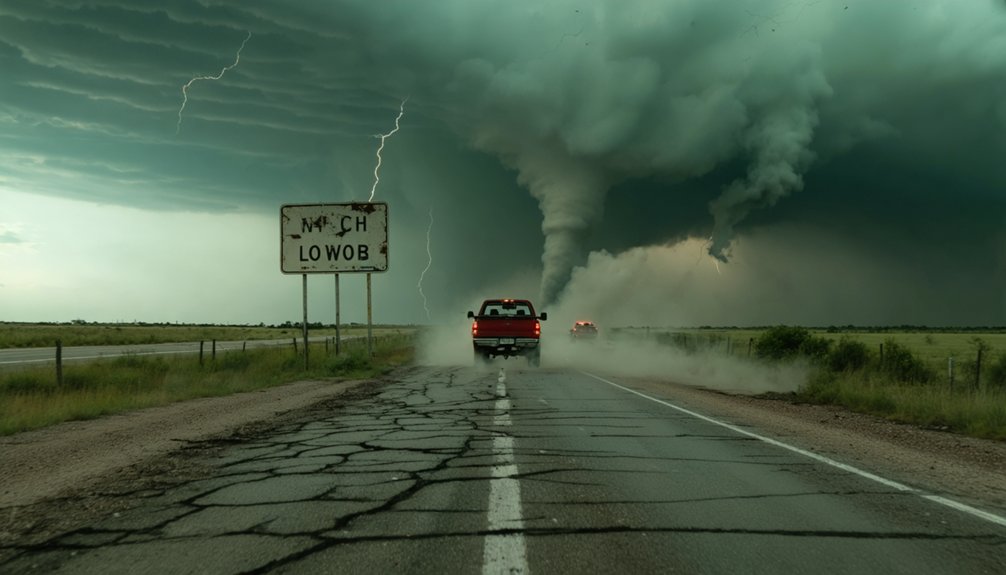
You must recognize the warning signs that signal it’s time to abort: a storm that’s rapidly cycling, a collapsed or rain-wrapped structure, or escape routes that are already compromised by flooding or downed debris.
If the storm has overtaken your position and you’re now in its forward path, you’ve lost your tactical advantage and no photo opportunity justifies the risk.
Execute your pre-planned exit immediately, moving perpendicular to the storm’s motion and never attempting to outrun it head-on.
Recognizing Deteriorating Storm Conditions
Recognizing when a chase has turned dangerous can mean the difference between getting home safely and becoming a statistic. Storm signals shift fast, and deteriorating weather patterns demand immediate assessment.
Watch for these critical indicators:
- The storm’s motion becomes erratic, with wall clouds rotating violently overhead.
- Precipitation wraps around your position, cutting off your primary escape route.
- Hail intensifies suddenly, indicating you’ve drifted dangerously close to the core.
- Visibility drops sharply, preventing you from tracking the mesocyclone’s movement.
When any of these conditions appear, don’t hesitate—execute your perpendicular escape route immediately.
Your freedom to chase another day depends on decisive action now. No photograph or data point justifies compromising your exit strategy. Abort cleanly, reposition safely, and live to chase again.
Blocked Escape Routes Ahead
Blocked escape routes represent one of the most lethal scenarios in storm chasing, and you’ve got to identify the warning signs before they fully materialize.
Successful route recognition means pre-loading your road network mentally before positioning near any storm. If your primary exit runs parallel to storm motion, you’re already compromised.
Watch for converging supercell movement toward low-water crossings, narrow rural roads, or dead-ends. Once precipitation wraps around your position, options collapse fast.
Execute your blocked escape contingency plan immediately — hesitation kills. Never assume a road you entered on remains passable during rapid storm intensification.
Abort the chase decisively when perpendicular escape routes disappear. Your freedom to chase another day depends entirely on disciplined exit strategy execution before conditions force impossible choices.
Storm Overtakes Your Position
When a storm overtakes your position, every second of hesitation compounds your danger exponentially. Your chase strategy must include a predetermined abort threshold—don’t wait until you’re surrounded.
Execute these steps immediately:
- Abandon photography and data collection—survival overrides documentation entirely.
- Drive perpendicular to storm motion, never parallel, to maximize lateral separation quickly.
- Avoid overpasses and low-water crossings—both create lethal secondary hazards during escape.
- Seek a sturdy structure immediately if forward storm position cuts off vehicle escape routes.
Recognizing when your chase strategy has failed isn’t defeat—it’s tactical intelligence. Storms move unpredictably, and your storm position can deteriorate within seconds.
Your freedom to chase another day depends entirely on your willingness to abort decisively today.
Lightning Risks That Kill Storm Chasers
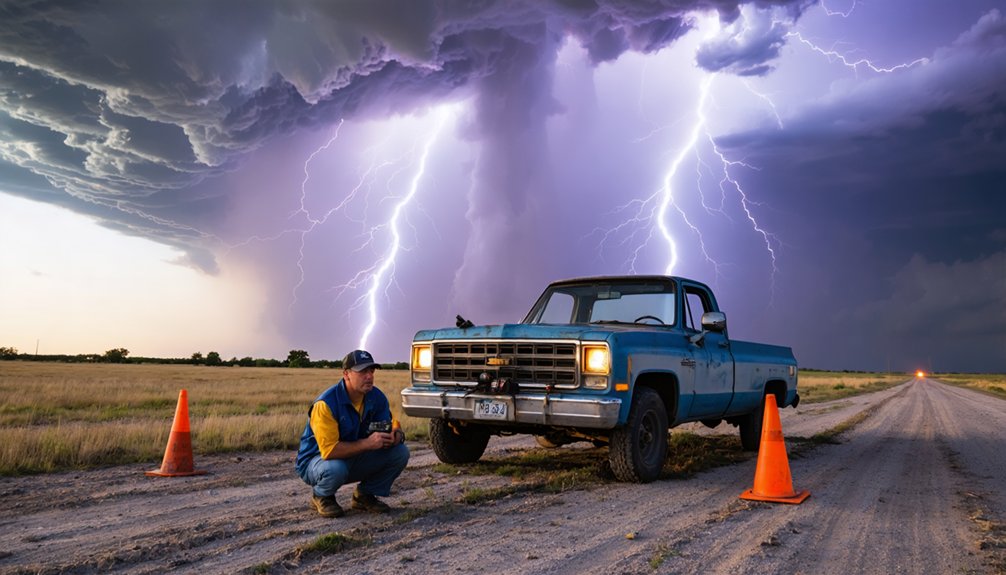
Lightning poses one of the deadliest threats to storm chasers, striking without a reliable warning sign or predictable pattern. Your lightning safety protocol must activate the moment a cloud-to-ground strike occurs within one mile of your position.
Don’t wait for a second strike—immediately seek shelter inside a hard-top vehicle or sturdy building.
Avoid isolated trees, tall objects, fences, water, motorcycles, and convertible vehicles. These dramatically increase your exposure risk. If you’re caught outdoors with no shelter, squat low with your head between your knees. Never lie flat.
Sound storm preparedness means you’ve already identified nearby shelter options before lightning becomes a threat. If your hair stands on end, treat it as an immediate warning and act fast—hesitation costs lives.
How to Handle Tornadoes While Storm Chasing
Tornadoes demand split-second decision-making, and your survival depends on reading the storm’s movement correctly before it closes the gap.
Mastering tornado safety starts with understanding storm behavior.
- Assess lateral movement — If the tornado moves side-to-side across your field of view, it’s not tracking toward you. If it stays stationary, evacuate immediately.
- Never outrun a tornado — Repositioning perpendicular to storm motion is your safest escape strategy.
- Abandon your vehicle — If a tornado closes in, exit immediately and seek a substantial structure or a low-lying ditch.
- Avoid overpasses — Winds accelerate through narrow spaces, creating lethal projectile corridors.
You’re free to chase, but only disciplined positioning keeps you alive to chase again.
Hail Stops, Flood Crossings, and Road Hazards You Won’t See Coming
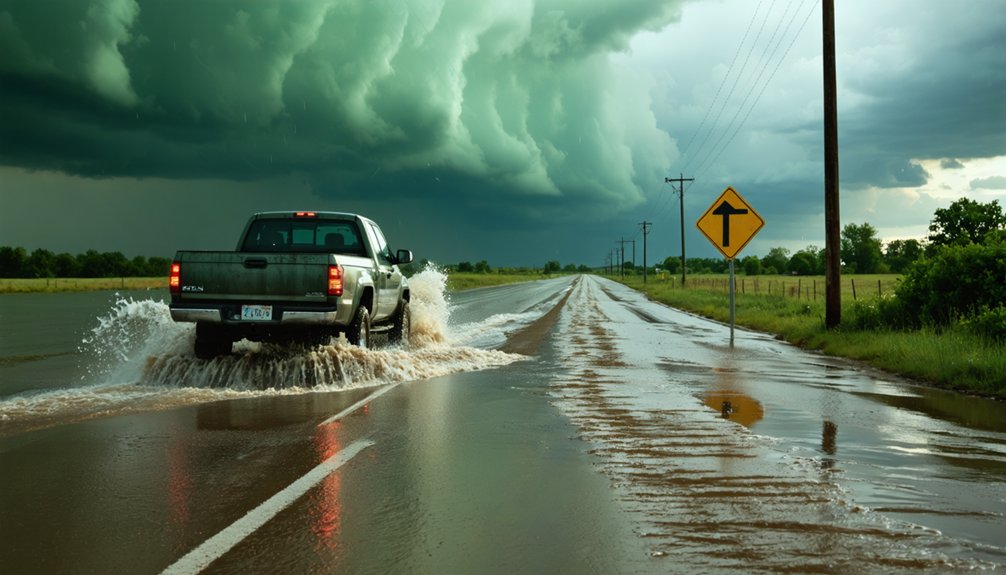
Hail, floodwater, and unexpected road conditions can end a chase faster than any tornado. If hail begins striking your vehicle, pull over immediately. Continuing to drive multiplies momentum and accelerates hail damage to your windshield and body panels.
Find a protected position away from the core before stones intensify.
Flood awareness is equally critical. You can’t always see submerged road surfaces, and your vehicle will float in just 12 inches of moving water. Never cross low-water bridges or flood-prone roads during active precipitation events. That shortcut could trap you permanently.
Scan your route continuously for washed-out shoulders, debris fields, and downed power lines.
Pre-planned alternative routes aren’t optional — they’re essential. Knowing your road network before the storm hits keeps every escape option open.
How to Chase Without Trespassing or Breaking the Law
Staying legal and respectful of private property is just as important as managing road hazards during a chase.
Violating ethical guidelines doesn’t just risk fines—it damages the broader chasing community’s reputation. Property respect keeps access open for everyone.
Cutting corners on property ethics doesn’t just cost you—it costs every chaser who comes after you.
Follow these four rules every chase:
- Stay on public roads at all times; never cut across fields or private land without explicit permission.
- Request landowner consent before parking on or entering private property.
- Avoid damaging crops, fences, or structures during repositioning maneuvers.
- Comply fully with local ordinances, law enforcement directives, and road closures.
Freedom to chase depends on responsible conduct.
Prioritize your shot from public ground over a slightly better angle that compromises someone else’s property or your legal standing.
Frequently Asked Questions
Can Beginners Safely Storm Chase Alone Without Experienced Mentor Guidance?
You shouldn’t chase alone as a beginner. Without mastering chasing techniques and weather technology under mentorship, you’re risking your life. You’ll lack critical judgment to interpret rapidly evolving, dangerous supercell scenarios safely and effectively.
What Insurance Coverage Do Storm Chasers Typically Need for Their Vehicles?
“Hope for the best, prepare for the worst.” You’ll need thorough vehicle insurance covering storm damage, including hail, flood, and collision. Confirm your policy includes roadside assistance and consider specialized coverage for your chase equipment.
How Do Storm Chasers Communicate With Each Other During Active Chases?
You’ll rely on communication devices like ham radios, CB radios, and mobile apps for effective chase coordination. Share real-time storm data, positions, and hazard alerts with your team to maintain situational awareness and safety.
Are There Age Restrictions or Legal Requirements for Storm Chasing Activities?
There’s no federal storm chasing regulations or formal age requirements, but you’re responsible for respecting private property, obeying traffic laws, and ensuring you’ve got the skills, equipment, and experience to chase safely.
How Do Storm Chasers Handle Medical Emergencies Far From Hospitals?
You’ll want to carry a well-stocked first aid kit and emergency supplies in your vehicle at all times. Maintain a charged cellphone for emergency contact, and always know your nearest medical facility’s location before deploying.
References
- https://www.livingskytours.com/storm-chasing-101/
- https://www.flame.org/~cdoswell/chasesums/Chase_safety.html
- https://meetingsmags.com/illinois/il_planning/il_checklist/safety-tips-from-a-storm-chaser/
- https://will.illinois.edu/weatherrealness/episode/storm-chasing-can-be-deadly-heres-how-to-stay-safe
- https://www.tempesttours.com/safety-tips