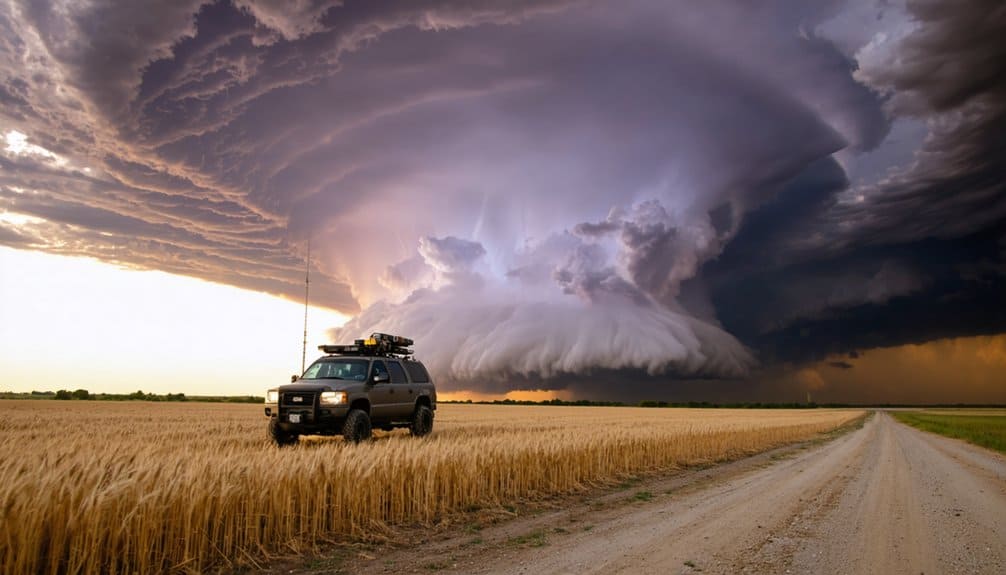
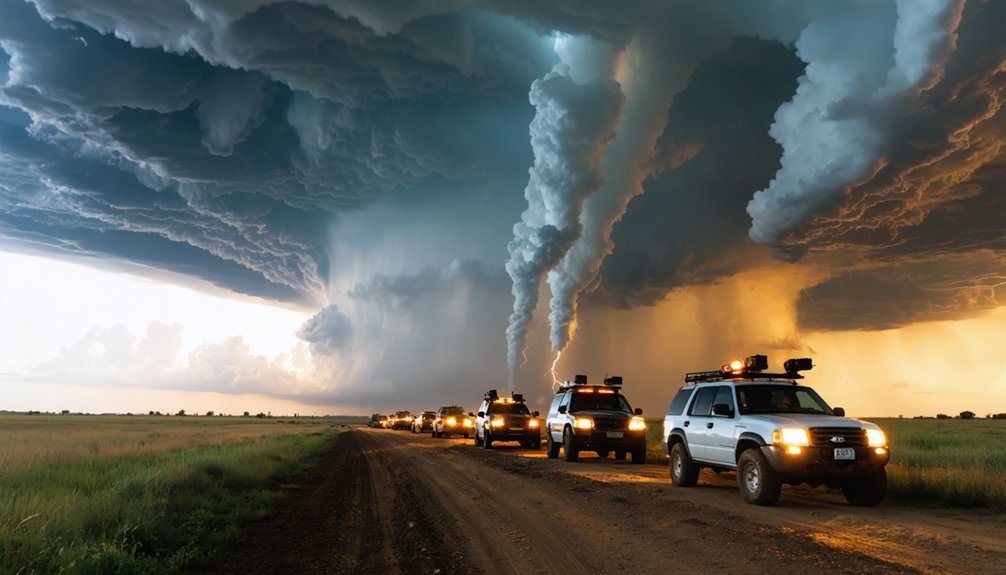
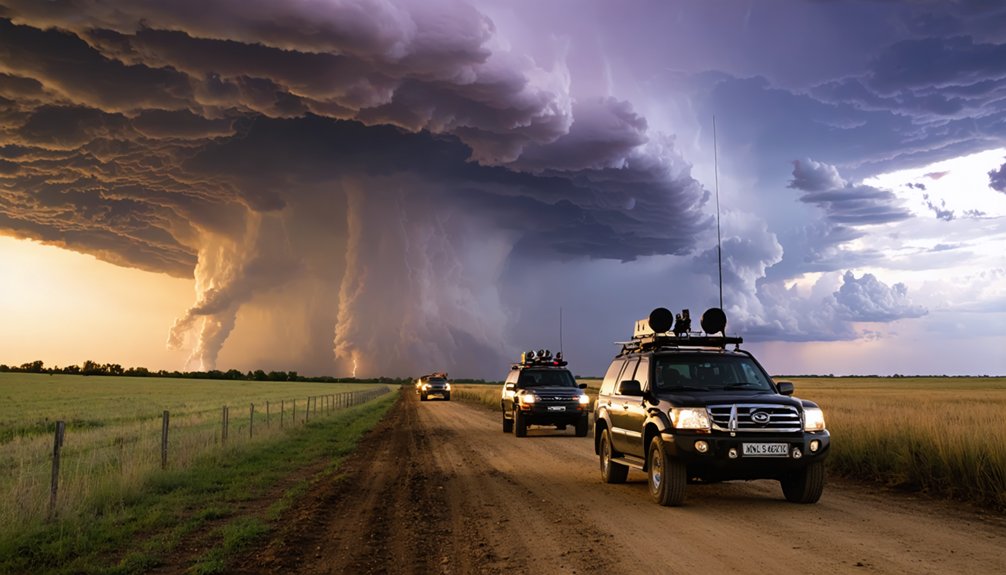
If you’re chasing tornadoes in Oklahoma, your best options include Tempest Tours, Silver Lining Tours, Storm Chasing USA, Tornadic Expeditions, and Extreme Tornado Tours. Each runs 10- to 12-hour expeditions through Oklahoma’s most active corridors during peak season—April through June—when 120 tornadoes annually tear across the state. Certified guides, onboard tracking systems, and specially equipped vehicles keep you close to the action safely. Everything you need to plan your chase is covered ahead.
Key Takeaways
- Oklahoma’s peak tornado season runs April through June, with May offering the highest activity, making it the optimal time to book storm chasing tours.
- Six major operators run tours across Oklahoma, including Silver Lining Tours, Tempest Tours, and Extreme Tornado Tours, offering 10-12 hour daily expeditions.
- Tours depart primarily from Oklahoma City, efficiently accessing three prime tornado corridors: central Oklahoma, southwest Oklahoma, and northwestern Oklahoma.
- Guides are certified and trained in safety protocols, with specially equipped vehicles and storm tracking systems ensuring approximately 90% positive traveler experiences.
- Early booking is essential, as peak season tours fill quickly; flexible scheduling and advance reservations maximize chances of witnessing significant tornado events.
Why Oklahoma Is the World’s Best Place to Chase Tornadoes
Oklahoma sits at the convergence of three distinct air masses—warm, moist Gulf air from the south, dry continental air from the west, and cold Arctic air from the north—creating atmospheric conditions that produce more tornadoes per square mile than anywhere else on Earth.
You’re looking at a region where historical patterns consistently confirm peak tornado activity between April and June, with May representing the statistical apex of violent weather phenomena.
The flat terrain accelerates wind shear while eliminating natural barriers that would otherwise disrupt tornado formation.
Oklahoma averages 120 tornadoes annually during peak season, giving you maximum exposure opportunities within concentrated geographic corridors.
These conditions aren’t random—they’re predictable, trackable, and repeatable, making Oklahoma the definitive destination for experiencing nature’s most powerful atmospheric events firsthand.
When Is Tornado Season in Oklahoma?
Those predictable atmospheric conditions that make Oklahoma the premier tornado destination operate on a defined calendar you can plan around. Peak tornado season runs April through June, with May representing the highest frequency window. During this period, roughly 75% of Oklahoma’s annual average of 120 tornadoes occur.
Weather patterns driving this cycle involve Gulf moisture colliding with dry continental air masses across the central plains, creating ideal supercell conditions.
Don’t let tornado myths convince you activity spreads evenly year-round — it doesn’t. The atmospheric dynamics concentrate markedly within this three-month window.
You’ll want to book tours between late April and early June for maximum storm encounter probability.
Tour operators run daily 10 to 12-hour expeditions precisely because weather patterns during this window produce consistent, trackable supercell development.
Top Storm Chasing Tours in Oklahoma Ranked
Six storm chasing tour operators run regular expeditions across Oklahoma’s tornado corridor, but they’re not equal in experience, coverage, or safety infrastructure. You’ll find meaningful differences in how each company interprets weather patterns and applies storm prediction data to positioning decisions.
Not all storm chasing operators are created equal—experience, coverage, and safety infrastructure vary significantly across the field.
Extreme Tornado Tours operates out of Broken Arrow with 12-hour daily expeditions, giving you extended field exposure compared to the 10-hour tours offered by Silver Lining Tours, Tornadic Expeditions, Storm Chasing USA, and Tempest Tours, all based in Oklahoma City.
Each operator maintains certified chasers and weather-monitored vehicle fleets engineered for severe conditions.
Your choice should factor in tour duration, geographic coverage, and how aggressively each operator pursues storm prediction models.
Pre-booking is essential since peak season slots fill quickly between April and June.
Extreme Tornado Tours vs. Silver Lining Tours: Which Wins?
Narrowing the field to two standout operators, Extreme Tornado Tours and Silver Lining Tours represent distinct approaches to storm chasing that’ll directly affect your field experience. Both handle weather unpredictability effectively, but key differences determine which suits your objectives:
- Tour Duration: Extreme Tornado Tours operates 12-hour tours versus Silver Lining’s 10-hour format, giving you extended exposure to storm intensity events.
- Base Location: Extreme Tornado Tours launches from Broken Arrow, while Silver Lining Tours operates from Oklahoma City, influencing your intercept positioning.
- Chase Philosophy: Silver Lining prioritizes close tornado encounters, whereas Extreme Tornado Tours emphasizes systematic severe weather navigation.
If maximizing storm intensity exposure matters most, Extreme Tornado Tours edges ahead.
If proximity to Oklahoma City suits your logistics, Silver Lining Tours wins your operational flexibility.
How Safe Are Oklahoma Storm Chasing Tours, Really?
Safety is the first question any serious storm chaser should ask before booking a tour, and Oklahoma’s top operators deliver concrete answers. Every major company employs certified chasers trained to read shifting weather patterns in real time, repositioning vehicles before conditions turn critical. You’re not riding blind — onboard monitoring systems track storm trajectories continuously, giving guides decisive data to act on.
Certified chasers, real-time monitoring, and decisive repositioning keep you informed — never exposed.
Tour fleets use vehicles engineered specifically for severe weather navigation, not standard passenger vans. Pre-departure briefings outline escape routes, communication protocols, and decision-making hierarchies.
Tour safety records across Oklahoma’s top six operators remain consistently high, with roughly 90% of travelers reporting positive experiences.
You accept inherent risk when chasing tornadoes, but these operators minimize exposure through training, technology, and disciplined protocol execution.
Who Leads the Tours and What Qualifies Them?
Behind those safety records are the people actually making split-second decisions in the field. When you’re booking a tour, you need to know exactly who’s behind the wheel and why their storm chaser credentials matter.
Qualified tour guides typically hold:
- Meteorological training — formal education or certification in atmospheric science and severe weather pattern recognition
- Safety training certification — documented protocols covering vehicle positioning, evacuation routes, and real-time radar interpretation
- Field experience — verified years of active storm chasing with documented tornado intercepts
You’re not just paying for proximity to a tornado — you’re investing in someone’s judgment under extreme pressure.
Every leading Oklahoma tour operator employs certified chasers who’ve logged hundreds of field hours. Their credentials aren’t optional extras; they’re your primary protection when conditions shift fast.
What Actually Happens During a 10- to 12-Hour Oklahoma Tornado Tour
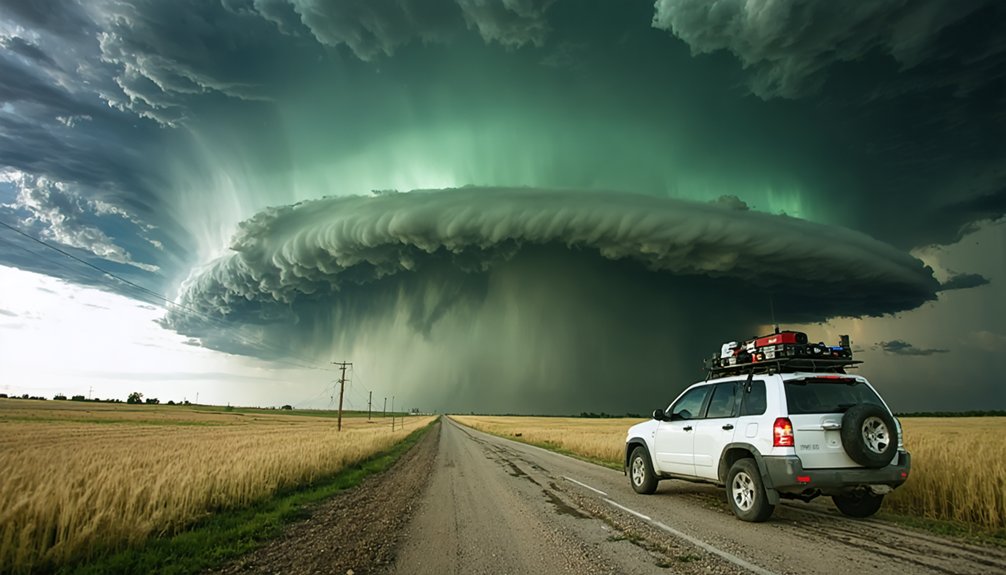
Once you’re loaded into a specialized chase vehicle at the tour’s staging point, the day unfolds through three distinct operational phases: pre-chase briefing, active intercept, and post-chase debrief.
During the briefing, your certified guide analyzes real-time weather patterns, identifying atmospheric instability zones and probable storm development corridors. You’ll review storm tracking data, including radar signatures, wind shear profiles, and convective outlooks.
Before you chase, you decode the sky — radar signatures, wind shear profiles, and the atmospheric instability driving every storm.
The active intercept phase puts you in motion, repositioning constantly as storm dynamics shift. Your guide reads mesocyclone rotation, adjusts intercept angles, and maintains safe observation distances while maximizing your exposure to severe weather.
Finally, the post-chase debrief breaks down the day’s meteorological events, explaining every decision your guide made. You leave with a precise, technical understanding of what you witnessed firsthand.
The Best Areas in Oklahoma to Spot a Tornado
Oklahoma’s most tornado-active corridors align closely with the classic “Tornado Alley” geography, and knowing where to position yourself dramatically improves your chances of witnessing significant tornado activity. Dismiss tornado myths suggesting random statewide distribution — activity concentrates in specific zones.
Prime targeting areas include:
- Central Oklahoma (Oklahoma City metro) — highest tornado frequency, open terrain enables unobstructed sightlines critical for storm chasing safety.
- Southwest Oklahoma (Lawton/Chickasha corridor) — supercell development accelerates here as dry lines frequently establish across this region.
- Northwestern Oklahoma (Woodward/Enid area) — long-track tornadoes historically traverse this corridor during May’s peak activity window.
You’ll maximize encounter probability by positioning within these corridors rather than chasing broadly across the state. Tours operating from Oklahoma City strategically leverage all three zones efficiently.
What to Bring on a Storm Chasing Tour in Oklahoma
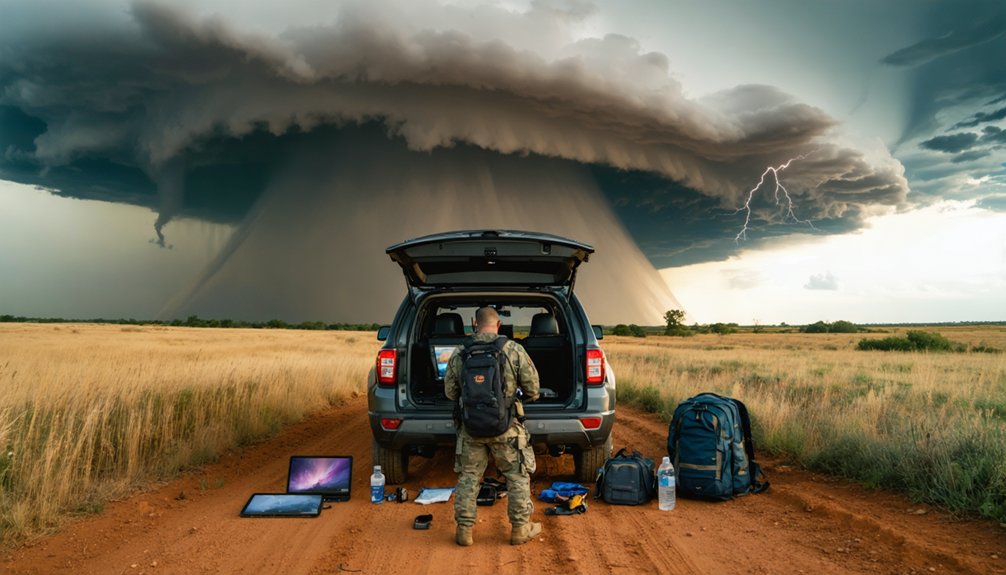
When preparing for a storm chasing tour in Oklahoma, you’ll need to pack strategically across three critical categories: essential gear and clothing, safety and emergency supplies, and camera and technology essentials.
You should wear moisture-wicking layers, sturdy boots, and a weather-resistant jacket, as conditions shift rapidly in tornado-prone environments.
You’ll also want to bring a first aid kit, emergency radio, and fully charged devices loaded with weather-tracking apps to guarantee you’re equipped for real-time situational awareness.
Essential Gear and Clothing
Packing the right gear for a storm chasing tour in Oklahoma can make the difference between a safe, comfortable experience and a miserable one. You’ll spend hours in vehicles monitoring weather forecasting data and storm tracking systems, so preparation matters.
Prioritize these three essentials:
- Layered clothing — Oklahoma weather shifts rapidly; bring moisture-wicking base layers, a windbreaker, and rain gear.
- Footwear — Sturdy, waterproof boots protect you during any necessary outdoor exposure near storm systems.
- Technology — A fully charged smartphone, portable battery pack, and weather apps enable real-time storm tracking updates.
Additionally, pack sunglasses, sunscreen, and a refillable water bottle. You’ll cover significant ground during 10 to 12-hour tours, so staying hydrated and protected keeps you focused on the experience ahead.
Safety and Emergency Supplies
Beyond the standard gear, you’ll want to pack a dedicated set of safety and emergency supplies before joining any storm chasing tour in Oklahoma. Emergency preparedness isn’t optional when you’re operating in tornado-prone corridors where conditions shift rapidly.
Carry a first aid kit stocked with trauma essentials, including tourniquets, compression bandages, and antiseptic.
Pack a battery-powered weather radio to access real-time meteorological data independent of your tour guide’s equipment.
Bring a portable phone charger, emergency whistle, and a laminated evacuation route map covering Oklahoma’s high-risk zones.
Store a 24-hour supply of water and high-calorie rations in your bag.
Keep emergency contacts written on paper—never rely solely on digital storage when chasing severe Oklahoma weather systems.
Camera and Technology Essentials
Capturing severe weather demands the right technology, so you’ll want to prioritize a DSLR or mirrorless camera with a fast telephoto lens—at least 200mm—to document tornadoes from a safe operational distance. Pair your camera with essential camera accessories and weather monitoring tools to maximize your field performance.
- Weatherproof camera housing — protects your gear from rain, hail, and debris during active storm intercepts.
- Portable weather station or app — delivers real-time atmospheric pressure, wind speed, and storm trajectory data.
- High-capacity power banks — keeps your devices operational during 10-12 hour tours.
You’ll also want extra memory cards, lens filters, and a rugged laptop for immediate footage review. These tools guarantee you’re capturing extraordinary weather events without compromising your situational awareness.
How to Book an Oklahoma Storm Chasing Tour Before Spots Fill Up
Booking your Oklahoma storm chasing tour early is critical, as peak season slots from April through June fill up fast. You’ll want to visit your chosen operator’s website directly to secure your reservation online, selecting tour dates that align with May’s historically high tornado frequency.
Locking in your spot months in advance guarantees you a place in a certified chaser’s vehicle while giving you time to coordinate travel logistics around your confirmed tour dates.
Book Early, Save Spots
Since Oklahoma storm chasing tours operate on limited capacity—typically small groups per vehicle—spots fill up fast once peak season forecasts drop in late winter. Tracking weather patterns early gives you a decisive advantage when operators open their booking windows.
Follow these steps to secure your spot:
- Monitor tour operator websites starting in February, when seasonal schedules launch
- Cross-reference forecasted weather patterns with your preferred tour dates before committing
- Confirm tourist accommodations in Oklahoma City or Broken Arrow simultaneously—hotels fill alongside tour rosters
Most operators require deposits at booking. You’ll want flexibility in your schedule since tours chase dynamic conditions daily.
Locking in early doesn’t just save your spot—it gives you the freedom to plan everything around prime tornado season without scrambling last minute.
Choosing Your Tour Dates
Picking the right tour dates hinges on one critical window: mid-April through late May, when Oklahoma’s tornado frequency peaks and tour operators run daily chase routes. Weather patterns during this period produce the highest concentration of supercell activity, giving you maximum intercept probability.
Tour availability tightens fast once forecasters signal active pattern setups. Operators like Extreme Tornado Tours, Silver Lining Tours, and Tempest Tours fill slots weeks in advance during high-activity stretches. You’ll want to monitor the Storm Prediction Center’s outlooks and cross-reference them with your operator’s open dates.
Book a flexible window spanning at least five to seven consecutive days. Tornado development isn’t guaranteed daily, so broader date ranges increase your odds of witnessing a significant event without scrambling for last-minute availability.
Securing Your Reservation Online
Once you’ve locked in your target dates, head directly to your chosen operator’s website and navigate to their reservations portal—most major tour companies like Extreme Tornado Tours, Silver Lining Tours, and Tempest Tours use dedicated booking platforms that display real-time seat availability.
Peak season slots disappear fast as weather patterns become favorable, so act decisively.
Follow these steps to secure your spot:
- Submit your deposit immediately after confirming seat availability
- Register your emergency contact and waiver documentation during checkout
- Monitor your confirmation email for storm prediction updates from your assigned guide
Most platforms accept major credit cards and offer cancellation flexibility tied to severe weather forecasts.
Don’t delay—experienced chasers book weeks ahead, leaving last-minute travelers scrambling for openings during prime tornado windows.
Frequently Asked Questions
What Age Restrictions Apply to Oklahoma Storm Chasing Tours?
Like a gatekeeper of the skies, most tours require you’re at least 18, though some allow minors with guardian consent. You’ll find safety precautions and tour customization options vary, so check directly with operators.
Are Oklahoma Storm Chasing Tours Suitable for People With Disabilities?
You’ll need to contact tour operators directly about accessibility accommodations, as vehicle designs vary. Safety precautions are prioritized, but rugged terrain and rapid movement may limit suitability depending on your specific disability and mobility requirements.
Do Oklahoma Storm Chasing Tours Operate During Nighttime Tornado Events?
Ironically, darkness doesn’t stop tornadoes, and tours won’t stop for it either. You’ll find Oklahoma storm chasing tours operate during nighttime events, utilizing advanced nighttime visibility technology and specialized safety equipment to keep you protected.
Can International Travelers Easily Join Oklahoma Storm Chasing Tours?
You can easily join Oklahoma storm chasing tours as an international traveler. Make sure your international travel documentation is current, and you’ll follow the same weather safety protocols as domestic participants during all tours.
Do Oklahoma Storm Chasing Tours Offer Refunds for Tornado-Free Days?
Refund policies vary by operator, so you’ll want to confirm terms before booking. Most tours don’t guarantee tornado sightings but maintain strict safety precautions, ensuring you’re still experiencing professional, guided severe weather environments regardless of conditions.
References
- https://www.facebook.com/groups/7245540758805445/posts/31886486507617528/
- https://midlandusa.com/blogs/blog/storm-chasing-tours
- https://www.travelok.com/listings/view.profile/id.16213
- https://www.stormchasingusa.com/departure-cities/oklahoma-city-oklahoma/
- https://www.stormchasingusa.com/storm-chasing-in-oklahoma/
- https://www.tornadicexpeditions.com/2027-tour-schedule
- https://stormchasing.com/book-a-tour/
- https://extremetornadotours.com/booktour/
- https://www.youtube.com/watch?v=JblpLnJ0Qb0
- https://www.silverliningtours.com/tour-experience/types-of-tours/t1-close-encounters-tour/