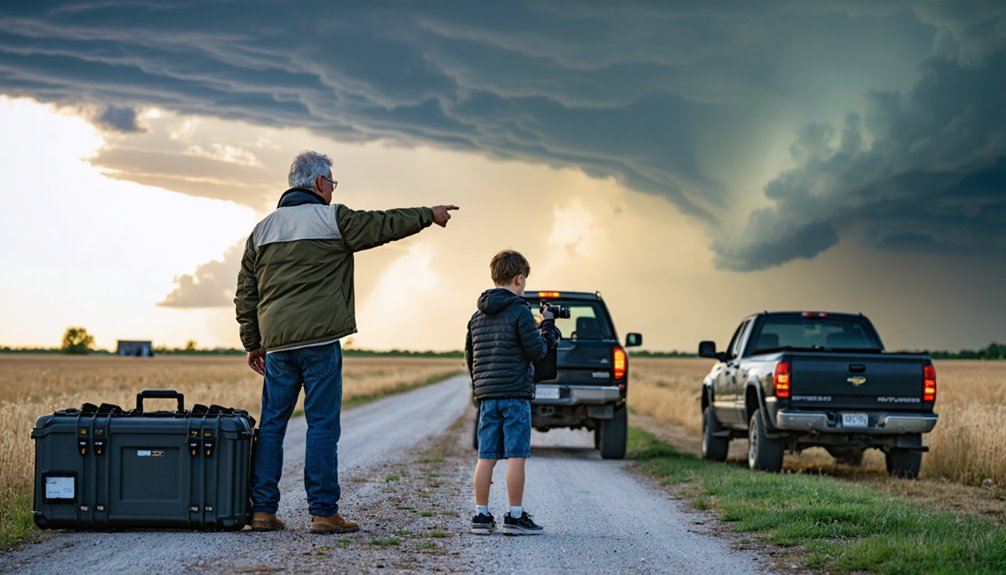
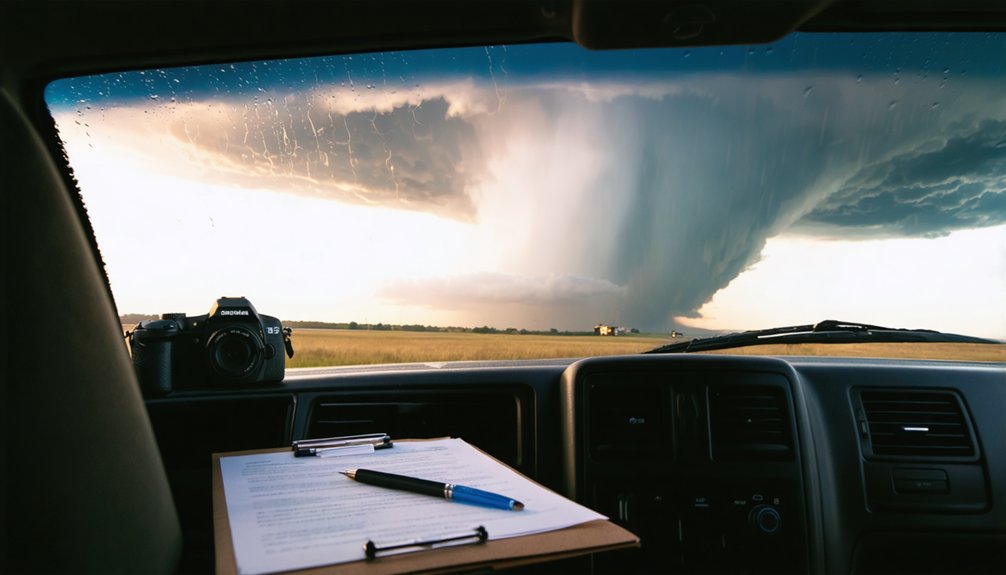
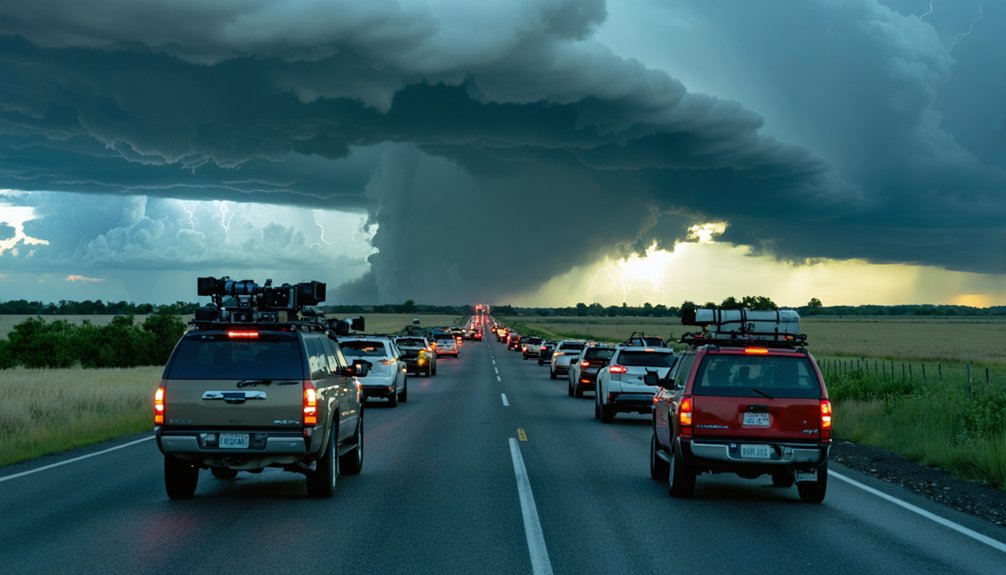
When a tornado hits a populated area, you should stop chasing and shift focus to victim assistance immediately. Storm chasers typically arrive hours before emergency personnel, making their ground-level data and direct intervention critical. You can transmit GPS coordinates, extract survivors from rubble, and provide early medical stabilization. Continuing to chase while people need help damages credibility and raises serious ethical concerns. The full picture of your responsibilities as a chaser runs much deeper.
Key Takeaways
- When a tornado strikes a populated area, chasers should immediately stop chasing and shift focus to assisting victims.
- Storm chasers often arrive before emergency personnel, making their ground assistance critical for saving lives.
- Ethical standards require chasers to prioritize human rescue over data collection or continued footage during active strikes.
- Chasers can provide life-saving help by extracting victims, offering medical stabilization, and transmitting precise GPS coordinates to emergency services.
- Continuing to film during a populated-area strike damages public trust and undermines the credibility of storm chasers.
Do Storm Chasers Have a Moral Duty to Help Tornado Victims?
When a tornado tears through a populated area, storm chasers are frequently the first people on scene — arriving well before emergency personnel reach rural damage zones. That proximity creates a genuine ethical responsibility most chasers can’t ignore.
Ethical frameworks consistently argue that capability generates obligation. If you’re trained, equipped, and present, the moral obligation to assist injured victims becomes difficult to dismiss.
Professional organizations reinforce this position, warning that refusing aid contradicts the fundamental purpose of severe weather tracking.
Failing to help also carries real consequences — public criticism, loss of credibility, and diminished community trust.
You’ve got the position, the tools, and often the training. The data supports intervention.
Choosing data collection over human survival isn’t just questionable — it’s an ethical failure most freedom-minded individuals would reject outright.
Why Storm Chasers Are Often First on the Scene
When you follow a tornado’s path, you’re already positioned ahead of emergency personnel who must travel from fixed stations, sometimes hours away from rural strike zones.
Your real-time tracking places you at damage sites before dispatch teams can even assess response routes, making you the critical link between destruction and aid.
You also report structural damage, road conditions, and victim locations instantly, giving emergency coordinators actionable data that accelerates their deployment decisions.
Chasers Reach Sites First
How do storm chasers consistently arrive at tornado damage sites before emergency personnel? It comes down to weather forecasting precision and strategic positioning. You’re tracking atmospheric data in real time, interpreting radar signatures, and moving your vehicle ahead of storm cells before rotation tightens.
Emergency dispatch teams, by contrast, respond reactively — they mobilize only after damage reports flood communication lines.
Rural tornado sites compound this delay. Emergency personnel navigate unfamiliar terrain, downed infrastructure, and overwhelmed dispatch systems. You’ve already mapped the terrain during equipment maintenance checks and pre-chase route planning.
This positioning advantage isn’t accidental. Chasers invest heavily in forecasting tools, vehicle preparation, and field experience. That investment places you directly at impact zones minutes after a tornado lifts — often long before the first ambulance arrives.
Rural Areas Lack Coverage
Rural infrastructure gaps explain why emergency response times in tornado-prone regions routinely exceed acceptable thresholds. Sparse populations, underfunded agencies, and long travel distances create systemic failures that leave victims without immediate support. You can’t rely on centralized systems when dispatchers take hours to reach rural damage zones.
Effective volunteer coordination becomes critical precisely because government resources aren’t positioned where tornadoes strike hardest. Storm chasers fill this vacuum naturally, arriving before ambulances or fire crews mobilize.
Resource allocation decisions by county emergency managers consistently prioritize urban centers, leaving rural communities structurally underserved. When you examine response data, chasers consistently document damage and stabilize victims before official personnel arrive.
This isn’t coincidental—it’s a predictable consequence of institutional gaps that independent operators, operating freely, routinely compensate for.
Chasers Report Damage Immediately
Beyond structural gaps in rural coverage, chasers don’t just arrive first—they communicate immediately. When you’re tracking a tornado through a rural corridor, you’re already transmitting GPS coordinates, damage assessments, and injury reports before emergency dispatch even confirms the event. That real-time reporting directly shapes how resources get deployed.
Expert guidelines reinforce this: alert law enforcement and emergency management personnel the moment a tornado strikes a populated area. Your media coverage isn’t just documentation—it’s actionable intelligence that accelerates response timelines.
However, personal safety governs every decision. You must assess debris fields, downed power lines, and unstable structures before exiting your vehicle.
Accurate reporting requires you to stay operational. A compromised chaser can’t relay critical data—and that silence costs lives.
Is It Actually Safe: or Legal: for Chasers to Stop and Help?
When you stop your vehicle near an active tornado path, you’re exposing yourself to collision risks, wind hazards, and flying debris that can be lethal even after a tornado passes.
You also face potential legal liability if your rescue attempt causes further injury to a victim, which means you must weigh your first-aid capabilities against your legal exposure before acting.
Understanding these compounding risks—safety, debris, and law—is critical to making a sound decision in the field.
Legal Liability Concerns
Stopping to help tornado victims sounds straightforward, but it exposes chasers to a layered web of legal and physical risks that can’t be ignored. Legal liability becomes a real concern the moment you attempt a rescue — if your actions worsen someone’s injuries, you’re potentially facing civil litigation.
Most states offer Good Samaritan protections, but those laws vary markedly and don’t always cover untrained responders performing medical procedures. Your rescue obligations aren’t legally mandated in most jurisdictions, meaning you retain the right to assess risk before acting.
Flying debris, unstable structures, and active tornado paths create compounding physical dangers. Understanding your state’s specific liability framework before you chase isn’t optional — it’s a strategic necessity that protects both your freedom and your safety.
Active Tornado Safety Risks
Active tornado proximity transforms a rescue decision into a life-or-death calculation with compounding variables. You’re steering ethical dilemmas where stopping your vehicle near an active tornado path exponentially increases collision risk from debris-laden winds exceeding 200 mph. Flying projectiles don’t distinguish between rescuers and victims.
Technological innovations like reinforced intercept vehicles and real-time radar applications help you assess immediate danger zones, but no equipment eliminates risk entirely. Data confirms that unprotected individuals on open ground face severe injury probability during active circulation events.
You must evaluate wind trajectory, debris fields, and secondary tornado formation simultaneously.
Expert protocols explicitly prioritize your survival alongside victim assistance.
Stopping prematurely without protective gear or terrain knowledge converts two potential survivors into multiple casualties, undermining the fundamental rescue objective you’re attempting to fulfill.
Debris Hazards on Ground
Beyond the wind velocity calculations that define active tornado proximity, ground-level debris fields introduce a separate category of physical threat that’s both measurable and legally consequential. When you exit your vehicle near a strike zone, debris hazards—including airborne lumber, shattered glass, and displaced metal—travel at unpredictable trajectories.
Ground obstructions compound your exposure, forcing unstable footing across fractured pavement, collapsed structures, and buried utilities. Legally, if you cause additional injury while maneuvering these conditions without proper protective gear, liability shifts directly onto you.
Data confirms that unprotected individuals sustain lacerations and blunt-force trauma within active debris fields at considerably elevated rates. Your decision to stop isn’t simply ethical—it’s a calculated risk assessment involving terrain knowledge, personal protective equipment, and real-time situational awareness that most chasers aren’t fully equipped to manage.
When Should Storm Chasers Stop Chasing and Help?
When a tornado strikes a populated area, expert guidelines are clear: you should cease chasing immediately and shift focus to victim assistance. Equipment ethics demand that you prioritize human life over data collection.
Media portrayal of chasers who continue filming during active strikes damages public trust and undermines professional credibility.
You should alert law enforcement and emergency management personnel the moment a tornado impacts a town. Knowing the terrain lets you relay accurate coordinates to dispatchers, accelerating response times in rural zones where emergency teams take hours to arrive.
Chasing in groups strengthens this process. Your team can coordinate rescue efforts, divide communication responsibilities, and deliver immediate triage support.
Prioritizing victims over footage isn’t optional—it’s the professional and ethical standard your community expects you to uphold.
Real Rescues: How Storm Chasers Have Saved Lives
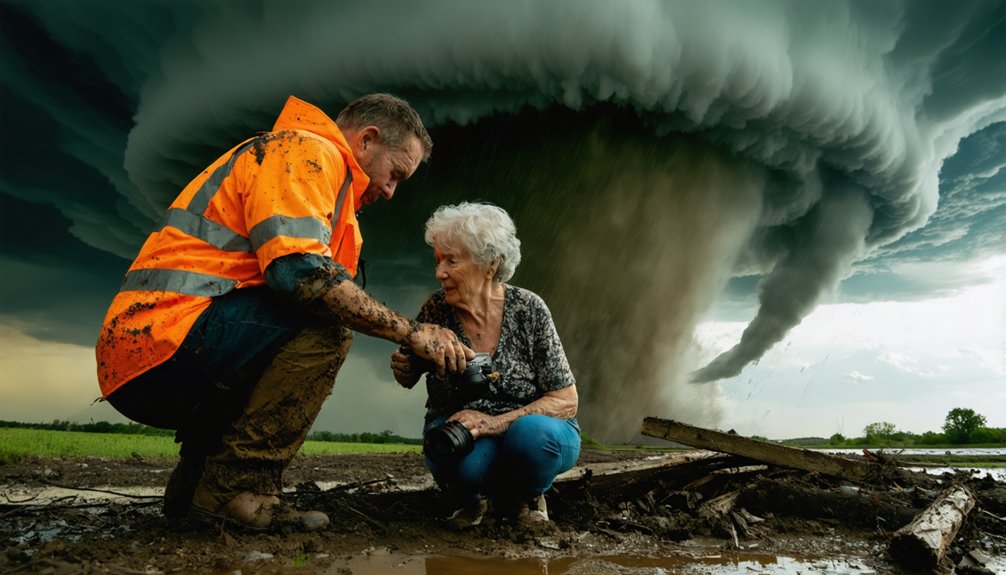
Real-world data confirms that storm chasers have directly preserved lives in documented rescue operations. You can examine specific cases: chasers extracted an elderly man from Illinois rubble, reunited scattered families after Texas tornadoes, and delivered critical medical stabilization before emergency personnel arrived.
These outcomes reflect how professional responsibilities extend beyond data collection into active human intervention.
You’ll notice these rescues didn’t happen accidentally. Chasers carried first aid kits, coordinated in groups, and communicated precise location data to dispatchers. Their ethical dilemmas resolved through action, not hesitation.
Nonprofit chaser organizations have further extended this impact, distributing supplies and clearing debris during recovery phases. The evidence demonstrates that when chasers exercise both technical skill and moral accountability, survival rates measurably improve and community trust strengthens considerably.
How Storm Chasers Help Communities Rebuild After a Tornado
Storm chasers don’t stop contributing once the tornado dissipates. Their involvement extends into rebuilding phases, where they leverage meteorological research to help communities understand what struck them and why.
You’ll find chaser-led nonprofits distributing water, clearing debris, and transporting supplies to cut-off areas. That operational freedom lets them move faster than bureaucratic relief systems.
Their weather prediction data also informs structural rebuilding decisions, helping residents and contractors understand which areas face repeated tornado exposure.
Chasers build long-term partnerships with emergency services, strengthening future disaster response frameworks. Community trust grows when chasers remain present beyond the event itself.
You’re looking at individuals who transform raw storm data into tangible recovery action, making them valuable not just as documentarians, but as active participants in post-disaster restoration.
Frequently Asked Questions
Do Storm Chasers Receive Formal Training Before Attempting Tornado Victim Rescues?
Ironically, you don’t need formal training to chase tornadoes, yet volunteer coordination and legal liabilities demand it. You’ll find most chasers self-train, though professional organizations actively push structured rescue preparedness programs to reduce risks.
How Do Storm Chasers Mentally Cope With Witnessing Tornado Destruction Firsthand?
You build emotional resilience through peer debriefing, structured trauma management protocols, and professional counseling. Data confirms chasers who actively help victims process destruction better, as purposeful action transforms passive witness stress into measurable psychological recovery outcomes.
Are Storm Chasers Ever Compensated Financially for Assisting During Disaster Events?
Most storm chasers aren’t compensated financially; you’ll find they’re driven by volunteer motivations rooted in ethical dilemmas between data collection and human aid. Some nonprofits offer stipends, but most operate independently, prioritizing community impact over monetary gain.
What Equipment Do Storm Chasers Typically Carry Beyond Standard First Aid Kits?
You’re carrying a mountain of gear! Beyond first aid kits, you’ll typically pack weather monitoring tools like portable radar, GPS units, and helmets. You’ll also follow safety protocols using satellite communicators and dashcams for data-driven situational awareness.
Do Insurance Policies Cover Storm Chasers Who Stop to Assist Tornado Victims?
Most standard insurance policies won’t cover you during volunteer rescues, raising critical ethical considerations. Your volunteer motivations matter, but you’ll need specialized liability coverage before stopping to assist tornado victims as a storm chaser.
References
- https://www.youtube.com/watch?v=3s3TPcE5BiE
- https://en.wikipedia.org/wiki/Storm_chasing
- https://www.youtube.com/watch?v=I9O_D5SI8sg
- https://www.accuweather.com/en/severe-weather/the-harrowing-moment-when-storm-chasing-turned-to-search-and-rescue/1503826
- https://news.meaww.com/gallery/storm-chasers-capture-dramatic-rescue-as-massive-tornadoes-rip-through-the-midwest-mqbzyxc4
- https://wmms.iheart.com/featured/capntony/content/2026-06-16-storm-chaser-rescues-man-trapped-by-rubble-after-tornado/
- https://www.youtube.com/watch?v=RTbkif4rONI
- https://www.cjonline.com/story/news/politics/state/2013/03/09/storm-chasers-helping-save-lives/16402581007/
- https://www.foxweather.com/extreme-weather/storm-chaser-rescues-family-during-live-coverage-of-texas-tornado
- https://people.com/real-life-twister-chasers-go-viral-with-livestreams-then-help-survivors-rebuild-exclusive-8704217