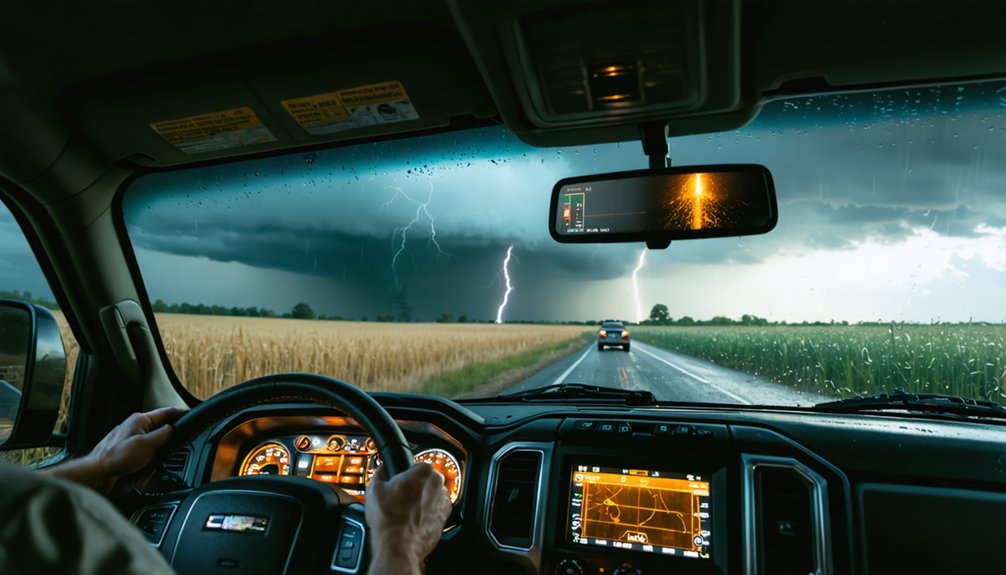
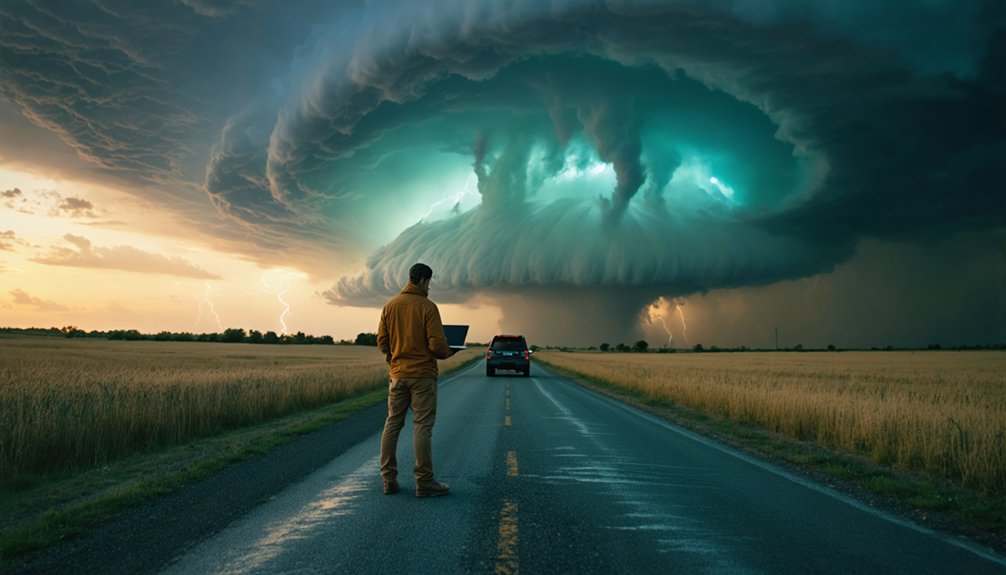
Chasing supercell storms safely means you’ve got to assess storm structure, avoid high-precipitation supercells with rain-wrapped tornadoes, and position yourself east or southeast of the updraft base. Use radar to confirm rotational couplets and storm-relative helicity before committing. Always pre-identify two escape routes perpendicular to storm motion, and treat risk evaluation as continuous — not a one-time check. The strategies below break down exactly how experienced chasers execute each of these critical decisions.
Key Takeaways
- Assess supercell size, radar rotation, and updraft tilt to evaluate storm intensity before committing to a chase position.
- Avoid high-precipitation supercells, as rain-wrapped tornadoes severely limit visibility and dramatically reduce safe reaction time.
- Position southeast of the updraft base, keeping the wall cloud visible while staying clear of the dangerous notch region.
- Always identify two viable escape routes perpendicular to storm motion before stopping, verifying road conditions using mapping software.
- Continuously reassess risk throughout the chase, avoiding ego-driven decisions that compromise situational awareness and threat evaluation.
Read the Supercell Before You Chase It
Before you commit to a chase, assess the supercell’s size, structure, and appearance to gauge its intensity and behavior. A well-organized storm structure with a distinct bounded weak echo region, striated updraft towers, and a clearly defined wall cloud signals a high-potential storm worth targeting.
Use radar interpretation to identify rotational couplets, storm-relative helicity, and updraft tilt before positioning.
Radar data reveals the storm’s rotational signature, helicity values, and structural tilt—interpret these before committing to any intercept position.
Larger, visually imposing supercells often pack stronger mesocyclones and greater tornado potential. Favor environments displaying strong wind shear and substantial CAPE, as these parameters sustain longer, more prolific storms.
Avoid committing to a chase position until radar data confirms the storm’s motion, speed, and intensity trends. Reading the supercell accurately before approach keeps you mobile, informed, and positioned to intercept safely on your own terms.
Avoid HP Supercells, Rain-Wrapped Tornadoes, and Core Punching Risks
High-precipitation (HP) supercells rank among the most deceptive and dangerous storm structures you’ll encounter, wrapping tornadoes in dense rain curtains that eliminate visual confirmation until you’re dangerously close.
Rain-wrapped tornadoes reduce storm visibility to near zero, stripping your reaction time and escape margin simultaneously.
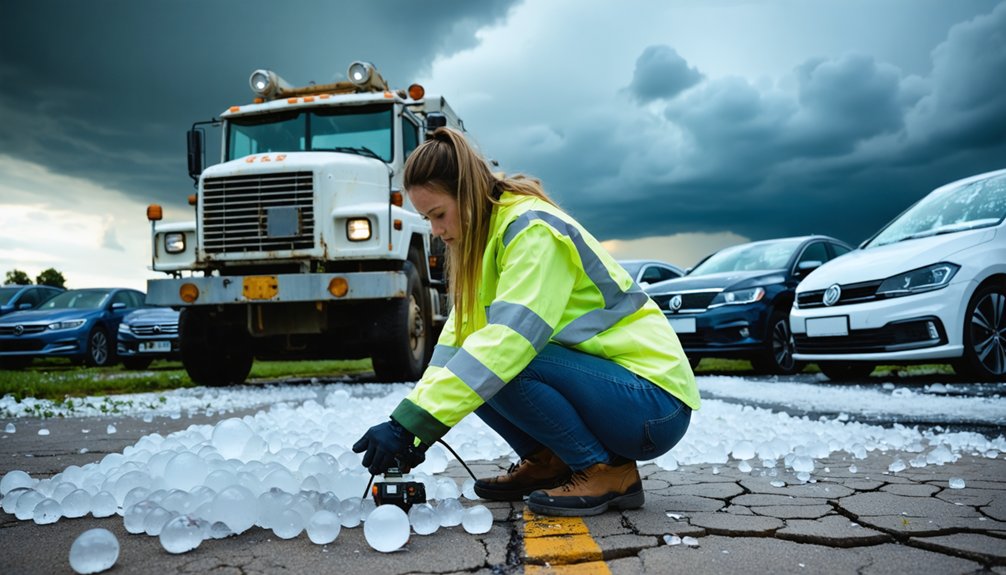
Core punching compounds this danger exponentially. Driving through a precipitation core exposes you to baseball-sized hail, sudden visibility collapse, and hydroplaning on debris-covered roads.
You’re fundamentally maneuvering blind inside a violent system with no reliable exit guarantee.
Avoid HP supercells unless your road network provides confirmed perpendicular escape routes with zero compromise.
Prioritize classic supercells offering clean visual structure instead.
Radar alone won’t protect you here—ground-truth visibility conditions determine survivability.
Respect the storm’s concealment capability before committing to any intercept position.
Pick Your Position Around the Supercell Wisely
Positioning around a supercell determines whether you observe safely or become part of the damage survey. Station yourself east or southeast of the updraft base, keeping the wall cloud visible without entering the forward flank downdraft.
Understand storm dynamics before committing to any fixed location — supercells shift, accelerate, and produce tornadoes that deviate from expected paths. Avoid the notch region between the hail core and mesocyclone; it’s a high-risk corridor with no clean escape.
Chase safety demands you pre-identify two viable exit routes before stopping. Use radar loops to track storm motion relative to your position, adjusting continuously.
Stationary positioning invites disaster. Move deliberately, maintain southern or eastern angles, and never let road network limitations force you into a compromised vantage point.
Plan Escape Routes Before a Supercell Forces Your Hand
Escape route planning isn’t optional — it’s a non-negotiable step you execute before committing to any fixed position near a supercell.
Before deploying storm observation techniques, identify at minimum two viable exit vectors oriented perpendicular to storm motion. Verify road surface conditions, bridge clearances, and network density on your mapping software. A single paved route east means you’re already compromised.
Cross-reference radar stops with storm speed and heading — a 55-knot supercell closes distance faster than most chasers anticipate. Avoid low-lying roads prone to flash flooding and debris accumulation from recent tornado paths.
If your primary route deteriorates, you execute the secondary without hesitation. Freedom in storm chasing isn’t recklessness — it’s disciplined preparation that keeps your options open when the supercell accelerates unexpectedly.
Develop the Mindset That Separates Smart Chasers From Dangerous Ones
Mindset isn’t abstract — it’s the operational variable that determines whether your decision-making degrades under pressure or holds. Smart chasers treat risk assessment as a continuous process, not a pre-chase checklist. Your situational awareness must stay active — tracking storm motion, road options, and environmental shifts simultaneously.
Mindset is the variable that holds your decisions together when conditions stop cooperating.
Three mindset principles that separate disciplined chasers from dangerous ones:
- Acknowledge ego drift — recognize when excitement overrides objective threat evaluation
- Operate within margins — rain-wrapped tornadoes and debris fields extend further than visual perception suggests
- Avoid task saturation — limit simultaneous inputs so your cognitive bandwidth stays sharp under dynamic conditions
You’re not chasing to prove something. You’re chasing to observe, document, and return. That clarity is your most critical operational asset.
Frequently Asked Questions
What Tools Do Beginners Need Before Chasing Their First Supercell Storm?
Before your first chase, you’ll need essential gear like radar apps, a weather radio, and a reliable vehicle. Follow safety tips by seeking experienced chasers, attending Skywarn workshops, and always securing multiple escape routes.
How Do Storm Chasers Coordinate Safely With Emergency Management Teams?
You’ll coordinate with emergency management teams by following established communication protocols, sharing real-time storm data via radio frequencies, and carrying proper safety equipment. You’re providing critical ground-truth observations that support official warning systems and public safety decisions.
What Insurance Coverage Do Storm Chasers Need for Vehicle Hail Damage?
You’ll need extensive vehicle insurance to cover hail damage, as liability-only policies won’t protect your equipment. Verify your deductible thresholds, document pre-chase condition, and confirm your insurer doesn’t exclude storm-chasing activities from coverage terms.
How Does Storm Chasing Differ Across Various Geographic Regions and Terrains?
You’ll face distinct storm patterns and terrain challenges by region: Great Plains offers open visibility, while Appalachian ridges obstruct escape routes, southeastern forests limit sightlines, and mountainous western regions create unpredictable orographic storm development requiring adaptive positioning strategies.
What Certifications or Training Programs Exist Specifically for Aspiring Storm Chasers?
Want to chase storms effectively? You’ll find Skywarn’s storm spotting certification and NWS training invaluable. These programs sharpen your weather radar interpretation skills, equipping you with precise, data-driven knowledge to chase freely and responsibly.
References
- https://www.youtube.com/watch?v=nxPSFg2R8YY
- http://www.inflowimages.com/Education/chasetips.html
- https://stormtrack.org/threads/what-are-some-short-term-chase-strategies.2665/
- https://www.youtube.com/watch?v=w-5nJ61umeA
- https://matadornetwork.com/trips/6-tips-for-amateur-storm-chasers/