When you photograph hailstones, log GPS coordinates, and submit storm reports, you’re closing data gaps that satellites and radar systems can’t fill alone. Your ground-level observations help scientists validate melting models, reconstruct hailstone formation, and improve severe weather forecasts. Platforms like CoCoRaHS, mPING, and SEaRCH make it easy to contribute meaningful data from your own backyard. Stick around, and you’ll discover exactly how your reports are transforming storm science.
Key Takeaways
- Citizen scientists fill critical data gaps by reporting hailstone size, location, and timing that radar and satellites cannot capture alone.
- Platforms like CoCoRaHS, mPING, and mPING enable volunteers worldwide to submit real-time hail observations through simple apps and web portals.
- Volunteers photograph hailstones beside rulers, log precise coordinates, and freeze physical samples at -13°C for laboratory analysis.
- Ground-level citizen reports validate radar algorithms, support melting models, and reveal hail formation mechanics, microphysics, and aerosol influences.
- Over 3,000 citizen-collected hailstones across 15 Chinese provinces have directly advanced storm forecasting, warning systems, and microphysics research.
Why Scientists Can’t Do Hailstorm Research Without You
Hailstorms are fleeting, localized, and wildly unpredictable—and that’s exactly why scientists need you. Radar and satellites can’t capture every strike, every size, every precise location. You can. When you report a hailstone’s diameter, photograph it against a ruler, and log the exact time and coordinates, you’re filling critical gaps that instruments simply miss.
That ground-level data builds historical records scientists use to track climate impact across seasons and decades. Without your contributions, hail frequency trends stay incomplete, forecasting models stay weak, and warning systems stay behind.
Platforms like CoCoRaHS, mPING, and SEaRCH exist because researchers know the truth: dense, real-time, human-sourced observations are irreplaceable. You’re not a passive bystander—you’re an active node in a living research network that’s reshaping how we understand severe storms.
The Top Citizen Science Platforms for Hail Reporting
Whether you’re chasing storms in Argentina or measuring rainfall in your backyard, there’s a platform built for your contribution. Each tool puts storm tracking power directly in your hands.
CoCoRaHS connects you to NASA, NOAA, and NSF-backed precipitation research.
mPING lets you submit app-based reports that sharpen radar classification algorithms.
SEaRCH focuses volunteer efforts across the Southeast U.S. on hail observation specifically.
Going global? Hailstone Hunting! mobilizes Chinese volunteers to collect freshly fallen samples for hailstone formation analysis.
Cosecheros de Granizos Córdoba gives Argentine participants a geolocating app to map storms and gather physical samples.
You’re not just reporting weather—you’re feeding real science. Pick your platform, follow its protocols, and start contributing data that researchers genuinely can’t get anywhere else.
What Volunteers Actually Do in Hailstorm Studies
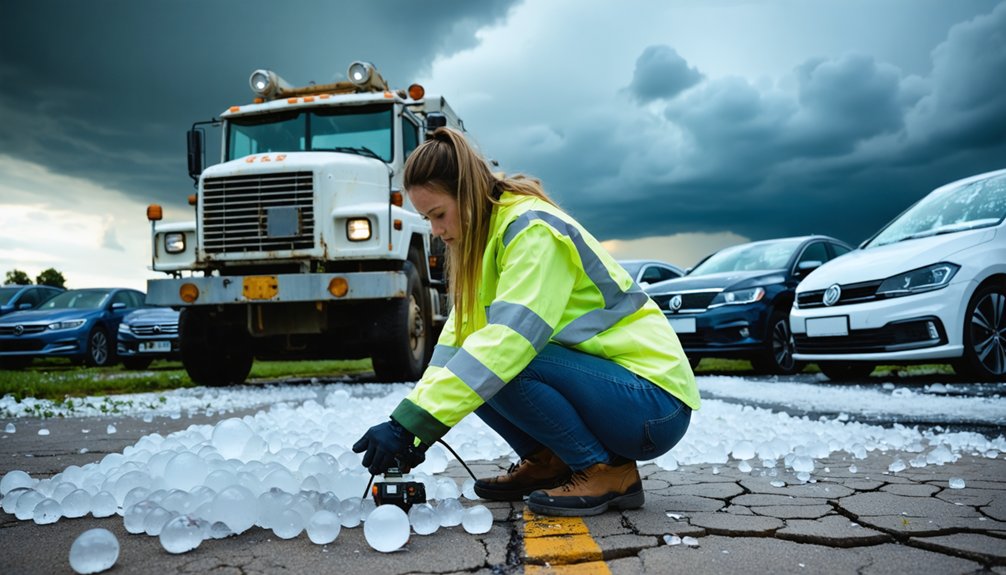
Once the storm clears, your real work begins. You’ll photograph hailstones alongside a ruler for accurate size comparison, log the exact time, date, and location, then submit everything through a mobile app or web portal. Data accuracy depends entirely on your precision here — a blurry photo or missing timestamp weakens the entire dataset.
Some projects ask you to collect physical hailstones, seal them in plastic bags, and freeze them at -13°C or lower for laboratory analysis. Scientists later examine chemical composition, stable isotopes, and aerosol particles embedded inside.
Volunteer training is freely available through platforms like CoCoRaHS, so you’re never operating blind. You’re contributing real measurements that feed into radar validation, hail melt modeling, and next-generation warning systems. Your independence drives discovery.
How Your Reports Help Scientists Model Hail Melting and Growth
Every measurement you submit feeds directly into something scientists can’t easily replicate with instruments alone: real-time ground truth for hail melting models. When you report hail size, time, and location, researchers pair your data with archived satellite overpass records to reconstruct how hailstones evolved after falling below freezing levels.
That’s storm microphysics in action—and you’re part of it. Your reports reveal how fast hail melts across different elevations, temperatures, and storm structures, sharpening models that currently rely too heavily on sparse instrument networks.
Understanding hail formation requires knowing what survives to the ground. Your observations close that gap.
Combined with radar validation and chemical sample analysis, citizen-reported data directly advances next-generation hail warning systems—ones that’ll protect communities that instruments alone can’t serve.
What Hail Citizen Science Has Actually Discovered
Your contributions have already fueled concrete scientific breakthroughs. Through projects like China’s “Hailstone Hunting!” initiative, volunteers collected 3,063 freshly fallen hailstones across 15 provinces.
This enables laboratory analysis of chemical composition, stable isotopes, and insoluble particles that reveal how aerosols drive hail growth. You’re not just reporting storms—you’re helping researchers decode the microphysical fingerprints locked inside every hailstone.
Key Research Findings
Through the painstaking work of thousands of volunteers, hail citizen science has produced findings that traditional instrumentation simply couldn’t achieve alone. Your reports on hail size and storm timing have directly validated radar-based precipitation classification algorithms, exposing gaps that satellite data missed entirely.
China’s collection initiative gathered 3,063 freshly fallen hailstones across 15 provinces, enabling chemical composition analysis, stable isotope profiling, and aerosol-hail growth research.
mPING volunteer submissions sharpened meteorological identification algorithms, strengthening next-generation warning systems.
NASA’s integration of public observations with archived satellite overpass data has advanced hail melt modeling below freezing levels.
You’re not just collecting data — you’re actively dismantling the boundaries of what severe storm science can accomplish, accelerating discoveries that protect communities and reshape how researchers understand hailstorm microphysics.
Hailstone Chemical Discoveries
When volunteers rush outside after a storm to collect freshly fallen hailstones, they’re handing researchers something irreplaceable: chemically intact samples that reveal what’s happening inside severe convective systems. Chemical analysis of citizen-collected hailstones has revealed discoveries that radar simply can’t provide.
Here’s what laboratory examination reveals:
- Isotopic signatures expose the altitude and temperature conditions where hail embryos formed.
- Insoluble particle analysis identifies aerosols that triggered hail growth, connecting air quality directly to storm severity.
- Chemical composition profiling maps layer-by-layer atmospheric conditions the hailstone passed through during growth.
Your collected sample becomes a frozen atmospheric record. Projects like China’s volunteer network gathered 3,063 hailstones across 15 provinces, proving that decentralized, citizen-driven collection produces research-grade data that transforms storm microphysics understanding.
How to Join a Hail Citizen Science Project Near You
You can start contributing to real hail science today by finding the network that fits your region—CoCoRaHS operates across North America, mPING works anywhere via smartphone, and projects like Cosecheros de Granizos Córdoba serve South American volunteers.
Once you’ve registered on your chosen platform, you’ll access free training that covers measurement standards, photo protocols, and safe post-storm observation practices.
Then you’re ready to submit your first report—storm time, location, hail size, and a ruler-referenced photo that researchers can actually use.
Find Your Local Network
Whether you’re chasing hailstorms in the American Southeast or collecting hailstones on the Chinese plains, there’s a citizen science network built for your region. Citizen engagement drives real discoveries, and joining the right platform connects your observations directly to researchers mapping hailstorm patterns globally.
Find your match here:
- CoCoRaHS — Join at cocorahs.org for free training, a mobile app, and immediate integration with NOAA and National Weather Service data networks.
- SEaRCH — Southeast-based volunteers report hail events that refine regional storm analysis and detection algorithms.
- mPING — Download the app, report precipitation anywhere, and contribute to next-generation radar classification systems.
Each platform gives you autonomy over your participation level while feeding critical data into severe weather science. Your location is your laboratory.
Register And Get Trained
Signing up is straightforward, and the training won’t slow you down. CoCoRaHS offers free online modules that walk you through measurement protocols, reporting standards, and the hail physics behind what you’re observing. You’ll learn why data accuracy matters—how a single misreported hailstone size can skew storm models researchers depend on.
mPING lets you register directly through its app, submitting precipitation reports that feed real-time radar algorithm validation. For sample-based projects like Cosecheros de Granizos Córdoba, registration connects you to collection guidelines and proper storage protocols.
Each platform gives you the tools to contribute meaningfully without bureaucratic friction. You control your participation level, your schedule, your contribution. The science needs your ground-truth observations, and the entry point has never been more accessible.
Submit Your First Report
When your first hailstorm rolls through, you’ll want to be ready to act fast—but only after the storm has passed. Your report directly shapes hail data that scientists use to decode storm patterns. Here’s how to submit:
- Photograph hailstones beside a ruler—never your hand—for accurate size reference.
- Log the time, date, and location through your CoCoRaHS app, mPING, or your region’s platform.
- Submit size estimates or physical samples if your project, like Hailstone Hunting! or Cosecheros de Granizos, requires lab-ready specimens stored at −13 °C or lower.
Every report you file becomes part of a larger collaborative network validating radar algorithms and strengthening next-generation warning systems. You’re not just observing—you’re actively building scientific knowledge from the ground up.
How to Stay Safe While Collecting Hail Data
Safety is the foundation of good citizen science, and you’ll want to follow a few essential guidelines before you step outside after a storm. Hail safety starts with one non-negotiable rule: never collect data during active hailfall. Wait until the storm has completely passed before venturing out.
Storm awareness means monitoring local alerts and confirming the cell has moved on before you grab your ruler and phone.
When photographing hailstones, place a ruler beside them rather than using your hand — your hand distorts size perception and skews scientific accuracy.
If you’re storing physical samples, seal them in plastic bags and freeze them at -13 °C or lower immediately.
You’re contributing real data to serious research, so protecting both yourself and sample integrity matters enormously.
Frequently Asked Questions
Can Children Participate in Citizen Science Hail Reporting Projects?
Yes, you can absolutely change the world! CoCoRaHS welcomes volunteers of all ages, making children’s educational engagement effortless. Free volunteer training resources guarantee you’re contributing accurate hail data confidently alongside scientists driving real storm research breakthroughs.
Are Citizen Scientist Hail Reports Used in Insurance or Legal Claims?
The knowledge base doesn’t confirm insurance integration or legal validation uses. Your citizen science hail reports actively support forecasting and storm research, but you shouldn’t assume they’d hold weight in formal insurance or legal claims processes.
Do Volunteers Receive Any Recognition or Compensation for Their Contributions?
Like unsung heroes of the skies, you fuel discovery through passion alone. Volunteer motivation drives most contributors, as formal recognition programs are rare—but your data shapes real science, and that impact’s your greatest reward.
How Long Does Submitting a Single Hail Report Typically Take Volunteers?
Submitting a single hail report takes just minutes! You’ll boost data accuracy by noting time, location, and size, then uploading a photo. Your reporting frequency directly fuels cutting-edge storm research we’re all passionate about advancing together.
Can Volunteers Access the Research Findings Their Hail Data Contributed To?
You won’t always get direct access, but your data accuracy fuels published studies, forecasts, and warning systems. Through scientific collaboration, you’re shaping real research—CoCoRaHS and mPING regularly share findings publicly, so you can track your impact.
References
- https://science.nasa.gov/get-involved/citizen-science/hail-yeah-nasa-researchers-use-volunteer-observations-for-hail-estimates/
- https://www.youtube.com/watch?v=Sj_mRyfAArQ
- https://meetingorganizer.copernicus.org/EMS2025/EMS2025-662.html
- http://hiweather.net/article/132/151.html
- https://news.uq.edu.au/2017-10-10-citizen-scientists-needed-hailstorm-research
- https://www.argentina.gob.ar/sites/default/files/hailstone_collectors.pdf
- https://journals.ametsoc.org/view/journals/wcas/12/2/wcas-d-19-0131.1.pdf
- https://www.eol.ucar.edu/sites/default/files/2025-04/icechip-final-0423.pdf
- https://apps.apple.com/fr/app/mping/id584383400
- https://science.nasa.gov/citizen-science/community-collaborative-rain-hail-and-snow-network/