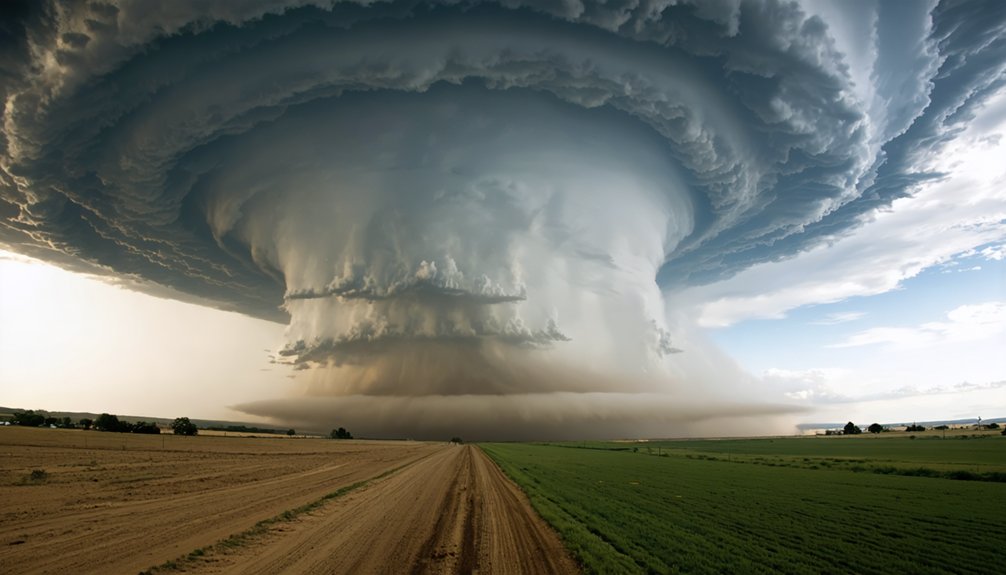
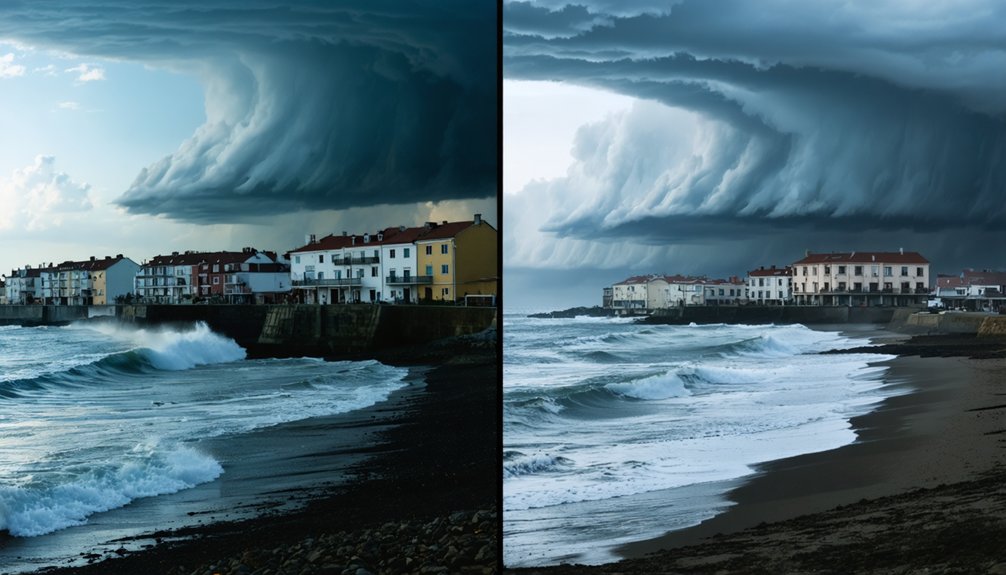
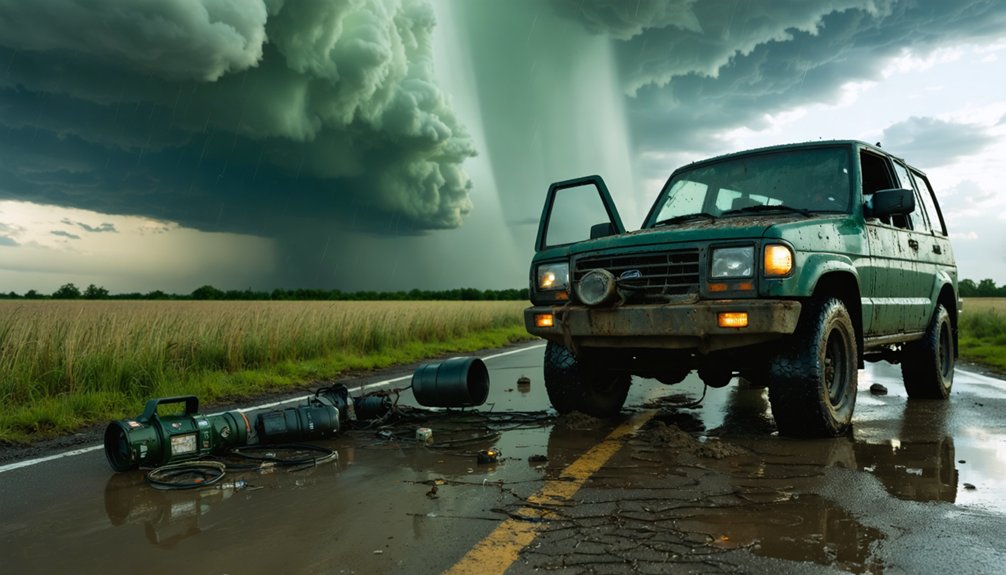
If you’re tracking flash floods today, you’re not finding them where you used to. Storm chasers are watching traditional plains events migrate toward the Gulf Coast, Southeast, and Lower Mississippi Valley. Climate change is intensifying the hydrological cycle, making flood losses projected to surge from $8 billion to $41 billion annually by 2050. Burn scars, hardened drought soils, and compound storm surge are rewriting every trigger pattern you once relied on — and the full picture runs deeper.
Key Takeaways
- Storm chasers observe tornado activity migrating eastward, with flash floods now striking Gulf Coast and Southeast states far more frequently than before.
- Traditional flood triggers are shifting geographically, making historical forecasting models unreliable and forcing storm chasers to adapt their prediction strategies constantly.
- Chasers document monsoon-driven rainfall triggering flash floods without tornadoes present, representing a newly emerging and dangerous weather pattern.
- Burn-scarred terrain observed by chasers transforms dry landscapes into rapid flood channels, creating deadly flash flood conditions within minutes of rainfall.
- AI-integrated drones and high-resolution radar now assist storm chasers in capturing real-time data, enabling faster, more precise flash flood warnings.
How Has Flash Flooding Changed in the Last Decade?
Flash flooding has shifted dramatically over the last decade, with storm trajectories migrating away from traditional plains toward the Gulf Coast, northern High Plains, and densely populated Southeast states.
Flash flood trends now reflect a lower Mississippi Valley concentration of severe weather events, exposing urban centers to compounding risks they weren’t historically designed to handle.
Rainfall patterns have intensified alongside these geographic shifts.
Burn scars from wildfires accelerate runoff in urban zones, while monsoon systems deliver fierce precipitation events independent of tornado activity.
You’re seeing storms that once struck every 50 years now projected to hit every 25.
Climate change isn’t a distant variable — it’s actively reshaping where, when, and how hard flash floods strike across regions you may have considered relatively safe.
Where Are Flash Floods Striking Now: And Why Has It Shifted?
Geographic displacement of flash flood risk has accelerated beyond what most infrastructure planning anticipated.
Tornado migration eastward has repositioned storm trajectory patterns toward Southeast vulnerability zones, overwhelming urban infrastructure designed for older rainfall patterns. You’re now seeing densely populated Gulf Coast cities absorbing storm intensities previously absorbed by open plains.
Drought impacts complicate this shift further.
Burn-scarred terrain and hardened soil can’t absorb sudden downpours, converting dry landscapes into instant flood channels. The lower Mississippi Valley concentrates severe weather events that once distributed across broader geography.
Hardened, fire-scarred earth repels rainfall entirely — transforming parched ground into high-velocity flood channels overnight.
Flood preparedness strategies built on historical data are failing because that data no longer reflects current conditions.
Climate resilience demands you acknowledge that traditional flood maps are structurally obsolete — and that infrastructure investments must reflect where storms are actually striking today.
What Is Climate Change Doing to Flash Flood Intensity?
When climate change intensifies the hydrological cycle, you get storms that don’t just occur more often — they hit harder and faster. A 2°C temperature rise doubles the frequency of short-lived summer rainstorms in Alpine regions alone. Events once expected every 50 years now recur every 25.
These climate impacts compound quickly. Heavier rainfall overwhelms drainage infrastructure, burn scars accelerate runoff, and rapid snowmelt collides with storm surge in coastal zones.
You’re not dealing with isolated hazards anymore — you’re facing synchronized threats.
The data’s unambiguous: U.S. flood losses averaging $8 billion annually will surge to $41 billion by 2050. Building flood resilience isn’t optional — it’s a calculated response to measurable risk.
The atmosphere’s changed, and the flood patterns reflect that precisely.
What Ground-Level Flash Flood Data Actually Reveals
When you examine ground-level flash flood data, you’ll notice two critical shifts emerging: traditional flood triggers are relocating geographically, and urban centers are recording sharply higher flood frequencies.
Burn scars from forest fires are now accelerating surface runoff in cities, while severe weather activity concentrates increasingly in the lower Mississippi Valley rather than historical plains regions.
You’re looking at a system where Tornado Alley’s eastward migration into densely populated Southeast states is compounding urban flood vulnerability in ways that older hydrological models never anticipated.
Shifting Flood Trigger Patterns
Ground-level flash flood data reveals that trigger patterns are shifting in ways that challenge traditional forecasting models.
You’re seeing flood trigger mechanisms evolve as storm trajectory shifts push severe weather from the traditional plains toward the Gulf Coast and densely populated Southeast states. Urban landscape impacts intensify these risks, with burn scars accelerating runoff in city centers.
Key pattern shifts you need to understand:
- Monsoon-driven rainfall now triggers flash floods without generating tornadoes, complicating early warning systems.
- Lower Mississippi Valley regions absorb increasingly concentrated severe weather events.
- Urban infrastructure faces compound flooding from simultaneous storm surge, rainfall, and river flow.
Developing effective climate adaptation strategies requires you to recognize these shifting dynamics before traditional forecasting assumptions leave communities dangerously underprepared.
Urban Flash Flood Increases
Urban centers are absorbing flash flood impacts at accelerating rates, and ground-level data confirms burn scars as a primary driver—fire-damaged soil repels water rather than absorbing it, converting rainfall directly into high-velocity surface runoff.
Your urban infrastructure wasn’t engineered for this compound threat. Drainage systems designed decades ago can’t handle burn scar-accelerated runoff volumes hitting simultaneously with intensified storm events.
Risk assessment data demands you rethink urban planning priorities now. Emergency response teams are encountering flood scenarios that exceed standard preparedness frameworks, forcing rapid protocol adjustments in real time.
Community resilience depends on acknowledging these shifting baselines. Public awareness campaigns must communicate that traditional flood zone designations are increasingly unreliable.
Without updated flood preparedness strategies incorporating burn scar mapping and intensified storm projections, urban populations remain dangerously exposed.
How Technology Is Exposing Flash Flood Mechanisms in Real Time
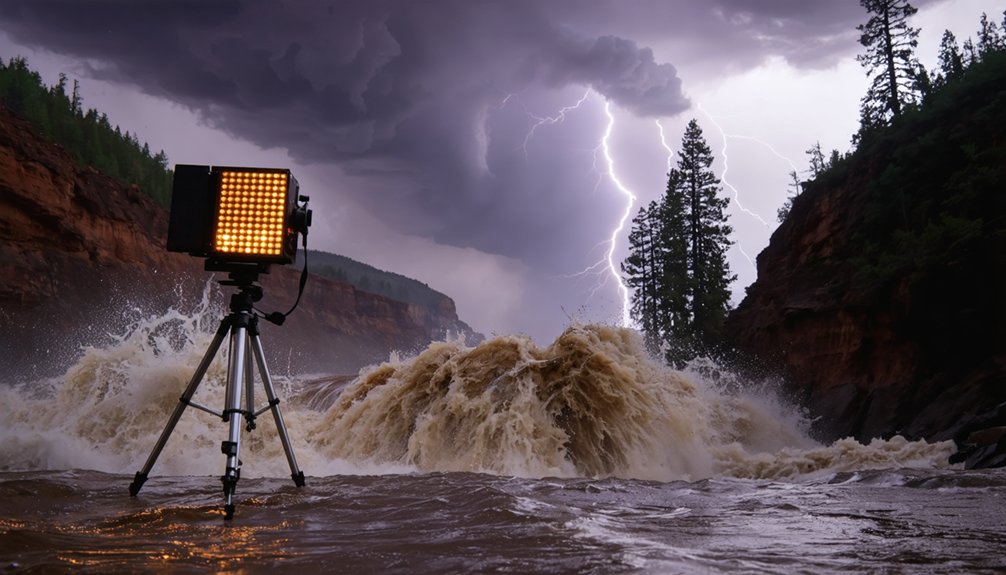
When you examine today’s storm-chasing operations, you’ll find that autonomous drones and AI-powered systems are capturing real-time data at scales previously impossible—like the 252 mph gust recorded during Hurricane Melissa in 2025.
You can now access high-resolution radar feeds and advanced satellite imagery that pinpoint flash flood triggers as they develop, feeding AI models that identify the precise atmospheric mechanisms driving rapid intensification.
These technologies aren’t just collecting data—they’re translating it into actionable forecasts that directly inform flood response strategies before water levels become catastrophic.
Real-Time Storm Data
As flash floods grow more erratic and deadly, real-time storm data collection is exposing the precise mechanisms driving these events with unprecedented clarity. You now have access to tools that deliver data accuracy at scales previously impossible to achieve.
Key advancements driving real time monitoring include:
- Autonomous drones recording gusts exceeding 252 mph during Hurricane Melissa in 2025
- AI-powered systems processing raw storm data into actionable forecasting models
- High-resolution radar and satellite networks sharpening trajectory predictions before floods strike
These technologies don’t just track storms — they decode them. Every transmitted data point strengthens climate adaptation strategies and reduces your vulnerability window.
When bandwidth limitations and satellite gaps get closed, storm chasers gain the intelligence edge needed to expose exactly how intensifying storms form and accelerate.
AI-Powered Flood Analysis
Raw storm data means nothing without interpretation — that’s where AI-powered flood analysis closes the gap. Through machine learning and advanced data analytics, you’re now seeing storm chasers convert raw atmospheric readings into actionable flood forecasting within minutes.
AI integration enables predictive modeling that identifies flash flood triggers before conditions fully develop, giving communities a sharper risk assessment window.
Event simulation tools run thousands of flood scenarios simultaneously, cross-referencing rainfall intensity, soil saturation, and urban drainage capacity. These aren’t theoretical exercises — they’re driving real-time climate adaptation decisions.
You can trace how specific storm mechanisms escalate into catastrophic flooding through precise computational modeling that wasn’t available a decade ago. The result: faster warnings, smarter evacuations, and a measurable reduction in preventable flood casualties.
How Much Worse Will Flash Flooding Get by 2100?
By 2100, flood hazards will expose an additional 300 million people worldwide, with climate change directly accounting for 21.1 percent of that increase.
Flood prediction models show U.S. losses climbing from $8 billion annually to $41 billion by 2050. Urban resilience strategies can’t wait—you’re already seeing the consequences unfold.
U.S. flood losses are projected to surge from $8 billion to $41 billion annually by 2050—urban resilience cannot wait.
The projections demand your attention:
- Storms currently expected every 50 years will strike every 25 years
- Annual global flood damage already exceeds $40 billion according to OECD data
- U.S. death tolls have surpassed 100 people per year in recent decades
These aren’t distant abstractions. You’re watching compound flood risks accelerate through storm surge, extreme rainfall, and rapid snowmelt converging simultaneously.
The data’s trajectory is unambiguous—inaction compounds every risk exponentially.
Frequently Asked Questions
How Do Burn Scars From Wildfires Directly Contribute to Urban Flash Flooding?
Like open wounds on the landscape, burn scars strip away nature’s sponge, so when rain hits, you’re watching urban runoff surge unchecked, overwhelming drainage systems and triggering dangerous flash floods in cities faster than you’d expect.
What Specific Safety Protocol Changes Are Storm Chasers Adopting for Compound Flood Events?
You’re now upgrading safety gear and overhauling communication protocols to match compound flood risks. You’ve integrated AI systems, real-time satellite links, and adaptive tracking tools that counter unpredictable storm trajectories, bandwidth gaps, and increasingly harsh field conditions.
How Does Compound Flooding Differ From Standard Flash Flooding in Coastal Zones?
Compound flooding hits you harder by combining storm surge, extreme rainfall, and river flow simultaneously in coastal zones, accelerating coastal erosion beyond standard flash flooding’s isolated impact—it’s a converging multi-hazard event that’s dramatically increasing your flood exposure risk.
What Bandwidth and Satellite Limitations Most Hinder Storm Chasers During Active Flood Events?
“Knowledge is power”—you’ll find satellite connectivity gaps and data transmission bottlenecks hit hardest during active flood events. Bandwidth limitations slow real-time uploads, while coverage gaps in extreme weather zones leave you without critical storm intelligence precisely when it matters most.
How Does Rapid Snowmelt Combine With Heavy Rain to Trigger Sudden Flash Floods?
When snowmelt dynamics accelerate alongside high rainfall intensity, you’re facing a double water-load your drainage systems can’t handle. Saturated ground rejects additional moisture, runoff surges rapidly, and sudden flash floods strike with little warning.
References
- https://www.curbed.com/2022/01/storm-chasers-nyc-climate-change.html
- https://www.youtube.com/watch?v=uFGdZeKtYnI
- https://www.cosmopolitan.com/lifestyle/a39895714/storm-chasers-climate-change/
- https://www.nationalgeographic.com/travel/article/storm-chasing-is-an-exhilarating-rush-but-is-it-safe
- https://crazystormchasers.com/preparing-for-climate-change-storm-chasers-mission-consequences/
- https://www.sciencedaily.com/releases/2025/06/250620031102.htm
- https://crazystormchasers.com/climate-change-and-the-future-challenges-for-storm-chasers/
- https://www.jaclynwhittal.com
- https://www.ipcc.ch/report/ar6/wg1/chapter/chapter-11/
- https://apnews.com/article/storm-chasers-hailstorms-severe-weather-climate-change-da4a31e572da571afdd57fea8a6a62ba