You don’t need a permit to chase storms anywhere in the United States. No federal licensing framework exists, and no state currently requires formal authorization to observe severe weather from public roads. Storm chasing is legal in all 50 states. However, standard traffic laws, trespassing statutes, and emergency closure orders still apply and can create serious legal exposure. There’s more to understand about exactly where the legal lines fall.
Key Takeaways
- Storm chasing is legal in all 50 U.S. states, with no federal licensing framework or permit requirement currently in place.
- Standard traffic laws, trespassing statutes, and emergency closure orders apply to storm chasers regardless of their experience level.
- Oklahoma proposed SB 158, which would create a structured licensing system requiring background checks, insurance, and a $500 application fee.
- Licensed storm chasers under Oklahoma’s proposal would gain access to closed roads and receive limited emergency vehicle treatment.
- Without formal permits, legal issues arise from reckless driving, trespassing, or interfering with active emergency operations, not chasing itself.
Do Storm Chasers Actually Need a Permit?
Whether you’re a weekend hobbyist or a seasoned field researcher, storm chasing doesn’t require a permit in most U.S. states.
No federal licensing framework exists, and state-level mandates are largely absent. You’re free to operate under standard traffic laws and trespassing statutes — nothing more.
That said, storm chasing ethics and liability concerns remain practically significant. Reckless driving, ignoring roadblocks, or interfering with emergency responders can expose you to real legal consequences.
Reckless behavior in the field — not a missing permit — is what puts storm chasers in real legal jeopardy.
Oklahoma’s proposed SB 158 outlined a voluntary professional licensing category, but it targeted access privileges — not a ban on unlicensed activity.
Your legal risk isn’t tied to lacking a permit. It’s tied to your behavior in the field.
Operate within traffic laws, respect private property, and you’re largely within your rights.
Is Storm Chasing Legal Across the U.S.?
Storm chasing is legal across all 50 states — no statute criminalizes the act of observing severe weather from public roads. You’re free to position yourself near a supercell, document a tornado, or track a squall line without holding a government-issued permit.
That freedom, however, operates within a defined legal boundary. Traffic laws, trespassing statutes, and emergency closure orders apply regardless of your intent or equipment.
Storm chasing ethics aren’t just philosophical guidelines — they reflect the legal exposure you carry every time you deploy. Responsible chasing means staying on public roads, respecting law enforcement directives, and avoiding interference with emergency responders.
Your right to chase is broad, but it’s not unconditional. The law doesn’t restrict your presence; it restricts your conduct.
Traffic Laws, Trespassing Rules, and Emergency Restrictions That Always Apply
Chasing storms doesn’t suspend the legal framework you operate under every day. Traffic statutes remain fully enforceable during active weather events, meaning reckless driving, speeding, and roadblock violations carry the same legal implications as any other day.
Law enforcement can and does cite chasers who endanger others.
Trespassing laws apply equally on private land, regardless of storm safety objectives. You need explicit permission before accessing private property, even to document a tornado.
Emergency closures restrict entry into designated zones, and ignoring those boundaries can result in fines or arrest.
Interference with first responders creates additional liability exposure. You’re not shielded by meteorological intent.
Understanding these baseline rules isn’t optional—it’s the foundation that keeps your operation lawful before any licensing discussion even becomes relevant.
Does Any State Formally License Storm Chasers?
Oklahoma stands out as the only state to have formally proposed a structured licensing system for storm chasers through Senate Bill 158, which outlined eligibility requirements, application fees, and enforcement penalties.
If you qualified as a “professional severe weather tracker” under that framework, you’d gain tangible operational advantages, including access to certain closed roads and treatment comparable to emergency vehicles during active severe weather events.
No other state has advanced a comparable licensing framework, making Oklahoma’s proposal the clearest benchmark for what formal storm chaser credentialing could look like in practice.
Oklahoma’s Licensing Proposal
While no state has enacted a fully operational licensing system for storm chasers, Oklahoma came closest with Senate Bill 158, which proposed a formal professional licensing category for “severe weather trackers.”
Under the bill’s framework, eligibility required employment or a contractual relationship with a media outlet or an accredited university program.
Applicants would’ve submitted a background check, proof of insurance, and a recommendation letter, along with a $500 initial fee and $250 annual renewal.
The bill also addressed storm safety by granting licensed trackers access to certain closed roads, treating them similarly to emergency vehicles.
Ethical considerations were embedded through law enforcement compliance requirements.
Violations carried fines up to $500 and potential license revocation, creating measurable accountability standards for professionals operating in extreme weather environments.
Licensed Tracker Privileges
The privileges tied to Oklahoma’s proposed licensing framework reveal what formal recognition could actually mean for a storm chaser operating in the field.
Under the bill, licensed tracker benefits included access to roads closed during active severe weather events—access unlicensed chasers couldn’t legally claim. Licensed trackers could also receive treatment comparable to emergency vehicles in limited, defined situations.
These distinctions matter practically. You’d retain mobility when civilian access gets cut off, letting you document storms others must observe from a distance. That operational freedom carries weight.
But licensed tracker benefits come with accountability. Storm tracking ethics aren’t optional under a formal framework—you’d represent an employer or university, carry insurance, and comply with law enforcement on demand.
Licensing trades unrestricted access for structured, verifiable credibility.
What Oklahoma’s Proposed Storm Chaser License Would Have Required
If Oklahoma’s SB 158 had passed, you’d have needed to meet specific eligibility criteria, submit a formal application, and pay a structured fee to operate as a licensed severe weather tracker.
Your eligibility would have depended on verified employment or contractual ties to a media outlet or accredited university program, backed by a background check, proof of insurance, and a recommendation letter, along with a $500 initial fee and $250 annual renewal.
In exchange, you’d have gained privileges unavailable to unlicensed chasers, including access to certain closed roads and treatment comparable to emergency vehicles during active severe weather events.
Eligibility And Application Requirements
Oklahoma’s SB 158 set a clear eligibility threshold: you’d need to demonstrate a direct professional or academic tie to qualify. Specifically, the eligibility criteria required employment or a formal contract with either a media outlet or an accredited university program.
Hobbyists and independent chasers wouldn’t meet that bar.
The application process added further requirements beyond affiliation. You’d submit to a background check, provide proof of active insurance coverage, and secure a formal recommendation letter.
On the financial side, the fee structure included a $500 initial payment and a $250 annual renewal charge.
Penalties for non-compliance included fines reaching $500 and potential license revocation.
Every requirement stacked deliberately, creating a credentialed tier designed to separate professional trackers from the broader chasing community.
Fee Structure And Renewal
Under SB 158’s proposed framework, you’d face a two-part fee structure: a $500 initial licensing fee followed by a $250 annual renewal charge.
These fee details reflect a cost model targeting professionals rather than casual observers, since the bill tied eligibility to media employment or university affiliation.
The renewal process would’ve required annual compliance verification, meaning you’d need to maintain valid insurance, a clean background check, and continued professional affiliation to keep your license active.
Missing a renewal deadline likely meant losing access privileges tied to the license.
For context, these aren’t trivial costs if you’re an independent chaser operating outside institutional backing.
The framework fundamentally priced out hobbyists while creating a structured, accountable tier for professionals seeking expanded road access during severe weather events.
Privileges Granted To Licensed Chasers
Paying those fees wasn’t arbitrary—the cost structure existed because a license carried real operational privileges that unlicensed chasers couldn’t access.
Licensed benefits under Oklahoma’s proposed framework included tangible field advantages worth the investment:
- Closed road access during active severe weather events
- Emergency vehicle treatment in limited operational situations
- Authorization to display lights or sirens referenced in the bill’s reporting
- Law enforcement recognition requiring compliance protocols upon license presentation
These privileges represented professional recognition from the state—something no amount of experience alone could grant you.
Without licensure, you’d face hard stops at roadblocks while licensed trackers moved through restricted corridors.
The framework fundamentally created a two-tier system: those with verified credentials gained mobility, while unlicensed chasers operated under standard public-access restrictions only.
What a Storm Chasing License Would Actually Allow
Although a storm chasing license sounds restrictive on paper, the proposed Oklahoma framework was actually designed to grant privileges rather than eliminate unlicensed activity. If you held a license, you’d gain access to certain closed roads during active severe weather events — access unlicensed chasers simply wouldn’t have.
Licensed trackers could also be treated similarly to emergency vehicles in limited situations, with emergency lights and sirens referenced in reporting on the bill.
Think of it as a tiered system rooted in severe weather safety and storm tracking ethics. You’d still follow law enforcement directives and present your license on demand.
Unlicensed chasing wouldn’t become automatically illegal — you’d just forfeit those expanded access privileges. The license rewarded accountability, not compliance through restriction.
How Local Closures and Private Land Rules Apply During a Storm Chase
Beyond state-level licensing questions, 3 distinct land-access rules can cut short a storm chase before you ever get close to the target: local emergency closures, private property boundaries, and drone airspace restrictions.
Local ordinances and safety protocols create hard boundaries that weather interest won’t override. Know these 4 access constraints before you deploy:
Local ordinances and safety protocols create hard boundaries that weather interest alone will never override.
- Emergency road closures — Law enforcement can seal corridors instantly; no weather exemption exists for unlicensed chasers.
- Private property lines — Owner permission is legally required regardless of storm proximity or urgency.
- Drone restrictions — Active weather events can trigger temporary flight restrictions under FAA authority.
- Jurisdictional safety zones — Some counties enforce exclusion perimeters around active incident command areas.
Violating any one of these exposes you to fines, arrest, or civil liability.
How To Chase Storms Without Exposing Yourself to Legal Risk
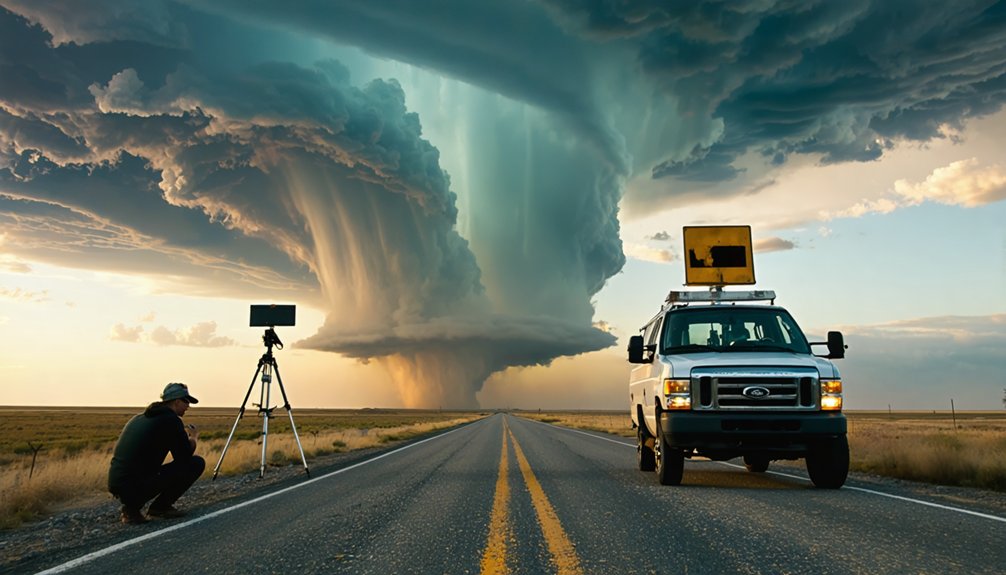
Staying legal during a storm chase comes down to four operational habits: obeying all traffic laws, respecting road closures, staying off private land without permission, and keeping clear of active emergency operations.
Storm safety and legal awareness aren’t separate concerns—they’re operationally linked. Reckless driving during an intercept can trigger charges regardless of weather conditions. Crossing a roadblock creates immediate legal exposure, even if you’re chasing professionally.
Trespassing on private land without owner permission remains enforceable whether skies are clear or tornadic. If you’re flying a drone, check local aviation restrictions before launch.
Carry insurance, document your routes, and monitor road closure updates in real time. You don’t need a permit to chase legally—you just need disciplined, informed decision-making at every stage of the intercept.
Frequently Asked Questions
Can Storm Chasers Use Emergency Lights or Sirens on Their Vehicles?
You can’t legally use emergency lights or sirens without authorization under emergency vehicle laws. Storm chaser regulations, like Oklahoma’s SB 158, reference such privileges only for licensed professionals meeting strict eligibility, insurance, and compliance requirements.
Does Storm Chasing Activity Affect Personal Auto Insurance Premiums or Coverage?
“Fortune favors the prepared.” Your storm chasing can trigger higher premiums, reduced coverage, or denied insurance claims. Insurers flag liability issues from storm damage and driving safety risks, so you’ll want to disclose your activities upfront.
Are There Age Restrictions for Someone Who Wants to Chase Storms?
No federal age restrictions govern storm chasing licenses. You’re free to chase storms at any age, though you must hold a valid driver’s license and comply with all standard traffic and trespassing laws.
Do Drone Operators Need Separate Permits When Filming Storms From Above?
Yes, you’ll need separate permits. When your drone cuts through churning skies, FAA drone regulations and local filming guidelines still govern your flight — you can’t escape those rules, even chasing freedom through a storm.
Can a Storm Chaser Be Held Liable if Their Actions Distract Other Drivers?
Yes, you can face legal repercussions if your storm chasing distracts other drivers. Reckless behavior compromising driver safety creates liability under existing traffic laws, regardless of weather conditions or your intent to document severe storms.
References
- https://www.reddit.com/r/stormchasing/comments/1if5q3h/a_bill_is_being_proposed_to_require_licensing_to/
- https://www.yahoo.com/news/bill-targets-storm-chasers-licensure-223038734.html
- https://crazystormchasers.com/legal-aspects-of-storm-chasing-regulations/
- https://www.youtube.com/watch?v=60KlQQ2CSXU
- https://www.foxweather.com/lifestyle/ok-rules-severe-weather-tornado
- https://www.cityofsouthlake.com/DocumentCenter/View/45683/Storm-Shelter-Permit-Guidelines?bidId=
- https://www.fox23.com/news/state-lawmakers-to-further-study-storm-chasing-licensing-bill/article_a71b6d76-e343-11ef-9379-8f976e339a5c.html
- https://www.facebook.com/groups/549252388010868/posts/604082575861182/
- https://1063thebuzz.com/?p=503566
- https://stormtrack.org/threads/should-storm-chasing-be-regulated.19620/