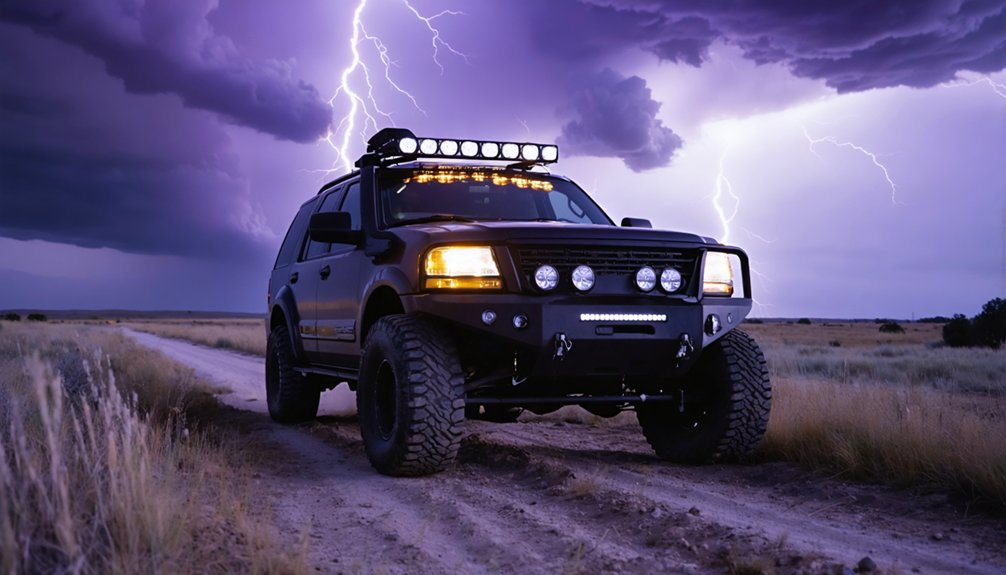
When comparing the three Dominators, you’re looking at a clear progression in platform, armor, and capability. Dominator 1 runs on a 2007 Tahoe with Lexan armor and survives up to 170 mph deployed. Dominator 2 adds LINE-X coating, stronger steel, and deeper anchoring spikes. Dominator 3 shifts to a 2012 Ford F-350 turbodiesel with hydraulic spikes and gull-wing doors, rated for EF5 winds up to 200 mph. There’s markedly more to break down across each generation.
Key Takeaways
- Dominator 1 is built on a 2007 Chevrolet Tahoe, while Dominator 3 upgrades to a 2012 Ford F-350 Super Duty platform.
- Wind resistance improves across generations, from 170 mph on Dominator 1 to 200 mph on Dominator 3.
- Dominator 1 and 2 use gasoline engines, whereas Dominator 3 features a 6.7-liter turbodiesel for greater torque.
- Dominator 2 prioritizes safety with LINE-X coating, stronger steel, and deeper anchoring spikes than Dominator 1.
- Dominator 3 emphasizes crew comfort and agility, featuring gull-wing doors and airbag lowering suspension.
Platform, Armor, and Powertrain Differences Across All Three Dominators
Each Dominator builds on a progressively heavier-duty platform: Dominator 1 rides on a 2007 Chevrolet Tahoe, Dominator 2 scales up to a 2011 GMC Yukon XL, and Dominator 3 breaks from the GM lineage entirely with a 2012 Ford F-350 Super Duty.
You’ll notice structural enhancements compound across generations. Dominator 1 uses bulletproof sheet metal and Lexan armor. Dominator 2 adds LINE-X coating, higher-quality steel, and anchoring spikes for stronger intercept scenarios. Dominator 3 pushes further with airbag lowering suspension, hydraulic spikes, and gull-wing doors that deliver real mobility improvements for faster crew entry and exit.
Powertrain evolution follows the same trajectory, shifting from gasoline engines in the first two vehicles to a 6.7-liter turbodiesel Power Stroke in Dominator 3, giving you greater torque and field endurance.
How Much Wind Each Dominator Can Actually Survive
Platform and armor upgrades only matter if they translate into real wind survival thresholds, and across the three Dominators, those numbers climb noticeably. Dominator 1 sets the baseline with tornado thresholds of 140 mph undeployed and 170 mph once its hydraulic system lowers the vehicle. That’s functional, but it leaves a gap when you’re chasing violent storms.
Dominator 2 pushes wind resistance further through upgraded armor, LINE-X coating, and deeper anchoring spikes, positioning it for stronger intercepts than Dominator 1 could safely handle.
Dominator 3 takes the ceiling highest, with reported wind resistance engineered for EF5 tornado winds reaching 200 mph. Each generation doesn’t just add features—it raises the actual survivability bar you’re working with inside the storm.
Which Dominator Works Best for Tornado Intercept Research
When it comes to tornado intercept research specifically, the right Dominator depends on what role you need it to fill.
- Dominator 1 suits baseline intercept work with its probe launcher and vertical windspeed radar.
- Dominator 2 prioritizes tornado safety through deeper spike penetration and stronger armor for closer EF-scale encounters.
- Dominator 3 delivers crew comfort, faster setup, and diesel-powered agility for rapid repositioning.
- Dominator 2 and 3 together give you comparative data collection, with one vehicle inside the tornado and one outside.
If you’re pushing deep into violent tornado cores, Dominator 2‘s anchoring and armor give you a structural edge.
If you need speed and adaptability across multiple intercepts, Dominator 3‘s platform handles that role more efficiently.
Frequently Asked Questions
What Is the Total Cost of Building Each Dominator Vehicle?
You’ll find cost analysis data only for Dominator 3, totaling approximately $750,000. Vehicle maintenance and construction costs for Dominator 1 and 2 aren’t publicly documented, leaving those figures analytically unavailable for precise comparison.
How Many Crew Members Can Each Dominator Safely Carry Inside?
Like a fortress on wheels, the knowledge doesn’t specify exact crew capacity for each Dominator. You won’t find precise Safety standards or Crew capacity figures here, so you’d need to consult TVN directly.
Have Any Dominator Vehicles Ever Been Damaged During Tornado Intercepts?
The knowledge base doesn’t confirm specific damage incidents to Dominator vehicles during intercepts. You’ll find that vehicle durability and tornado safety drove each iteration’s design, suggesting engineers prioritized preventing damage through stronger armor, anchoring spikes, and advanced stabilization systems.
How Long Does It Take to Deploy the Anchoring Spikes Fully?
The knowledge doesn’t hand you an exact deployment timeline for the anchoring spikes—that data’s locked away. What’s clear is anchoring efficiency matters critically when you’re staring down 200 mph of nature’s raw, unstoppable freedom.
Are Any of the Dominator Vehicles Still Actively Used for Research?
The knowledge you’ve reviewed doesn’t confirm active research status for any Dominator. Their historical context reflects technological evolution across three platforms, but you’d need current TVN sources to verify whether they’re still operationally deployed today.
References
- https://www.youtube.com/watch?v=oF6fiArta3E
- https://en.wikipedia.org/wiki/SRV_Dominator
- https://www.reddit.com/r/TornadoInterceptors/comments/1mtpd50/information_about_dominators_1_2_3_5/
- https://www.reddit.com/r/TornadoInterceptors/comments/1m11gab/tiv_2_or_dom_3/
- https://www.reddit.com/r/TwistedRobloxOfficial/comments/1s1dhoo/should_i_buy_dominator_2_or_save_up_for_dominator/
- https://stormchasers.fandom.com/wiki/Dominator
- https://www.youtube.com/watch?v=kPfq6fX84yQ
- https://www.youtube.com/watch?v=eTBftYDDhB4
- https://www.youtube.com/watch?v=yfLi7ysSdGk
- https://www.thedrive.com/news/the-tornado-chasing-dominator-3-started-life-as-a-2013-ford-f-350-super-duty