Enhancing storm chaser funding through media coverage means treating every piece of footage, every broadcast appearance, and every brand partnership as a deliberate revenue asset. You can’t rely on stringer work anymore—smartphone saturation has collapsed that market. Instead, you need diversified streams: documentary deals, corporate sponsorships, licensing agreements, crowdfunding, and direct content monetization. Proactive copyright enforcement protects what you capture. The strategies that actually rebuild storm chaser income go much deeper than most chasers realize.
Key Takeaways
- Register and watermark footage before publishing to protect copyright and maintain licensing revenue from media outlets seeking storm content.
- Pursue documentary deals over stringer work, as structured budgets offer greater compensation and long-term brand partnership opportunities.
- Secure corporate sponsorships by documenting audience analytics and offering deliverables like exclusive footage rights and social media coverage.
- Diversify income through subscriptions, crowdfunding, merchandise, and educational workshops to reduce dependence on traditional media video sales.
- Apply for legitimate grants from NSF, NOAA, or NASA while maintaining transparent budgets to ensure accountable, sustainable research funding.
Why the Old Ways of Funding Storm Chasing Don’t Work Anymore
For decades, storm chasers built sustainable income by selling footage directly to news agencies hungry for dramatic weather visuals, with skilled stringers earning thousands of dollars per chase.
That model’s collapsed. Smartphones transformed ordinary bystanders into inadvertent competitors, flooding the market with broadcast-quality footage that news agencies now access freely through social media permissions.
You’re competing against amateur competition that doesn’t charge licensing fees, doesn’t negotiate contracts, and doesn’t understand the value of what they’re surrendering. News agencies exploit this ignorance deliberately, monitoring hashtags and securing usage rights from an uninformed public.
Video saturation has gutted professional pricing structures that sustained the industry for over two decades. The freelance stringer market that once represented financial independence for skilled chasers has effectively been dismantled by technological democratization.
How Media Coverage Still Drives Real Income for Storm Chasers
While traditional footage sales have cratered, media coverage still generates real income for storm chasers who’ve adapted their approach.
You don’t have to rely on outdated models when these four channels remain viable:
- Video licensing — Platforms and broadcasters still pay for exclusive, high-quality footage that amateur smartphones can’t match.
- Brand partnerships — Companies like Casey’s sponsor documentary projects, funding entire storm seasons in exchange for real-time exposure.
- Content monetization — Direct audience platforms let you control revenue without intermediaries undercutting your value.
- Storm safety consulting — Media outlets pay credentialed chasers for expert commentary, strengthening both income and credibility.
Each avenue rewards professionalism and specialization.
Professionalism and specialization aren’t just advantages—they’re the price of entry for chasers who want to get paid.
You’re competing on quality and access, not volume—that’s a fight you can win.
Documentary Deals vs. News Stringer Work: Which Pays Storm Chasers More?
When comparing documentary deals to news stringer work, the income gap has widened sharply in favor of documentary production. Stringer contracts once paid chasers low thousands daily, but smartphone saturation and social media have gutted that market.
News agencies now source free footage directly from the public, eliminating your leverage as a professional.
Documentary funding offers a more sustainable alternative. Casey’s convenience store sponsorship of “Weather Women: Into the Bear’s Cage” demonstrates how branded productions can secure financing outside traditional media structures.
You retain greater creative control, earn higher per-project compensation, and build long-term brand partnerships.
While stringer work remains unpredictable and declining, documentary deals reward your expertise with structured budgets.
Choosing documentary production isn’t just financially smarter—it protects your independence as a professional chaser.
Corporate Sponsorships That Actually Work for Storm Chasers
Corporate sponsorships work best when they align your chasing activities with a brand’s marketing goals rather than simply requesting financial support.
Casey’s partnership with “Weather Women: Into the Bear’s Cage” demonstrates how corporate partnerships can fund full documentary productions while giving brands real-time exposure.
Use these sponsorship strategies to position yourself effectively:
- Match your audience to the sponsor’s target demographic
- Offer deliverables like social media coverage, logo placement, and exclusive footage rights
- Propose seasonal campaigns tied to storm chasing timelines, as Casey’s did launching on the first day of spring
- Document your reach with analytics proving viewership value
You’re fundamentally selling marketing access, not just content.
Structure your pitch around what the brand gains, not what you need.
Grant Funding for Storm Chasers: Real Opportunities and Red Flags
When pursuing grant funding, you’ll find legitimate opportunities through agencies like NSF, NASA, and NOAA, which have historically supported severe weather research initiatives such as the Doppler on Wheels program.
However, you must recognize that mismanaging these funds carries serious consequences — the Center for Severe Weather Research paid $2.4 million to resolve federal fraud allegations tied to undocumented expenses and inadequate financial controls.
Understanding both the real opportunities and the red flags of grant funding helps you secure resources responsibly while avoiding the legal and reputational damage that fraudulent practices can trigger.
Legitimate Grant Funding Sources
Several federal agencies offer legitimate grant opportunities for storm chasers, but accessing them typically requires institutional affiliation or a formal research framework.
Understanding grant eligibility upfront saves you time and redirects your energy toward viable funding opportunities.
Key sources worth investigating:
- NSF (National Science Foundation) – Funds atmospheric research with measurable scientific outcomes.
- NOAA – Supports weather observation projects tied to public safety improvements.
- NASA – Considers remote sensing and storm data collection proposals.
- State emergency management agencies – Occasionally fund localized severe weather documentation.
These agencies expect documented methodologies, transparent budgets, and accountable reporting.
The Center for Severe Weather Research’s $2.4 million fraud settlement proves that mismanaging grant funds carries serious federal consequences.
Structure your proposals honestly, maintain clean financial records, and align your research objectives directly with each agency’s stated mission.
Recognizing Fraudulent Grant Practices
Spotting fraudulent grant practices early protects your funding efforts and your professional reputation. The Center for Severe Weather Research’s $2.4 million federal fraud settlement illustrates what inadequate funding accountability costs organizations—and the broader research community.
Their violations included requesting reimbursement for undocumented expenses and maintaining weak controls over large cash transactions, despite receiving grants from NSF, NASA, and NOAA.
You should treat fraud detection as a core operational discipline, not an afterthought. Watch for these red flags: vague expense documentation requirements, pressure to spend funds quickly, and missing audit trails.
Legitimate grantors like NOAA require transparent reporting structures. If your organization can’t clearly justify every expenditure, you’re vulnerable—both legally and financially.
Build rigorous documentation habits before accepting any grant funding.
Build a Storm Chasing Media Brand That Sponsors Actually Want
Build your brand strategically using this framework:
- Define your niche — Apply niche marketing to target specific storm demographics sponsors recognize.
- Develop a content strategy — Publish consistently, maintaining quality that differentiates professional footage from smartphone uploads.
- Pursue creative collaborations — Partner with filmmakers, meteorologists, or retailers to expand sponsorship opportunities.
- Demonstrate measurable reach — Show sponsors concrete analytics proving your audience responds.
You’re competing for corporate dollars — make your brand impossible to overlook.
How Storm Chasers Can Stop Platforms From Stealing Their Footage
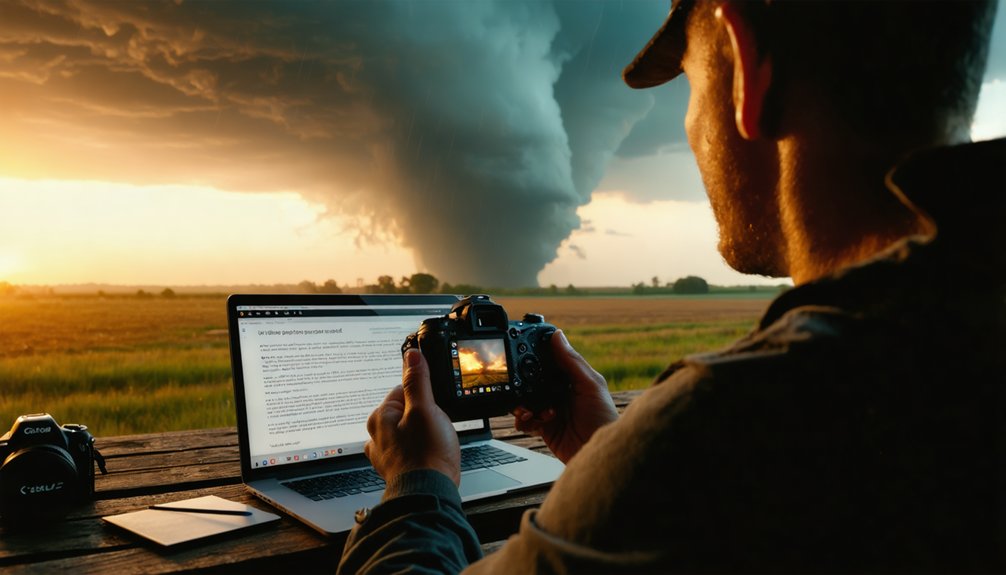
Once you’ve built a brand worth sponsoring, protecting the footage that defines it becomes just as important as creating it. Platforms and pirates routinely exploit storm chaser content without compensation, siphoning revenue that sustains your operation.
The Copyright Alliance has spotlighted this systemic theft, with videographers like Brandon Clement detailing its career-level damage.
Your defense starts with proactive copyright enforcement. Register footage before publishing, watermark files, and issue takedown notices immediately upon discovering unauthorized use.
Don’t grant permissions casually—news agencies increasingly source free footage from uninformed social media users who don’t understand footage licensing.
Treat every clip as a licensed asset with defined terms. When platforms profit from your risk, you deserve compensation.
Enforce that right aggressively before theft becomes your funding model’s biggest threat.
Six Income Streams Storm Chasers Should Add Before Next Season
If you’re still depending on video sales as your primary income, you’re operating on a model that the smartphone era has effectively dismantled.
You need to actively build multiple revenue streams—sponsorships, licensing agreements, content subscriptions, educational workshops, merchandise, and grant partnerships—before next season begins.
Protecting your monetization rights through copyright enforcement isn’t optional; it’s the financial foundation that makes every other stream viable.
Diversifying Revenue Beyond Videos
While video sales once anchored storm chaser income, the market’s collapse under smartphone saturation and news agencies mining free social media footage means you can’t afford to depend on a single revenue stream.
Diversifying protects your financial independence. Consider these four proven alternatives:
- Crowdfunding campaigns and subscription services — Build a loyal audience that funds your chases directly through platforms like Patreon.
- Merchandise sales — Branded gear converts your audience into walking advertisements.
- Educational workshops and online courses — Monetize your expertise by teaching forecasting, safety protocols, and chase techniques.
- Live streaming events and social media partnerships — Real-time chases attract sponsorships and platform revenue through storm chasing apps integrated into your broadcast workflow.
Each stream compounds your financial resilience.
Leveraging Sponsorship Partnerships
Diversifying your revenue through crowdfunding and merchandise builds a foundation, but sponsorship partnerships can scale your income in ways that individual audience members simply can’t match.
Corporate sponsors seek authentic, high-stakes content—exactly what storm chasing delivers. Casey’s partnership with “Weather Women: Into the Bear’s Cage” demonstrates how sponsorship strategies create mutual value: brands gain real-time exposure while chasers secure operational funding independent of volatile video markets.
When pursuing partnership benefits, target companies whose identity aligns with weather resilience, outdoor adventure, or emergency preparedness.
Negotiate beyond flat fees—push for equipment provisions, travel coverage, and revenue-sharing arrangements. Structure contracts that protect your editorial independence while delivering measurable audience engagement metrics sponsors actually value.
Sponsorships don’t just supplement income; they replace the unpredictability that’s eroded professional storm chasing sustainability.
Protecting Content Monetization Rights
- Register copyright immediately — Establish legal recourse before distributing footage anywhere.
- Audit license agreements — Clarify usage rights, distribution rights, and revenue sharing terms before signing media partnerships.
- Reject Creative Commons traps — News agencies exploit unaware creators; never surrender footage protection for “exposure.”
- Monitor platforms actively — The Copyright Alliance confirms big tech systematically profits from unauthorized storm chaser content.
Brandon Clement’s experience illustrates how copyright enforcement directly determines career sustainability.
Your footage is intellectual property — treat every distribution channel as a negotiation requiring documented, compensated agreements protecting your long-term creative and financial independence.
Frequently Asked Questions
Can Storm Chasers Unionize to Negotiate Better Rates With News Agencies?
You can explore storm chaser unions as a collective bargaining strategy, but fragmented freelance structures complicate media negotiation. Organizing independently lets you reclaim leverage, counter falling rates, and protect your footage’s value from exploitative agencies.
Do Storm Chasers Need Special Insurance Coverage for Sponsored Media Work?
Want real freedom in sponsored content? You’ll need specialized insurance requirements covering liability, equipment, and vehicle risks. Sponsored media work demands tailored policies protecting you from lawsuits, like Weather Channel’s $125 million collision case.
How Do International Storm Chasers Access Us-Based Corporate Sponsorship Opportunities?
You’ll access US-based corporate sponsorship opportunities by leveraging international partnerships through documentary co-productions, like Casey’s model, and employing targeted sponsorship strategies that showcase your broadcast-quality footage to brands seeking authentic, cinematic storm chasing narratives.
Are Storm Chaser Media Earnings Considered Self-Employment Income for Tax Purposes?
Yes, your storm chaser media earnings typically fall under self-employment classification, meaning you’re responsible for self-employment taxes. You’ll also gain tax deduction eligibility for equipment, travel, and operational expenses directly tied to your chasing activities.
Can Beginning Storm Chasers Qualify for Grants Without an Established Track Record?
You can qualify for grants as a beginner by researching eligibility criteria carefully. Explore diverse funding sources, target beginner resources, and craft a strong grant application highlighting your passion, safety training, and clear research objectives to stand out.
References
- https://www.cbsnews.com/colorado/news/boulder-storm-chasing-fraud-center-severe-weather-research-noaa-nasa-joshua-wurman-ling-chan/
- https://gatewayjr.org/storm-chasing-in-the-21st-century/
- https://www.mainepublic.org/2019-03-27/the-weather-channel-sued-for-125-million-over-death-in-storm-chase-collision
- https://www.convenience.org/Media/Daily/2025/March/21/6-Caseys-Storm-Chasing-Documentary_Marketing
- https://www.mediamatters.org/donald-trump/storm-chasers-and-meteorologists-warn-trumps-cuts-noaa-threaten-public-safety
- https://stormtrack.org/threads/copyright-alliance-spotlight-on-content-theft-of-chaser-footage.32926/