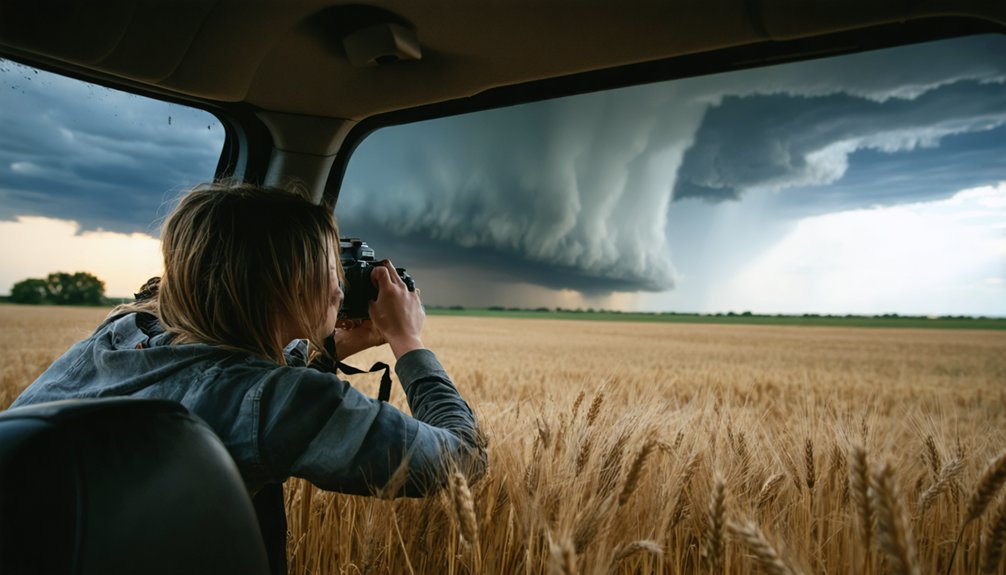
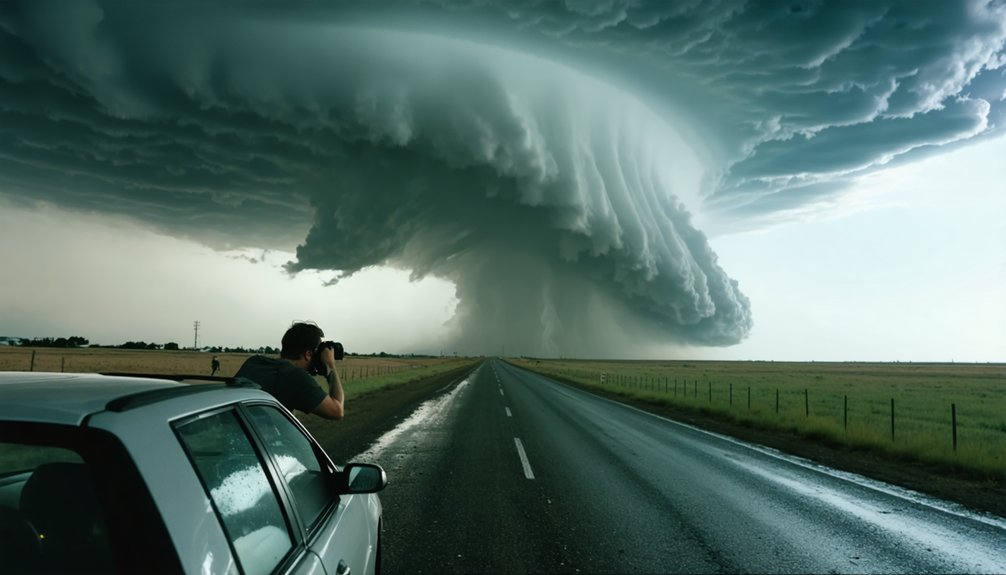
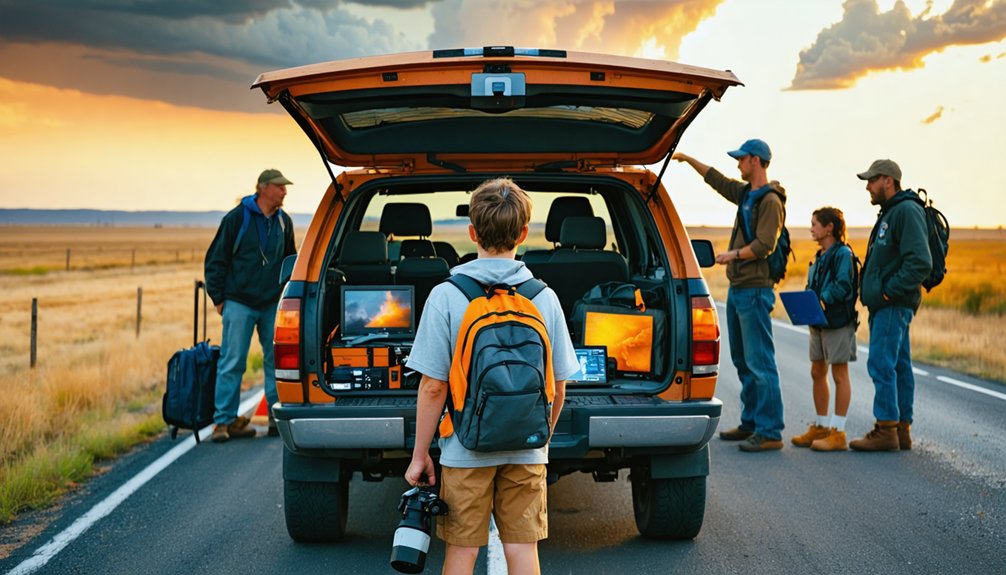
Your first storm chase requires preparation across five critical domains. You’ll need to monitor SPC outlooks, CAPE values, and wind shear data before leaving home. Pack weather-sealed camera gear, waterproof clothing, a first aid kit, and at least two liters of water per person. Equip your vehicle with recovery tools, a jump starter, and GPS mapping software. Master your escape routes before deploying — and there’s much more critical detail ahead.
Key Takeaways
- Study SPC outlooks, CAPE, and wind shear data, refreshing forecasts every 30 minutes to track rapidly evolving storm conditions.
- Pack weather-sealed camera gear, waterproof bags, extra batteries, and high-speed memory cards to protect equipment in harsh conditions.
- Equip your vehicle with tow straps, a jump starter, fix-a-flat kit, and emergency tools for roadside recovery.
- Use GPS mapping, a mobile data connection, and amateur radio to maintain navigation and real-time team communication.
- Always identify escape routes, chase with a partner, and complete Skywarn training before pursuing severe storms.
Storm Chasing Basics Every Beginner Needs to Understand
Before your first chase, you’ll need to understand that storm chasing isn’t simply driving toward dark clouds — it requires reading convective outlooks, identifying storm modes, and executing real-time escape routing.
Storm chasing safety depends entirely on your ability to interpret SPC outlooks, surface analysis charts, and hodographs before you leave your driveway. You’ll want to identify whether discrete supercells, linear squall lines, or cluster convection dominates the forecast.
Each storm mode demands a different positioning strategy. Weather pattern analysis lets you anticipate storm motion vectors, so you’re never repositioning reactively.
Study wind shear profiles, CAPE values, and mid-level lapse rates consistently.
Train with Skywarn or SpotterNetwork before your first deployment.
Your situational awareness — not your vehicle — is your primary safety tool in the field.
How to Read a Storm Forecast Before You Leave Home
Reading a storm forecast accurately starts with the Storm Prediction Center’s convective outlook, where you’ll identify risk categories — Marginal through High — alongside the associated probabilistic tornado, wind, and hail hatching overlays.
Start with the SPC convective outlook — identify risk categories and study tornado, wind, and hail probability overlays carefully.
Master storm forecast symbols early; hatched areas indicate significant severe potential exceeding defined thresholds.
Cross-reference the SPC mesoanalysis with GFS and NAM model output for weather model interpretation, focusing on CAPE values, wind shear vectors, and lifted index readings.
Higher CAPE combined with strong directional shear signals explosive supercell development.
Check the 500mb and 850mb charts to confirm jet stream positioning and low-level jet strength.
Verify storm motion vectors against your planned chase area.
Refresh data every 30 minutes once you’re mobile, since convective parameters shift rapidly and outdated forecasts compromise your positioning decisions entirely.
Essential Clothing and Gear for Your First Storm Chase
Packing the right gear determines whether your first chase runs smoothly or turns dangerous fast. You’ll move through muddy fields, scorching sun, and sudden downpours within the same afternoon, so your kit must handle each condition precisely.
Start with weather resistant footwear featuring high-traction soles — muddy terrain and wet grass will compromise your footing otherwise. Layer your clothing for temperature swings that can exceed 20°F between morning setup and afternoon storm initiation.
Sun protection isn’t optional; pack SPF 30+ sunblock and UV-blocking sunglasses since you’ll spend hours exposed in open terrain.
Carry a high-capacity power bank, because your devices will drain fast running GPS, radar apps, and communications simultaneously.
A waterproof bag protects your camera gear when storms produce unexpected rain before you’re repositioned safely.
Vehicle Safety and Recovery Tools for Storm Chasers
Your vehicle is your lifeline on a chase, and a single mechanical failure can strand you in a rapidly deteriorating storm environment. Equip your vehicle with an all-weather tow strap rated for heavy recovery, road flares, and emergency triangles for low-light visibility.
Carry a fix-a-flat kit, portable air compressor, bottle jack, and lug wrench for roadside tire failures. A lithium-ion jump starter eliminates dependence on other drivers when you’re miles from a storm shelter.
Monitor weather alerts continuously so mechanical delays don’t trap you inside a tightening storm corridor. Jumper cables serve as a reliable backup to your jump starter.
These tools don’t just prevent inconvenience — they preserve your exit options, keeping your escape routes viable when conditions escalate without warning.
Reliable navigation and real-time communication gear are non-negotiable when you’re tracking fast-moving severe weather. You’ll need a GPS device loaded with Delorme Street Atlas, a USB wireless modem or dedicated air card for mobile internet.
And a NOAA Weather Radio tuned to your target area’s frequency. Pair these tools with an amateur radio transceiver and an unlimited-data cell plan to keep your team coordinated and your storm data flowing without interruption.
Essential Navigation Tools
When you’re intercepting fast-moving convective systems, real-time navigation and communication tools aren’t optional — they’re operationally critical. A GPS device loaded with Delorme Street Atlas gives you precise rural road mapping where standard apps fail. Pair it with a USB wireless modem or dedicated air card to maintain mobile internet access for live radar feeds and weather pattern analysis.
A NOAA Weather Radio delivers direct National Weather Service alerts without cellular dependency. Your cell plan should cover wide geographic areas — gaps in coverage compromise positioning decisions. An amateur radio transceiver with an external antenna keeps your team coordinated across distances.
Proper storm chasing etiquette demands situational awareness, not reactive guesswork. These tools give you the data advantage to intercept efficiently, reposition quickly, and operate with calculated precision in dynamic severe weather environments.
Real-Time Communication Devices
Staying connected during a chase isn’t a convenience — it’s a tactical necessity. You’ll need layered communication systems that don’t rely on a single point of failure.
Run mobile internet through a USB wireless modem or dedicated air card to pull live satellite imagery and radar loops while moving. Pair that with a NOAA Weather Radio tuned to local frequencies for automated storm warning alerts independent of cell coverage.
An amateur radio transceiver with an external antenna lets you coordinate directly with your team when networks saturate during high-traffic severe weather events.
Back everything with an unlimited cell plan from a carrier with verified rural coverage in your target region. Redundancy isn’t overkill — it’s the operational standard that keeps you ahead of rapidly evolving storm cells.
Food, Water, and Health Supplies for Long Chase Days
Long chase days can stretch 10 to 14 hours or more, so packing the right food, water, and health supplies isn’t optional — it’s operational.
Effective hydration strategies start with a reusable water bottle and at least two liters of water minimum per person. Dehydration degrades decision-making, and poor decisions in severe weather cost lives.
For food preservation, prioritize high-protein, shelf-stable options — nuts, energy bars, and string cheese resist heat and require zero preparation. Skip anything that spoils fast or needs refrigeration.
Your first aid kit should include nitrile gloves, wound care basics, and SPF 30+ sunblock for extended outdoor exposure.
Tissues and travel toilet paper handle restroom shortages in rural corridors.
You’re self-sufficient out there — plan accordingly.
Camera and Documentation Gear for Capturing Severe Weather
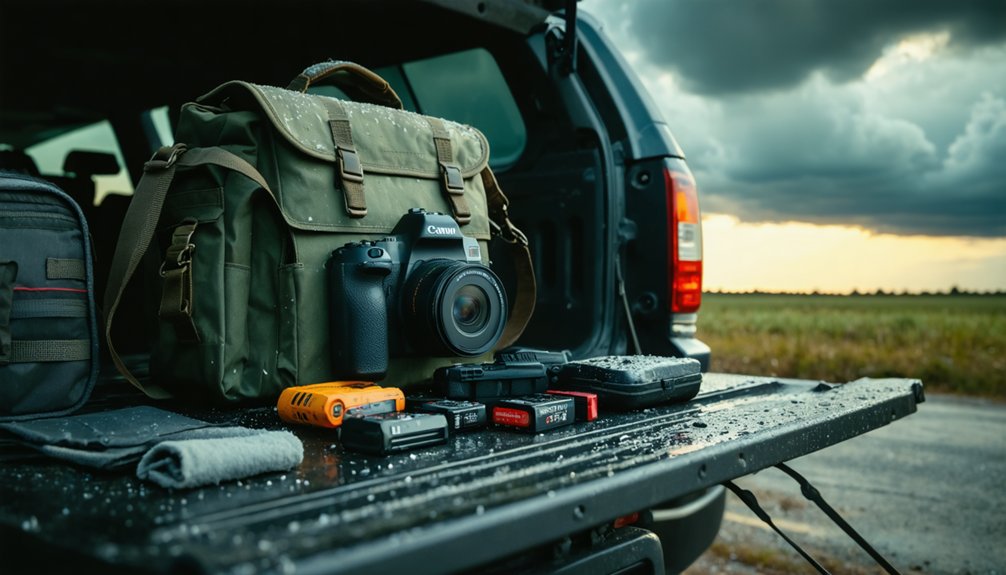
When choosing camera equipment for storm chasing, you’ll want a DSLR or mirrorless camera loaded with extra batteries and high-capacity memory cards, since severe weather events can last hours with no access to power.
You should store your gear in a waterproof camera bag or backpack to protect sensitive electronics from rain, hail, and wind-driven debris.
In the field, carry an empty notebook and pencil to log timestamps, GPS coordinates, storm direction, and visual observations that your camera alone won’t capture.
Essential Camera Equipment Choices
Capturing severe weather demands reliable, high-performance gear that holds up under extreme field conditions. You’ll want a DSLR or mirrorless camera body with weather sealing, paired with a wide-angle lens covering 16-35mm for broad storm structure shots.
Carry extra batteries and high-speed memory cards rated at 90MB/s or faster to handle rapid burst shooting.
For lighting techniques, shoot during golden hour or use manual exposure settings between 1/500s and 1/1000s to freeze lightning strikes accurately.
A tripod with a remote trigger stabilizes long-exposure shots in low-light conditions.
Prioritize lens maintenance by carrying microfiber cloths and lens caps to protect optics from wind-driven debris and rain.
Store everything inside a waterproof camera bag to prevent moisture damage during active storm pursuit.
Protecting Gear From Weather
Protecting your gear from rain and wind-driven debris matters just as much as choosing the right equipment. A waterproof camera bag or backpack shields your DSLR, lenses, and memory cards from direct precipitation and moisture infiltration. Look for bags rated IPX4 or higher for reliable rain resistant gear performance under heavy downpours.
Pair your bag with stormproof clothing that keeps you mobile without restricting access to your equipment. A waterproof jacket with sealed seams prevents saturation during extended exposure, letting you operate freely in the field. Keep lens cloths and silica gel packets inside your bag to manage condensation between shots.
Secure loose cables and straps before repositioning, since wind-driven debris at storm margins can snag equipment and cause drops or damage.
Field Documentation Techniques
Severe weather documentation demands deliberate gear choices and disciplined technique before you ever press the shutter. Bring a DSLR or mirrorless camera loaded with extra batteries and formatted memory cards. Mount your camera on a tripod with a remote trigger to eliminate shake during lightning exposures. Keep a waterproof bag securing all equipment between shots.
Your notebook serves equally critical functions — log GPS coordinates, storm movement direction, estimated wind speed, and hail size for accurate storm data analysis. These field notes transform raw observations into actionable records.
Respect storm chase etiquette by positioning your vehicle clear of emergency responders and other chasers’ sightlines. Your documentation shouldn’t compromise anyone’s safety or mobility. Discipline your workflow, protect your gear, and you’ll return with data and imagery worth studying.
Safety Rules Every First-Time Storm Chaser Must Follow
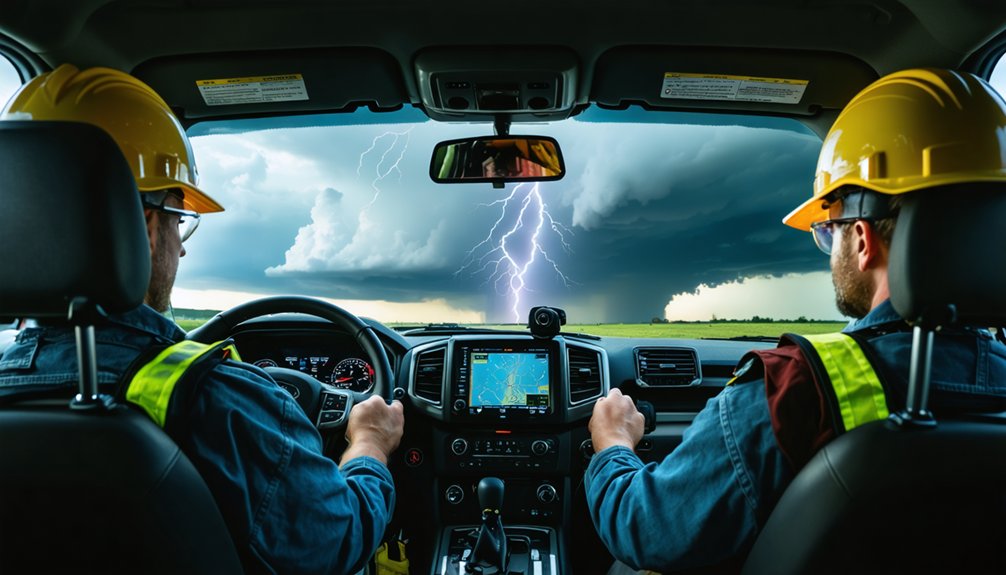
Storm chasing carries real risks, and following core safety protocols can mean the difference between a successful chase and a fatal mistake. Prioritize storm safety by identifying escape routes before you deploy into the field. Never position yourself directly in a tornado’s projected path, and always maintain a minimum 1-mile lateral buffer from rotating wall clouds.
Weather awareness is non-negotiable. Monitor NOAA Weather Radio continuously and cross-reference live radar data to track storm movement in real time. If a storm accelerates or shifts direction unexpectedly, exit immediately.
Start with minor thunderstorm events before attempting supercell chases. Complete a Skywarn or SpotterNetwork certification course to build foundational knowledge.
Always chase with a partner, communicate your location regularly, and know your nearest hard shelter at every stop.
Frequently Asked Questions
How Much Does a Typical Storm Chasing Trip Cost Beginners?
Like fueling a rocket on a budget, your first storm chasing trip runs $500–$1,500, covering storm chasing gear and weather forecasting tools. You’ll spend freely, chasing your own horizon with precision and purpose.
Are There Legal Permits Required for Storm Chasing in Certain States?
Storm chasing doesn’t require formal permit requirements in most U.S. states, but you’ll face legal restrictions on road access, private property entry, and emergency zone closures during active disaster declarations.
What Insurance Coverage Do Storm Chasers Need for Their Vehicles?
Like a knight needing armor before battle, you’ll need all-encompassing insurance policies with vehicle coverage that includes collision, liability, and off-road protection — standard policies often won’t cover storm-related damage to your vehicle.
Can Minors Participate in Storm Chasing With Parental Consent?
Minor participation in storm chasing isn’t legally prohibited, but parental consent doesn’t eliminate liability risks. You’ll need to guarantee minors stay in vehicles, follow strict safety protocols, and comply with local jurisdiction regulations during active chase operations.
How Do Storm Chasers Handle Encounters With Hostile Landowners?
You’ll face landowner negotiations like defusing a bomb — stay calm, be respectful, and leave immediately if asked. Always prioritize trespassing concerns by sticking to public roads, avoiding private property entirely during your chase.
References
- https://www.benholcomb.com/storm-chasing/equipment/items-in-my-storm-chase-vehicle/
- https://www.reddit.com/r/stormchasing/comments/1hjxvuy/suggestions_for_supplies_for_my_first_chase/
- https://www.stormtours.com/information/must-bring-items/
- http://deskrib.com/2017/07/11/storm-chasing-what-to-expect/
- https://matadornetwork.com/trips/6-tips-for-amateur-storm-chasers/
- https://weather.cod.edu/chasing/assets/documents/chaserules.pdf
- https://www.reddit.com/r/stormchasing/comments/1boanfg/how_do_i_get_started_storm_chasing/
- https://www.facebook.com/groups/6926972223/posts/10161041750897224/
- https://www.reddit.com/r/meteorology/comments/f0o9p1/storm_chasers_of_reddit_what_are_your_essentials/
- https://stormchasing.com/the-ultimate-guide-to-planning-your-first-storm-chasing-adventure/