Storm chasing tour guides earn far less than most people expect. You’ll typically see figures like $74,000 cited online, but experienced chasers reported gross earnings below $37,000 back in 2005, and that’s before expenses. Once you subtract roughly $13,700 in first-year operating costs, your net profit can collapse to around $2 per hour. If you want the full financial picture broken down, there’s considerably more to unpack.
Key Takeaways
- Simply Hired cites an average annual salary of $74,000, but this figure is considered outdated and likely inflated.
- Experienced storm chasing guides reported gross earnings below $37,000 in 2005, before accounting for expenses.
- After deducting operational costs, net profit can drop to approximately $2 per hour.
- First-year expenses, including vehicle, lodging, and communication costs, can total roughly $13,700 before earning any income.
- Financial gain is rarely the primary motivator, as many chasers pursue the career for passion and freedom.
What Do Storm Chasing Guides Actually Earn?
How much storm chasing tour guides actually earn depends heavily on separating inflated figures from field realities.
Simply Hired cites $74,000 annually, but experienced chasers on Stormtrack forums dismiss that number as outdated. In 2005, gross earnings for seasoned chasers fell below $37,000, and that’s before expenses hit.
You’re looking at roughly $13,700 in first-year costs covering vehicle mileage, hotels, food, and data plans.
After those deductions, net profit drops to approximately $2 per hour. Part-time fast food work pays considerably more.
The tour guide lifestyle isn’t built around financial freedom — it’s built around storm chasing passion.
If you’re evaluating this career purely on income, the numbers don’t support it. Guides chase because the pursuit itself is the reward.
What Does Storm Chasing Tour Guide Pay Actually Cover?
When you examine what storm chasing tour guide pay actually covers, you quickly discover that gross compensation and net earnings are two very different figures.
You must account for vehicle costs averaging $6,200 per season, plus $1,500 in hotels and food, $1,000 in cellular and data expenses, and additional first-year costs that push total outlays to $13,700 before any income materializes.
Once you subtract these operational expenses from gross earnings, your actual take-home pay collapses to figures that rival fast food wages rather than the $74,000 annual salary figures commonly cited online.
Breaking Down Guide Compensation
Understanding what storm chasing tour guide compensation actually covers requires dissecting the expense layers that eat into gross earnings before a guide ever pockets a dollar.
Vehicle costs alone consume $6,200 annually based on 20,000 miles at $0.31 per mile. Add $1,500 for hotels and food, plus $1,000 for cellular and data services supporting real-time chasing techniques, and you’re already facing $8,700 in operational overhead before accounting for equipment or tour logistics coordination.
First-year total expenses reach $13,700, leaving zero net pay.
Experienced chasers in 2005 reported gross earnings falling below $37,000, which translated to roughly $2 per hour after deductions.
You should recognize that guide compensation structures rarely reflect actual take-home pay, making independent financial analysis essential before committing to this career path.
Expenses Versus Actual Earnings
Although gross earnings figures like $74,000 circulate as benchmarks, that number collapses quickly once you stack actual seasonal expenses against it.
Vehicle costs alone reach $6,200 for roughly 20,000 miles. Add $1,500 for hotels and food, $1,000 for cellular and data services, and your first-year expenses hit $13,700 before you’ve earned a dollar.
Experienced chasers reported gross earnings below $37,000 in 2005, reducing net profit to approximately $2 per hour. That’s less than part-time fast food wages.
Income misconceptions persist because storm chasing passion dominates the narrative, obscuring hard financial realities. You’re not entering a lucrative profession — you’re funding a lifestyle through discipline, expertise, and deliberate cost management.
Understanding this distinction separates realistic career planning from romanticized expectations.
The Real Expenses Eating Into Storm Chasing Guide Income
When you factor in the full scope of seasonal operating costs, the financial picture for storm chasing tour guides becomes strikingly lean.
Vehicle expenses alone hit approximately $6,200 for a 20,000-mile season at $0.31 per mile, with cellular and data services adding another $1,000 annually.
Stack hotels and food on top at roughly $1,500 per season, and you’re looking at $13,700 in baseline expenses before you’ve earned a single dollar.
Hidden Seasonal Operating Costs
Three major expense categories quietly drain storm chasing tour guide income before a single dollar reaches their pocket.
Vehicle operation alone costs roughly $6,200 per season, calculated at $0.31 per mile across 20,000 miles of pursuit. Hotels and food add another $1,500, while cellular and data services consume $1,000 annually.
These hidden costs create brutal seasonal challenges that most outsiders never consider. Your first year generates $13,700 in expenses before you’ve earned anything.
Even experienced chasers reported gross earnings below $37,000 in 2005, leaving net profits equivalent to approximately $2 per hour.
You’re fundamentally funding an operation that passion sustains, not profit. Understanding these financial realities lets you evaluate whether guiding storm tours genuinely aligns with your independence-driven financial goals.
Vehicle And Communication Expenses
Two expense categories hit storm chasing tour guides hardest: vehicle operation and communication infrastructure.
You’re looking at roughly $6,200 annually just for vehicle maintenance and mileage—calculated at $0.31 per mile across 20,000 seasonal miles. That figure doesn’t include unexpected mechanical repairs that high-demand chase conditions inevitably produce.
Communication tools compound these costs greatly. Cellular data and phone services alone consume $1,000 yearly—non-negotiable expenses since real-time radar access and client coordination require constant connectivity.
Without reliable communication tools, you can’t locate storms efficiently or maintain operational safety standards.
Combined, these two categories represent your largest controllable expense blocks. Before adding hotels, food, or equipment, you’ve already committed over $7,200 annually—money that exits your pocket before a single tour generates revenue.
Why Storm Chasing Net Profit Often Falls Below Minimum Wage
Although storm chasing appears lucrative on paper, the financial reality breaks down quickly once you factor in seasonal expenses.
You’re looking at $13,700 in first-year costs before earning a single dollar. Even experienced chasers reported gross earnings below $37,000 in 2005, leaving net profit equivalent to roughly $2 per hour.
That’s less than part-time fast food wages despite full-time commitment. Your vehicle mileage, lodging, cellular data, and equipment costs systematically erode every dollar earned. The passion pursuit that drives most chasers simply doesn’t translate into financial sustainability for the majority.
Simply Hired’s $74,000 average figure misrepresents reality, as Stormtrack forum veterans confirm those numbers reflect an outdated era.
You’re not chasing storms to get rich—you’re chasing because the alternative feels like standing still.
Does Experience Level Affect a Storm Chasing Guide’s Salary?
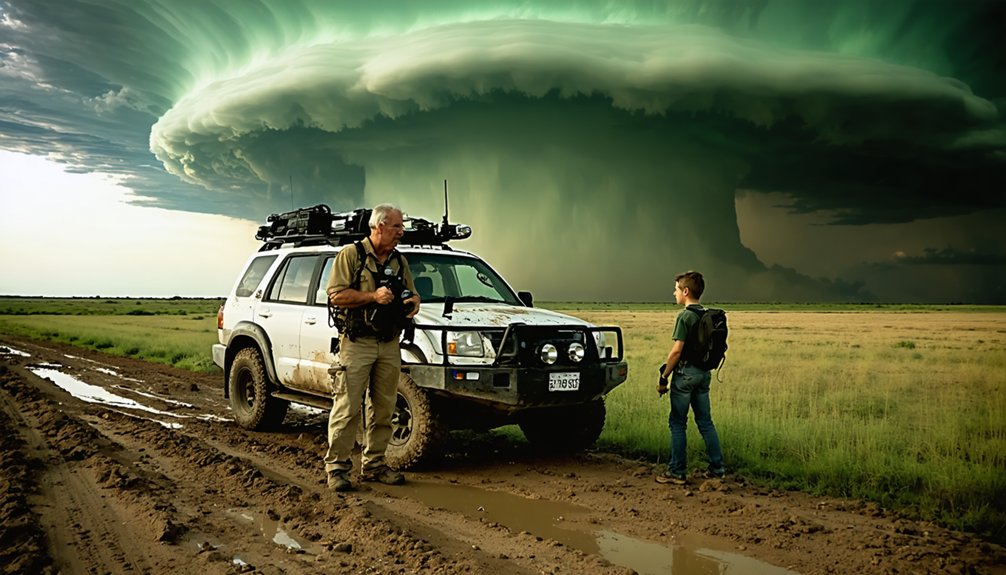
Experience level directly shapes what a storm chasing guide earns, though not through traditional salary structures. Most tour operators running successful operations carry 10–15 years of active chasing behind them. That experience impact translates directly into client confidence and booking rates, not a higher base salary.
Experience doesn’t raise your base salary in storm chasing—it fills your calendar and justifies your rates.
When you’re evaluating guides, skill assessment becomes your most critical filter. A seasoned guide reads probabilistic storm development faster, positions vehicles more precisely, and delivers safer, more productive tours. Those outcomes drive repeat bookings and premium pricing power.
Newer guides struggle to command competitive rates because clients can’t verify their track record. Experience doesn’t just improve safety—it builds the reputation that justifies higher fees.
In storm chasing, your years in the field are fundamentally your earning credential.
Is Becoming a Storm Chasing Tour Guide Worth It Financially?
Financially, becoming a storm chasing tour guide rarely justifies the investment. Your first-year expenses alone reach $13,700, covering vehicle mileage, lodging, and communication costs before earning a single dollar.
Even experienced chasers reported gross earnings below $37,000 in 2005, netting roughly $2 per hour after deductions. Part-time fast food work generates nearly ten times the comparable income, making career sustainability a serious concern for anyone entering this field with financial motivations.
That said, the financial reality doesn’t stop passionate chasers. You’re not pursuing this career for wealth — you’re pursuing freedom, adrenaline, and the raw power of extreme weather.
If your primary driver is financial gain, redirect your energy. If passion fuels you, accept the economics and chase anyway.
Frequently Asked Questions
How Do Storm Chasing Tour Guides Typically Find and Book Clients?
With 10-15 years of experience behind them, guides leverage their expertise in client acquisition through targeted marketing strategies—you’ll find them building reputations online, showcasing storm footage, and attracting freedom-seeking adventurers who crave nature’s most powerful spectacles.
What Insurance Coverage Do Storm Chasing Tour Guides Need to Carry?
You’ll need robust liability coverage to protect yourself and clients during high-risk pursuits. Prioritize storm safety protocols alongside commercial vehicle, medical, and equipment policies—they’re essential for operating legally and responsibly in extreme weather environments.
Are Storm Chasing Tour Guide Earnings Seasonal or Available Year-Round?
You’ll find storm chasing tour guide earnings experience significant seasonal fluctuations, concentrated during spring storm season. Income variability means you’re actively generating revenue only months annually, requiring you to strategically plan finances around this unpredictable, passion-driven profession.
Do Storm Chasing Guides Earn Differently Based on Geographic Location?
Yes, your location directly impacts earnings. You’ll find guides in Tornado Alley command higher rates due to favorable storm patterns and stronger client demographics, while remote regions yield fewer bookings and considerably reduced income opportunities.
What Certifications or Licenses Do Storm Chasing Tour Guides Require?
You don’t need formal certifications, but you’ll want extensive experience in storm prediction and proven client safety protocols. Most guides rely on 10-15 years of chasing expertise, which effectively serves as your industry-recognized qualification.
References
- https://stormtrack.org/threads/article-claims-storm-chasers-average-annual-income-is-74-000.30435/
- https://www.stormchase.us/Articles/money.html
- https://www.stormchasingusa.com/what-to-consider-before-a-storm-chasing-tour/