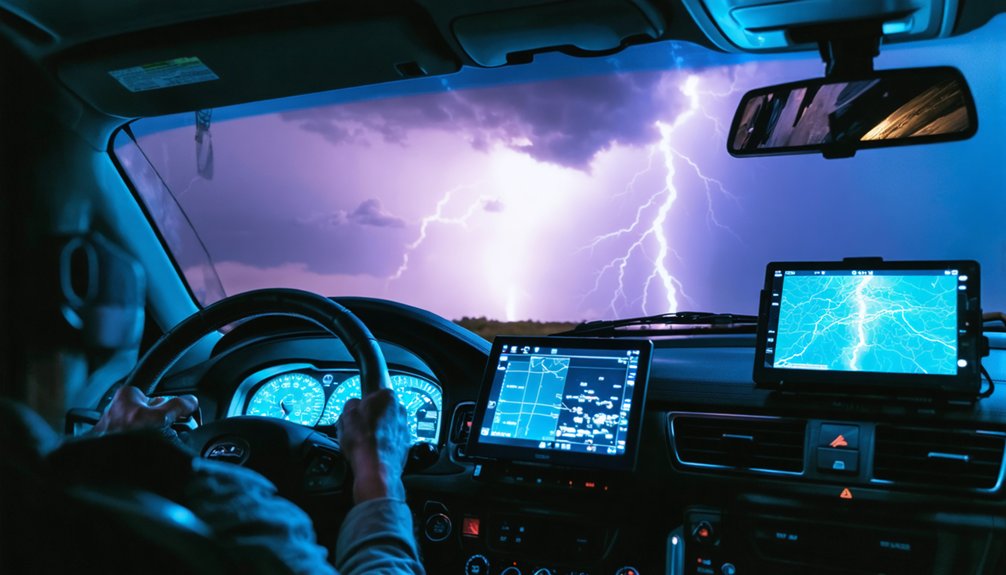
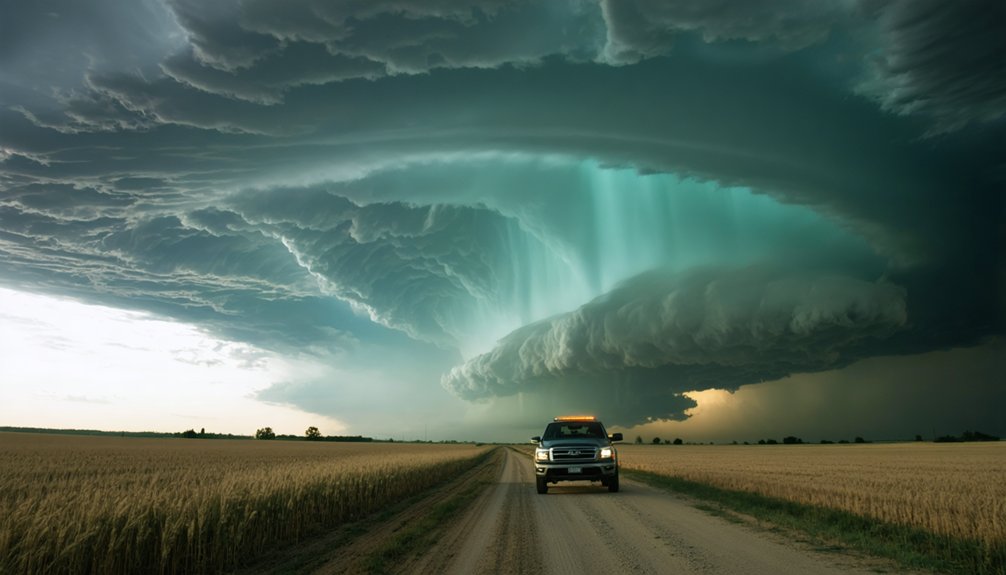
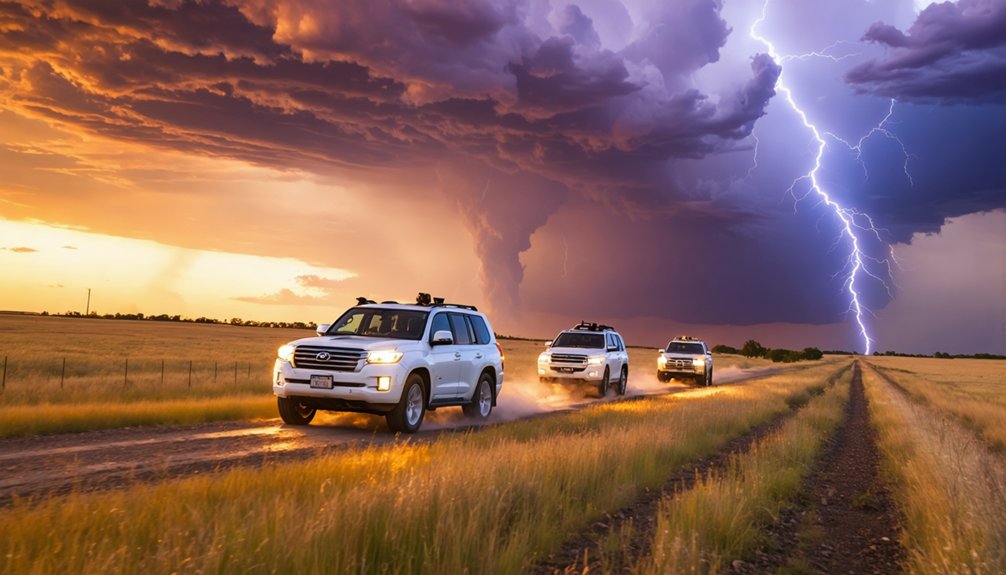
Renowned storm chasing champions aren’t motivated by recklessness—they’re driven by meteorological mastery and scientific precision. You’ll find them spending hours analyzing hodographs, skew-T diagrams, and convective parameters before ever hitting the road. They treat each intercept as a data collection opportunity rather than a spectacle. Adrenaline is secondary; intellectual engagement with complex atmospheric systems is the real reward. If you want to understand exactly how they’ve built that edge, keep going.
Key Takeaways
- Renowned storm chasers are primarily motivated by meteorological mastery and scientific curiosity, treating each intercept as valuable data rather than spectacle.
- Elite chasers build forecasting skills systematically by analyzing hodographs, skew-T diagrams, and mesoscale discussions to make precise, data-driven decisions.
- Field data collection transforms meteorological theory into calibrated instinct, sharpening observational skills through real-time feedback and repeated exposure.
- Cultural influences from respected predecessors established documentation standards, safety protocols, and forecasting expectations that elite chasers uphold today.
- Emotional rewards, including satisfaction from successful supercell intercepts and autonomous decision-making, outweigh measurable costs like fuel, fatigue, and vehicle wear.
What Really Motivates Elite Storm Chasers?
When you strip away the dramatic footage and media attention, elite storm chasers are driven by a surprisingly disciplined set of motivations rooted in meteorological mastery, scientific curiosity, and the calculated pursuit of an unpredictable target.
Their passion pursuit isn’t reckless—it’s methodical. You’ll find them spending hours analyzing convective parameters, moisture profiles, and shear indices before committing to a chase.
The adrenaline drive is real, but it functions as a secondary reward rather than the primary engine.
What sustains elite chasers is intellectual engagement—decoding atmospheric behavior, refining forecasting accuracy, and expanding direct observational knowledge. They treat each intercept as data, not spectacle.
You’re looking at individuals who’ve chosen to master a dynamic, high-stakes system where skill, preparation, and adaptability determine success far more than luck.
How Elite Storm Chasers Develop Their Forecasting Edge
Forecasting isn’t a skill elite storm chasers stumble into—they build it systematically through sustained study of convective meteorology, pattern recognition, and iterative field testing.
You develop your forecasting techniques by analyzing hodographs, skew-T diagrams, and mesoscale discussions before dawn on chase days. You’re not guessing—you’re processing environmental data into actionable intercept decisions.
Before dawn, elite chasers transform raw environmental data into precise intercept decisions—no guessing, only disciplined analysis.
Meteorological knowledge becomes your competitive edge. You learn to identify storm initiation timing, anticipate mode evolution, and adjust routing when conditions shift mid-chase.
Every bust sharpens your calibration; every successful intercept validates your methodology.
Elite chasers treat forecasting as a discipline requiring continuous refinement, not passive accumulation. You cross-reference model output, observe actual storm behavior, and systematically close the gap between prediction and reality.
That rigor separates champions from casual participants.
How Field Data Collection Sharpens Storm Chasing Instincts
Collecting field data transforms abstract meteorological theory into calibrated instinct. When you’re actively logging field observations during storm interactions, you’re building a personal reference library that no classroom can replicate.
Each data point refines your observational skills, sharpening your ability to recognize subtle shifts in weather patterns before they fully develop.
You’re not guessing — you’re making data driven decisions backed by real-time feedback loops between what you observe and what predictive modeling projected. That gap between prediction and reality is where experience enhancement happens fastest.
Repeated exposure to raw atmospheric conditions accelerates your analytical processing speed. Data analysis becomes intuitive rather than deliberate.
You start reading rotation signatures, pressure drops, and inflow boundaries almost instinctively — because you’ve measured them firsthand, repeatedly, under actual field conditions.
The Storm Chasers Who Built the Culture Everyone Follows Today
Behind every calibrated field instinct you’ve developed, there’s a cultural framework that someone else built first. Chasing history didn’t emerge from chaos—it was shaped by influential figures who prioritized meteorological discipline over reckless spectacle.
They established documentation standards, safety protocols, and forecasting expectations that still define the community today.
Their community impact spread through newsletters, field networks, and eventually online forums where knowledge moved freely and quickly. You’ve inherited those systems whether you recognize them or not.
Cultural evolution in storm chasing wasn’t accidental. It reflected deliberate choices made by respected chasers who understood that skill, not sensation, builds lasting credibility.
When you apply structured forecasting methods or choose a safer intercept angle, you’re executing principles that influential figures refined decades before you arrived.
Why Elite Storm Chasers Keep Chasing Despite the Cost
Once you’ve absorbed the cultural inheritance and technical discipline that define elite storm chasing, the obvious question becomes why anyone sustains it given the measurable costs.
You’re absorbing fuel expenses, vehicle wear, fatigue from multi-day drives, and repeated busts that yield zero data. The chasing challenges are real, quantifiable, and cumulative.
Yet elite chasers don’t quit. The emotional rewards recalibrate the math. Successfully intercepting a supercell after forecasting its initiation from raw model data delivers a satisfaction that’s difficult to replicate elsewhere.
You’ve exercised independent judgment, navigated complex terrain, and captured something most people never witness.
That autonomy matters. You’re not following a script. You’re executing skill under pressure, which produces the kind of earned freedom that keeps experienced chasers returning regardless of what each season costs them.
Frequently Asked Questions
Can Storm Chasing Actually Become a Full-Time Paying Career?
You can chase storms, you can build a brand, but you’ll rarely find career sustainability easy. Storm chasing economics favor photographers and media contributors, yet most chasers work regular jobs alongside their passion.
What Equipment Do Elite Storm Chasers Typically Bring Into the Field?
You’ll typically deploy advanced radar, mobile technology, and photography equipment while relying on vehicle modifications for stability. Your protective gear and data collection tools guarantee you’re capturing critical storm metrics independently, without constraints slowing your pursuit.
How Do Storm Chasers Coordinate With Emergency Management or Local Authorities?
You coordinate with emergency management through real-time communication strategies, actively sharing observational data via radio or digital platforms. You’re reporting storm positions, relaying information sharing updates, and supporting local authorities’ situational awareness while maintaining your operational independence in the field.
Are There Formal Certifications or Training Programs for Aspiring Storm Chasers?
Over 90% of chasers are self-taught. You won’t find mandatory storm chasing certifications, but you can pursue training programs through Coursera or university meteorology courses to sharpen your forecasting skills and knowledge.
How Has Social Media Changed the Way Storm Chasers Share Their Work?
You’ve transformed how you share data within the storm chaser community. Social media impact lets you instantly distribute real-time footage, observations, and forecasts, accelerating knowledge exchange and expanding your audience beyond traditional meteorological circles considerably.
References
- https://en.wikipedia.org/wiki/Storm_chasing
- https://www.facebook.com/matthew.cappucci/posts/ever-wondered-what-the-best-part-of-storm-chasing-is-spoiler-its-not-the-storms-/3057922801022477/
- https://www.reddit.com/r/stormchasing/comments/1m3ysm5/how_do_you_decide_if_a_chase_is_worth_pursuing/
- https://science.howstuffworks.com/nature/climate-weather/storms/storm-chaser5.htm
- http://www.stormeyes.org/tornado/chasing/FAQ/
- https://fujitasupply.com/blog/famous-storm-chasers-history
- https://skepticalscience.com/why-chase-tornadoes.html
- https://makezine.com/article/science/storm-chasers-real-twister-tech/
- https://www.youtube.com/watch?v=MogZEEeYISs
- https://stormtrack.org/threads/night-storm-chasing-techniques.17618/