Neil Ward pioneered modern storm chasing by conducting the first scientific tornado intercept on May 4, 1961, using radar guidance and Oklahoma Highway Patrol support to document a supercell’s full lifecycle. After his death, NSSL partnered with the University of Oklahoma in 1972 to launch the Tornado Intercept Project, which successfully intercepted the 1973 Union City tornado and extracted the TVS radar signature, transforming tornado detection forever. There’s much more to this story worth uncovering.
Key Takeaways
- Neil Ward pioneered storm chasing by directly intercepting tornadoes and building the first physical tornado model to study vortex formation.
- On May 4, 1961, Ward conducted the first successful scientific tornado intercept, using radar guidance and institutional support from the Oklahoma Highway Patrol.
- Ward’s self-driven research established a foundational framework for tornado study, inspiring future organized storm chasing efforts.
- In 1972, NSSL partnered with the University of Oklahoma to launch the first institutional tornado chasing program, continuing Ward’s legacy.
- The 1973 Union City intercept extracted the Tornado Vortex Signature, revolutionizing radar detection, warning accuracy, and modern storm chasing methodologies.
Who Was Neil Ward, the First Scientific Storm Chaser?
Neil B. Ward stands as a defining figure in meteorological history. Born June 26, 1914, he dedicated his career to understanding storm behavior in ways no scientist had attempted before.
Neil B. Ward redefined meteorology by dedicating his life to understanding storm behavior no scientist had dared explore before.
He didn’t just study tornadoes from a distance — he chased them directly, developing the techniques and forecasting methods that gave researchers real-world access to severe weather events.
Ward built his first physical tornado model in his own garage before refining it at the National Severe Storms Laboratory (NSSL).
His work identified the core parameters governing vortex formation, fundamentally reshaping how scientists approached tornado research.
When he died on April 12, 1972, he left behind a framework that empowered future researchers to pursue storms with purpose, precision, and an earned sense of independence.
Ward’s Historic Tornado Intercept on May 4, 1961
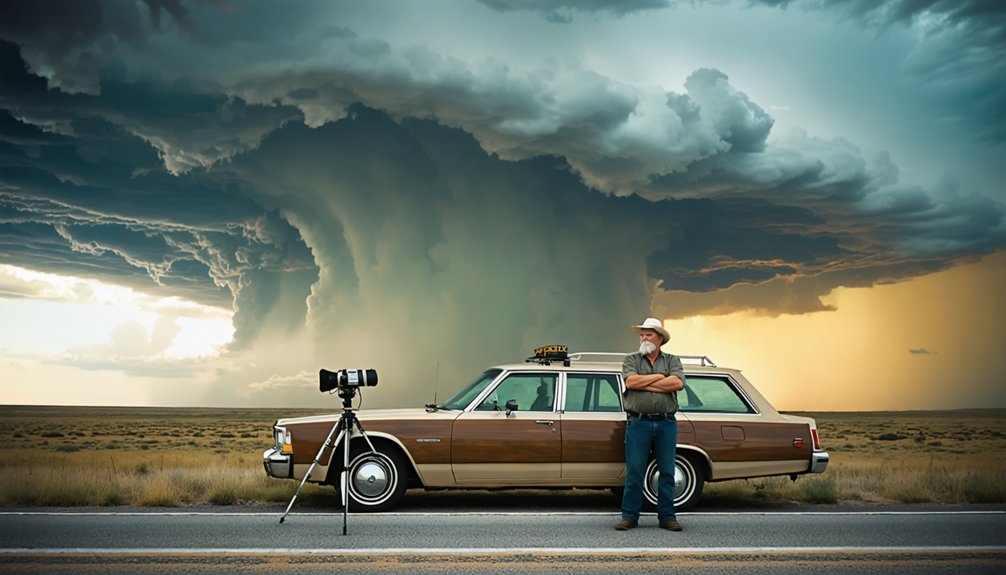
On May 4, 1961, Ward became the first scientific storm chaser to successfully intercept a tornado — a milestone built on real-time coordination between multiple agencies. The Oklahoma Highway Patrol provided transportation and communication support, while the Weather Bureau relayed radar guidance via shortwave radio. That infrastructure let Ward pinpoint the tornado’s location near Geary, Oklahoma, in real time.
Once on the ground, Ward shot motion picture film documenting the tornado’s later life cycle stages, capturing historical weather data that hadn’t been collected through direct scientific observation before.
He also recognized the storm as a supercell structure, advancing early understanding of tornado mechanics and how these violent systems organize and evolve. That single intercept proved coordinated field observation could unlock what radar and theory alone couldn’t deliver.
Why the Oklahoma Highway Patrol Was Essential to Early Storm Chasing
Ward’s successful intercept on May 4, 1961 didn’t happen through solo effort — it happened because the Oklahoma Highway Patrol made it operationally possible. They provided Ward with both transportation and communication facilities, two resources that transformed storm tracking from a concept into a functioning operation.
Without reliable mobility and radio contact, even the sharpest weather prediction skills couldn’t put a chaser in the right place at the right time.
Without the right tools and connections, even perfect instincts mean nothing in the field.
The Patrol relayed radar guidance from the Weather Bureau in Oklahoma City via shortwave radio, feeding Ward real-time positional data as he moved toward Geary. They also coordinated radio reports that helped him locate the tornado directly.
That institutional partnership proved that chasing required collaboration, not just courage, laying the groundwork for every organized intercept program that followed.
How Ward Built the First Physical Tornado Model
Before Ward had institutional backing, you’d find him constructing a physical tornado model in his personal garage, piecing together the first working vortex simulation in meteorological history.
He identified the key parameters governing vortex formation through this early model, establishing a foundation that NSSL would later build upon.
Once at NSSL, Ward refined the design into an updated version that more accurately imitated actual tornado features, advancing the scientific community’s understanding of atmospheric vortices.
Building The Garage Model
While his storm chasing work unfolded in the field, Ward was simultaneously pursuing tornado research from an unlikely starting point: his personal garage. Independent of institutional support, he constructed the first physical laboratory model of a tornado, a breakthrough that would reshape climate adaptation strategies and urban planning considerations for severe weather zones.
His garage model accomplished three critical things:
- Identified the key parameters governing vortex formation
- Replicated actual tornado characteristics in a controlled environment
- Established a replicable framework later refined by Purdue University
You can trace today’s advanced tornado modeling directly back to this humble workspace. Ward’s self-driven initiative proved that groundbreaking science doesn’t always begin in a laboratory — sometimes it starts in a garage, with curiosity and determination driving every step.
NSSL’s Refined Vortex Model
The garage model’s success gave Ward the institutional foothold he needed. Once inside NSSL, he built a refined version that more accurately replicated actual tornado features. You can think of it as a leap from proof-of-concept to precision instrument.
The updated model let researchers isolate specific parameters governing vortex formation, giving storm prediction a harder scientific foundation than it had ever had before. It also illuminated how cloud formation dynamics contributed to vortex intensification, connecting laboratory behavior to real atmospheric conditions.
Purdue University later advanced Ward’s design further, proving the model’s framework was durable enough to outlast its creator. What Ward built in that garage became a legitimate research tool—one that reshaped how meteorologists understood, studied, and ultimately anticipated the conditions that produce tornadoes.
How Ward’s NSSL Team Launched the Tornado Intercept Project
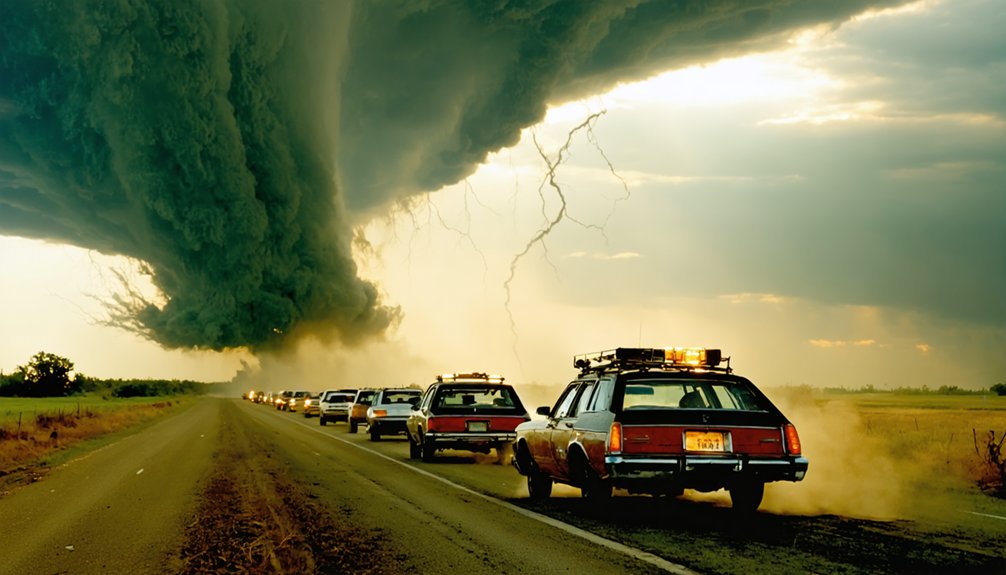
Ward’s groundbreaking solo intercept work laid the foundation for something far larger: in 1972, NSSL partnered with the University of Oklahoma to launch the Tornado Intercept Project, the first institutionally sponsored, large-scale tornado chasing effort in history.
This milestone in historical meteorology marked science’s decisive move from reactive observation to deliberate, structured field pursuit of atmospheric dynamics.
The project’s early timeline reveals its rapid momentum:
- April 19, 1972 — The project’s first official outing took place, weeks after Ward’s death that same month.
- 1972–1973 — Teams refined intercept coordination using forecasting techniques Ward pioneered.
- 1973 — The Union City, Oklahoma F4 tornado became the project’s defining success, intercepted from birth to dissipation.
You’re witnessing science claim the open road.
The Union City Tornado That Validated the NSSL’s Methods
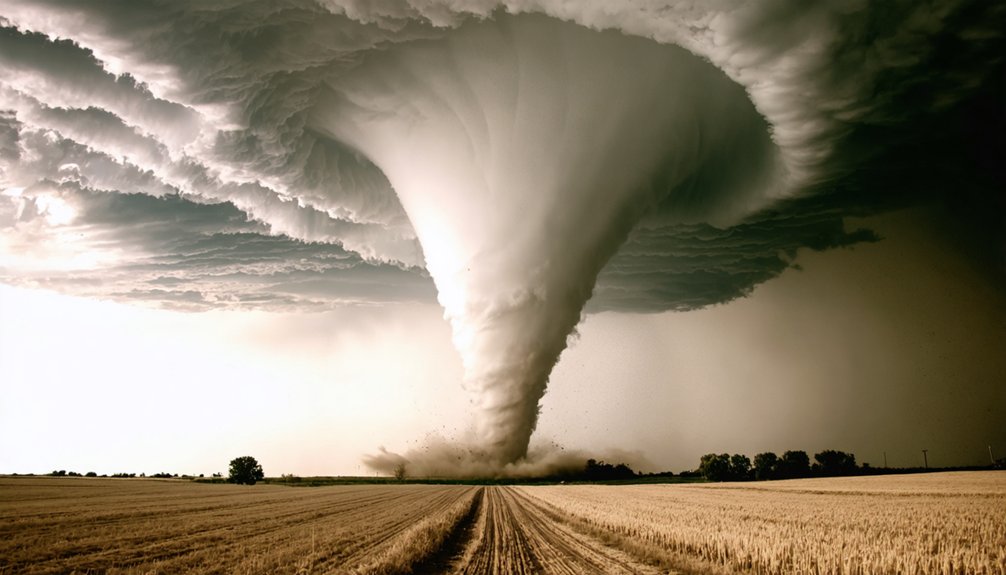
When the Union City, Oklahoma F4 tornado touched down in 1973, NSSL’s Tornado Intercept Project teams were ready—and they documented it from birth to dissipation, a first in meteorological history. That complete record proved the project’s methods worked.
Analysis of the collected data produced the tornado vortex signature, a breakthrough that transformed Doppler radar studies and strengthened storm preparedness nationwide. Teams also identified the temporal relationship between bounded weak echo region collapse and tornadogenesis, reshaping understanding of supercell morphology.
These discoveries gave meteorologists sharper tools to protect lives—tools that remain critical today as climate change intensifies severe weather patterns.
Union City didn’t just validate Ward’s vision; it handed future researchers a documented foundation they could build on, expanding your freedom to live and move with advance warning of deadly storms.
How the TVS Discovery Transformed Doppler Radar Tornado Warnings
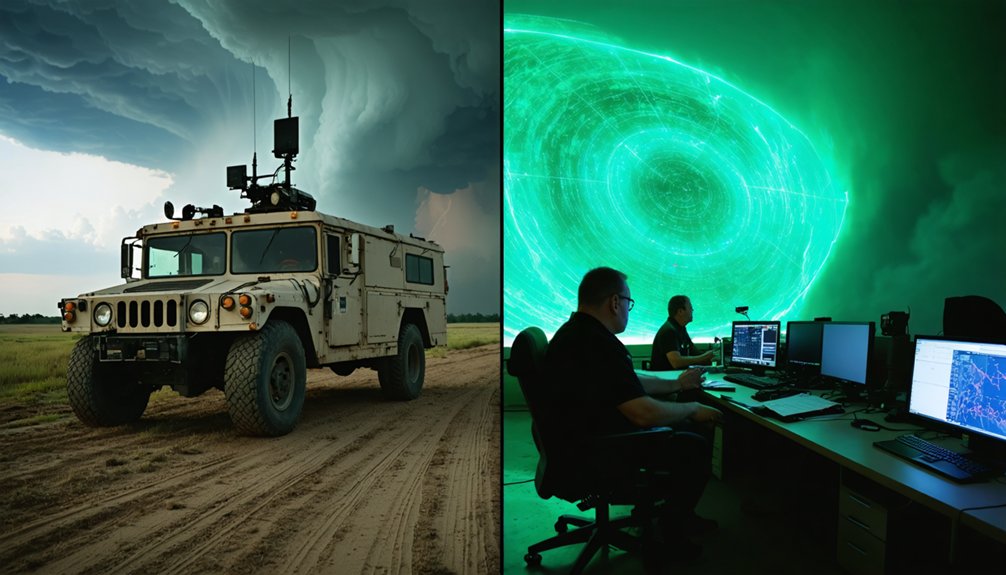
Before the tornado vortex signature (TVS), Doppler radar data existed but lacked a definitive rotational marker that forecasters could tie directly to tornadogenesis. The 1973 Union City intercept changed that permanently.
Researchers extracted a clear, repeatable storm radar signature from the data, giving forecasters a concrete tool for improving warning accuracy. The TVS gave you three measurable advances:
- Earlier detection of rotation before tornado touchdown
- Reduced false alarm rates by distinguishing organized vortices from general storm rotation
- Standardized criteria forecasters could apply consistently across warning operations
You can trace today’s structured tornado warning protocols directly back to this discovery. The Union City data didn’t just validate the Tornado Intercept Project—it permanently restructured how Doppler radar analysis informs life-saving decisions.
Frequently Asked Questions
Did Neil Ward Ever Train Other Meteorologists in Storm Chasing Techniques?
The records don’t confirm direct storm chaser mentorship, but Ward’s meteorologist training influence shaped you through his documented techniques, NSSL collaboration, and the Tornado Intercept Project he helped establish before his death in 1972.
Were Any Other Institutions Besides NSSL Using Tornado Laboratory Models?
Yes, you’ll find that Purdue University actively refined Ward’s original tornado laboratory simulations, marking one of the key institutional collaborations that expanded understanding of atmospheric vortices beyond NSSL’s foundational work.
How Many Tornadoes Did Ward Successfully Intercept Throughout His Career?
The records don’t specify an exact count of Ward’s successful intercepts. You’ll find his storm chasing innovations confirmed one documented tornado in 1961, yet his tornado research advancements shaped every intercept method you’d recognize in modern meteorology.
Did the Tornado Intercept Project Continue Operating After Ward’s Death?
Like a torch passed forward, yes, the Tornado Intercept Project continued after Ward’s 1972 death. You’ll find it carried tornado research and storm prediction into 1973, famously capturing the Union City F4 tornado successfully.
How Did the TVS Discovery Specifically Improve Public Tornado Warning Times?
The TVS discovery boosted public safety by letting you detect tornado-strength rotation on Doppler radar before touchdowns occurred, giving warning systems critical extra minutes to alert communities and protecting your freedom to seek shelter in time.
References
- https://en.wikipedia.org/wiki/Neil_B._Ward
- https://www.rmets.org/metmatters/history-storm-chasing
- https://www.youtube.com/watch?v=sLYJzfC-S_4
- https://www.nationalgeographic.com/science/article/130604-storm-chasing-dangers-samaras-weather-tornadoes
- http://ndtornado.com/primary/history.htm
- https://journals.ametsoc.org/view/journals/wefo/14/4/1520-0434_1999_014_0558_ahossi_2_0_co_2.xml
- https://en.wikipedia.org/wiki/Storm_chasing
- https://www.youtube.com/watch?v=uRQ-nTTCazo
- https://www.youtube.com/watch?v=nOGklFoKEHQ
- https://ams.confex.com/ams/pdfpapers/176816.pdf