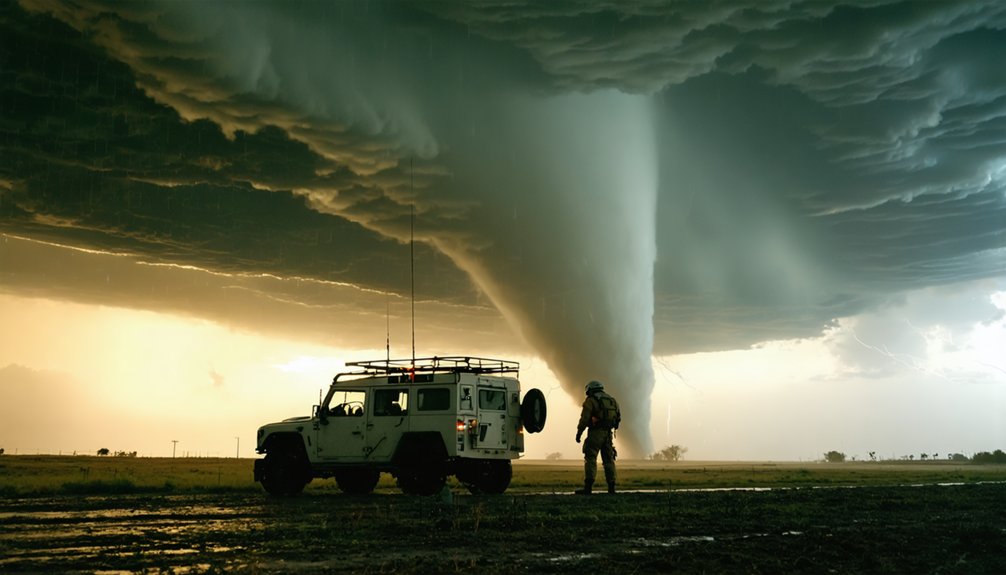
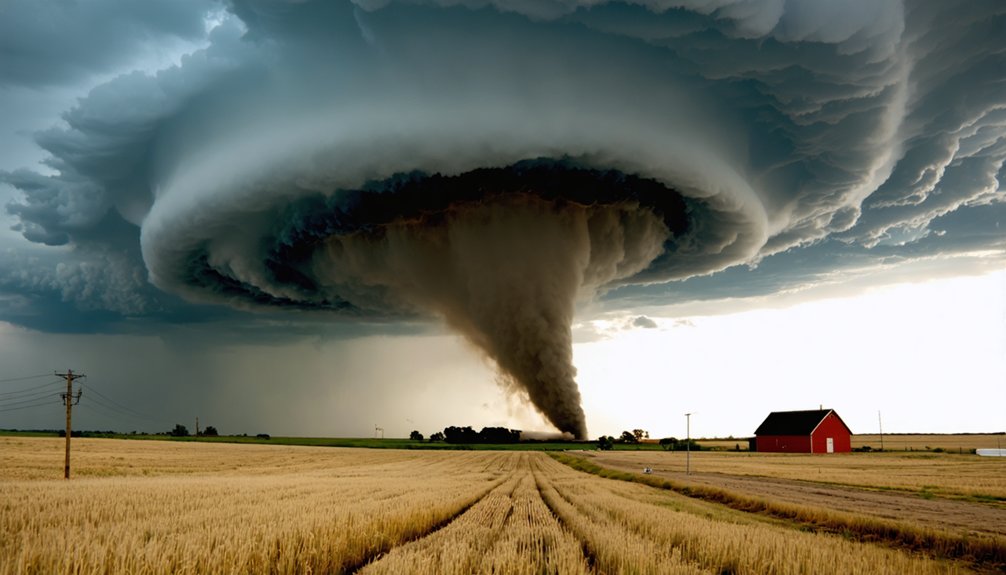
Before your storm chase expedition, you’ll need to map detailed routes with at least three escape paths and position yourself southeast of the tornado’s track. Cross-reference GFS and HRRR models, monitor NOAA outlooks, and study wind shear profiles daily. Prep your vehicle with extra fuel, repair tools, and hail-rated gear. Always research local laws and obtain landowner permission. The full planning framework goes much deeper than these essentials.
Key Takeaways
- Map detailed chase routes with at least three escape plans, positioning southeast of the tornado track for optimal safety and visibility.
- Use a reliable, fully fueled vehicle with good tire traction and operational communication systems for deteriorating conditions.
- Cross-reference GFS, HRRR models, radar velocity data, and NOAA outlooks to accurately identify storm targets and rotation early.
- Pack a comprehensive kit including hail-rated clothing, first aid supplies, emergency food, water, and charged backup devices.
- Research local storm chasing laws, obtain landowner permissions, and follow ethical conduct to maintain trust and access.
Map Your Storm Chase Route and Escape Plans Before You Leave
Before you head out, map your storm chase route and escape plans in detail—this step can mean the difference between a successful chase and a dangerous situation. Identify at least three unobstructed escape routes away from developing storms, accounting for storm surge risks in low-lying areas and lightning safety near exposed terrain.
Approach from the west, south, or east—never cross in front of a storm from the north. Position yourself southeast of the expected tornado track for ideal visibility and reduced risk.
Pre-identify local shelters and verify road conditions for closures or construction delays before entering the target area. Create detailed alternative routes so you’re reacting to real-time data proactively, not scrambling when conditions deteriorate.
Preparation now guarantees the freedom to chase confidently later.
What Does a Storm Chasing Vehicle Actually Need to Handle?
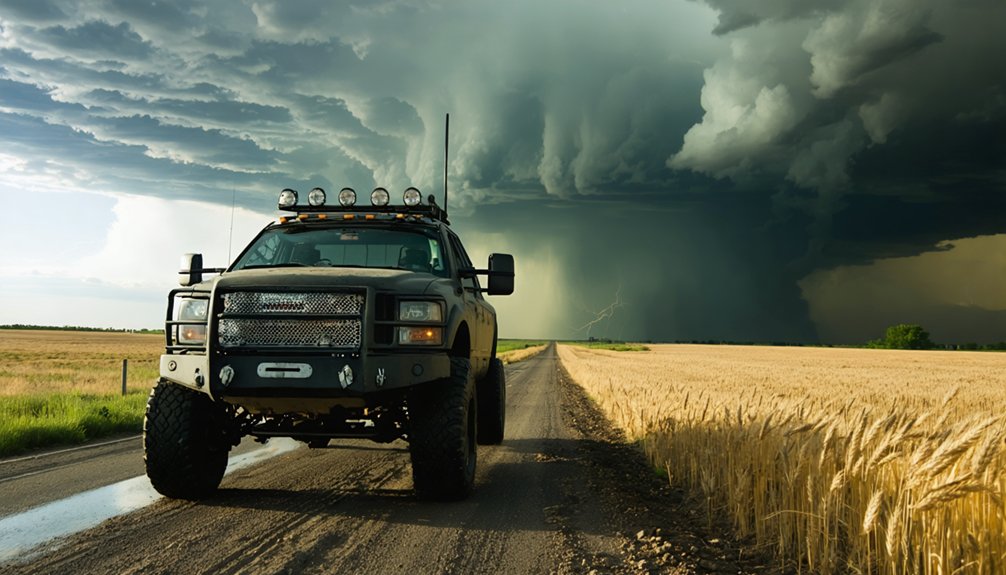
With your route mapped and escape plans locked in, your vehicle becomes the next critical variable. You’ll need a reliable, fully fueled machine capable of handling rapidly deteriorating road conditions, sudden hail exposure, and high-speed repositioning across open terrain.
Maintain extra fuel reserves — remote chase corridors won’t offer convenient stops. Check tire traction before departure; worn treads fail you precisely when muddy back roads demand maximum grip. Keep your antenna maintenance current, ensuring communication and weather data systems stay operational when signal reliability matters most.
Stow jumper cables, basic tools, and repair kits onboard for roadside fixes. Monitor road conditions continuously and obey traffic laws even under pressure. Your vehicle isn’t just transportation — it’s your command center and your primary escape asset.
Read the Forecast Like a Storm Chaser, Not a Weatherman
Storm chasers don’t consume forecasts passively — they interrogate them. You’re not waiting for a meteorologist to hand you conclusions; you’re pulling GFS and HRRR models yourself, cross-referencing them against surface observations and visible satellite imagery to independently assess storm intensity and weather patterns.
Monitor NOAA convective outlooks daily. When a moderate or high risk appears, you build your own target area — don’t outsource that decision.
Study wind shear profiles, dewpoint concentrations, and cap strength to determine whether conditions will actually support supercell development.
Learn to read velocity data and correlation coefficients on radar so you can identify rotation before it becomes a headline.
Freedom in storm chasing comes from knowledge. The more fluently you interpret raw data, the more decisively you move.
Build a Storm Chasing Kit That Covers Hail, Breakdowns, and Injuries
Your kit isn’t optional gear — it’s what keeps a bad situation from becoming a catastrophic one. Pack weather resistant clothing — layered, waterproof, and hail-rated boots — because conditions shift fast and unforgiving terrain won’t wait for you to adapt.
Your kit doesn’t just prepare you — it’s the difference between a close call and a catastrophe.
For breakdowns, carry jumper cables, a tire repair kit, basic tools, and extra fuel. Remote areas don’t offer roadside assistance, so you’re your own mechanic. Stock a first aid kit with bandages, antiseptic, and pain relievers for injuries sustained in the field.
Know your storm shelter options along every planned route before you deploy. Identify structures, underpasses, and low-lying terrain in advance. Also bring emergency food, water, and a charged backup device.
Your kit isn’t comfort — it’s operational survival infrastructure.
Know Storm Chasing Laws and How to Leave No Trace on the Plains
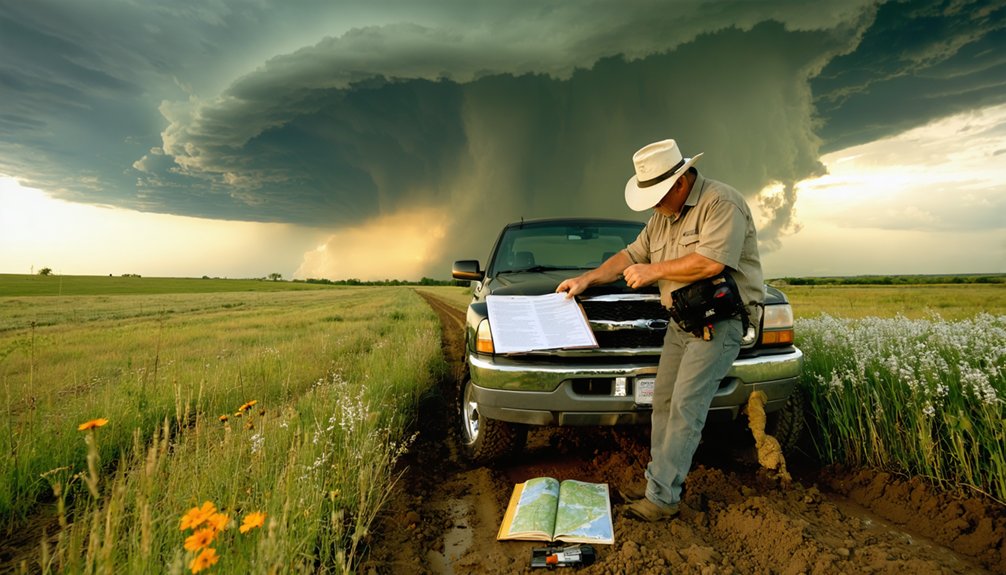
Chasing storms legally isn’t optional — it’s a condition of continued access to the plains. You’re operating in jurisdictions with distinct regulations, so research local storm chasing laws before entering any target area. Obtain landowner permission before stepping off public roads — trespassing erodes trust and restricts future access for every chaser.
Stay on established routes to protect native grasslands and support wildlife conservation across sensitive Great Plains ecosystems. You’re a guest in these landscapes, so pack out everything you bring in, leave no tire tracks through fragile habitat, and avoid disturbing nesting areas.
Practice cultural sensitivity near Indigenous lands and rural communities — your presence affects real people. Responsible behavior protects your freedom to chase, preserves landowner goodwill, and sustains the open access the plains currently offer.
Frequently Asked Questions
How Early Should You Arrive at Your Target Storm Location?
Like a chess player anticipating moves, you’ll want to arrive at least one hour before expected storm initiation. This head start optimizes storm timing, guarantees you’ve executed safety protocols, and maximizes your positioning flexibility.
What Meteorological Terms Should Beginners Study Before Their First Chase?
Before your first chase, you’ll need to master supercells, mesocyclones, and the Enhanced Fujita Scale. Study severe weather patterns, interpret forecast models like GFS and HRRR, and analyze correlation coefficients and velocity data to identify active tornadoes.
How Do You Interpret Radar Correlation Coefficients to Confirm a Tornado?
When confirming tornado confirmation, you’ll check radar interpretation for correlation coefficient values dropping below 0.8 near the surface. That debris signature, paired with strong rotational velocity, confirms a tornado’s on the ground.
Which Camera Equipment Settings Work Best for Photographing Fast-Moving Storms?
Set your shutter speed above 1/1000s to freeze motion, use ISO 400–800 for dynamic range, and you’ll need camera stability from a sturdy tripod. Dial in manual exposure settings for consistent, sharp storm captures.
How Do You Stay Flexible When Storms Develop Slower Than Originally Forecasted?
When storm timing shifts, you’ve got to embrace weather adaptability by monitoring HRRR model updates, adjusting your positioning proactively, and utilizing surface observations. Don’t react—anticipate. Keep multiple route options ready and arrive early to maximize your operational flexibility.
References
- https://stormchasing.com/the-ultimate-guide-to-planning-your-first-storm-chasing-adventure/
- https://www.reddit.com/r/stormchasing/comments/1boanfg/how_do_i_get_started_storm_chasing/
- https://extremetornadotours.com
- https://www.livingskytours.com/storm-chasing-101/
- https://www.youtube.com/watch?v=6otZLjSZvPU&vl=en
- https://tornadoextreme.com/storm-chasing-equipment-safety-tips-more/
- https://www.reddit.com/r/stormchasing/comments/bp4avm/so_you_wanna_go_storm_chasing_and_you_want_some/
- http://www.stormeyes.org/tornado/chasing/FAQ/