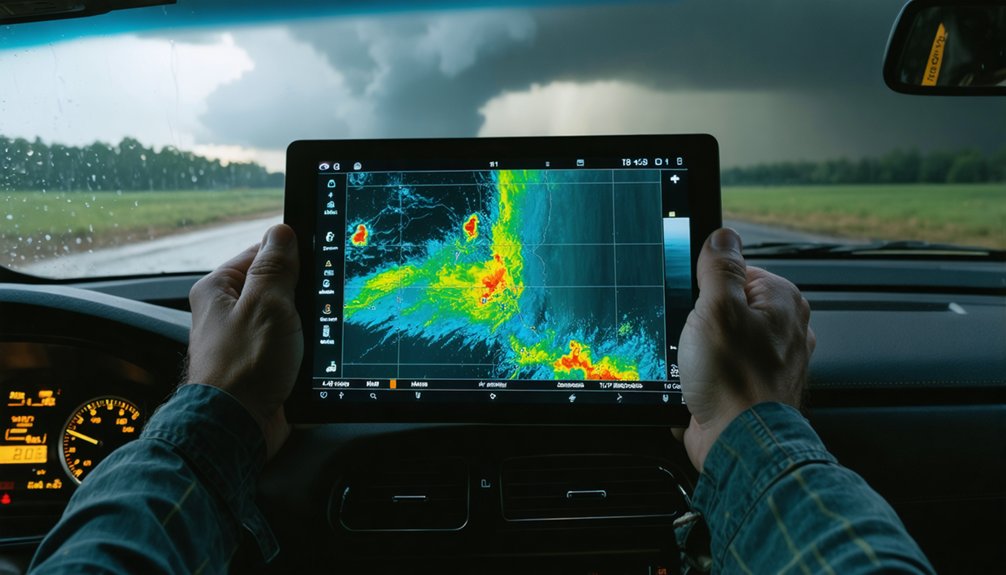
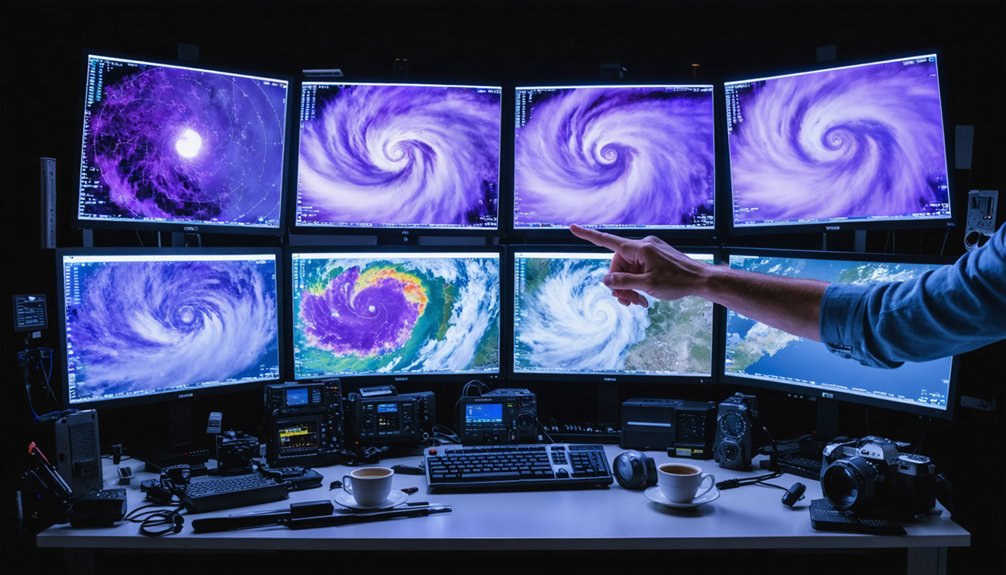
You’ve got three methods that separate successful chasers from missed opportunities. First, use ensemble models to identify high-confidence targets where multiple runs converge. Second, interpret real-time radar signatures—rotation depth, reflectivity gradients, and velocity couplets exceeding 80–90 knots—to confirm intercept timing. Third, integrate GIS mapping with surface observations to execute precise positioning and maintain escape routes. Each method builds on the last, and there’s considerably more to unpack on all three.
Key Takeaways
- Ensemble model convergence across GFS and ECMWF runs identifies high-confidence chase targets, improving forecasting precision days in advance.
- Transitioning from ensemble models to HRRR updates closer to chase day refines storm positioning and timing decisions.
- Real-time radar signatures, including velocity couplets exceeding 80–90 knots, confirm tornadic potential and guide precise intercept timing.
- GIS platforms overlaying road networks, storm vectors, and escape routes enable strategic, data-driven intercept execution.
- Surface mesonet data revealing dewpoint boundaries and wind shifts exposes critical local storm features that models often miss.
Use Ensemble Models to Lock In Your Chase Target
When multiple ensemble runs converge on the same storm solution, you’ve got a high-confidence chase target worth committing to. Monitor ensemble variability closely — tight clustering across members signals strong forecast confidence, while wide spread demands caution and scenario flexibility.
Use GFS and ECMWF ensembles for multi-day pattern recognition, then shift to HRRR short-range updates as the chase day approaches. Compare timing, storm placement, and convective initiation across runs. When members consistently agree on boundary positioning and lift timing, you can commit resources and routing decisions with precision.
High ensemble variability doesn’t mean abort — it means build contingency plans. Identify your primary and secondary targets early, stay mobile, and let real-time radar updates guide final positioning. Data earns your freedom to move decisively.
Use Radar Signatures to Confirm Your Intercept Timing
Radar gives you three critical signatures to confirm intercept timing before committing to a final approach vector. Monitor these real-time indicators as storm evolution accelerates:
- Rotation depth — A mesocyclone signature extending through multiple tilt angles signals organized, persistent rotation worth intercepting rather than a surface-only spin.
- Reflectivity gradient — A tight, inbound gradient on the hook echo’s forward flank confirms strong inflow feeding the updraft, validating moisture support.
- Velocity couplet strength — Gate-to-gate shear exceeding 80–90 knots indicates tornadic potential is imminent, tightening your intercept window considerably.
You’re reading radar signatures as a live decision engine. When all three align, you commit. When they diverge, you reposition.
Storm evolution waits for no one—your timing precision determines your success and your safety.
Use GIS and Surface Obs to Execute the Storm Intercept
Once radar commits you to an intercept, GIS and surface observations become your execution layer. Load your GIS mapping platform and overlay road networks, hazard zones, and storm tracking vectors simultaneously.
You’re not guessing routes—you’re calculating them against real movement data.
Pull surface analysis from nearby ASOS and mesonet stations to confirm dewpoint boundaries, wind shifts, and pressure trends. These observational data points reveal local features that models miss entirely, like subtle convergence lines or outflow boundaries repositioning your ideal intercept corridor.
Cross-reference storm tracking motion with your mapped escape routes before committing to any position. Hazard zones aren’t static—they shift as storms evolve.
GIS lets you adapt spatially in real time, keeping you mobile, informed, and free to reposition without hesitation when conditions demand it.
Frequently Asked Questions
How Does Moisture Levels Impact Initial Storm Chaser Forecasting Decisions?
You’ll assess moisture sources and humidity effects by monitoring dew point readings, since higher values signal increased atmospheric stability disruption, fueling convection. These data-driven metrics sharpen your initial targeting decisions before committing to a chase route.
Which Global Models Work Best for Multi-Day Storm Chase Trip Planning?
Like a compass guiding your journey, GFS and ECMWF/Euro are your best tools for long range predictions and multi-day planning. Compare both for stronger model accuracy, helping you confidently target chase days before hitting the open road.
How Can AI Algorithms Improve Pattern Detection in Severe Weather Forecasting?
You’ll sharpen severe weather forecasting by leveraging machine learning for anomaly detection, algorithm optimization, and data assimilation. AI drives real-time analytics, predictive modeling, and weather simulations, extracting patterns from satellite imagery that you’d otherwise miss manually.
What Role Do Drones Play in Supplementing Real-Time Storm Chaser Data?
When the skies get lively, drone technology becomes your ultimate ally. You’ll deploy aerial units for real-time data collection, capturing atmospheric pressure, wind shifts, and moisture readings that supplement radar gaps with precision and independence.
How Do SPC Outlooks Help Narrow Down Severe Weather Risk Chase Areas?
SPC outlooks analysis lets you apply risk assessment techniques to categorize severe weather threats from marginal to high. You’ll actively narrow chase targets by comparing probability contours, focusing your efforts where conditions most favor significant storm development.
References
- https://crazystormchasers.com/advanced-techniques-for-storm-chasers-data-analysis/
- https://www.pbs.org/newshour/show/how-storm-chasers-and-meteorologists-are-working-together-to-improve-tornado-forecasts
- https://pdfs.semanticscholar.org/4271/a78b907a5b6e72a63cb9b99c105373926377.pdf
- https://www.metoffice.gov.uk/research/news/2023/storm-chasing-to-improve-our-forecasts
- https://research.noaa.gov/three-ways-noaa-research-works-to-improve-our-weather-forecasts/
- https://www.youtube.com/watch?v=MCWCqGOZ99k
- https://www.youtube.com/watch?v=Rg4vomBlnec
- https://www.stormchasingusa.com/blog/learning-the-basics-about-tornadic-storm-forecasting/
- https://environment.leeds.ac.uk/icas-research-impact/doc/storm-chasers-making-life-saving-forecasts
- https://academic.oup.com/itnow/article/65/3/8/7249191