The SPC updates its convective outlook, mesoanalysis, and probability graphics multiple times daily, and knowing exactly which products to pull—and when—determines whether you’re in position when a tornado touches down or chasing the wrong storm entirely. You’ll need to monitor CAPE values, storm-relative helicity, and Lifted Index thresholds alongside real-time NWS alerts and mesoscale discussions. Master these tools and you’ll have everything you need to make smarter, faster chase decisions.
Key Takeaways
- SPC Day 1 convective outlooks provide tornado, wind, and hail probabilities, offering chasers high-confidence targeting based on CAPE, helicity, and Lifted Index.
- SPC hourly mesoanalysis updates deliver real-time environmental parameters, helping chasers refine corridor decisions and adjust routes as atmospheric conditions evolve.
- SPC Mesoscale Discussions flag emerging storm patterns before watches are issued, giving chasers critical early warning of rapidly developing convective threats.
- Gate-to-gate shear exceeding 90 knots on radar signals immediate repositioning, while tornado warnings in the escape corridor require aborting the chase entirely.
- Tornado watches activate full operational mode, prompting aggressive positioning within the watch box and heightened communication among chase team members.
Reading SPC Outlooks Before You Leave the House
Before heading out on any chase, pull up the SPC’s convective outlook and treat it as your operational baseline. Day 1 and Day 2 products break down tornado, wind, and hail probabilities by hazard type, giving you a clear picture of what’s developing.
Master SPC terminology basics early — categorical risk levels, significant tornado hatching, and probabilistic contours all carry specific operational weight.
Your chase preparation strategies should start with CAPE, helicity, and Lifted Index values from the hourly mesoanalysis page. These environmental parameters tell you where supercell potential is strongest before you commit to a target.
Cross-reference the latest soundings and Radar/MSLP overlays to sharpen your timing. The data’s there — use it to chase smarter, not harder.
Day 1 vs. Day 2 Forecasts: What Chasers Actually Use
When you’re standing in front of a map the night before a potential chase day, the distinction between Day 1 and Day 2 outlooks isn’t just temporal — it’s operational.
Day 1 Insights carry higher confidence, tighter probability contours, and refined Timing Considerations tied to observed atmospheric conditions.
Day 1 outlooks sharpen the picture — tighter contours, higher confidence, timing locked to real atmospheric data.
Day 2 Trends reflect broader Weather Patterns with wider uncertainty envelopes, demanding different Forecasting Techniques and looser Operational Strategies.
Chaser Preferences typically lean heavily on Day 1 products for commit decisions, since mesoscale boundaries, moisture return, and shear profiles are better resolved.
You’d use Day 2 for preliminary Risk Assessment — flagging potential target regions without burning resources prematurely.
Smart chasers treat Day 2 as a directional signal, then execute final positioning only when Day 1 data sharpens the picture.
How to Track Tornado and Severe Weather Probabilities in Real Time
Once the Day 1 outlook commits you to a target region, real-time probability tracking becomes your primary operational tool.
SPC’s hourly mesoanalysis updates deliver sharp data on CAPE, helicity, and Lifted Index shifts, letting you refine tornado tracking decisions mid-chase. Pair that with active severe alerts from NWS to stay ahead of rapid convective changes.
Use these three tools systematically:
- SPC Mesoscale Discussions – Flag emerging storm patterns before watches are issued, giving you time for event planning and repositioning.
- SPC Probability Graphics – Monitor tornado and significant wind percentages for precise data analysis and route adjustments.
- NWS Radar/MSLP Products – Support radar interpretation and weather mapping to prioritize chaser safety during fast-moving supercell development.
CAPE, Helicity, and Lifted Index: How Chasers Use These Numbers to Decide
When you pull up the SPC mesoanalysis page, you’re looking at CAPE values above 2,500 J/kg as a strong indicator of explosive convective potential, with anything above 3,500 J/kg signaling extreme instability worth targeting.
You pair that with storm-relative helicity (SRH), where 0–1 km values exceeding 150 m²/s² suggest meaningful rotation risk and readings above 300 m²/s² warrant serious concern for supercell development.
A Lifted Index below -6 reinforces your go/no-go decision by confirming that air parcels will accelerate aggressively once lifted, tightening your confidence that initiation will produce sustained, organized convection.
Reading CAPE Values
Three core atmospheric parameters—CAPE, helicity, and Lifted Index—give you a quantitative snapshot of a storm environment before you ever leave the house.
CAPE analysis starts with knowing your thresholds:
- Below 1,000 J/kg — Limited instability; CAPE significance drops sharply, and supercell potential is marginal.
- 1,000–2,500 J/kg — Moderate range where CAPE interpretation matters most; CAPE variations across a dryline can separate tornadic from non-tornadic cells.
- Above 2,500 J/kg — Explosive CAPE forecasting territory; CAPE comparisons between soundings reveal corridor-level targeting opportunities.
Don’t ignore CAPE limitations—high values don’t guarantee storm initiation. A capped environment with 4,000 J/kg still won’t fire without a trigger.
Cross-reference CAPE thresholds against convective inhibition before you commit to a target.
Helicity and Rotation Risk
Helicity quantifies the rotational potential of a storm’s inflow layer, and it’s the number that separates a tornadic supercell environment from a garden-variety severe weather setup. When you’re pulling helicity dynamics from SPC’s hourly mesoanalysis, target Storm Relative Helicity values above 300 m²/s² for serious rotation forecasting.
Values exceeding 400 m²/s² signal a high-end tornadic threat demanding immediate repositioning. Wind shear vectors directly control storm structure, dictating whether updrafts tilt favorably for sustained mesocyclone development.
You’ll want to cross-reference 0-1 km SRH against 0-3 km SRH to assess low-level versus deep-layer rotation potential. Steep directional shear profiles combined with strong speed shear produce the most dangerous supercell architectures.
Don’t chase helicity numbers in isolation—always integrate them with CAPE and Lifted Index before committing to a target.
Lifted Index Thresholds
The Lifted Index cuts straight to the core of atmospheric instability, giving you a single number that quantifies how violently a parcel of air will accelerate once it breaks free of the capping layer.
Negative values signal instability; the more negative, the more explosive the convective potential. Understanding threshold significance lets you make decisive go/no-go chase decisions without hesitation.
Track these critical lifted index benchmarks:
- 0 to -2: Marginally unstable; weak storm development possible
- -3 to -5: Moderately unstable; supercell and severe weather conditions likely
- -6 or below: Extremely unstable; violent tornado-producing storms become a serious operational concern
Cross-reference your lifted index readings against CAPE and helicity values to build a complete, actionable severe weather picture before you roll.
How to Use the SPC Mesoanalysis Page Before and During a Chase
When planning or actively executing a chase, you’ll want to bookmark the SPC Hourly Mesoanalysis page as a core diagnostic tool. Updated each hour, it delivers critical environmental parameters—CAPE, MUCAPE, helicity, and Lifted Index—mapped across your target region in near-real time.
Before committing to a chase corridor, cross-reference multiple mesoanalysis tools simultaneously. Comparing surface boundaries against helicity swaths helps you identify the highest-threat intersection points quickly.
During active operations, real-time adjustments are essential. Convective environments shift rapidly, and a helicity surge or CAPE gradient change can redefine your best positioning within minutes.
Pull updated mesoanalysis frames every hour to stay ahead of evolving conditions. Treat each refresh as actionable intelligence, not background noise—your decision-making window during a live chase is narrow.
How to Read Radar and Soundings When a Storm Is Moving Fast

Fast-moving storms compress your decision window to minutes, so you’ll need to extract maximum value from every radar scan and sounding update without losing time to indecision.
Prioritize storm tracking by looping the last three radar scans to establish motion vectors quickly.
Loop your last three radar scans immediately—motion vectors built fast keep you ahead of storms that won’t wait.
- Radar interpretation: Check velocity tilt and rotational couplets at low levels first—gate-to-gate shear above 90 knots demands immediate repositioning.
- Sounding analysis: Identify the hodograph shape and effective bulk shear; fast-movers in high-shear environments escalate tornado risk faster than models predict.
- Update timing: Sync your radar loop refresh with the SPC mesoanalysis hourly cycle to catch rapid destabilization signatures before they outpace your route.
Your mobility is your advantage—use precise data to stay ahead, not behind.
Which NWS Updates Tell You to Go, Stay, or Abort
When SPC upgrades a Day 1 outlook to a moderate or high risk, particularly with a 10%+ significant tornado probability (hatched area), that’s your clearest go signal to position.
You should also watch for SPC mesoscale discussions and tornado watches, which indicate rapidly organizing convective parameters like increasing CAPE, backed surface winds, and strengthening low-level shear.
Abort the chase when NWS active alerts shift from tornado watch to tornado warning in your immediate grid square with no safe egress route, or when SPC issues a mesoscale discussion citing rapidly deteriorating positioning conditions.
Go Signals From SPC
Three SPC products function as your primary decision triggers on chase day: the convective outlook, the mesoscale discussion (MD), and the watch issuance.
Each product signals a different phase of chase readiness:
- Convective Outlook – Elevated categorical risk (Enhanced or higher) confirms favorable weather patterns and storm dynamics worth committing to. Run your risk assessment early.
- Mesoscale Discussion – MDs signal storm initiation is imminent. Monitor SPC triggers here for tightening event timelines and shifting local conditions.
- Watch Issuance – A tornado watch activates full operational mode. Prioritize chaser communication, confirm safety protocols, and position aggressively within the watch box.
Don’t wait for warnings to move. SPC’s progressive update cycle gives you the lead time to own your chase window.
When To Abort Chase
Knowing when to commit is only half the equation — knowing when to pull out is what keeps you alive. NWS active alerts signal abort conditions fast. If tornado warnings begin firing rapidly in your escape corridor, that’s a hard stop.
Watch for SPC mesoscale discussions that indicate a rapidly evolving, multi-storm environment — chaos kills clean decision making.
Monitor the SPC hourly mesoanalysis for collapsing CAPE or shifting hodographs. When parameters deteriorate or storm mode shifts to linear, your target’s gone. Don’t chase noise.
Flood-related alerts layered on top of severe weather warnings further restrict your exit options. Chase safety demands that you treat NWS updates as dynamic commands, not background information.
When the data shifts against you, move — immediately.
When Active Alerts Should Force You to Change Your Chase Plan
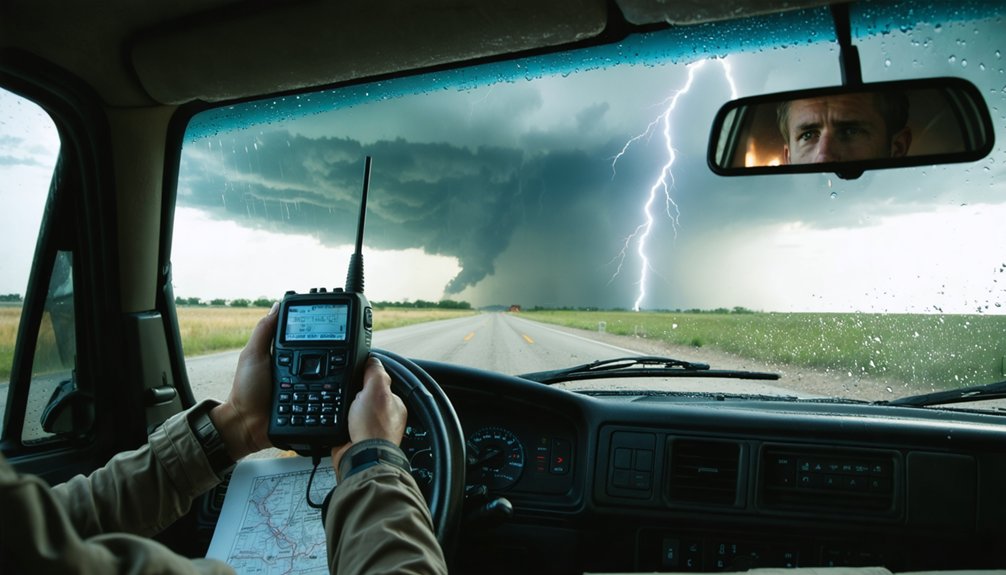
Active alerts aren’t just background noise—they’re operational signals that can force an immediate reassessment of your chase plan.
Effective weather monitoring means treating every new warning as a decision making trigger, not a passive notification. Your alert response must be fast and data-driven.
Three situations that require immediate chase adjustments:
- Tornado warning issued ahead of your position — Reassess your escape routes and recalculate intercept geometry immediately.
- Severe thunderstorm warning with 70+ mph wind probabilities — Update your risk assessment and increase your safety buffer distance.
- Flash flood watch overlapping your chase corridor — Reevaluate road viability; flooded roads eliminate exit options.
Your safety protocols depend on treating active alerts as hard operational constraints, not suggestions.
Freedom means making informed, disciplined decisions under pressure.
Build Your Pre-Chase Routine Around These NWS and SPC Resources
Before you leave the driveway, your pre-chase routine should be locked around a structured sequence of NWS and SPC resources.
Start your pre chase checklist with the SPC Day 1 convective outlook, then pull the hourly mesoanalysis for CAPE, helicity, and Lifted Index values.
Cross-reference the SPC tornado and significant wind probability graphics to identify your target zone precisely.
Check the latest soundings and Radar/MSLP products for real-time atmospheric structure.
Before you roll, verify NWS Active Alerts for any existing tornado warnings or watches in your corridor.
Before you roll, NWS Active Alerts aren’t optional reading — they’re your first line of situational awareness.
Storm chaser safety depends on this sequence being non-negotiable, not optional.
Running these resources in order gives you situational awareness before the first storm fires, keeping your decisions data-driven rather than reactive.
Frequently Asked Questions
How Do NWS Updates Differ From Local TV Weather Forecasts for Chasers?
Like a compass in open skies, NWS accuracy cuts through noise—you’ll get raw, data-driven forecast timing, real-time mesoanalysis, and SPC outlooks local TV can’t match for chase-critical precision.
Can Storm Chasers Legally Access NWS Radar Feeds During Active Tornado Warnings?
Yes, you can legally access NWS radar feeds during active tornado warnings—it’s public data. Radar access carries no legal considerations or data ownership restrictions, but chaser ethics demand you prioritize safety over coverage.
What Communication Devices Do Storm Chasers Use to Receive NWS Alerts?
Just as a tornado touches down, you’re already receiving NWS alerts through satellite phones, mobile apps, and weather radios — devices that’ll keep you free, mobile, and critically informed during active severe weather operations.
How Do Chasers Report Storm Data Back to the National Weather Service?
You’ll report storm data directly to NWS via spotter networks like CoCoRaHS or SKYWARN, using chaser networking platforms, phone hotlines, and social media, ensuring real-time ground-truth observations reach forecasters rapidly and independently.
Are There NWS Training Programs Specifically Designed for Amateur Storm Chasers?
The NWS doesn’t offer dedicated storm chasing training programs for amateurs, but you can access Skywarn spotter certification, which equips you with severe weather recognition skills, safety protocols, and structured reporting guidelines directly supporting NWS operations.
References
- https://www.weather.gov/ddc/chaser
- https://www.spc.noaa.gov
- https://www.weather.gov/okx/severewxpage
- https://www.severestudios.com
- https://www.stormchase.us/Severe.html
- https://www.youtube.com/watch?v=FI_Tu2zsGIs
- https://www.nssl.noaa.gov
- https://www.youtube.com/watch?v=wAo7C3Zl0DI
- https://www.weather.gov/alerts
- https://www.facebook.com/NYCStormChaser/