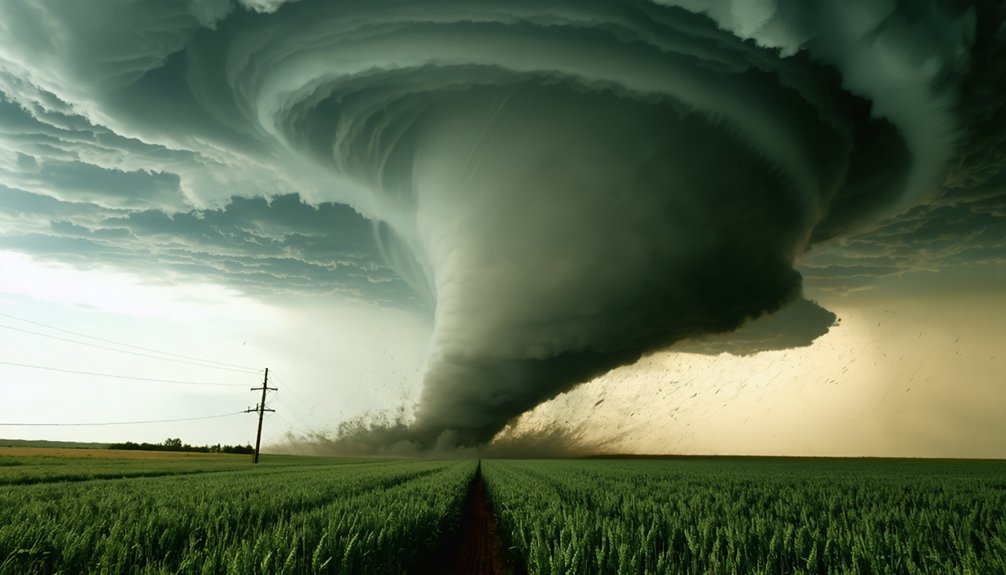
Into the Storm gets tornado science wrong on almost every level. You’ll notice funnel clouds forming from unremarkable gray skies instead of dark, rotating mesocyclones. The film’s CGI depicts hailstones as 3-ton blocks, while real storms max out around one pound. Wind velocities shown lifting heavy objects exceed any historically recorded maximums. Even veteran storm chasers flagged the erratic, disorganized wind patterns as physically impossible. The deeper technical failures go much further than these surface-level problems.
Key Takeaways
- Funnel clouds emerge from unremarkable gray skies, contradicting real tornado formation from dark, rotating mesocyclone bases.
- CGI hailstones depicted as 3-ton blocks far exceed the realistic one-pound maximum for extreme storms.
- Wind velocities shown lifting 3-ton tanks surpass all historically recorded tornado wind speeds.
- The film ignores real supercell behavior, replacing organized rotational wind structures with inaccurate chaotic patterns.
- Stock characters, plot contradictions, and visual spectacle prioritize entertainment over meteorological and narrative accuracy.
Did Into the Storm Get Tornadoes Right?
How accurately does *Into the Storm* depict tornado mechanics? Not very. The film’s tornado dynamics contradict established meteorological data at nearly every turn.
You’ll notice funnel clouds emerging from gray, unremarkable skies, whereas actual storm classification systems like the Enhanced Fujita Scale correlate with dark, rotating mesocyclone bases producing visible updrafts.
The depicted winds supposedly lift 3-ton tanks, requiring velocities exceeding any historically recorded tornado. That’s physically impossible.
Real supercell thunderstorms generate organized, rotational wind structures—not the erratic patterns shown here. Oklahoma severe weather events also typically produce tornado clusters, not a single catastrophic funnel.
The film prioritizes visual spectacle over meteorological accuracy, delivering impressive CGI that’ll entertain casual viewers but frustrates anyone measuring the science against documented atmospheric reality.
Where Into the Storm Gets the Tornado Science Wrong
Although the previous section touched on erratic wind patterns and impossible updraft velocities, the film’s meteorological errors run deeper than surface-level spectacle.
When analyzing tornado dynamics, you’ll notice the funnel clouds emerge from gray, unremarkable skies — real supercell tornadoes develop beneath dark, rotating mesocyclones with visible wall clouds.
Meteorological accuracy also demands multiple tornadoes during Oklahoma severe weather events, yet the film presents a single massive funnel as the sole threat.
The CGI hail defies physics entirely, depicting 3-ton blocks when actual extreme storms produce hailstones barely exceeding one pound.
Additionally, the organized rotational structure characteristic of real supercells contradicts the chaotic, inconsistent wind behavior shown throughout.
These aren’t minor creative liberties — they’re fundamental misrepresentations that undermine the film’s credibility with scientifically informed viewers.
How Into the Storm’s CGI Makes Real Storm Physics Worse
Beyond the meteorological inaccuracies already outlined, the film’s CGI amplifies those errors by rendering storm physics in ways that contradict measurable, documented data.
You’ll notice CGI limitations most sharply when hailstones appear as 3-ton blocks, defying the physical ceiling of roughly 1 pound for extreme storm-generated hail. Real supercell dynamics follow organized rotational structures, yet the rendered wind patterns behave erratically, misrepresenting documented atmospheric behavior.
The CGI-generated updrafts supposedly lift 3-ton tanks, requiring wind velocities that exceed every recorded historical maximum. These visual fabrications don’t just entertain—they actively distort your understanding of genuine storm physics.
CGI updrafts lifting 3-ton tanks don’t entertain—they corrupt your understanding of real storm physics.
When spectacle overrides accuracy, the CGI becomes misinformation dressed as realism, undermining the film’s credibility and leaving scientifically informed viewers with a fundamentally corrupted picture of tornado mechanics.
The Plot Holes and Stock Characters That Kill Dramatic Tension
When stock characters and logic gaps collide, dramatic tension collapses entirely, and Into the Storm delivers both in measurable quantities.
You’ll immediately recognize the strict single father, the reckless footage-obsessed storm chaser, and resentful sons — character clichés operating without psychological depth or individual agency.
These narrative flaws compound when the plot contradicts itself structurally.
Cell towers collapse instantly, yet communication devices remain conveniently functional during critical rescue sequences. A single storm system disrupts an entire town, ignoring documented meteorological patterns involving multiple simultaneous storm cells.
Rescue operations proceed while storm intensity escalates, defying established physics of storm decay.
You’re watching a framework where visual spectacle substitutes for coherent storytelling.
The result isn’t tension — it’s predictability, exposing a thin narrative infrastructure that collapses under analytical scrutiny.
What Actual Storm Chasers Thought of Into the Storm
Stock characters and logic gaps aren’t the only targets of criticism — professional storm chasers applied a stricter, field-tested standard when evaluating Into the Storm.
Veterans with real storm chaser experiences flagged multiple technical failures immediately. Wind velocities depicted exceed any recorded historical maximums, making the lifted tanks physically impossible. Actual supercell structures produce organized rotational patterns, not the erratic behavior the film portrays.
Veteran chasers flagged it immediately — wind velocities, impossible physics, and supercell behavior that defies every documented pattern.
Funnel cloud formations emerge from gray skies here, contradicting the dark, rotating bases chasers document in the field. On tornado chasing ethics, professionals were particularly critical — abandoning safety protocols to prioritize footage collection misrepresents their discipline entirely.
You’re watching a fictionalized caricature, not an accurate operational portrait. These distortions don’t just frustrate experts; they misinform audiences about genuinely dangerous, scientifically complex meteorological events.
Frequently Asked Questions
What Was the Total Box Office Revenue for Into the Storm?
The provided knowledge doesn’t include box office revenue data for *Into the Storm*. You’d need external revenue analysis sources to explore its box office trends accurately. Consider checking databases like Box Office Mojo for precise financial breakdowns.
Did Into the Storm Receive Any Awards or Nominations After Release?
You won’t find awards significance or nomination impact data in the available knowledge base for *Into the Storm*. The provided information covers meteorological accuracy, production details, and critical reception scores, but excludes any awards history.
How Long Did Production of Into the Storm Take to Complete?
The available data doesn’t specify Into The Storm’s exact production timeline. You’ll find that filming challenges, including found-footage techniques and complex CGI tornado sequences, likely extended the process, but precise production duration figures aren’t documented in current records.
Was a Sequel to Into the Storm Ever Planned or Considered?
No confirmed sequel’s ever been planned. You’ll find no data supporting sequel possibilities moving forward. Given the film’s mixed reception and storm accuracy criticisms, studios didn’t greenlight further development, leaving the franchise effectively dormant after its 2014 release.
How Did Into the Storm Perform Compared to Other 2014 Disaster Films?
Like a lone funnel cloud among supercells, you’ll find *Into the Storm* earned $161M globally in 2014, holding its ground despite competitors’ stronger disaster realism and storm effects, yet it couldn’t outshine *Interstellar* or *San Andreas*.
References
- https://thedissolve.com/reviews/981-into-the-storm/
- https://adamthemoviegod.com/into-the-storm-review/
- https://www.crosswalk.com/culture/movies/into-the-storm-movie-review.html
- https://www.rogerebert.com/reviews/into-the-storm-2014
- https://www.stormchasingusa.com/blog/into-the-storm-review-will-the-real-main-characters-please-stand-up/
- https://screenrant.com/into-the-storm-movie-reviews/
- https://www.reddit.com/r/movies/comments/1g8am4w/into_the_storm_2014/
- https://www.scmp.com/yp/discover/entertainment/movies/article/3056731/review-head-storm-boring-predictable-two-hours
- https://www.ioncinema.com/reviews/into-the-storm-review
- https://www.imdb.com/title/tt2106361/