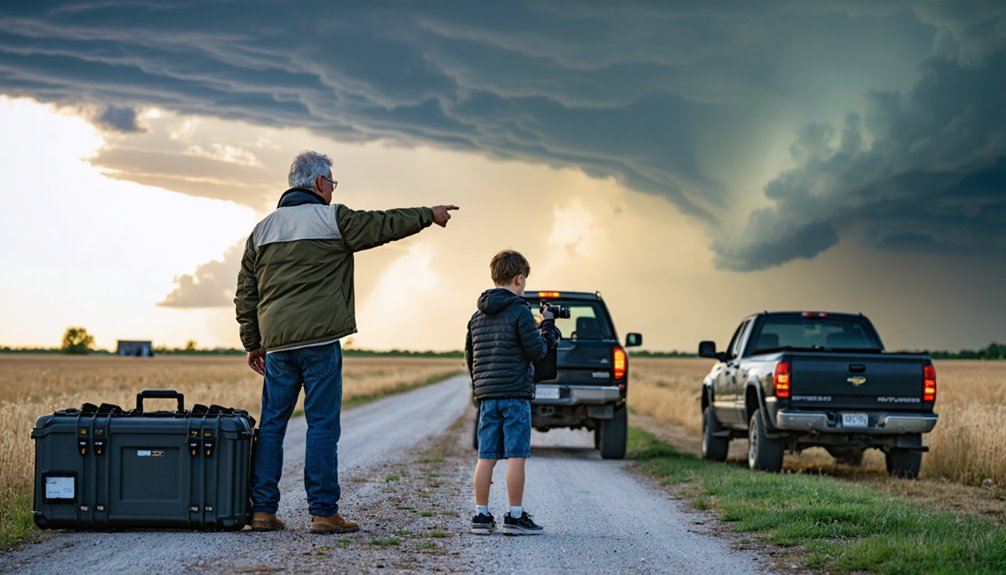
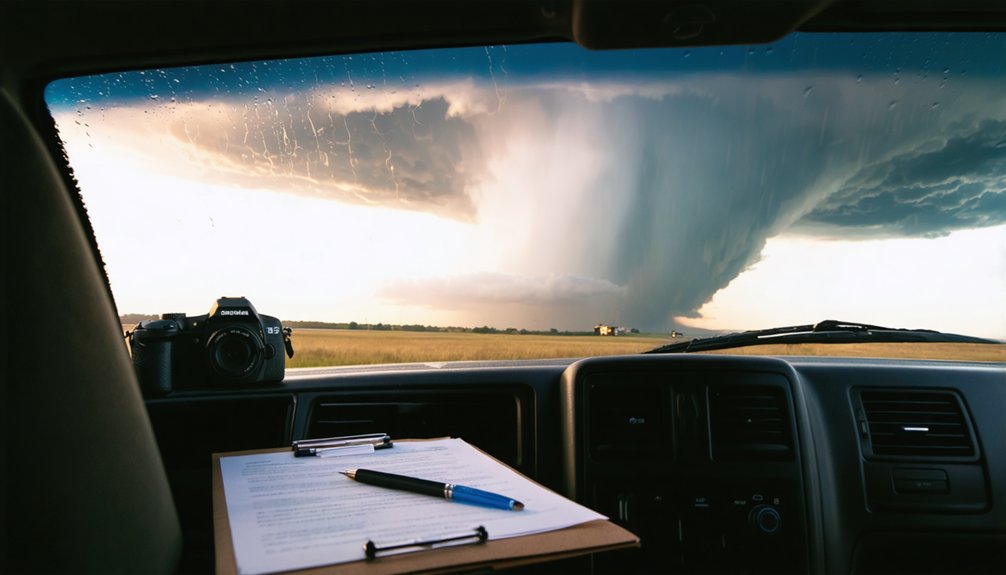
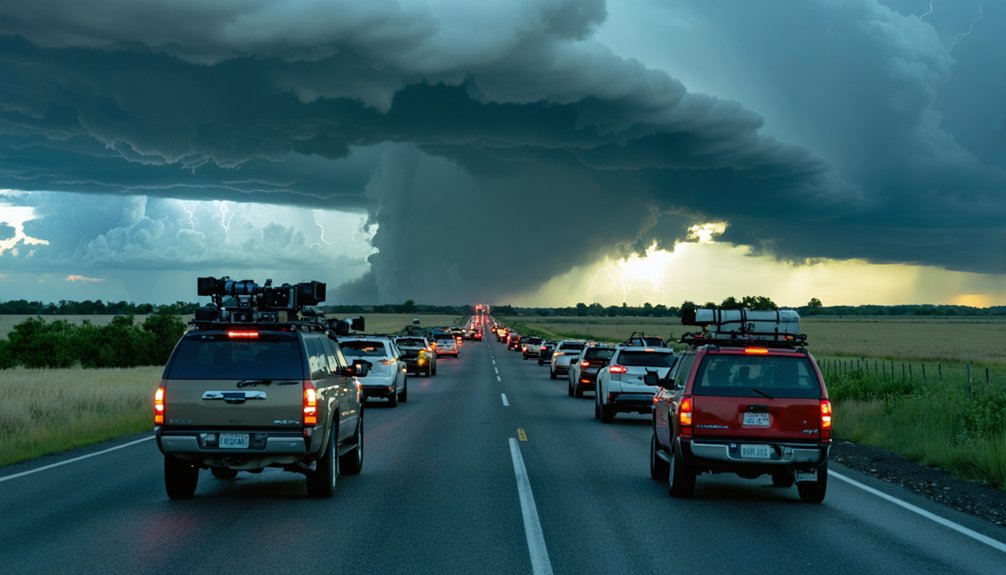
Maximizing adrenaline in storm chasing competitions isn’t about recklessness — it’s about engineered precision. You’ll position yourself in the southeast quadrant, read rotating wall clouds in real-time, and maintain escape corridors before the supercell matures. Your gear must handle 150 mph winds while your GPS tracks every second. You move when the storm moves — no hesitation, no second-guessing. Master these fundamentals, and everything that follows will push your competitive edge further than you thought possible.
Key Takeaways
- Position in the southeast quadrant for maximum storm exposure while maintaining clear escape corridors to heighten controlled risk.
- Master radar signatures like hook echoes and mesocyclone rotation to confidently push closer to peak storm intensity.
- Use GPS trackers with one-second updates to make split-second repositioning decisions during rapidly evolving supercell conditions.
- Read wall clouds and outflow boundaries in real-time to anticipate dramatic storm shifts before they happen.
- Pre-map backroad escape routes so you can chase more aggressively without compromising survival during peak storm moments.
Read Supercell Development Before You Chase
Before you even think about getting behind the wheel, you’ve got to master reading supercell development patterns. Your survival and success depend on it.
Watch for supercell indicators like rotating wall clouds, persistent updrafts, and anvil-shaped tops spreading downwind. These aren’t just visual cues — they’re your roadmap into the storm’s core and out again.
Understanding the storm lifecycle means you’re never reacting blindly. You’ll recognize when a supercell is intensifying versus collapsing, giving you calculated positioning advantages your competitors won’t have.
Knowing when a supercell peaks or collapses isn’t luck — it’s the edge that separates survivors from spectators.
Study radar signatures before deployment. Note the hook echo, the bounded weak echo region, and mesocyclone rotation.
When you’re in the field, that knowledge translates into split-second decisions that keep you aggressive, precise, and alive. Freedom belongs to those who prepare relentlessly.
Position Yourself for Maximum Storm Intensity
Once you’ve read the supercell’s structure, your next move is positioning — and getting it wrong means missing the shot or dying.
Storm dynamics dictate everything: the mesocyclone’s rotation, forward speed, and hook echo placement determine where you plant yourself.
Target the southeast quadrant. It’s your sweet spot — close enough to capture violent inflow and wall cloud development, far enough to maintain your escape corridor.
Never let the rain-wrapped core cut off your exit.
Chase strategies demand constant recalibration. As the storm matures, it shifts. You shift with it, using backroads to leap-frog ahead while keeping the structure in your sightline.
Stay off the radar screen mentally — trust your eyes, trust your instincts.
Five hundred meters from the core minimum. Any closer, you’re not chasing anymore. You’re dying.
Gear Every Competitive Storm Chaser Needs on the Road
Your gear isn’t just equipment — it’s the difference between capturing the shot and becoming a statistic. Load your rig with high-resolution camera technology featuring 400mm+ lenses that cut through rain and debris.
GPS accuracy matters — run trackers with one-second update intervals so storm tracking stays razor-sharp when you’re repositioning fast.
Don’t gamble on weather predictions without a portable station measuring real-time wind shifts. Your communication devices need redundancy — scanner, satellite phone, NOAA integration. No signal dead zones allowed.
Safety equipment and protective gear aren’t optional accessories — they’re survival infrastructure. Your shelter must be rated for 150 mph winds.
For energy sources, run dual backup power systems across every electronic unit. Dead batteries end chases. Dead chasers end everything.
Move Fast When the Storm Chase Path Shifts
Gear loads the rig — but none of it matters if you’re parked in the wrong county when the storm pivots. Storm dynamics shift without apology, and your chase strategies must match that ruthlessness.
When the path changes, you move. No hesitation. No second-guessing.
- Ditch radar fixation — look up, read the wall cloud’s direction in real time
- Pre-identify backroad escape corridors before the storm matures
- Monitor outflow boundaries signaling a track deviation early
- Reposition at least 500 meters clear of the new core trajectory
You’ve got seconds, not minutes. The chasers who dominate competitions aren’t the ones with the best cameras — they’re the ones who read the shift first and punch the accelerator before everyone else does.
Protect Yourself at Peak Storm Chase Intensity
When the storm reaches peak intensity, your gear isn’t optional—it’s your lifeline.
Equip yourself with a portable weather station, GPS tracker with 1-second updates, and a vehicle shelter rated for 150 mph winds before you’re anywhere near the core.
You’ve already mapped your escape routes, so execute them without hesitation the moment conditions exceed your 500-meter safety threshold.
Gear Up For Safety
At peak storm chase intensity, you’ll need gear that’s rated to survive what you’re documenting. Your safety equipment isn’t optional—it’s the difference between capturing history and becoming it. Emergency protocols mean nothing without the hardware to back them up.
Deploy these non-negotiables before every chase:
- Protective shelter rated for 150 mph winds minimum
- GPS tracker updating every second for real-time positioning
- Portable weather station measuring live wind speed fluctuations
- Backup power systems keeping all electronics operational during extended pursuits
You’re chasing freedom on open roads, but that freedom demands preparation.
Every piece of gear serves a tactical purpose—redundancy saves lives when supercells behave unpredictably. Lock down your equipment checklist before you turn that ignition. The storm won’t wait.
Escape Routes Matter
Your gear keeps you operational—your escape route keeps you alive. Before you deploy, map your exits with the same intensity you bring to storm positioning. Escape route planning isn’t optional—it’s the difference between a competition win and a body recovery.
Study your backroads cold. Know which routes run perpendicular to the storm’s forward movement, because parallel paths turn lethal fast. When the wedge tightens and debris fields expand, you need instant execution, not hesitation.
Emergency communication systems must stay active throughout the chase. GPS trackers, NOAA integration, and direct contact with your chase network create a safety web that functions even when visibility collapses.
Freedom belongs to the prepared. Chase hard, but never let peak intensity override your pre-planned exit strategy. Your next chase depends on it.
Win the Storm Chasing Competition Without Losing Your Edge
Winning a storm chasing competition demands razor-sharp strategy without sacrificing the disciplined fundamentals that keep you alive. You’re not just chasing adrenaline—you’re executing precise storm strategies while outmaneuvering competitors who cut corners. Your tornado techniques must be sharper, faster, and smarter.
Storm chasing glory belongs to those who outthink the competition—strategy, discipline, and precision always outrun recklessness.
Position yourself using these competitive advantages:
- Optimal intercept angles – Approach the storm’s southern flank for maximum visual clarity and escape flexibility.
- Rapid repositioning – Master backroad grids before deployment, eliminating hesitation during critical storm shifts.
- Real-time radar discipline – Cross-reference mobile radar with direct visual observation, never relying solely on screens.
- Structured risk thresholds – Maintain your 500-meter minimum distance non-negotiably, even when competitors push closer.
Your edge isn’t recklessness—it’s executing superior preparation faster than everyone else on the road.
Frequently Asked Questions
How Do Competitors Legally Obtain Permits for Storm Chasing in Restricted Zones?
You’ll secure permit applications through NOAA and local emergency management agencies. Submit documented safety protocols, equipment specs, and escape routes. Restricted areas demand proof of meteorological credentials — you’re earning access, not demanding it.
What Mental Health Resources Exist Specifically for Competitive Storm Chasers?
You’re chasing the edge—now chase your mental resilience. Specialized stress management programs like Storm Chasing Community Support networks, NOAA-affiliated counselor directories, and peer debriefing groups exist specifically for you, ensuring you’re psychologically equipped for every deployment.
How Are Storm Chasing Competition Scores Officially Calculated and Verified?
You’re scored on proximity data, documentation quality, and meteorological accuracy. The verification process cross-references your GPS logs, imagery, and weather station readings against official radar archives, ensuring your scoring criteria reflect legitimate, verifiable storm intercepts.
What Insurance Coverage Do Professional Storm Chasers Typically Carry?
You’ll need extensive liability protection and storm damage coverage. Carry commercial auto, equipment, and professional liability policies. Don’t chase without umbrella coverage — it’s your financial lifeline when nature’s fury tests every boundary you push.
How Do Storm Chasers Coordinate With Local Emergency Services During Competitions?
You’ll coordinate with local emergency services through pre-established communication strategies, registering your chase route and sharing GPS data. You’re required to follow safety protocols, monitoring NOAA broadcasts while respecting official emergency management directives—keeping responders informed without compromising operational freedom.
References
- https://www.facebook.com/groups/LowellSkywarn/posts/4318711441699950/
- https://www.stormskyresiliencecollective.org/storm-chaser-freebies
- https://alllivingisstormchasing.substack.com/p/004-danger-and-dopamine-the-neurobiology
- https://www.youtube.com/watch?v=cNkPWEoQtAc
- https://www.youtube.com/watch?v=kXXzTXiknc4
- https://www.theadrenalinezone.com/episodes/hank-schyma-storm-chaser
- https://www.reddit.com/r/stormchasing/comments/1jujw33/what_are_some_tips_for_getting_into_storm_chasing/
- https://huzztle.com/storm-chasing-a-complete-guide-to-thrill-safety/
- https://roadtrippers.com/magazine/american-storm-chasing/
- https://crazystormchasers.com/risk-and-reward-in-storm-chasing/