Maximizing safety during storm chasing missions starts before you ever leave home. You’ll need to study weather models, plan multiple escape routes, and confirm your vehicle’s systems are chase-ready. During the chase, you must maintain at least a one-mile buffer from visible tornadoes, continuously monitor radar, and match your driving speed to road conditions—not storm urgency. The difference between a successful chase and a fatal one comes down to preparation, discipline, and knowing exactly when to walk away—all of which you can master.
Key Takeaways
- Thoroughly plan escape routes before chasing, using topographic data and road networks to avoid dead ends, flood-prone crossings, and choke points.
- Continuously monitor radar, weather models, and mesoscale discussions, rerouting or canceling immediately when conditions shift unexpectedly.
- Maintain at least a one-mile buffer from visible tornadoes, repositioning promptly if storm motion changes direction or accelerates.
- Inspect tires, brakes, fuel levels, and backup power systems before departure to ensure vehicle reliability in remote areas.
- Prioritize deliberate, controlled driving speeds matched to road conditions, visibility, and traffic rather than storm urgency.
Know the Weather Before You Leave Home
Before you commit to a target area, consult the National Weather Service, Storm Prediction Center outlooks, and mesoscale discussions to build a complete picture of the day’s severe weather potential.
Before committing to any target, consult the National Weather Service and Storm Prediction Center outlooks first.
Cross-reference multiple weather models rather than anchoring your storm forecasting decisions to a single data source.
Study road networks, terrain, and likely choke points before departure, and identify at least two escape routes for every position you’re considering.
Don’t lock into a target if storm evolution outpaces your ability to reposition.
Radar alone won’t give you the full picture, so combine it with direct observational data and updated mesoscale discussions throughout the morning.
Cancel or reroute aggressively when conditions shift.
Your freedom to chase effectively depends entirely on the quality of intelligence you gather before the wheels roll.
Why Driving Kills More Storm Chasers Than the Storm Does
When you’re steering toward a developing supercell, every glance at a radar app while driving multiplies your crash risk considerably.
You must assign a dedicated navigator to handle radar, communication, and route decisions so your eyes stay on the road.
Maintaining consistent speed discipline—avoiding sudden acceleration or braking to catch a storm—keeps you and surrounding traffic out of danger.
Distracted Driving Raises Risk
Although tornadoes dominate the public image of storm chasing danger, vehicle crashes kill more chasers than the storms themselves. Distraction is a primary crash driver, and you must treat distraction prevention as non-negotiable.
Reading radar, adjusting cameras, or texting while moving dramatically narrows your reaction window and compromises vehicle control.
Apply strict focus techniques before entering the chase corridor. Assign a dedicated navigator who handles all device interaction while you keep both hands on the wheel and both eyes on the road.
Pull completely off the road before consulting radar or updating your team. Even a two-second glance at a screen doubles your crash risk.
Your freedom to chase depends on staying alive, and that requires treating the vehicle cabin as an active operational environment.
Speed Discipline Saves Lives
Speed kills chasers more often through reckless driving than through direct storm contact, and you’re far more likely to wrap your vehicle around a guardrail than to get struck by a tornado.
Traffic congestion compounds that risk dramatically when multiple chase teams converge on the same road infrastructure simultaneously, creating bottlenecks that eliminate escape options.
You need to maintain speed discipline at all times, matching your pace to road conditions, visibility, and surrounding traffic rather than to storm urgency.
Rushing repositioning maneuvers causes overcorrection, rollover, and collision.
When roads narrow, flood, or deteriorate, reduce speed immediately.
The storm won’t wait for you, but neither will physics.
Controlled, deliberate driving keeps you mobile, alive, and operationally effective longer than aggressive speed ever will.
Check These Vehicle Systems Before Every Chase
Before you leave the driveway, inspect these critical vehicle systems—skipping this step can turn a mechanical failure into a life-threatening situation in the field. Vehicle maintenance isn’t optional; it’s your first line of defense before you commit to any road network.
Check tire pressure and tread depth, brake responsiveness, and all fluid levels including coolant, oil, and windshield washer fluid. Confirm your lights function correctly—headlights, brake lights, and hazard flashers matter in low-visibility conditions.
Verify fuel level; remote chase areas offer few refueling options.
Test your backup power systems, inverters, and chargers before departure. A dead device mid-chase eliminates situational awareness at the worst possible moment. Mechanical reliability keeps your options open and your escape routes intact.
How to Position Safely Near a Tornado
When positioning near a tornado, you must maintain a safe buffer from the storm’s rotating wall cloud and never attempt to core punch for a closer look.
You should always confirm at least two viable escape routes before committing to any position, avoiding roads that dead-end, flood, or funnel into choke points.
Stay alert to sudden storm motion changes—if the tornado reverses direction or accelerates unexpectedly, reposition immediately rather than waiting until the threat forces your hand.
Maintaining Safe Buffer Distances
Positioning safely near a tornado demands deliberate distance management, not instinct or adrenaline. You must establish a storm buffer of at least one mile from a visible tornado, adjusting constantly as storm motion shifts. Never treat that distance as fixed — tornadoes accelerate, change direction, and wrap in rain without warning.
Your safety perimeter isn’t just about proximity; it’s about exit geometry. Confirm that your current position gives you perpendicular escape routes relative to storm motion. If you’re only one road deep, you’ve already compromised your margin.
Avoid core punching entirely. Driving through a storm’s precipitation core to gain position trades your safety perimeter for a photograph. That exchange costs chasers their vehicles, and sometimes their lives.
Identifying Multiple Escape Routes
Every position you commit to near a tornado requires at least two confirmed exit routes before you stop moving. Study road networks during pre-chase terrain analysis so you’re never making those decisions under pressure. Identify paved alternatives, intersecting county roads, and highway on-ramps that move you perpendicular to storm motion — not parallel to it.
If one route floods, closes, or congests with chaser traffic, you execute the second immediately without hesitation. Don’t rely on a single corridor that dead-ends or crosses a flood-prone drainage.
Your emergency communication setup must stay active so your team confirms your position and can reroute you if radar shows unexpected storm acceleration. You retain freedom of movement only when you’ve planned for losing your primary exit before you ever need it.
Recognizing Storm Motion Changes
Storm motion can reverse or accelerate with little warning, and you need to recognize those shifts before they eliminate your escape options. Monitor radar updates at frequent intervals, noting any change in storm heading, forward speed, or rotational intensity.
A supercell that slows suddenly often signals a track shift, which can bring the core directly over your position. Watch for hook echo elongation, inflow tightening, and rapid intensification on radar as early indicators.
Cross-reference what you’re seeing on screen with direct visual observation. If the storm’s motion contradicts your exit plan, reposition immediately rather than waiting for confirmation.
Late movement consistently traps chasers near the core. Your freedom to operate depends entirely on maintaining positional advantage, and that advantage disappears fast when storm motion changes go unrecognized.
Build Your Storm Chasing Escape Routes Before You Need Them
Before you commit to a chase position, map at least two viable escape routes for every location you plan to occupy. Study the road network thoroughly before departure—identify paved alternates, directional options, and potential choke points that storm traffic or flooding could seal off fast.
Don’t rely on a single corridor when conditions deteriorate. Cross-reference topographic data, flood-prone crossings, and dead-end county roads before you move. A route that looks clean on radar may already be compromised on the ground.
Maintain emergency communication capability throughout the chase so your team tracks your position and can relay road closure intel in real time. Escape routes decided under pressure are rarely reliable—build them into your plan before the storm forces your hand.
NOAA Radio, Ham Radio, and Backup Tools to Carry
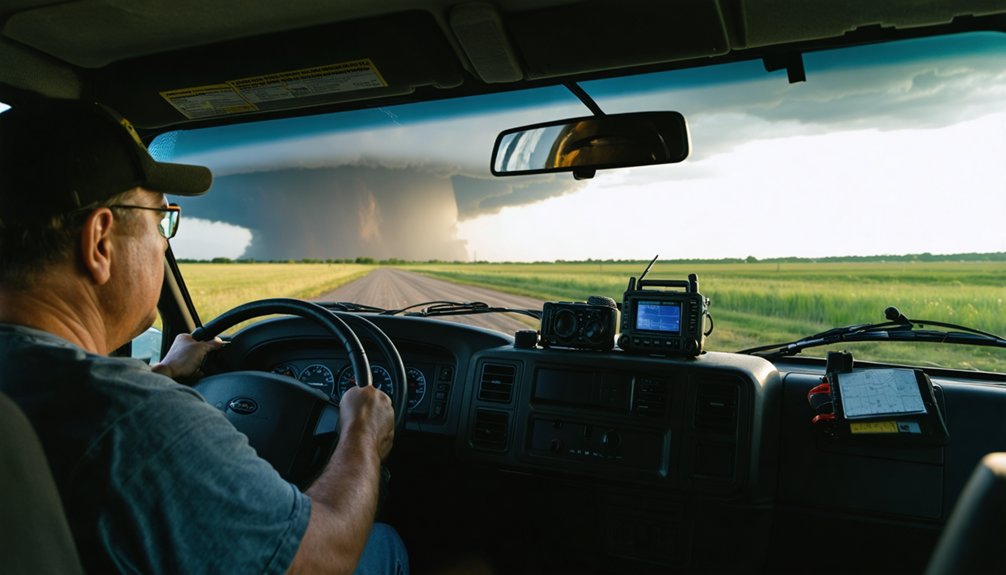
Reliable escape routes depend on real-time intelligence, and that intelligence collapses the moment your mobile data signal drops. Build communication redundancy before you enter the field.
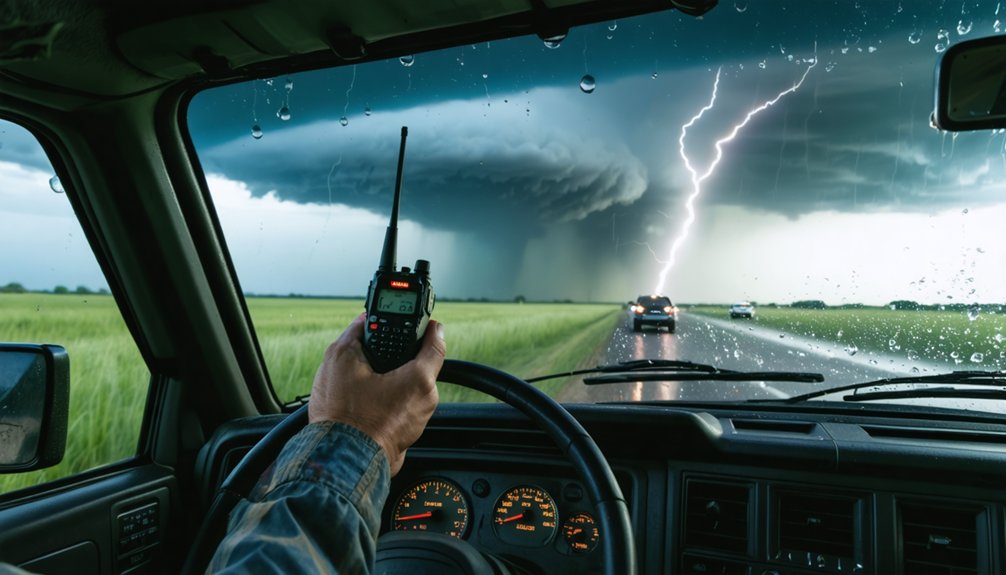
Carry a NOAA Weather Radio receiver for continuous broadcast alerts that operate independently of cellular networks. Add a ham radio license and a VHF/UHF handheld to tap into local repeater networks and coordinate with other chasers tracking storm motion.
Mount a dedicated GPS unit that functions offline, and load regional road maps to your device before departure. Keep a power inverter and spare battery bank charged to sustain all electronics during extended repositioning.
When identifying emergency shelter, you’ll need accurate storm data to make that call. Redundant tools keep that data flowing when your primary systems fail.
When to Stop Storm Chasing and Get Out Fast
Knowing when to abort a chase is as critical as knowing how to position for one. When darkness eliminates visual contact, when flooding blocks your escape route, or when you’ve lost radar and GPS, stop immediately. These aren’t suggestions — they’re hard triggers.
Storm debris traveling at tornado-strength winds can destroy your vehicle before you react. If cloud-to-ground lightning closes within one mile, seek emergency shelter without hesitation.
Never treat an overpass as emergency shelter; it concentrates wind and creates deadly traffic hazards. Reposition early — late movement surrenders your options.
When situational awareness collapses, your freedom to make calculated decisions disappears with it. Recognize that abandoning a chase isn’t failure; it’s the disciplined choice that keeps you chasing tomorrow.
Why Night Chasing and Flooding Demand Different Rules
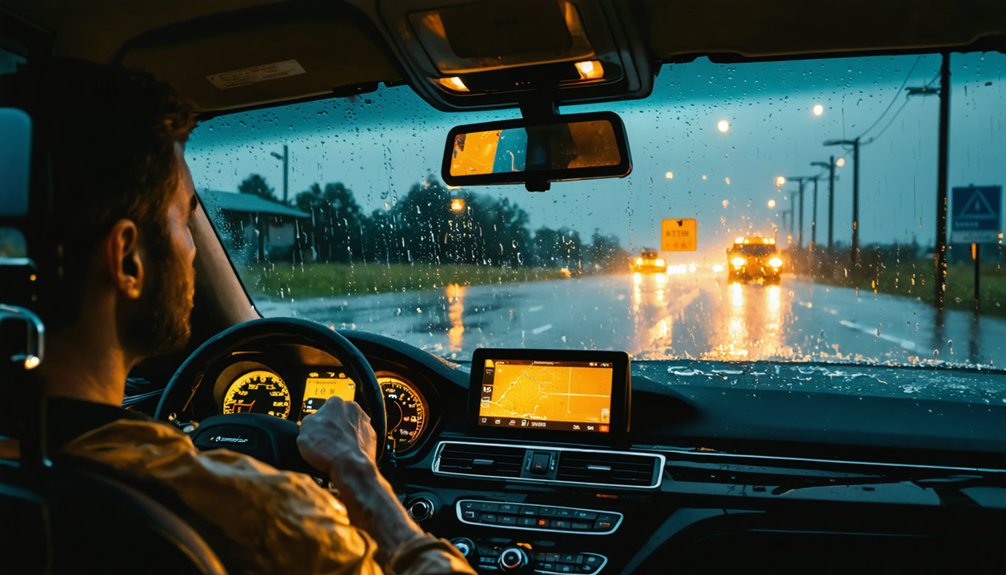
When darkness falls, storm chasing shifts from a manageable risk calculation to a considerably more dangerous one. Night visibility drops sharply, stripping you of the visual cues that daylight provides — rotating wall clouds, debris fields, and funnel development become nearly invisible. You’re steering by radar alone, which removes critical situational awareness.
Flooding hazards compound this danger considerably. Water across roads is difficult to detect at night, and even shallow crossings can sweep a vehicle off course. You must treat every low-lying road as a potential trap after dark.
Apply stricter abandonment thresholds at night than during daylight hours. If your radar updates lag, roads become questionable, or visibility deteriorates further, disengage immediately. Your freedom to chase another day depends on disciplined decision-making tonight.
Frequently Asked Questions
What Insurance Coverage Do Storm Chasers Typically Need for Their Vehicles?
You’ll need thorough vehicle coverage that includes collision, liability, and weather-related damage protection. Insurance requirements for storm chasing typically demand higher policy limits, given the elevated risks you’re exposing your vehicle to daily.
How Do Storm Chasers Handle Medical Emergencies Far From Hospitals?
You’ll need strong first aid preparedness—carry trauma kits, tourniquets, and medications. Use emergency communication devices like satellite messengers to contact rescue services. Log your GPS coordinates precisely so responders can reach you quickly in remote areas.
Are There Legal Permits Required to Chase Storms in Certain States?
most states don’t require storm chasing permits. However, state regulations vary, so you’ll want to check local laws. Always respect road closures and emergency management orders to stay legal and safe.
How Do Chasers Manage Fatigue During Multi-Day Chasing Expeditions?
You’ll combat fatigue by scheduling mandatory rest periods between weather pattern analysis sessions, rotating driver duties, and completing equipment maintenance during downtime—keeping you sharp, mission-ready, and free to chase safely across consecutive high-risk operational days.
What Training Certifications Are Recommended Before Someone Starts Storm Chasing?
Like a pilot earning wings before flight, you’ll want Skywarn training, Weather forecasting courses, and ham radio licensing. Master storm chasing gear operation, study NWS resources, and pursue meteorology certifications before you chase independently.
References
- https://www.atms.unca.edu/cgodfrey/courses/swfex/pdf/ChasingSafety.pdf
- https://www.stormchasingusa.com/storm-chasing-and-safety/
- https://crazystormchasers.com/best-practices-for-storm-chasing-safety-engagement/
- https://midweststormchasers.org/safety-tips/
- https://weather.cod.edu/chasing/assets/documents/safety.pdf
- https://www.reddit.com/r/stormchasing/comments/k89wnc/safety_tips_for_storm_chasing/
- https://medium.com/book-bites/the-real-danger-of-storm-chasing-from-meteorologist-dan-henry-2cbb417b5c02
- https://www.cnn.com/2017/03/29/us/storm-chaser-dangers
- https://crazystormchasers.com/storm-chasing-safety-rules/
- https://www.forbes.com/sites/jimclash/2026/05/21/storm-chasing-the-potential-killer-called-reckless-convergence/