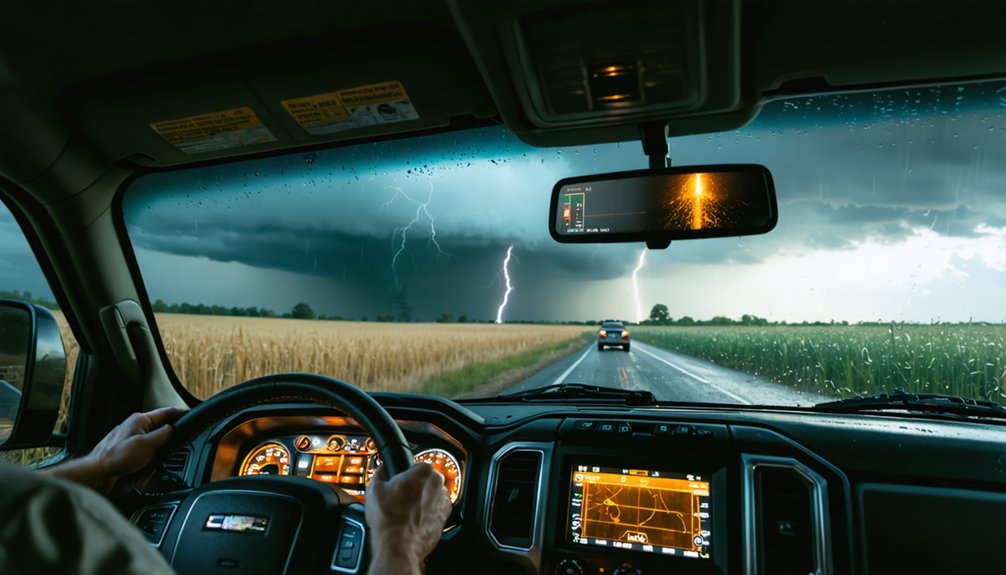
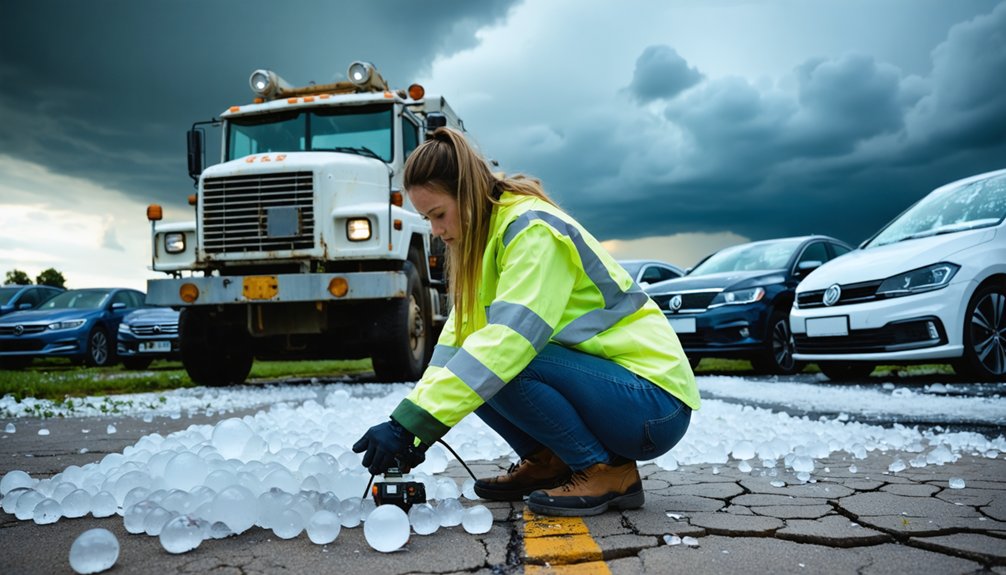
When maneuvering severe thunderstorms in Tornado Alley, you’ll need to act fast and smart. Watch for a dark green sky, freight train-like roaring, or low debris clouds. Don’t rely solely on outdoor sirens—use battery-powered weather radios and push notifications for indoor alerts. Head immediately to a basement or interior room on the lowest floor. Abandon mobile homes instantly, and never shelter under overpasses. The full breakdown of each life-saving strategy is just ahead.
Key Takeaways
- Enable weather app push notifications and monitor Storm Prediction Center outlooks before traveling through Tornado Alley during severe weather season.
- Dark green skies, freight train roaring sounds, or visible debris clouds signal immediate tornado threat requiring instant shelter-seeking action.
- Seek shelter in basements, interior bathrooms, or closets on the lowest floor, staying away from exterior walls and windows.
- Mobile home residents must evacuate immediately to sturdy permanent structures, as lightweight frames fail rapidly against tornado-force winds.
- After storms, maintain 30-foot clearance from downed power lines and avoid open flames due to potential gas leaks nearby.
Know the Warning Signs Before a Tornado Strikes
Recognizing a tornado’s warning signs can mean the difference between life and death. Watch for a dark green sky, a loud roar resembling a freight train, and visible debris clouds near the ground. These indicators demand immediate action.
Don’t fall for tornado myths and warning misconceptions that could cost you your life. One dangerous myth suggests opening windows equalizes pressure and prevents structural damage — it doesn’t. You’ll only waste critical evacuation seconds.
Another misconception claims you can visually confirm every tornado; many remain rain-wrapped and invisible until impact.
Tune to the National Weather Service, EAS, or local radio for real-time alerts. Never ignore official sirens or warnings.
The Storm Prediction Center also provides advance outlooks before traveling through high-risk regions. Your awareness is your first line of defense.
How to Get Tornado Warnings Before It’s Too Late
Getting tornado warnings before a storm hits requires reliable, redundant alert systems. Don’t depend on a single source. Tune directly to the National Weather Service, Emergency Alert System, or local TV and radio stations for real-time updates.
Meteorologists use satellite imagery to track storm rotation patterns hours before touchdown, giving you critical lead time.
Tornado siren systems provide immediate outdoor alerts, but they’re useless if you’re indoors with windows closed. Supplement them with a battery-powered weather radio that broadcasts continuous NWS updates even during power outages.
Download multiple weather apps and enable push notifications. Before traveling through Tornado Alley, check the Storm Prediction Center and your local NWS office for convective outlooks.
Layering these systems maximizes your warning window and preserves your freedom to act decisively.
Emergency Supplies Every Tornado Survivor Needs Ready
You’ll need a compact emergency kit stocked with water, non-perishable food, warm clothing, a first aid kit, and a weather radio before a tornado threatens your area.
Replace open-flame devices with battery-powered lanterns, since gas leaks after structural damage make matches and lighters a lethal hazard.
Pack a helmet, heavy shoes, wallet, and charged cell phone in an accessible bag so you can grab everything and reach your shelter zone within seconds.
Essential Survival Kit Items
When a tornado warning activates, having a pre-packed survival kit cuts your response time from minutes to seconds. Your kit should include a battery-powered weather radio for emergency communication, ensuring you’re receiving National Weather Service updates without relying on grid power.
Pack battery-powered lanterns instead of matches or lighters, since gas leaks make open flames dangerous post-storm.
Include a helmet, heavy shoes, wallet, and cell phone in one accessible bag.
Store water, non-perishable food, and warm clothing for extended shelter time.
A mattress or heavy blanket enables shelter customization, providing debris protection regardless of where you’re sheltering.
A first aid kit handles immediate injuries from glass and sharp debris.
Keep everything consolidated, accessible, and ready for immediate grab-and-go deployment.
Battery-Powered Safety Gear
Battery-powered gear extends your survival kit’s functionality when grid power fails, which it almost always does during a major tornado event. Pack a NOAA weather radio, battery-powered lanterns, and a reliable first aid kit as your foundation.
Skip wireless charging devices—they’re grid-dependent and useless post-storm. Instead, prioritize solar powered devices like compact panel chargers that recharge AA and AAA batteries independently.
Helmet and heavy footwear belong in your bag alongside your cell phone and wallet. Lanterns replace open-flame alternatives, eliminating ignition risk near potential gas leaks.
Keep batteries stored separately to extend shelf life and test equipment monthly. Your independence from infrastructure depends entirely on gear you’ve personally verified works before the sirens activate.
Find the Safest Tornado Shelter in Any Building Fast
A basement or storm cellar is your safest option when a tornado warning sounds, cutting debris impact and wind exposure to near zero.
Eliminate exterior access points from your route — doors and windows become lethal projectile vectors under high-velocity wind loads.
When no basement exists, move to the lowest floor’s interior room. Bathrooms and closets near the building’s center provide structural compression resistance and limit indoor ventilation pathways that channel debris.
Stay away from outside walls, which fail under rotational wind pressure exceeding 200 mph in EF4-EF5 events.
Position yourself in the bathtub if available — the metal shell adds ballistic shielding. Cover your body with a mattress or heavy blanket. Keep your head and neck protected with your arms throughout the event.
Why Mobile Homes Are the Deadliest Place to Be?
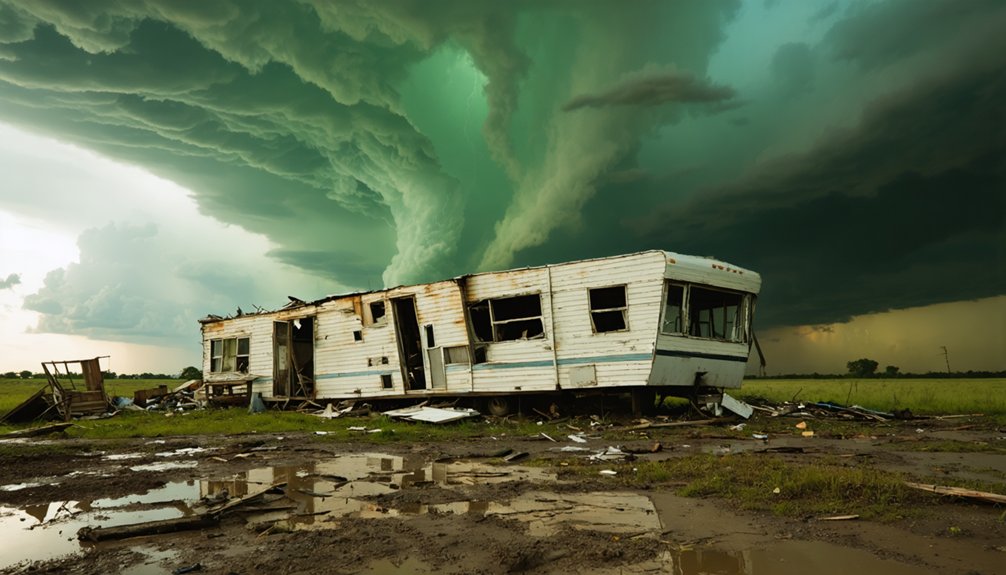
Mobile homes lack the structural integrity of permanent buildings, offering virtually no resistance against tornado-force winds that can exceed 200 mph.
Their lightweight frames and anchoring systems fail rapidly under rotational wind loads, turning the structure itself into lethal airborne debris.
If you’re in a mobile home when a tornado warning sounds, you must abandon it immediately and move to a pre-identified underground shelter or sturdy permanent building.
Mobile Home Structural Weakness
When a tornado strikes, mobile homes offer virtually no structural protection — their lightweight frames, minimal anchoring systems, and lack of reinforced foundations make them catastrophically vulnerable to even weak EF0 or EF1 tornadoes.
Unlike site-built homes, mobile home vulnerabilities stem from aluminum or steel frames that can’t withstand wind loads exceeding 70-90 mph. Without structural reinforcement, roof panels separate first, exposing interior walls to direct wind pressure.
Tie-down systems, when present, typically anchor only the frame — not the superstructure. Studies show mobile homes account for disproportionately high tornado fatalities relative to their population share.
You’re not gambling with odds you can win — you’re facing physics you can’t negotiate. The moment warnings sound, your only survivable decision is immediate evacuation to a designated underground shelter.
Immediate Evacuation Strategies
Because mobile homes account for a disproportionate share of tornado fatalities despite housing a small fraction of the U.S. population, you can’t afford to treat evacuation as optional — it’s your only viable survival strategy.
Evacuation planning must begin before storm season, not when sirens activate. Identify your shelter location now.
Execute these steps immediately upon warning:
- Leave instantly — don’t gather belongings or hesitate
- Move to a pre-identified underground shelter or permanent structure with an interior room
- Stay low while traveling to avoid airborne debris exposure
- Never return to the mobile home until officials confirm all-clear
Every second inside a mobile home during tornado conditions exponentially increases your mortality risk.
Freedom means making informed decisions before danger forces your hand.
What to Do If a Tornado Catches You in Your Car
Being caught in a tornado while driving puts you in one of the most vulnerable positions possible. Effective tornado navigation requires immediate, decisive action—not hesitation. If a building’s accessible, abandon your vehicle and shelter there now.
Without nearby structures, your car safety protocol changes drastically. Don’t park under overpasses or bridges; wind tunnel effects there dramatically amplify debris velocity and danger. Instead, exit your vehicle and lie flat in the lowest ditch available, keeping your head covered with both hands.
If leaving isn’t possible, stay below window level, crouch between seats, and shield your head. Never attempt outrunning a tornado—wind speeds escalate unpredictably, turning your escape route into a death trap. Prioritize low ground and head protection above everything else.
How to Avoid Hidden Hazards After a Tornado Hits
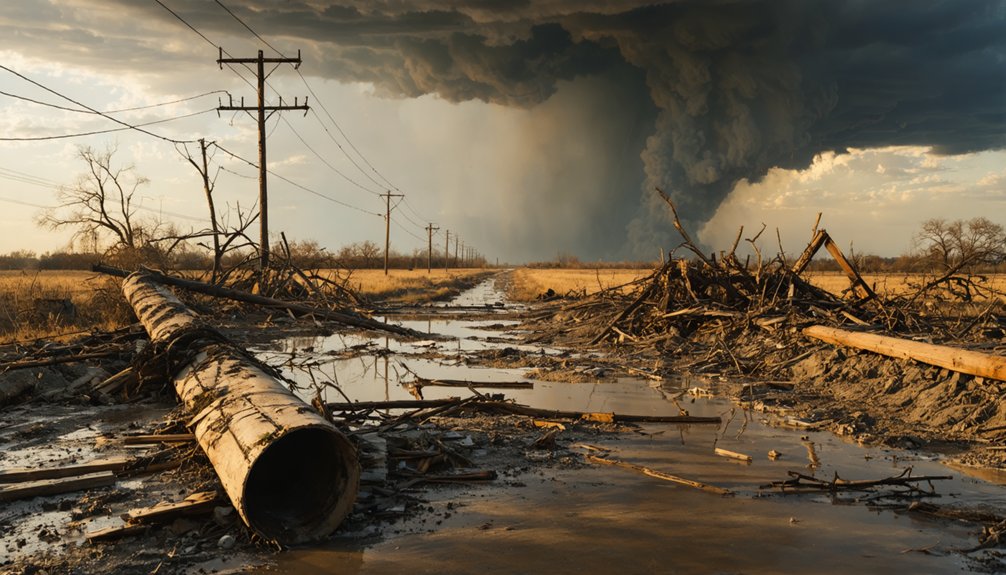
Surviving the storm’s immediate threat shifts your focus to a new set of dangers lurking in the aftermath. Post storm debris and hidden hazards demand sharp awareness before you move freely.
Follow these critical protocols:
- Avoid downed power lines — treat every line as live and maintain a minimum 30-foot clearance
- Watch for sharp objects — broken glass, exposed nails, and structural fragments pierce through standard footwear
- Skip open flames entirely — gas leaks make matches, lighters, and candles immediate ignition risks
- Don’t use indoor generators or grills — carbon monoxide accumulates lethally in enclosed spaces
Confirm authorities have declared the area safe before exploring damage. Stay with your group; disorientation increases *considerably* when familiar landmarks disappear completely.
Frequently Asked Questions
Can Opening Windows Really Prevent Your House From Exploding During Tornadoes?
Like a stubborn myth refusing to die, this idea’s simply false. Opening windows won’t boost your house protection. Window safety means staying away from them—you should immediately seek interior shelter instead.
Is It Ever Safe to Outrun a Tornado in a Vehicle?
You shouldn’t attempt vehicle evacuation during tornado safety situations. Tornado wind speeds increase rapidly and unpredictably, making outrunning one nearly impossible. Exit your vehicle, find a low-lying ditch, and protect your head immediately.
How Do Wind Tunnel Effects Make Overpasses Deadly During Tornado Events?
Contrary to popular belief, overpasses don’t offer safety — they’re deadly. Wind tunnel effects accelerate tornado winds dramatically beneath the structure, turning debris into lethal projectiles. You’ll face greater exposure there than in open ground. Overpass safety is a myth.
Should Matches and Lighters Be Stored Inside Homes During Tornado Season?
Don’t store matches or lighters indoors during tornado season. For indoor safety and emergency preparedness, you’ll eliminate gas leak ignition risks. Instead, rely on battery-powered lanterns, keeping your household protected from potential fire hazards during severe weather events.
Why Should Generators Never Be Used Inside Buildings After Tornado Damage?
After the storm’s “uninvited guest” departs, you shouldn’t run generators inside—generator safety is critical. Indoor hazards from carbon monoxide buildup can silently overwhelm you, and gas leakage risks make enclosed operation potentially fatal. Protect your freedom; stay outside.
References
- https://www.weather.gov/ama/SEVERESAFETYTIPS
- https://www.ecoflow.com/us/blog/tornado-alley-safety-guide
- https://everything-everywhere.com/traveling-in-tornado-alley-a-guide-for-visitors/
- https://www.kcur.org/podcast/up-to-date/2021-03-24/how-to-survive-living-in-tornado-alley
- https://www.inside.iastate.edu/article/2023/03/23/severe-spring-weather
- https://www.kansastag.gov/385/Tornado-Safety-for-Citizens
- https://wpde.com/weather/abc-15-weather-authority-blog/severe-weather-safety-tips-ahead-of-tuesdays-strong-storms
- https://www.reddit.com/r/RVLiving/comments/110mjm1/should_we_be_concerned_about_traveling_through/
- https://www.onithome.com/blog/insurance/what-to-do-in-a-tornado-a-guide-to-safe-living-in-tornado-alley/
- https://www.youtube.com/watch?v=4jwqSBeodnM