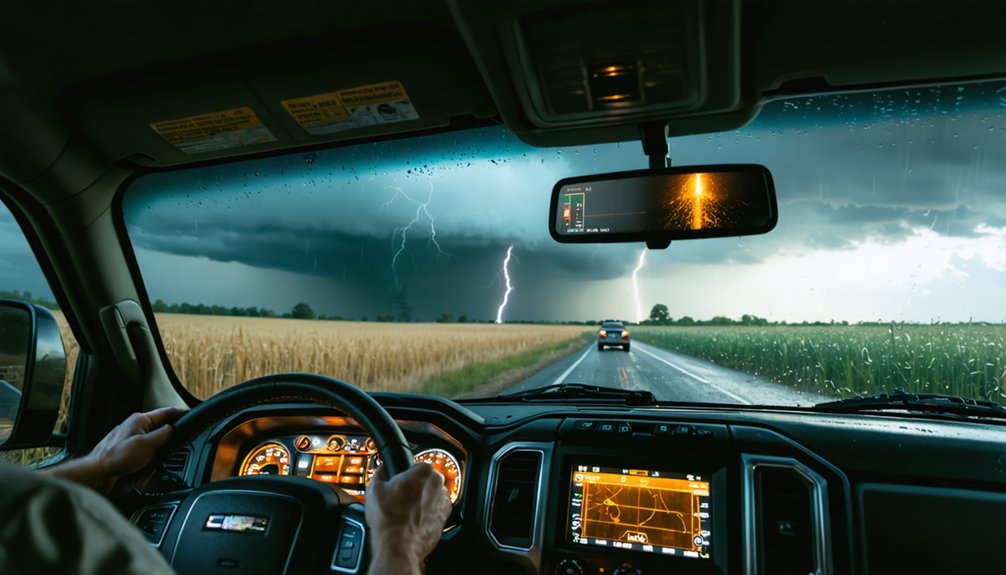
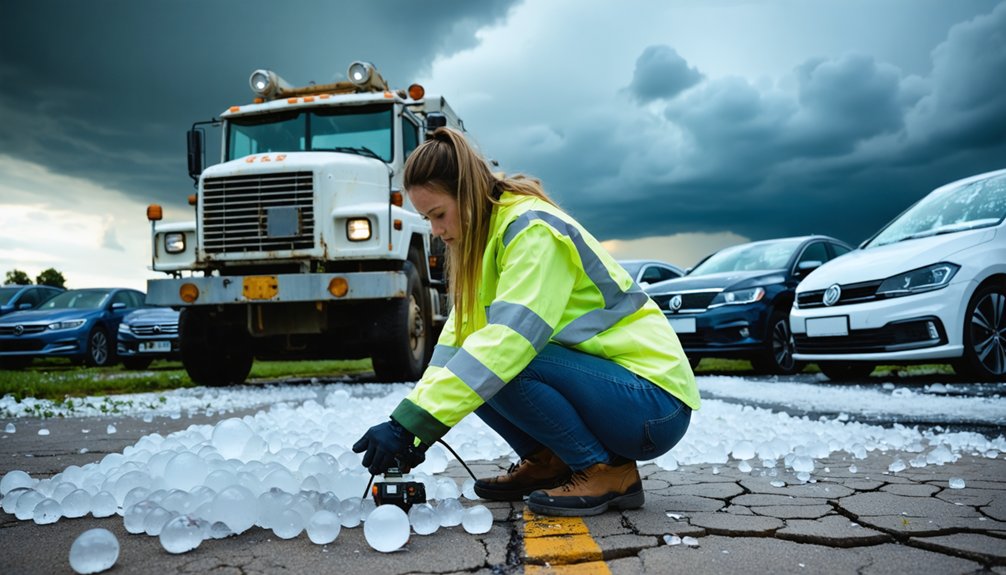
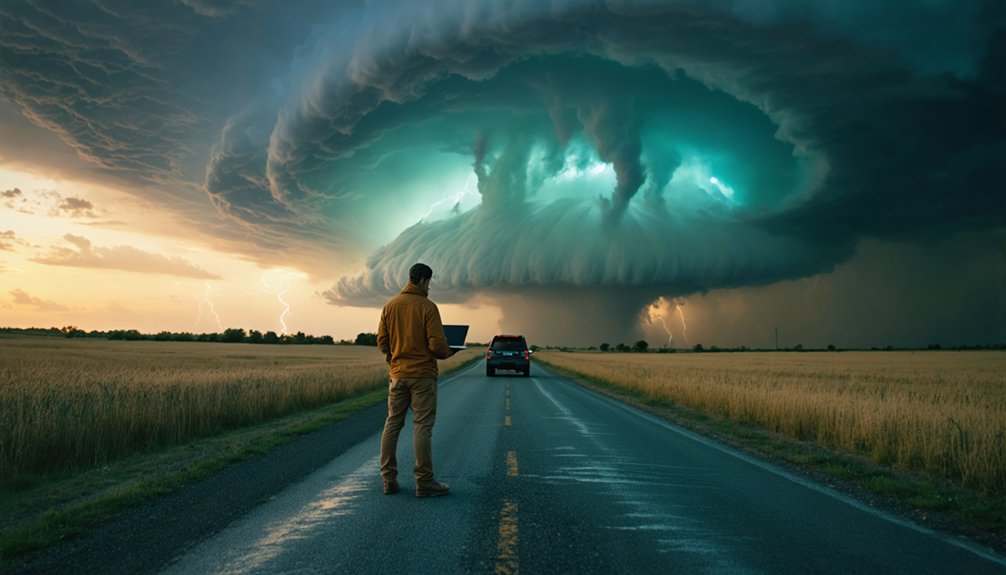
Chasing supercells means you’re constantly managing rapid structural shifts, hidden tornadoes wrapped inside rain curtains, and roads made lethal by hail and hydroplaning. You can’t outrun lightning, downbursts exceeding 100 mph, or a storm that suddenly accelerates and cuts off your escape route. Radar misinterpretation, poor positioning, and legal violations compound every risk you face. Master these dynamics before you get anywhere near a hook echo, and what’s ahead will sharpen your edge considerably.
Key Takeaways
- Maintain strategic east or southeast positioning relative to hook echoes to preserve escape routes and avoid entrapment in rotating storm cores.
- Continuously reassess storm motion using frequent radar updates, as supercells can accelerate, deviate, or merge unpredictably.
- High-precipitation supercells wrap rain around mesocyclones, concealing tornadoes and forcing chasers to navigate dangerous blind spots.
- Driving hazards, including hydroplaning and reduced visibility, cause more chaser fatalities than direct storm contact.
- Respect traffic laws and property boundaries to maintain legal standing, operational safety, and long-term chase viability.
What Makes Supercell Storms So Unpredictable?
Supercell storms defy predictable behavior because their internal dynamics shift rapidly and without warning. Their storm structure rotates around a powerful mesocyclone, which continuously reorganizes as atmospheric instability fluctuates. You can’t rely on visual cues alone—high-precipitation supercells wrap rain around the mesocyclone, concealing tornadoes entirely from your line of sight.
Low-precipitation supercells often produce tornadoes without displaying clear hook echoes on radar, eliminating your most reliable detection tool. Rotating rain curtains can precede tornado development within minutes, transforming what appears to be a manageable situation into a lethal one.
Unexpected shifts in storm motion can trap you in the direct path before you’ve identified the threat. Understanding these variables isn’t optional—it’s the foundation of every sound decision you’ll make while chasing.
Hidden Tornado Dangers Inside the Bear’s Cage
The rotating rain curtains surrounding the mesocyclone create what chasers call the “bear’s cage”—a corridor where you’re exposed to tornado-producing rotation while heavy precipitation blocks both your vision and your radar’s clarity.
High-precipitation supercells wrap rain directly around the mesocyclone, concealing active tornadoes from visual detection entirely. This storm structure defeats your primary safety mechanism: seeing the threat before it reaches you.
High-precipitation supercells hide tornadoes inside rain walls, eliminating your ability to see what’s already killing you.
Radar limitations compound this danger considerably. Heavy precipitation cores mask rotation signatures, stripping your real-time data of reliable resolution precisely when you need it most. You’re fundamentally navigating blind inside a system that’s actively producing tornadoes.
Without clear radar returns or visual confirmation, you can’t make sound positioning decisions. Entering the bear’s cage without understanding these dynamics removes your ability to escape on your own terms.
Why Driving Kills More Chasers Than the Storm Itself
While tornadoes dominate storm chasing’s mental risk calculus, driving kills more chasers than direct storm contact—and the mechanics behind this aren’t subtle. Hydroplaning accounts for nearly half of all indirect chase-related deaths, triggered by rain or hail-saturated roadways stripping traction from your tires.
You’re also navigating reduced visibility from hail fog, wind-driven dust, and heavy precipitation simultaneously.
Your storm equipment must include reliable GPS and real-time radar access—without them, you’re reacting blindly to rapidly shifting conditions. Weather awareness isn’t passive here; it demands continuous route reassessment as supercells accelerate or pivot unexpectedly.
Downed power lines, panicked animals, and congested evacuation traffic compound every decision. The storm doesn’t need to touch you directly to kill you—your vehicle becomes the primary threat the moment conditions deteriorate.
Lightning, Downbursts, and the Hazards You Can’t Outrun
Beyond driving hazards, lightning and downbursts introduce threats you can’t maneuver around or outpace. Lightning strikes remain unavoidable regardless of preparation, and standing near power lines or fences amplifies your exposure through conducted current. You don’t need direct contact to sustain a lethal strike.
Downbursts substantially compound the danger. Heavy precipitation cores can generate winds exceeding 100 mph without producing a single tornado, and storm size variability makes predicting their onset unreliable. A compact supercell can deliver damaging outflow with minimal warning.
Electromagnetic interference disrupts communication equipment and radar feeds precisely when accurate data matters most, stripping away your situational awareness. Blowing dust and hail fog simultaneously cut visibility while static electricity elevates fire risk. These converging hazards operate outside your control, demanding disciplined positioning before conditions deteriorate.
Must-Have Gear Before Your First Storm Chase
Preparation counters what positioning alone can’t fix. Before your first chase, you’ll need real-time radar access through tools like Radarscope or RadarOmega — guessing storm movement gets people killed.
Pair that with a reliable GPS, paper maps as backup, and a charged mobile device running multiple weather forecasting apps simultaneously.
Your vehicle needs a full fuel tank, functional tires, and an emergency kit containing first aid supplies, water, food, and a flashlight.
Don’t underestimate communications gear; a weather radio scanner provides ground-truth alerts independent of cell coverage.
For storm photography, protect your equipment with weather-sealed housing and carry extra batteries — supercell environments destroy unprotected gear fast.
Every tool you bring extends your decision-making window, and that window is what keeps you alive and free to chase again.
Positioning Mistakes That Trap Storm Chasers in Danger
Where you position your vehicle relative to the storm’s hook echo determines whether you escape safely or find yourself trapped in the circulation.
Hook slicing—driving through the forward flank precipitation toward the updraft—exposes you to large hail, reduced visibility, and a rapidly tightening mesocyclone with no safe exit.
Compounding this, supercells frequently accelerate or shift direction without warning, so if you haven’t pre-identified a southward escape route, you’ll quickly run out of options as the storm overtakes your position.
Hook Slicing Gone Wrong
Hook slicing—driving through the forward flank precipitation toward the updraft base—ranks among the most tactically reckless decisions an inexperienced chaser can make. Storm evolution happens rapidly, and what appears manageable instantly becomes a death trap.
When you slice the hook, you’re surrendering your escape options to three compounding failures:
- Hail cores intensify without warning, battering your vehicle and eliminating forward visibility.
- Rapid storm motion shifts block previously safe exit corridors.
- Tornado development within the wrapped precipitation leaves you inside the bear’s cage with zero reaction time.
Safety protocols exist precisely because these scenarios aren’t theoretical—they’re documented fatalities. You can’t outmaneuver a storm you’ve already driven into.
Maintain eastern or southeastern positioning, preserve your southward escape route, and never trade tactical curiosity for calculated survivability.
Escape Route Failures
Tactical failures don’t end with hook slicing—poor positioning before the storm even reaches critical intensity compounds every downstream risk. When you plant yourself west of the hook without a confirmed southward escape route, you’ve already surrendered your freedom to maneuver. Storms moving east-northeast close that window fast.
Unexpected shifts in storm motion transform manageable intercepts into traps. You can’t outrun a supercell on rain-slicked roads with zero visibility. Without functioning communication devices, you’re blind to real-time radar updates that could’ve prompted an earlier repositioning decision.
Identify your storm shelter options before you commit to any intercept position. Knowing where refuge exists gives you decision-making clarity under pressure. Escape route planning isn’t optional—it’s the structural foundation of every safe chase.
Unexpected Storm Motion Traps
Storms don’t always move where the models suggest, and that unpredictability is what turns a calculated intercept into a life-threatening trap. Weak storm forecasting assumptions and poor radar interpretation leave you vulnerable when supercells accelerate, jog, or deviate unexpectedly.
Three critical motion traps catch chasers off guard:
- Sudden forward acceleration — storms outpace your escape corridor, cutting off southward routes instantly.
- Deviant rightward motion — supercells tracking right of predicted paths push you directly into the hook.
- Storm mergers — absorbing neighboring cells causes erratic speed and directional shifts that invalidate your positioning entirely.
You can’t afford static assumptions. Continuously reassess radar interpretation every few minutes and maintain flexible routing. Your freedom to exit safely depends on treating storm motion as a dynamic, evolving variable.
Legal and Ethical Lines Storm Chasers Must Never Cross
When you trespass on private land to position yourself near a storm, you’re not only violating property rights but also exposing yourself to legal consequences that can include fines, arrest, and civil liability.
Damaging crops, fences, or other property during your chase compounds those legal risks considerably.
You must also comply with traffic laws at all times, as ignoring speed limits, running red lights, or driving recklessly during a chase markedly increases your risk of causing accidents that can prove fatal.
Trespassing Legal Consequences
Trespassing on private land during a storm chase carries 3 distinct legal consequences that can permanently derail your chasing career: criminal charges, civil liability, and forced removal during critical observation windows. Ignoring property rights isn’t just ethically wrong—it’s operationally destructive.
- Criminal Charges: Trespassing citations or misdemeanor arrests create permanent records, restricting your future chase mobility.
- Civil Liability: Liability issues escalate if you damage crops, fences, or infrastructure, exposing you to costly lawsuits.
- Forced Removal: Law enforcement intervention pulls you away from your observation position precisely when storm dynamics demand your full attention.
You can’t chase effectively from a courtroom or with a suspended license. Respecting property boundaries protects your freedom, your finances, and your ability to operate independently in the field.
Traffic Law Compliance
Beyond property law, traffic violations represent an equally career-ending legal trap—one that’s far more likely to kill you before any court date arrives. Running red lights, speeding through flooded intersections, or ignoring road closures during active storm encounters compounds every environmental hazard already working against you.
Safety regulations governing emergency vehicle yielding, hazardous road conditions, and posted speed limits exist precisely because reduced traction, hail fog, and downed power lines demand disciplined vehicle control.
You’re operating a mobile observation platform, not a chase vehicle exempt from civil law. Ignoring traffic violations doesn’t expand your freedom—it eliminates it permanently through fatality, license revocation, or criminal liability.
Disciplined compliance with safety regulations keeps you mobile, legal, and positioned to chase another day.
Frequently Asked Questions
How Do Storm Chasers Communicate With Local Emergency Services During Active Chases?
You’ll use radio networks and mobile apps for storm communication, coordinating directly with emergency coordination centers. You’re reporting real-time tornado sightings, hail data, and wind speeds to local NWS offices, enhancing public safety responses efficiently.
What Insurance Coverage Do Professional Storm Chasers Typically Carry for Their Vehicles?
You’ll typically carry extensive insurance policies that include specialized vehicle coverage for hail damage, flooding, and collision risks. Guarantee your policy explicitly covers storm-chasing activities, as standard plans often exclude hazardous professional pursuits.
Are There Age Restrictions or Licensing Requirements for Participating in Storm Chasing?
No federal storm chasing regulations exist, so you’re free to chase at any age. However, youth storm chasing carries serious risks—you’ll need solid meteorological education, reliable equipment, and experienced mentorship before independently pursuing supercells.
How Do Storm Chasers Coordinate Safely When Multiple Teams Chase the Same Storm?
Like a synchronized ballet, you’ll coordinate through shared storm tracking networks and radio communication. You must follow strict safety protocols, avoid crowding escape routes, and continuously update your team on position changes to prevent dangerous collisions.
What Psychological Effects Does Long-Term Storm Chasing Have on Experienced Chasers?
You’ll likely develop heightened thrill-seeking behavior as adrenaline dependency intensifies over time. Repeated trauma exposure can trigger PTSD symptoms, including hypervigilance and intrusive memories, subtly reshaping your risk tolerance and decision-making processes during high-stakes chasing operations.
References
- https://www.livingskytours.com/storm-chasing-101/
- https://www.reddit.com/r/stormchasing/comments/bszk2t/lets_talk_about_positioning_supercell_edition/
- https://en.wikipedia.org/wiki/Storm_chasing
- https://en.wikipedia.org/wiki/Supercell
- https://www.youtube.com/watch?v=fABwvj0rP_A
- https://www.youtube.com/watch?v=nPsSuWo5S48
- https://www.atms.unca.edu/cgodfrey/courses/swfex/pdf/ChasingSafety.pdf
- https://www.flame.org/~cdoswell/chasesums/Chase_FAQ/ChaseFAQ.html