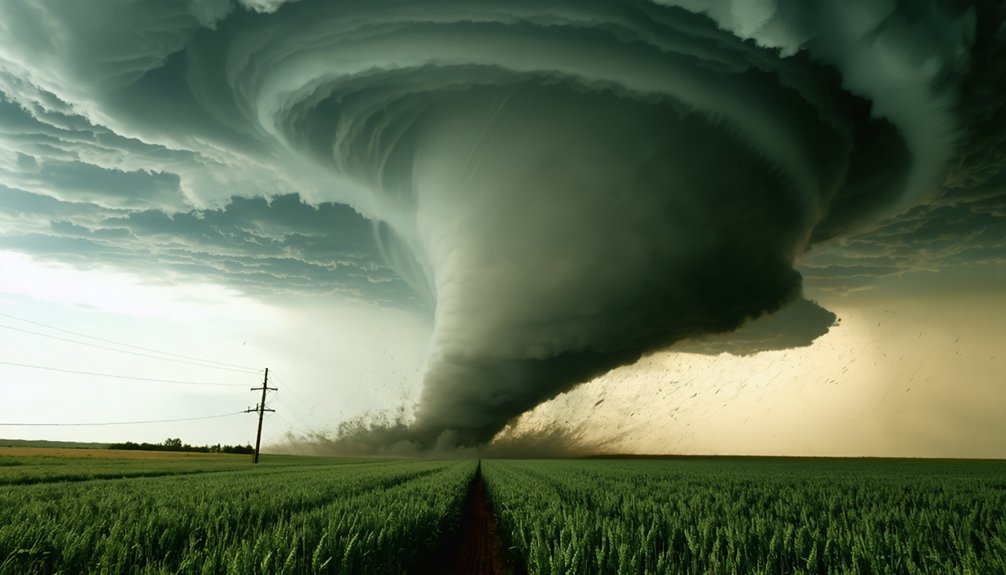
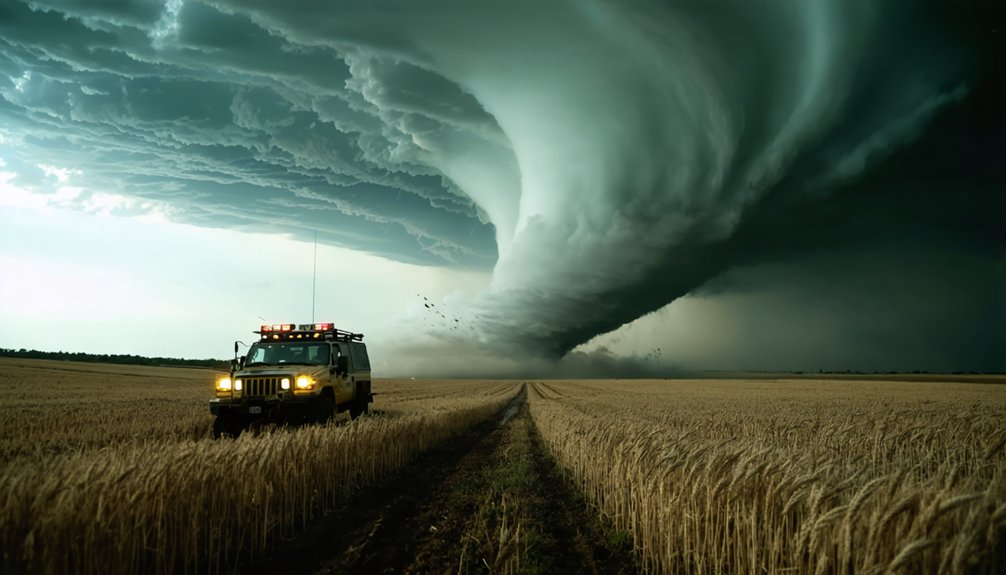
In *Tornado Alley*, you’re watching Sean Casey drive a 14,000-pound armored vehicle directly into a tornado’s path to film it in IMAX. The TIV runs on a reinforced Dodge Ram chassis with hydraulic anchoring spikes, sealing panels, and a rotating turret housing a 92-pound IMAX camera. It’s part mobile bunker, part scientific instrument — measuring wind speeds, temperature, and direction in real time. There’s far more engineered precision behind every intercept than you’d expect.
Key Takeaways
- Sean Casey, the filmmaker and storm chaser behind *Tornado Alley*, also appears in Discovery Channel’s *Storm Chasers* series.
- Casey films from a rotating turret atop the TIV, housing a 92-pound IMAX camera aimed directly into tornado vortexes.
- The TIV is built on a Dodge Ram 3500 chassis with three tons of armored plating, weighing approximately 14,000 pounds.
- Hydraulic systems anchor the TIV with ground spikes and seal the undercarriage, deploying within 20 seconds before a tornado arrives.
- The TIV doubles as a scientific platform, measuring real-time temperature, wind speed, and wind direction from within the storm.
What Is the IMAX Tornado Alley Film About?
Tornado Alley is a 40-minute IMAX short film that follows a team of storm chasers tracking tornadoes across America’s most volatile weather corridor. You’re watching raw, unfiltered pursuit — crews intercepting violent storms, documenting the birth and death cycles of tornadoes, and capturing destruction across entire towns.
Like wildlife conservation efforts that document endangered ecosystems before they vanish, this film preserves nature’s most extreme moments on camera. The team deploys two specialized vehicle fleets, measuring temperature, wind speed, and direction while positioning an IMAX camera directly into the vortex.
It’s the kind of boundary-pushing documentation comparable to space exploration — venturing where few dare to go. You’re not just watching a storm. You’re inside it, seeing Earth’s most powerful atmospheric forces through a lens that demands respect.
How Does the Armored TIV Survive a Direct Tornado Hit?
When you watch the TIV face a direct tornado hit, you’re seeing a hydraulic anchoring system do the heavy lifting — rams drive spikes into the dirt and panels drop flush to the ground, blocking winds from getting underneath the 14,000-pound vehicle.
Three tons of armored plating clad the Dodge Ram 3500 chassis, letting the structure absorb the full force of 300 mph tornadic winds without buckling.
Together, these two systems turn the TIV into a fixed, fortified platform that holds its position long enough for the IMAX camera to capture footage from inside the vortex itself.
Hydraulic Anchoring System
Surviving a direct tornado hit requires more than armored plating — the TIV relies on a hydraulic anchoring system to stay grounded against winds reaching 300 mph. When the tornado closes in, hydraulic rams drive downward, spiking into the dirt and locking the vehicle in place.
You’re watching hydraulic pressure translated into anchoring stability — a mechanical grip that keeps 14,000 pounds from becoming airborne debris.
Simultaneously, hydraulic panels drop flush to the ground, sealing the undercarriage and blocking winds from getting underneath. Without that seal, tornadic lift would exploit every gap.
Together, the spikes and panels create a unified resistance — the TIV becomes less a vehicle and more a fixed structure. You’ve got roughly 20 seconds to make it happen before the vortex arrives.
Armored Plating Protection
Three tons of armored plating clad a Dodge Ram 3500 chassis — that’s what stands between the crew and 300 mph winds hurling debris at projectile velocities. You’re looking at a vehicle engineered specifically for weather phenomena that historically obliterates everything in its path.
The TIV’s armor isn’t decorative. It’s functional defense against tornadic forces that reduce towns to splinters within seconds. You can see the historical context clearly here — storm chasers once had no viable option for penetrating a vortex safely. The TIV changed that equation entirely.
At 14,000 pounds total, the armored shell absorbs violent debris impact while keeping the crew operational inside. The vehicle fundamentally becomes a mobile bunker, letting you push directly into conditions that would destroy conventional trucks instantly.
How Does Sean Casey Position the TIV Before Impact?
Positioning the TIV before a tornado’s impact is a race against seconds. Once the tornado drops, Casey’s crew pushes ahead of the storm, identifies a road crossing point, and you’re watching a 14,000-pound armored machine maneuver into position with roughly 20 seconds to spare.
Vehicle positioning has to be precise — every angle matters when you’re staring down 300 mph winds.
Once stopped, hydraulic panels drop to the ground, blocking wind from getting underneath. Spikes penetrate the dirt, and hydraulic rams anchor the chassis firmly against tornadic forces.
Storm safety isn’t passive here; it’s engineered into every system firing simultaneously.
Casey then climbs into the rotating turret, the IMAX camera locked and ready, positioned directly inside the tornado’s path before the vortex swallows everything around him.
How Tornado Alley Films From Inside the Vortex
Once the TIV breaches the tornado’s outer wall, you’re looking at footage captured from inside the vortex itself, made possible by the vehicle’s armored Dodge Ram 3500 chassis absorbing winds up to 300 mph.
A 92-pound IMAX camera mounted in a rotating turret on top lets the filmmaker track the storm’s interior while staying protected within the vehicle’s steel shell.
Hydraulic rams simultaneously drive into the ground beneath the TIV, anchoring all 14,000 pounds of it in place so the camera holds steady as the vortex surrounds the crew.
Armored Vehicle Vortex Access
To film from inside a tornado vortex, the crew relies on a custom-built Tornado Intercept Vehicle (TIV) — a Dodge Ram 3500 chassis clad in three tons of armored plating, weighing 14,000 pounds total. You’re looking at vehicle durability engineered to withstand 300 mph winds without flinching.
When the tornado closes in, hydraulic rams drive into the ground, anchoring the TIV in place. Hydraulic panels drop low, blocking winds from slipping underneath and lifting the vehicle. Storm safety depends on these systems working flawlessly under extreme pressure.
A 92-pound IMAX camera sits mounted in a rotating turret on top, letting the filmmaker aim directly into the vortex while staying protected inside. Every design decision serves one purpose — surviving long enough to capture what’s happening inside the storm.
Rotating Turret Camera System
The rotating turret is what transforms the TIV from a survival vehicle into a functional camera platform. Mounted on top of the armored hull, it houses a 92-pound IMAX camera that you’d see tracking directly toward the vortex wall.
Turret rotation lets the filmmaker pivot toward the storm’s most active sectors without repositioning the entire vehicle, giving you precise framing control even as the tornado shifts unpredictably around you.
Camera stability becomes the defining challenge inside 300 mph winds. The turret’s armored housing absorbs external pressure while keeping the camera locked on target.
You’re fundamentally operating a precision optical instrument inside a weather event designed to destroy everything around it. That mechanical isolation between chaos outside and controlled movement inside is exactly what delivers the footage you see on the IMAX screen.
Hydraulic Anchoring Technology
Keeping a 14,000-pound vehicle planted when 300 mph winds are trying to lift it requires more than raw mass. The TIV deploys hydraulic rams that drive spikes directly into the dirt, anchoring the chassis against tornadic forces. Hydraulic fluid powers each ram with precision, while pressure regulation guarantees consistent force across every anchor point simultaneously.
You’re fundamentally watching the vehicle transform into a ground-locked platform in roughly 20 seconds.
Here’s what makes the system work:
- Hydraulic panels lower flush to the ground, blocking wind from getting underneath the chassis
- Spikes penetrate the soil to resist vertical and lateral lift forces
- Pressure regulation maintains anchor stability as wind loads shift unpredictably
Without this technology, capturing footage from inside the vortex simply wouldn’t be survivable.
What Does the TIV Measure Inside the Storm?
Beyond capturing stunning visual footage, the TIV carries a science package that actively measures temperature, wind speed, and wind direction from inside the storm. You’re looking at real-time storm environmental data collection happening simultaneously with IMAX filming — two missions running in parallel under extreme conditions.
As the tornado surrounds the vehicle, sensors record what’s actually occurring inside the vortex. You don’t just see the storm’s destruction; you get measurable data defining its behavior at ground level.
Wind speeds reaching 300 mph, dramatic temperature shifts, and directional changes all register through the onboard instrumentation.
This dual-purpose approach transforms the TIV from a filming platform into a mobile research station. Casey’s team isn’t just documenting tornadoes visually — they’re gathering scientific intelligence directly from within nature’s most violent atmospheric events.
Who Is Sean Casey, the Filmmaker Behind Tornado Alley?
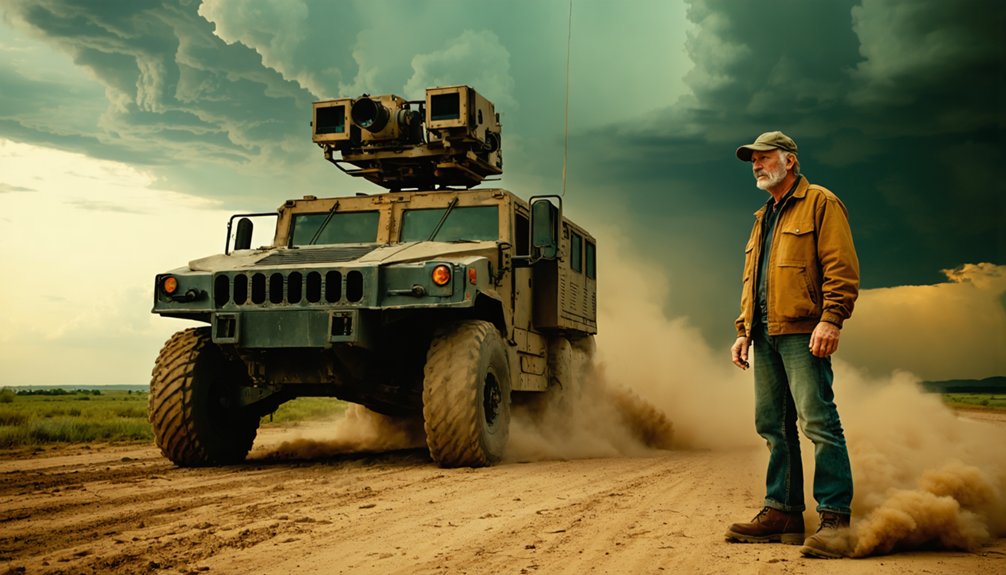
Behind the science package and armored steel sits the person who made all of it possible — Sean Casey, the filmmaker and storm chaser driving the entire Tornado Alley project. You’ll recognize him from the Discovery Channel reality series *Storm Chasers*, where he pushes vehicle engineering and storm safety to their limits chasing the perfect vortex shot.
Casey operates from the rotating turret atop the TIV, filming directly toward the tornado while armored plating surrounds him. He’s not just behind the camera — he shaped every design decision.
- He built a custom 14,000-pound armored vehicle around a Dodge Ram 3500 chassis
- He mounts a 92-pound IMAX camera inside a rotating turret
- He leads crews through 20-second positioning windows before tornadoes arrive
Where to Watch Tornado Alley on IMAX?
Select venues pair the screening with a pre-show talk and post-show Q&A featuring filmmaker Sean Casey and meteorologist Betsy Kling. Those sessions dig into storm safety protocols and the vehicle design engineering behind the TIV — details that sharpen what you’re watching on screen.
At 40 minutes, the runtime is tight and deliberate. Check individual IMAX venues directly for current scheduling, since availability shifts based on rotating programming calendars.
Frequently Asked Questions
How Long Is the Tornado Alley IMAX Film Runtime?
You’ll experience 40 minutes of raw, unfiltered storm prediction and Tornado safety awareness as you watch nature’s fury unfold through IMAX’s technically precise, visually stunning lens — capturing every terrifying, breathtaking vortex moment firsthand.
What Chassis Is the Custom-Built TIV Constructed Upon?
You’re looking at a Dodge Ram 3500 chassis clad in three tons of armored plating — 14,000 pounds total — engineered for extreme storm tracking and tornado safety, letting you chase nature’s most violent forces head-on.
Does the TIV Crew Help Tornado Victims After Storms Pass?
Yes, you’ll see the TIV crew spring into action after storms pass — the Navy-trained medic driver leads disaster relief efforts, conducting search and rescue operations and providing essential community support to tornado victims.
Who Is the Meteorologist Joining Sean Casey for Q&A Sessions?
You’ll catch NBC 3 Cleveland’s Betsy Kling delivering sharp meteorologist insights alongside Sean Casey during the Q&A session — watch two experts dissect raw storm data, vortex footage, and atmospheric forces you’ve never seen explained this precisely.
Was Tornado Alley Featured on Any Television Series?
Like a storm on the horizon, Sean Casey’s storm chasing and film production work caught TV’s eye — you can watch him as a star on Discovery Channel’s reality series, *Storm Chasers*.
References
- https://en.wikipedia.org/wiki/Sean_Casey_(filmmaker)
- https://www.youtube.com/watch?v=t4KCeX2fol0
- https://www.imdb.com/title/tt1852955/
- https://www.youtube.com/watch?v=gPVNW54YZPc
- https://www.youtube.com/watch?v=8v0XIrufREo
- https://www.cbsnews.com/chicago/news/tornado-alley-filmmaker-used-armored-truck-to-film-inside-twisters/
- https://www.npr.org/transcripts/136861305
- https://www.rottentomatoes.com/m/tornado_alley_2011