When you study near-death experiences from professional storm chasers, you’ll find survival rarely comes down to instinct or speed. It comes down to radar interpretation, escape-route discipline, and recognizing when a storm’s behavior shifts unpredictably. The El Reno tornado claimed Tim Samaras and his team when a sudden direction change collapsed their decision margin entirely. Post-chase hazards like hydroplaning kill nearly as often as the storms themselves. There’s far more to this than most people realize.
Key Takeaways
- The El Reno tornado (May 31, 2013) killed Tim Samaras and two others after a sudden, unpredictable direction shift caught experienced chasers off guard.
- Experienced chasers survived El Reno by recognizing rapid occlusion and immediately reversing course, relying on radar interpretation rather than instinct.
- Reed Timmer’s armored vehicle provided critical protection during extreme close calls where conventional vehicles would have failed completely.
- Genuine close calls occur when escape routes are lost, radar predictions fail, and decision margins collapse faster than response capabilities allow.
- Post-chase hazards, including hydroplaning and fatigue-related crashes, are nearly as deadly as the tornadoes professional chasers actively pursue.
How Storm Chasers Define a Genuine Close Call
Storm chasers draw a sharp line between routine risk and a genuine close call, and that distinction matters operationally. A true close call means you’ve lost primary escape routes, radar data failed to predict a directional shift, or debris entered your immediate vicinity.
It’s not about proximity alone—it’s about your decision margin collapsing faster than you can respond.
Chaser psychology plays a critical role here. Normalized exposure to violent weather gradually compresses your risk perception, making genuinely dangerous situations feel manageable until they aren’t.
Experienced chasers counter this by anchoring their definitions to measurable indicators: unexpected storm acceleration, conga-line traffic lock, or sudden circulation expansion.
When those variables converge simultaneously, you’re no longer managing routine danger—you’re surviving a genuine close call.
The Chasers Who Didn’t Make It Home
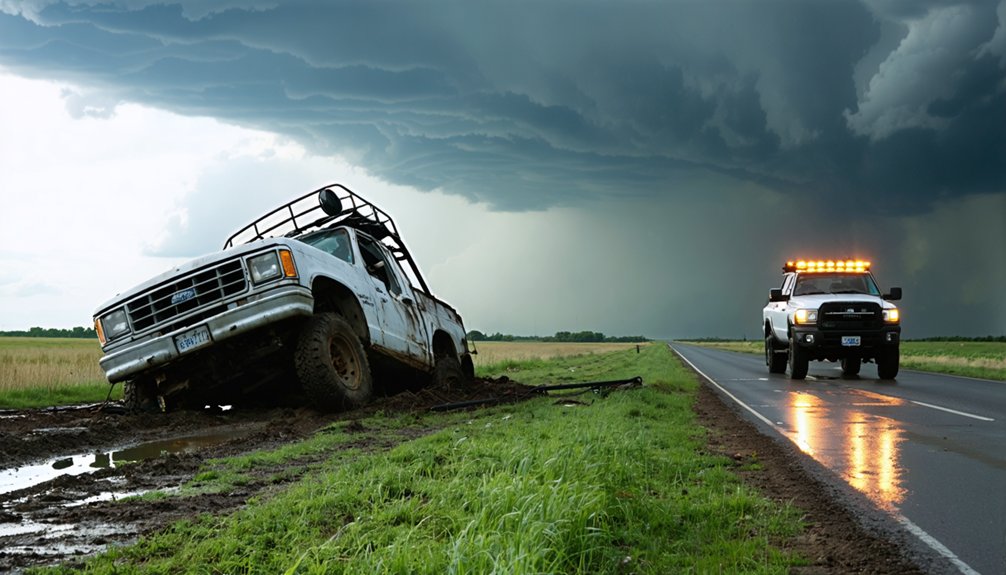
For nearly sixty years, driving killed storm chasers—not the storms themselves. Vehicle crashes, hydroplaning, and post-chase fatigue dominated storm fatalities, not direct tornado contact.
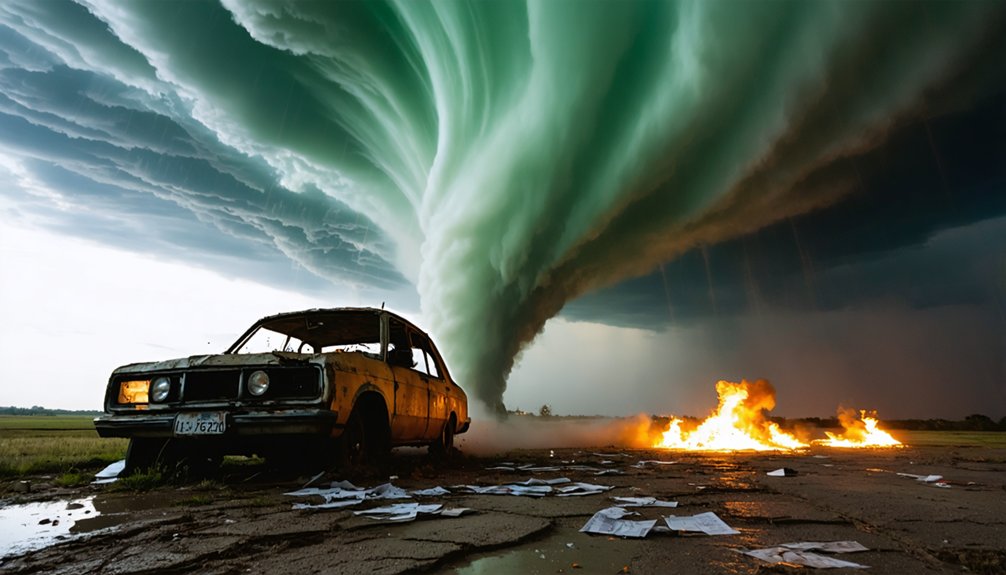
That changed on May 31, 2013, near El Reno, Oklahoma. Tim Samaras, Paul Samaras, and Carl Young died when the widest tornado ever recorded shifted direction without warning, eliminating every escape option. Their deaths marked the first confirmed weather-caused storm-chasing fatalities, forcing the entire community to recalibrate chaser safety protocols.
The pattern didn’t stop there. In 2022, two separate fatal accidents occurred—one involving three University of Oklahoma meteorology students hydroplaning on I-35, another killing a Mexican meteorologist after a semi struck his stopped vehicle near downed power lines.
You’re chasing the storm. The drive home can kill you just as fast.
The Closest Anyone Has Come and Survived
When the El Reno tornado expanded to 2.6 miles wide on May 31, 2013, several chase teams narrowly avoided the same fate as Tim Samaras.
Despite the adrenaline rushes driving them closer, experienced chasers who recognized the radar signature’s rapid occlusion reversed course immediately.
You can survive extreme tornado encounters only through disciplined escape-route management.
Veterans describe watching rotation accelerate southward across highways they’d occupied seconds earlier.
Reed Timmer’s armored vehicle sustained significant damage near El Reno but kept him alive where conventional vehicles would’ve failed.
Post-event analysis confirmed that congested chaser traffic nearly triggered a mass-casualty event.
Survivors credited real-time radar interpretation, not instinct or speed, for their exits.
Every documented close call reinforces one principle: your situational awareness determines whether you drive home or don’t.
Why Post-Chase Driving Kills as Often as the Storm
Surviving the tornado itself doesn’t end your risk—it just shifts the threat profile. Post-storm hazards claim lives with brutal regularity. Nearly half of all indirect storm-chasing deaths involve hydroplaning on rain-slicked roads after the chase concludes.
You’ve just spent hours in high-alert mode, processing radar data, managing escape routes, and executing split-second decisions. That cognitive load accelerates driving fatigue faster than most chasers acknowledge. Darkness, standing water, and debris-scattered highways compound the danger.
You’re now operating a vehicle at highway speed while your nervous system is crashing from sustained adrenaline. The 2022 I-35 crash that killed three University of Oklahoma meteorology students illustrates exactly this threat.
Discipline doesn’t stop when the storm dissipates—it’s when your guard drops that the road becomes the killer.
What Surviving Storm Chasers Changed About How They Work
Close calls don’t just shake you—they systematically restructure how experienced chasers operate. Survivors consistently recalibrate their chase protocols, often abandoning proximity-based success metrics in favor of structured risk management frameworks.
Close calls don’t just shake experienced chasers—they rebuild how they operate from the ground up.
You’ll notice veterans enforcing hard stand-off distances, pre-designating escape routes before intercept, and refusing to enter congested chaser traffic zones regardless of target quality.
Post-El Reno, radar interpretation standards tightened considerably—chasers now prioritize detecting occlusion signatures and lateral storm motion shifts earlier.
You’re also expected to establish communication checkpoints with team members, reducing solo decision-making during rapidly evolving intercepts.
Post-chase driving rules changed too; many operators now mandate rest stops after extended chases in wet conditions.
Survival, for these professionals, converts directly into operational discipline rather than simply reinforcing personal caution.
Frequently Asked Questions
Do Storm Chasers Experience Lasting Psychological Trauma After Surviving Close Calls?
Yes, you can develop lasting trauma after surviving close calls. Extreme threat reshapes your risk perception and tests your psychological resilience, often producing persistent distress, hypervigilance, and altered decision-making patterns even when you’ve physically escaped unharmed.
How Does Storm Chasing Compare in Risk to Other High-Danger Professions?
Sure, storm chasing’s totally safe—ignore the storm risks. You’d actually face lower fatality rates than logging or fishing, but adrenaline factors skew perception, making every close-call feel statistically catastrophic compared to mundane occupational hazards.
Are Storm Chasers Required to Carry Specialized Insurance for Field Operations?
No mandate requires you to carry specialized insurance, but you’d benefit from securing insurance policies that include liability coverage tailored to high-risk field operations, as standard plans rarely account for storm-chasing risk assessment demands.
What Mental Health Resources Exist Specifically for Traumatized Storm Chasers?
You’ll find counseling support through AMS peer networks, NOAA employee assistance programs, and trauma recovery specialists familiar with occupational stress. Private therapists trained in PTSD and critical incident debriefing also serve field meteorologists experiencing storm-related psychological distress.
Do Near-Death Experiences Change a Storm Chaser’s Personal Relationships or Lifestyle?
Surviving storm scares shifts your relationship dynamics profoundly—you’ll reassess priorities, distance from dismissive people, and pursue purposeful connections. These near-death encounters drive meaningful lifestyle adjustments, compelling you to balance chase ambitions with personal freedom, health, and emotional sustainability.
References
- https://www.youtube.com/watch?v=asdkLn12gmM
- https://www.youtube.com/watch?v=V-q8rWVkn5A
- https://en.wikipedia.org/wiki/Storm_chasing
- https://www.facebook.com/TornadoIntercept/videos/brace-for-impact-a-near-death-experience-is-the-consequence-you-get-when-you-tu/1490629979074762/
- https://texasstandard.org/stories/new-book-chronicles-the-life-and-death-of-storm-chaser-tim-samaras/
- https://www.instagram.com/popular/storm-chasing-near-death-experiences/
- https://www.youtube.com/watch?v=3l81A6sBefM
- https://www.reddit.com/r/tornado/comments/1jd5rb3/who_is_a_storm_chaser_you_think_is_going_to_get/
- https://www.lifeafterlife.com/blog/howard-storm-touched-death-and-found-a-path-towards-a-new-life
- https://pmc.ncbi.nlm.nih.gov/articles/PMC6173534/