If you’ve searched for Pecos Hank, you’ve found one of YouTube’s most distinctive storm chasers. He’s a Houston-based musician, filmmaker, and professional chaser who combines cinematic editing, original music, and real meteorological science into something networks like BBC Earth and National Geographic have licensed. He’s even discovered a rare upper-atmospheric electrical discharge called the “green ghost.” With 1.1 million subscribers, his channel earns loyalty through precision and storytelling—and there’s considerably more to uncover about how he does it.
Key Takeaways
- Pecos Hank, born April 1, 1982, is a Houston-based storm chaser, musician, and filmmaker with 1.1 million YouTube subscribers.
- His cinematic storytelling blends original music, narration, and meteorological accuracy, making storm videos feel like mini-documentaries.
- He discovered the “green ghost,” a rare upper-atmospheric electrical discharge, proving his work contributes genuine scientific value.
- His footage has been licensed by BBC Earth, National Geographic, and Discovery Channel, validating his independent production quality.
- Audiences trust him for honest science, real danger, and thoughtful narration that respects their intelligence and time.
Who Is Pecos Hank?
Behind the Pecos Hank brand is Hank Schyma, a Houston-based musician, filmmaker, author, and professional storm chaser who’s built a career at the intersection of extreme weather and cinematic storytelling. Born April 1, 1982, he captured his first lightning on film in 1994 and his first tornadoes in 2002, establishing an identity rooted in weather symbolism long before YouTube existed.
The name itself draws from Pecos Bill, Texas fake-lore, signaling that storm symbolism runs deeper than documentation here. By 2008, he’d turned that identity into a professional operation, licensing footage to BBC Earth, National Geographic, and Discovery Channel.
You’re looking at someone who treats severe weather as both a scientific subject and a storytelling medium, and that dual focus defines everything he produces.
How Pecos Hank Went From Filming Lightning to Chasing Tornadoes
Hank’s path into storm chasing started early, with his first lightning captured on film in 1994 when he was just twelve years old. That early success pushed him further, and by 2002 he’d documented his first tornadoes, marking a clear change from casual filming to deliberate pursuit.
Lightning Sparked His Passion
When Hank Schyma captured lightning on film for the first time in 1994, he was twelve years old—and that single moment set the trajectory for everything that followed. Lightning carries deep weather symbolism—raw power rendered visible in an instant—and for Hank, it wasn’t just a spectacle. It was a signal.
You can trace his entire career back to that early instinct to document rather than simply observe. The storm symbolism embedded in that first capture reflects something larger: a recognition that severe weather tells a story worth preserving.
He didn’t chase tornadoes until 2002, but those eight years weren’t idle. They were formative, sharpening his eye and deepening his commitment to filming what most people run from.
First Tornadoes Captured
Eight years after filming lightning at age twelve, Hank Schyma chased and documented his first tornadoes in 2002—a progression that wasn’t accidental. Those early years of weather photography sharpened his eye for storm structure, timing, and position.
By the time tornadoes entered his frame, he already understood light, movement, and risk well enough to capture something meaningful rather than just survive the encounter.
Storm photography at that level demands more than courage. You need field knowledge, mechanical instincts, and the discipline to hold your position when most people run. Hank built those skills gradually, starting with static electrical events and scaling upward.
His 2002 milestone wasn’t a lucky break—it reflected deliberate preparation across nearly a decade of watching severe weather develop, intensify, and move across the Texas landscape.
Becoming A Professional Chaser
By 2008, six years after documenting his first tornadoes, Hank Schyma had converted his storm-chasing experience into a professional credential—supplying extreme-weather footage to local Houston TV stations as a working videographer. That shift marked a clear change from independent enthusiast to credentialed field operator.
What separates Hank from casual chasers is his commitment to storm safety protocols and his willingness to challenge weather myths that put untrained viewers at risk. He doesn’t just chase—he documents with intention, pairing raw footage with accurate science.
That professional discipline attracted major buyers. Networks including BBC Earth, National Geographic, and Discovery licensed his material, validating years of methodical field work.
You’re watching a career built not on recklessness, but on precision, preparation, and a deep understanding of atmospheric behavior.
What Makes the Pecos Hank Channel Different From Other Storm Chasers?
When you watch a Pecos Hank video, you’ll notice immediately that it doesn’t feel like raw chase footage—it feels like a documentary.
His cinematic editing, original narration, and custom-composed soundtracks work together to give storm behavior a coherent visual story rather than just a live-action spectacle.
That fusion of science communication and original music is what separates the channel from the typical storm-chasing feed.
Cinematic Storytelling Approach
What separates Pecos Hank from most storm chasers isn’t just what he films — it’s how he frames it. He treats each chase like a documentary, weaving weather symbolism and storm metaphors into narration that makes extreme atmospheric events feel personally meaningful to you.
His cinematic approach includes:
- Original music composed specifically for each storm film
- Narrative structure that builds tension the way a feature film would
- Visual framing that prioritizes dramatic composition over raw documentation
- Storytelling voice that connects storm behavior to broader human experience
You’re not just watching wind and rain — you’re watching a crafted story unfold. That deliberate editorial control is what transforms raw chase footage into something that holds your attention long after the storm passes.
Science Meets Original Music
Although storm chasing channels are common on YouTube, Pecos Hank’s channel stands apart because he’s built original music composition directly into the production — not as background filler, but as a narrative tool that reinforces storm science.
When you watch his videos, you’ll notice how the music mirrors storm symbolism — tension builds as rotation tightens, and resolution follows when the structure dissipates. That’s intentional weather symbolism translated into sound.
Hank composes original scores that move in sync with atmospheric behavior, giving you an emotional and scientific read simultaneously. You’re not just observing a tornado; you’re interpreting it through layered sensory information.
This dual-channel communication — visual science paired with structured music — deepens your understanding of storm mechanics without sacrificing accuracy or dumbing down the meteorological detail.
How Pecos Hank Uses Music and Narration to Tell Storm Stories
One element that separates Pecos Hank’s videos from standard storm-chase footage is his deliberate use of original music and narration as storytelling tools rather than decorative additions. You’ll notice each video functions like a short documentary, where sound and voice actively shape how you interpret the storm’s behavior.
His approach delivers real value across several dimensions:
- Music cues guide your emotional read of shifting weather forecasting conditions
- Narration explains storm structure without oversimplifying the science
- Pacing reflects actual danger, reinforcing storm safety awareness naturally
- Soundtracks are composed specifically for each chase, not recycled
This intentional craft means you’re not just watching clouds rotate — you’re understanding why they matter. The result is content that respects your intelligence while making severe weather genuinely compelling to follow.
What Is the Green Ghost and Why Did Pecos Hank’s Discovery Matter?
Among Pecos Hank’s most significant scientific contributions is his credited discovery of the “green ghost,” a rare upper-atmospheric electrical discharge that wasn’t part of mainstream storm documentation before his footage surfaced. This finding placed him directly within the conversation around meteorological innovations, as upper-atmospheric phenomena like sprites, elves, and jets remain difficult to capture and study.
The green ghost added a previously unrecorded category to that list. For researchers, verified visual documentation matters because it drives further investigation and instrumentation.
For you as a viewer, it reframes what storm chasing produces beyond storm safety awareness and dramatic footage. It demonstrates that independent field work, executed with precision and proper equipment, can generate legitimate scientific discoveries outside traditional academic or governmental research channels.
Where Pecos Hank’s Storm Footage Has Appeared on TV and Film
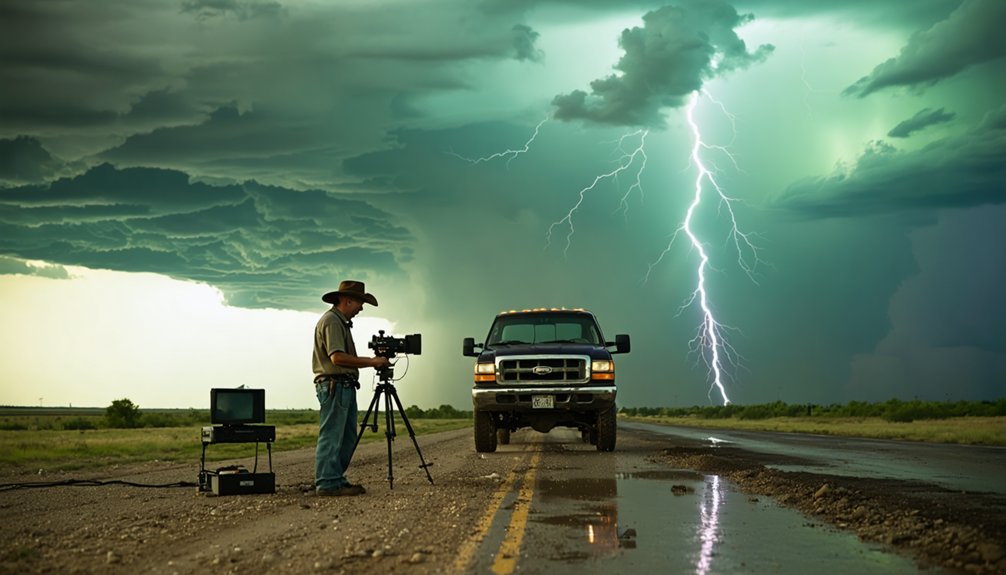
When storm footage reaches networks like BBC Earth, National Geographic, The Weather Channel, and Discovery Channel, it signals a level of technical and cinematic quality that most independent videographers never achieve.
Pecos Hank’s work carries deep weather symbolism and storm symbolism, turning raw atmospheric violence into licensed, broadcast-ready documentation.
His footage has appeared across:
- BBC Earth – cinematic storm structure documentation
- National Geographic – tied to Disney productions featuring extreme weather
- The Weather Channel – severe weather event coverage
- Discovery Channel – documentary-style storm narratives
You’re watching footage that passed rigorous editorial standards at major networks. That placement confirms Hank’s work isn’t hobbyist content.
It’s independently produced media that competes directly with fully funded production teams, earning its spot through technical precision and compelling visual storytelling.
What the Book Storm Reveals About His Photography and Science
Hank’s book *Storm* pulls back the curtain on how he thinks about severe weather as both a scientific subject and a visual one. You’ll find it structured around road narratives, photography, and plain explanations of storm behavior.
It challenges meteorological myths that distort how most people interpret tornado risk and structure. Rather than sensationalizing danger, Hank grounds each story in observable atmospheric mechanics.
His photography doesn’t just document—it teaches you to read storm anatomy visually. The book also treats storm safety as essential knowledge, not a footnote.
His photography turns storm anatomy into a visual language anyone can learn to read and act on safely.
You come away understanding why certain decisions in the field matter and how misreading a storm’s movement gets chasers killed. It’s a practical, visually driven guide that respects both the science and the reader’s intelligence.
Why the Pecos Hank Brand Connects Science, Art, and Road Life
What makes Pecos Hank’s brand distinct is that it refuses to separate three things most weather channels treat as unrelated: scientific accuracy, artistic craft, and the lived experience of the road. You’re not just watching storm footage — you’re absorbing weather symbolism and storm symbolism woven into music, narration, and landscape.
His brand delivers four interlocking elements:
- Original soundtracks that frame storm behavior emotionally and scientifically
- Cinematic editing that respects both danger and natural beauty
- Road-travel storytelling that grounds extreme weather in real geography
- Educational narration that never sacrifices accuracy for drama
Together, these components give you something rare: freedom to explore atmospheric science without institutional stiffness. Pecos Hank treats the storm as both data and metaphor, making the experience intellectually honest and genuinely compelling.
What Keeps 1.1 Million Subscribers Watching Pecos Hank
Sustaining 1.1 million subscribers requires more than dramatic footage — it requires a format viewers can trust to deliver the same quality every time. Pecos Hank delivers that consistency through a combination of cinematic editing, original music, and clear explanations of meteorological techniques that decode storm behavior without oversimplifying it.
Audience engagement holds because you’re never just watching a tornado. You’re watching a story unfold — one that connects storm structure, chase strategy, and human experience inside a single, polished frame.
Hank’s long track record removes guesswork. You know what you’re getting: honest science, real danger, and thoughtful narration.
That reliability builds loyalty. When a creator respects your intelligence and your time consistently, you don’t unsubscribe. You keep coming back.
Frequently Asked Questions
What Is the Meaning Behind the Pecos Hank Nickname?
You’ve probably heard a name bigger than Texas itself — “Pecos Hank” draws from Pecos Bill’s legendary Texas folklore, perfectly capturing Hank Schyma’s fearless storm photography pursuits and weather safety expertise across Tornado Alley’s wildest, most untamed skies.
How Old Was Hank When He First Filmed Lightning?
Hank was just 12 when he first captured lightning on film. You can see how early storm chasing gear and basic weather prediction techniques shaped his path toward becoming the independent, freedom-driven filmmaker he’s known as today.
Does Pecos Hank Have Any Formal Meteorology or Weather Science Training?
Can you imagine mastering storm chasing techniques without a formal degree? The knowledge base doesn’t confirm Hank has formal meteorology training, yet he’s refined his weather forecasting skills through decades of hands-on, professional experience chasing severe storms independently.
Has Pecos Hank Ever Been in Danger During a Chase?
Yes, he’s faced real danger across decades of chasing. His storm safety discipline and careful chase logistics have kept him alive while documenting violent tornadoes and extreme weather that’s claimed others less experienced or prepared.
How Does Pecos Hank Decide Which Storms to Chase Each Season?
You’d find that Pecos Hank applies sharp weather prediction techniques and storm chasing logistics, analyzing atmospheric data to target high-potential severe weather setups, letting science—not chance—guide which storms earn his pursuit each season.
References
- https://www.youtube.com/watch?v=MFT3i23lN0A
- https://en.wikipedia.org/wiki/Hank_Schyma
- https://www.youtube.com/watch?v=fn6IxjMUB2M
- https://www.youtube.com/watch?v=BMDl7oNNYGE
- https://online.umich.edu/teach-outs/extreme-weather-tornado-season-teach-out/lessons/hank-schyma-biography/
- http://www.youtube.com/watch?v=z8-8sf9N0Tk
- https://pecoshank.com/
- https://www.youtube.com/watch?v=dqz075yQabA
- https://www.youtube.com/watch?v=24ecDZOX3lk&vl=en
- https://www.youtube.com/watch?v=YySTBxbRNOE&vl=en