The quickest storm chaser communication methods combine push-to-talk radio, dual-carrier cellular, and ham 2-meter VHF into one redundant system. Push-to-talk transmits instantly with no dial tone delay. Dual-carrier phones maintain data flow when one network drops. Ham radio operates peer-to-peer without infrastructure, keeping you coordinated when towers fail. Every second of lag compounds your positioning risk exponentially. Stick around to see exactly how each system performs when a tornado changes direction fast.
Key Takeaways
- Push-to-talk radio enables instant transmission without dial tones or handshakes, making it the fastest method for real-time storm chaser coordination.
- Ham radio 2-meter VHF allows direct chaser-to-chaser communication independently of cellular infrastructure, ensuring reliable contact during network outages.
- Dual-carrier cellular setups with external antennas maintain voice and data connectivity, allowing rapid switching when one network fails.
- Text messages transmit faster than voice calls in low-signal areas, providing a critical backup when cellular voice communication drops.
- Mobile hotspots with dual-carrier redundancy deliver live radar data and GPS tracking, enabling split-second repositioning decisions during dynamic storm chases.
Why Communication Speed Decides Safety on a Storm Chase
When a tornado shifts direction unexpectedly, the seconds between receiving that positional update and relaying it to your team can determine whether you’re repositioning safely or caught in a bad spot.
Communication protocols aren’t procedural formalities—they’re operational lifelines. Delayed information creates cascading positioning errors across your entire team.
Speed matters because storm dynamics outpace slow relay chains. A wedge tornado moving at 40 mph covers roughly 60 feet per second. Your communication protocols must transmit critical updates faster than that movement degrades your safety margin.
Every lag point—whether device latency, carrier congestion, or unclear messaging—compounds risk exponentially.
Effective safety strategies prioritize redundancy and brevity. You need layered systems that activate instantly when your primary channel fails, keeping your team coordinated, informed, and mobile without hesitation.
Push-to-Talk Radios Storm Chasers Rely on for Instant Coordination
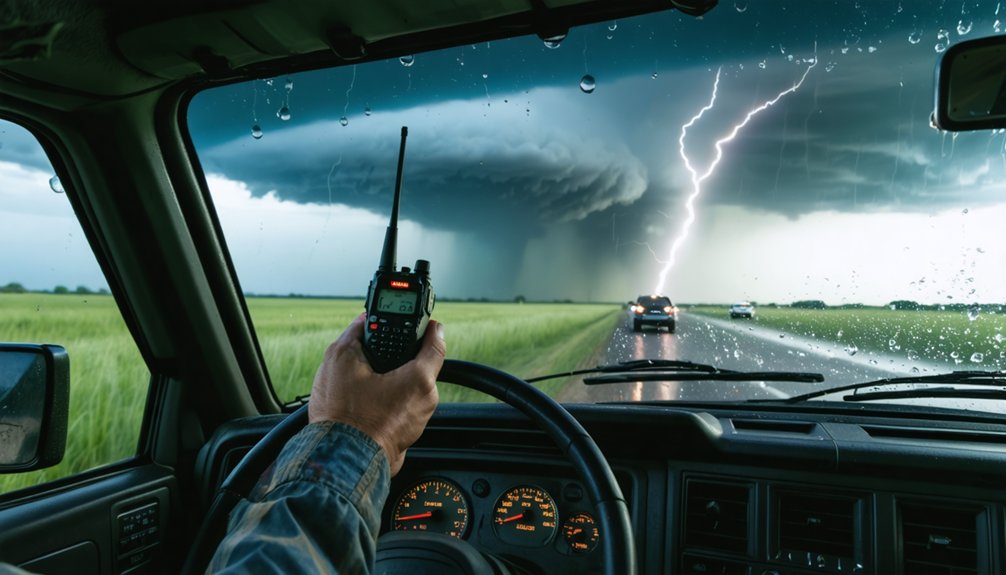
Push-to-talk radios cut transmission latency to near zero—no dial tone, no connection handshake, no carrier dependency.
Push-to-talk transmission is instant—no handshake, no dial tone, no carrier standing between you and your team.
When you’re repositioning ahead of a rotating wall cloud, push to talk features deliver instant group coordination across every vehicle simultaneously.
- Ham 2-meter VHF gives you direct chaser-to-chaser range without infrastructure reliance
- GMRS/FRS handhelds keep small convoy units tightly synced during rapid repositioning maneuvers
- CB radio still functions as a fallback, though its usage is declining among modern chase teams
You’re not waiting on a network to route your message. One button press broadcasts your position, decision, or warning to the entire group in real time—exactly when cellular towers are overwhelmed or completely absent.
How Cellular Phones Keep Storm Chasers Connected Across Networks
When you carry two phones on different carriers, you’re actively doubling your odds of maintaining service in low-coverage chase zones.
If your signal weakens, external antennas and amplifiers let you push reception further without switching networks.
When voice calls drop entirely, text messages still move through degraded networks, keeping your radar and position software connected when it matters most.
Dual Carrier Coverage Strategy
Because no single carrier guarantees coverage across every remote chase corridor, experienced chasers carry two phones on separate networks to maximize the odds of maintaining a live data or voice connection. This dual carrier approach directly improves coverage reliability when you’re operating in low-infrastructure zones across the Great Plains.
- Pair carriers with non-overlapping tower networks, such as Verizon and T-Mobile, to cover gaps each provider misses independently.
- Assign each phone a dedicated task — one handles radar data streaming while the other stays clear for voice coordination.
- Monitor signal strength on both devices continuously so you can switch data loads instantly when one network degrades.
You’re not hedging — you’re engineering redundancy into your communication stack before conditions force the decision.
Boosting Weak Signal Reception
Three hardware upgrades separate a chaser who loses data at the worst moment from one who doesn’t: an external antenna, a signal amplifier, and a correctly mounted coaxial cable run to the vehicle’s roof.
Signal boosters amplify weak LTE bands before they reach your modem, cutting dropout risk during critical intercepts.
Antenna placement determines gain; mount your antenna at the roof’s highest central point to maximize sky exposure and minimize body interference.
A low-loss coaxial run keeps signal from degrading between antenna and booster.
Pair these upgrades with a dual-carrier setup, and you’ve built a redundant data path that survives marginal coverage zones.
Without these three components working together, even the best radar software fails you precisely when storm structure demands your full attention.
Texts Over Voice Calls
Hardware upgrades keep your signal alive, but how you use that signal matters just as much as receiving it. When networks degrade during active storm events, text messaging advantages over voice call limitations become critical. Voice calls demand sustained bandwidth; texts transmit in compressed bursts, slipping through congested or partially failed networks.
- Text messages deliver when voice calls drop, using minimal data packets that route through degraded towers.
- Radar and positioning apps sync via SMS-based triggers, keeping your situational awareness intact without a full data connection.
- Carrying two phones on separate carriers doubles your transmission options, letting you push messages even when one network collapses.
Switch your default communication protocol to text during high-traffic severe weather events. You’ll move faster and stay connected longer.
What Ham Radio and the 2-Meter Band Actually Offer Chasers
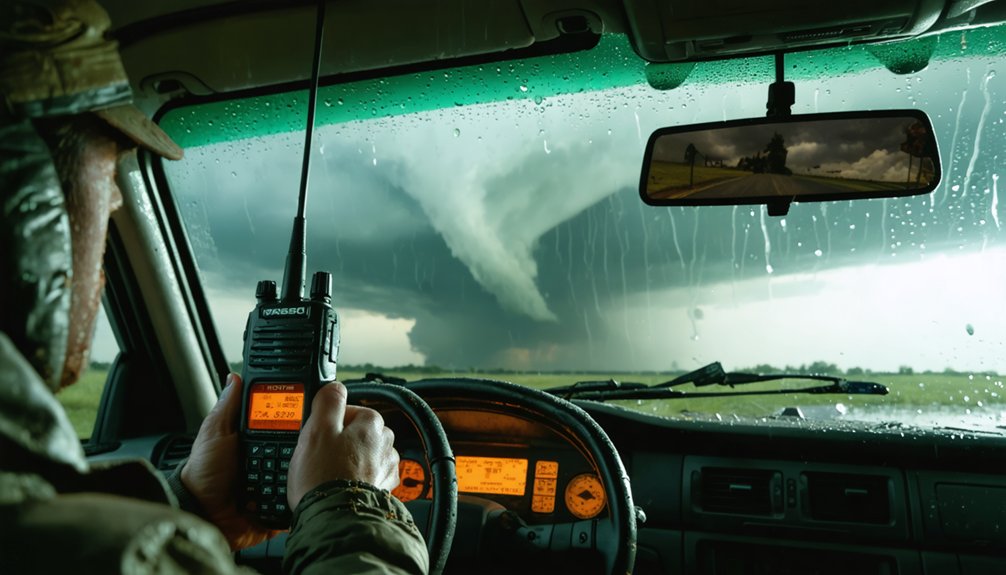
Ham radio gives chasers a direct, peer-to-peer communication channel that doesn’t depend on commercial infrastructure. When cell towers fail or get overloaded, you’re still transmitting. That’s a core Ham Radio Benefit no cellular plan can guarantee.
The 2-meter VHF band is the standard for storm chasing operations. It delivers reliable short-range voice communication between vehicles and integrates with APRS for real-time position tracking.
VHF Band Usage also connects you directly into Skywarn spotter networks, letting you relay ground-truth reports straight to NWS-affiliated operators without any internet dependency.
Licensing matters here. A Technician-class license gives you full 2-meter access. You’re not borrowing someone else’s network — you’re operating independently.
In low-coverage terrain across the Great Plains, that autonomy isn’t optional. It’s essential.
When Cell Networks Fail: Using Satellite Communication on a Chase
Ham radio keeps you connected when towers fail, but it’s a short-range tool. When you’re deep in the Great Plains with zero cell coverage, satellite communication delivers the remote connectivity you need to stay operational and safe.
Satellite reliability comes from independence — these systems don’t depend on ground infrastructure that storms destroy. You get emergency messaging and situational updates regardless of terrain or network outages.
Satellite systems don’t rely on ground infrastructure — when storms destroy towers, your connection survives.
Key satellite tools for your chase kit:
- Satellite phones — voice and text when every terrestrial network is down
- Satellite internet devices — support live data transmission far outside cellular range
- Dedicated messaging units (like Garmin inReach) — lightweight backup communication with two-way SOS capability
Treat satellite as your non-negotiable fallback, not an optional upgrade.
Live Radar and Mobile Hotspots During an Active Storm Chase
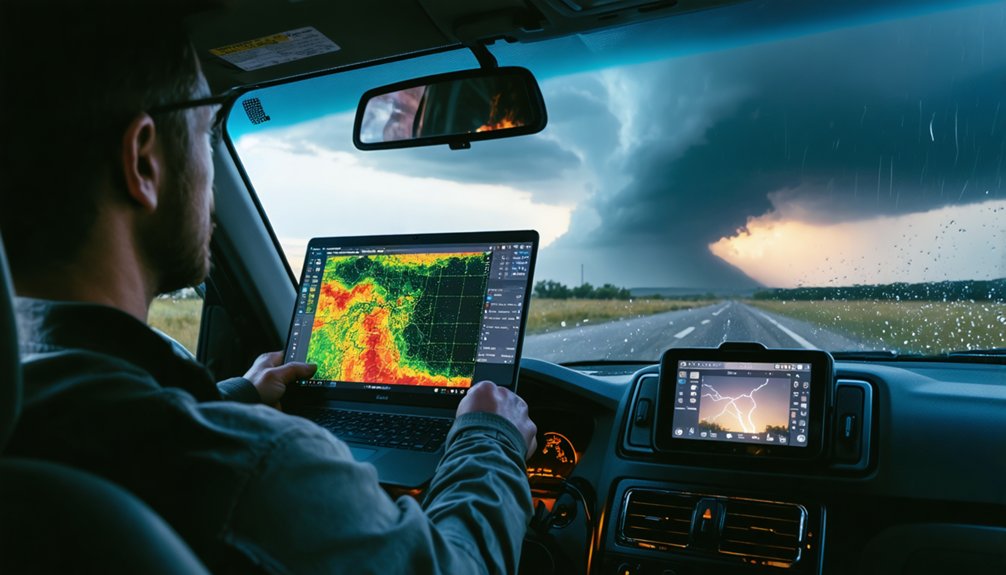
When you’re actively chasing, a mobile hotspot keeps your radar apps, mapping software, and team communication tools running on a dedicated data connection rather than competing with other network traffic.
You can pull live radar overlays, storm-relative velocity data, and GPS positioning simultaneously, giving you precise, up-to-the-minute situational awareness.
Pairing a hotspot with a rugged tablet and radar software lets you track storm paths, identify rotation signatures, and plan escape routes in real time.
Mobile Hotspot Connectivity Benefits
Mobile hotspots give storm chasers on-demand internet access when fixed infrastructure isn’t available, and that connectivity directly supports live radar retrieval, GPS tracking, and team coordination during an active chase.
Understanding mobile hotspot advantages helps you stay operationally independent, while recognizing connectivity challenges lets you plan redundancies before signal degrades.
- Dedicated hotspot devices separate your data load from your phone, keeping both functional under high network demand.
- Dual-carrier setups reduce dead zones by switching between networks when one provider loses signal in rural terrain.
- Hotspots support multiple devices simultaneously, letting your tablet run radar overlays while your phone handles voice and messaging.
You’re not dependent on roadside infrastructure when you carry your own connection, and that independence directly improves your decision-making speed during fast-moving severe weather events.
Real-Time Radar Data Access
Live radar data transforms raw atmospheric chaos into actionable positioning decisions, and your mobile hotspot is what keeps that data pipeline open during an active chase. Without consistent connectivity, you’re operating blind during the moments that matter most.
Real time radar platforms like RadarScope pull Level-III and Super-Resolution data directly to your device, giving you tilt-by-tilt storm structure analysis. Data accuracy depends heavily on your connection stability, so your hotspot’s signal strength directly affects how current your imagery stays.
Latency kills positioning confidence. You need sub-minute refresh cycles to track mesocyclone movement and identify potential tornado signatures before they’re on top of you.
Pair your hotspot with a secondary carrier device to maintain redundancy, ensuring your radar feed stays live even when one network degrades.
How Storm Chasers Use Social Media for Real-Time Field Reporting
Since the mid-2000s, social media has reshaped how storm chasers report field conditions in real time. You can push field updates instantly to thousands of followers without routing through traditional media gatekeepers. Social engagement drives faster ground-truth verification when multiple chasers report the same storm simultaneously.
Social media turned storm chasers into real-time broadcast nodes, bypassing gatekeepers and accelerating ground-truth verification across the field.
Each platform serves a distinct operational role:
- Twitter/X delivers rapid, timestamped field updates on storm position, rotation, and damage indicators as events unfold.
- Facebook supports image sharing and detailed chase reports, enabling broader discussion among chasers and meteorologists.
- Discord hosts structured forecast conversations and live chase threads, keeping teams coordinated during active events.
You’re fundamentally operating as an independent broadcast node, transmitting verified field intelligence directly to the public and professional meteorological community simultaneously.
Frequently Asked Questions
Can Storm Chasers Communicate Effectively Without Any Internet Connection Available?
Yes, you can communicate effectively without internet. Use two-way radios on 2-meter VHF for instant chaser-to-chaser coordination, and rely on satellite phones for remote connectivity when terrestrial networks completely fail you.
Do Storm Chasers Ever Lose All Communication During an Active Tornado?
Yes, you can lose all communication during an active tornado. EMP-like interference, terrain, and cellular overload cut signals fast. That’s why you’ll rely on tornado safety protocols and communication backups like satellite devices and ham radio.
How Do Storm Chasers Coordinate With Local Emergency Services During Events?
You’re practically a lifeline hub during events! You use ham radio and cellular networks, following emergency protocols and coordination strategies to relay real-time spotter data directly to NWS-affiliated Skywarn networks, syncing your position with local emergency services instantly.
Are There Legal Licensing Requirements for Radios Storm Chasers Commonly Use?
Yes, you’ll need a license for ham radio (FCC Part 97), but FRS handhelds carry licensing exemptions under radio frequency regulations. GMRS requires a simple FCC license, while CB operates license-free nationwide.
How Do Storm Chasers Communicate When Crossing Into Areas With Foreign Networks?
When you cross border signals, your phone handles network switching automatically via roaming. Carry dual-carrier phones, a satellite device, and ham radio to maintain reliable voice, data, and coordination regardless of foreign network availability.
References
- https://en.wikipedia.org/wiki/Storm_chasing
- https://crazystormchasers.com/storm-chasers-communication-protocols/
- https://www.youtube.com/watch?v=AswKDts1i0o
- http://www.ndtornado.com/primary/equipment.htm
- https://www.reddit.com/r/stormchasing/comments/1ckp7r6/how_can_i_meet_chasers_infield/
- https://crazystormchasers.com/communication-devices-for-storm-chasers/
- https://blog.peakptt.com/push-to-talk-ptt-two-way-radios-for-storm-chasers/
- https://midlandusa.com/blogs/blog/how-to-use-two-way-radios-while-storm-chasing
- https://www.youtube.com/watch?v=Ky-Qr9LwiS4
- https://midlandusa.com/blogs/blog/storm-chasers-rely-on-walkie-talkies-to-communicate