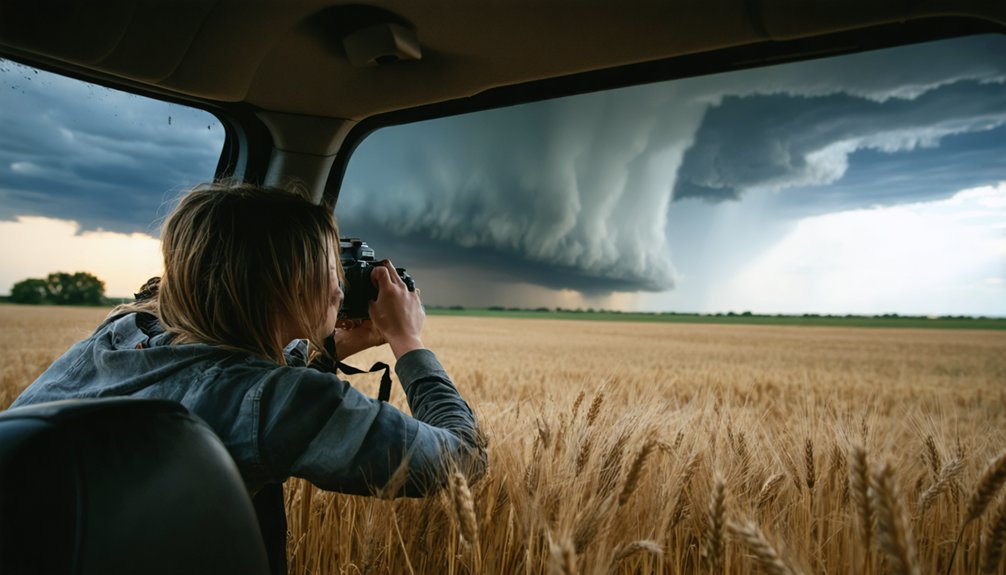
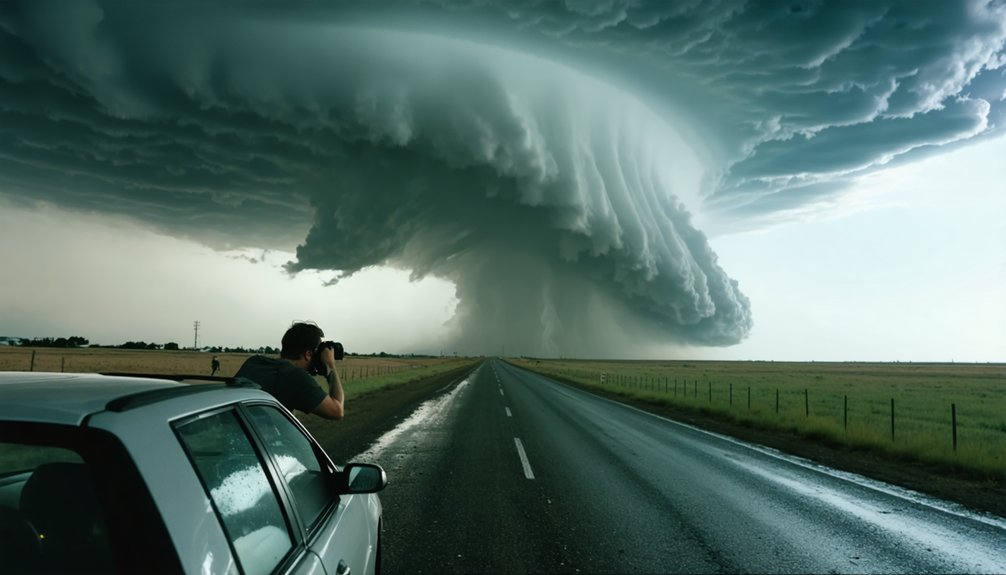
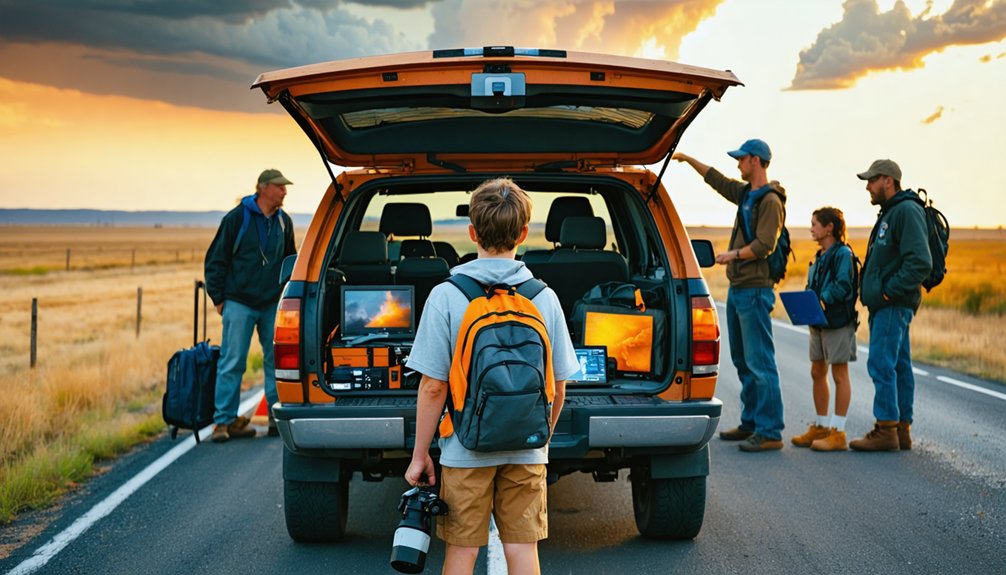
Storm chasing puts you in deliberate pursuit of violent weather — supercells, tornadoes, and hurricanes — using radar data, atmospheric analysis, and precise field positioning. You’ll need to understand severe weather ingredients like instability, wind shear, and moisture before you ever hit the road. Getting started means completing NWS spotter training, studying meteorology fundamentals, and connecting with experienced chasing communities. Master the knowledge, gear, and decision-making frameworks, and you’ll be ready to execute your first chase safely.
Key Takeaways
- Storm chasing is the deliberate pursuit of severe weather events like tornadoes and supercells for scientific, media, or adventurous purposes.
- Beginners should start with structured self-study of meteorology fundamentals and complete National Weather Service spotter training.
- Essential gear includes a reliable vehicle, GPS, weather apps, radar software, communication devices, and documentation equipment.
- Learning to read radar, skew-T diagrams, and recognizing storm features like mesocyclones is critical for safe chasing.
- Joining storm chasing communities or guided chase tours accelerates learning and provides valuable real-world experience.
What Is Storm Chasing and Why Do People Do It?
Storm chasing is the deliberate pursuit of severe weather events—supercells, tornadoes, hurricanes, and other extreme atmospheric phenomena—for purposes ranging from scientific data collection to media documentation.
You’ll find that storm chasing motivations span a broad spectrum: researchers prioritize atmospheric measurement and severe weather analysis, while broadcasters focus on real-time media coverage and storm documentation. Adventure seeking and thrill seeking drive many independent chasers into the field, though these motivations don’t exclude rigorous operational discipline.
Community involvement strengthens the practice considerably—spotter networks, chase teams, and meteorological societies create structured environments where knowledge transfers efficiently.
Community involvement transforms storm chasing—spotter networks and chase teams ensure critical knowledge reaches those who need it most.
Educational outreach represents another critical function, as documented chase footage and field data inform public awareness campaigns. Understanding *why* you’re chasing directly shapes your preparation strategy, risk tolerance, and long-term contribution to the broader severe weather community.
The Weather Knowledge Every Storm Chaser Needs First
Before you chase your first storm, you need a working grasp of severe weather ingredients—instability, wind shear, moisture, and lift—and how they combine to produce supercells and tornadoes.
You’ll interpret NEXRAD radar loops, surface charts, and upper-air data to pinpoint target areas and track storm motion in real time.
Once you’re in the field, you must recognize critical structural features—the mesocyclone, rear-flank downdraft, and inflow bands—to position yourself safely and read what the storm is doing next.
Understanding Severe Weather Basics
Whether you’re photographing supercells or collecting field data, understanding severe weather fundamentals isn’t optional — it’s the analytical foundation every decision in the field depends on. You need to recognize the four key severe weather ingredients: atmospheric instability, vertical wind shear, sufficient moisture, and a lifting mechanism.
Without that framework, you can’t accurately interpret storm dynamics or anticipate how weather patterns evolve across a target region.
Study storm types systematically — supercells, squall lines, and bow echoes each behave differently and demand different positioning strategies.
Learn to read skew-T diagrams, convective available potential energy values, and storm-relative helicity. These aren’t abstract concepts — they directly determine whether a storm produces a violent tornado or collapses entirely.
Your ability to interpret this data independently determines how effectively you operate in the field.
Reading Radar And Maps
Master these tools independently before field deployment — your decisions in the chase environment will only be as reliable as your ability to read the data accurately.
Recognizing Storm Structure
Radar proficiency gets you to the right county, but recognizing storm structure in real time is what keeps you alive once you’re there.
Master these core storm features: the rotating wall cloud signals mesocyclone intensification; the rear-flank downdraft wraps clear, descending air around the updraft base; inflow bands indicate strong low-level convergence feeding storm energy.
Accurate storm identification depends on distinguishing the storm’s forward-flank precipitation core from the vault region and recognizing the striated, layered updraft tower indicating organized rotation.
You’ll position yourself on the inflow side, southeast of the updraft base in most supercells, preserving clear sightlines and viable escape routes.
Each structural element communicates storm behavior. Read those signals correctly, and you maintain operational control of your position and your safety.
The Gear and Technology Storm Chasers Actually Need
Storm chasing demands a carefully selected kit that directly supports real-time decision-making, mobility, and safety in rapidly evolving conditions.
Your vehicle requirements start with a reliable, high-clearance unit carrying full fuel and quality tires. Mount your navigation devices — GPS units backed by paper atlases — to reroute instantly around dead ends or flooded crossings.
For technology tools, you’ll need mobile data, weather apps, and radar software delivering sub-minute scan updates.
Layer that with communication equipment: a cell phone, weather radio, and HAM scanner for coordinating with agencies and monitoring warnings.
Your documentation gear — cameras and protective cases — captures structural data for post-chase analysis.
Round out your safety gear and protective clothing with sturdy boots and weather-resistant layers, keeping you operational regardless of what conditions develop around you.
The Real Risks of Storm Chasing and How to Stay Safe
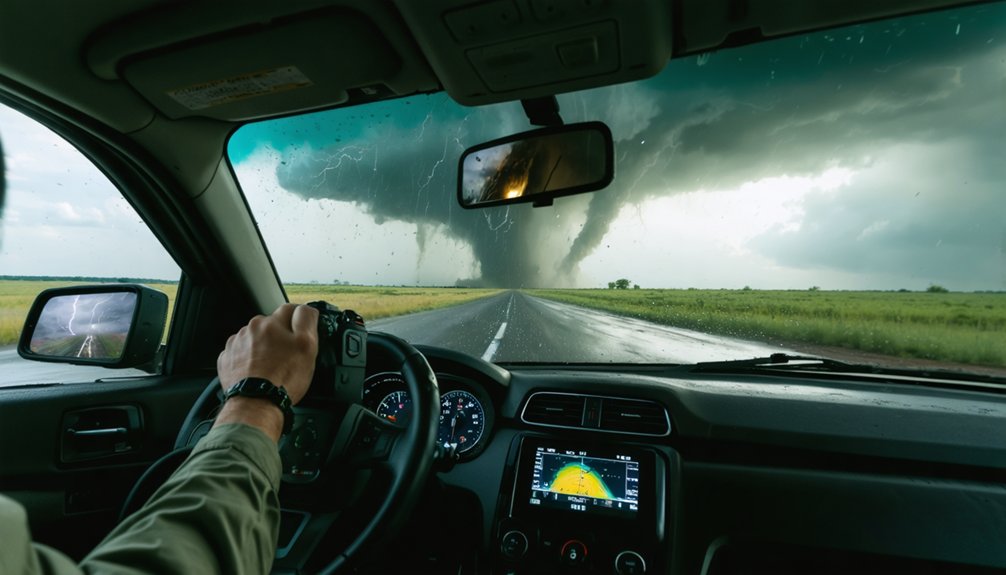
When you assess the true risk profile of storm chasing, driving hazards consistently rank as the leading threat — wet pavement, hail-covered roads, reduced visibility, and converging chaser traffic create accident conditions independent of any storm activity.
Beyond the vehicle, you’ll face direct storm-related dangers including large hail, lightning strikes, flash flooding, and rapid shifts in tornado track or storm structure that can compress your margin of error within seconds.
Mitigating these risks requires you to maintain pre-planned escape routes, hold safe distances from tornado cores, avoid low-water crossings, and never treat an overpass as a shelter option.
Driving Hazards Come First
Despite the dramatic imagery that defines storm chasing in popular culture, driving hazards—not tornadoes—account for the majority of chaser fatalities and injuries.
Wet pavement, hail-covered roads, zero-visibility rain cores, and converging chase traffic create compounding risks that demand serious vehicle preparedness and road awareness before you ever leave home.
Your navigation strategies must account for escape routes, low-water crossings, and dead-end rural roads. Emergency planning isn’t optional—it’s operational protocol. Keep your fuel full, your tires sound, and your maps loaded offline.
Traffic management matters too. Congested chase corridors near confirmed tornadoes concentrate inexperienced drivers making reactive decisions.
Chaser etiquette requires you to pull completely off roads when stopping. Driving safety under deteriorating weather conditions separates disciplined, independent chasers from those who become the incident.
Storm Dangers To Anticipate
Beyond vehicle and road management, you’ll face hazards that originate from the storm itself—and each carries distinct threat profiles, onset speeds, and survivable margins you need to understand before positioning near a supercell.
Tornado safety demands constant awareness of storm structure, particularly mesocyclone rotation and RFD surge timing.
Hail threats escalate rapidly near the core, with stones exceeding baseball size causing vehicle and personal injury within seconds.
Lightning risks remain statistically underestimated by newer chasers—supercells produce frequent, far-traveling ground strikes well outside precipitation areas.
Flooding concerns intensify near outflow boundaries where severe weather produces rainfall rates exceeding two inches per hour.
Wind dangers from downdraft surges and gustnadoes can exceed 80 mph without warning.
Treat every driving challenge and storm-generated hazard as interconnected—deteriorating conditions compound simultaneously, not sequentially.
Essential Safety Best Practices
Safety in storm chasing isn’t a mindset you adopt situationally—it’s a structured decision framework you apply before, during, and after every chase. Your risk assessment starts the night before: analyze convective outlooks, model soundings, and storm-relative helicity to quantify threat potential.
In the field, maintain continuous storm awareness by monitoring real-time radar loops and weather updates every few minutes. Pre-identify escape routes perpendicular to storm motion—never parallel. Your emergency plans must account for rapid storm acceleration, core shifts, and blocked roads.
Carry essential safety gear: weather radio, HAM communicator, first aid kit, and hail-rated vehicle protection. Follow established communication protocols—report verified observations to NWS and coordinate positions with partners.
Respecting chaser etiquette—no road-blocking, no reckless positioning—keeps the entire community operationally safe and legally protected.
The Legal and Ethical Rules of Storm Chasing
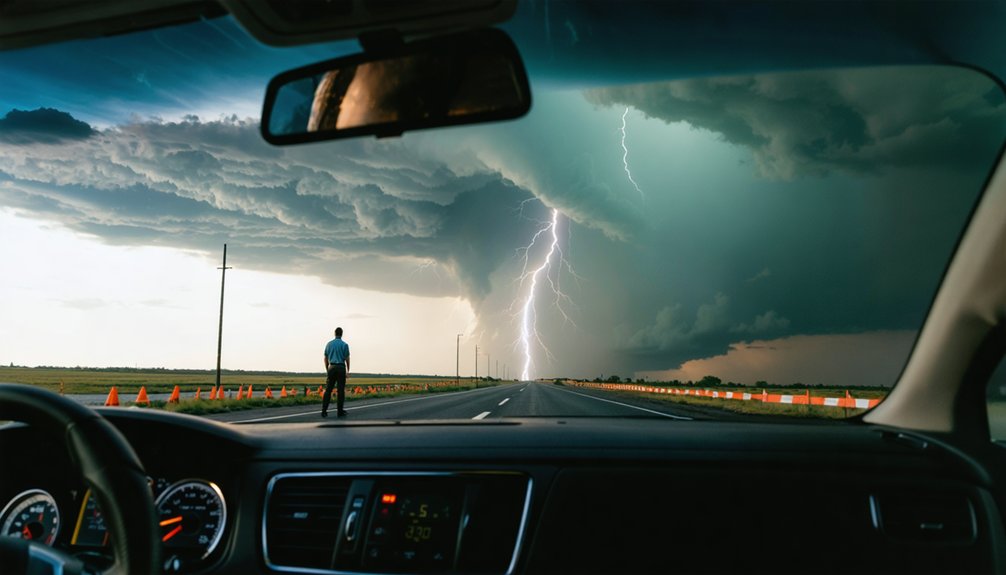
While storm chasing carries no universal licensing requirement, you’re still operating within a framework of legal obligations and ethical standards that directly affect field outcomes and public safety.
Respect property rights by staying off private land without permission. Don’t obstruct roadways or interfere with emergency services during active response operations — doing so creates cascading hazards and can carry legal consequences.
Ethical practices demand accurate reporting to the NWS or local dispatch when you’re trained to do so; false or delayed reports degrade warning systems.
Follow community respect protocols by not broadcasting unverified tornado reports on social media. Honor road closures set by authorities.
In storm chasing, your freedom of movement depends on maintaining credibility and operational discipline — both preserve your access and protect those in the storm’s path.
How to Get Started as a Beginner Storm Chaser
Understanding the legal and ethical framework gives you the operational baseline — now you need the foundational knowledge and field skills to act within it. Start with structured self-study: meteorology fundamentals, radar interpretation, storm structure, and severe weather ingredients.
Complete NWS spotter training — it’s free and builds situational awareness critical for safe positioning.
Complete NWS spotter training — free, structured, and essential for building the situational awareness that keeps you alive in the field.
Tap into storm chasing communities and beginner resources like online forums, chase logs, and documented case studies to accelerate your learning curve.
Before independent operations, pursue guided chase tours where you’ll observe professional target selection, escape route planning, and real-time radar analysis firsthand.
Transition to independent chasing gradually — partner with experienced chasers on well-forecast, daytime supercell setups in open terrain.
Post-chase, review your radar loops, GPS tracks, and positioning decisions systematically to sharpen future performance.
What Actually Happens on a Storm Chase Day?
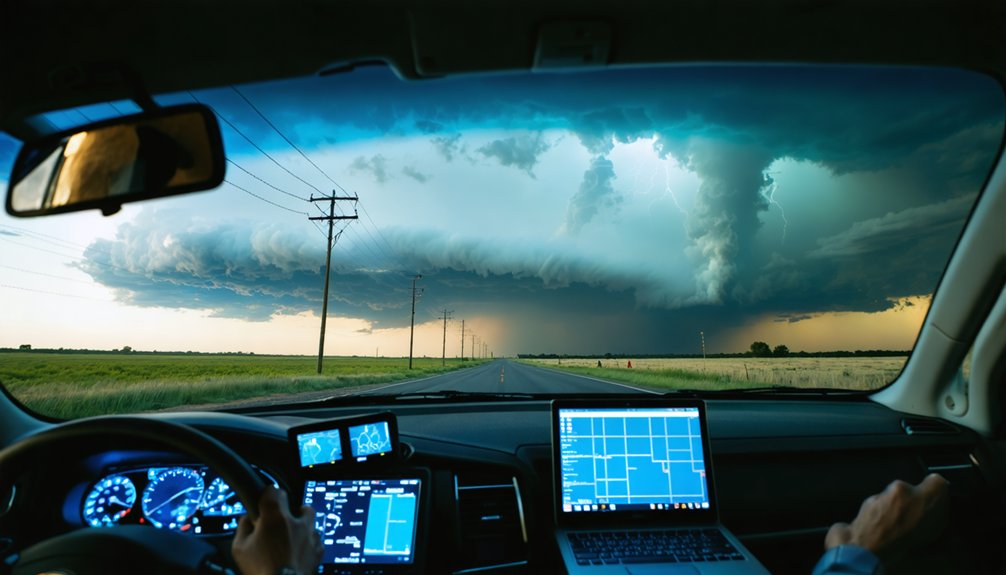
A storm chase day begins hours before you leave the house — typically with an in-depth exploration into convective outlooks, upper-air charts, model soundings, and storm-relative helicity fields to identify your target area.
Chase preparation demands you pinpoint the initiation zone before convection fires, giving you repositioning flexibility as radar evolves.
Once mobile, you’ll drive toward anticipated storm development while continuously pulling weather updates through radar apps and satellite imagery.
You’ll position on the right-front inflow flank of your target supercell, maximizing structural visibility while keeping escape routes viable.
From there, you’re constantly reassessing — storm motion, mesocyclone development, environmental shifts, road networks.
Every decision compounds. When significant phenomena appear, you document, report if trained, and adapt instantly.
The chase rewards disciplined, data-driven thinking, not reckless improvisation.
Frequently Asked Questions
How Much Does It Typically Cost to Go on a Storm Chase?
You’ll typically spend $500–$1,500 per week on storm chase expenses, covering fuel, lodging, food, and data plans. Smart budgeting strategies help you optimize resources, letting you chase more freely without financial constraints limiting your operational decisions.
What Physical Fitness Level Is Required for Storm Chasing Activities?
Picture endless highway miles ahead — storm chasing fitness doesn’t demand elite athleticism, but you’ll need solid endurance training to handle long drives, quick sprints, and hours of intense focus without fatigue slowing you down.
Can Storm Chasers Make a Living or Career From Chasing Storms?
Yes, you can build a career by combining storm forecasting, media contracts, and weather technology roles. You’ll monetize through broadcast networks, research institutions, tour operations, or data analytics firms actively seeking field-verified severe weather expertise.
Are There Storm Chasing Communities or Clubs Beginners Can Join?
Surprise — you don’t have to chase storms alone like a reckless maverick! You’ll find storm chaser networks, online forums, local meetups, and safety workshops where you can connect, analyze data, and sharpen skills collectively.
What Insurance Do Storm Chasers Need for Vehicles and Equipment?
You’ll need extensive auto insurance with off-road or high-risk coverage, plus separate equipment coverage for cameras and tech gear. Review policy exclusions carefully—standard plans often won’t cover storm-related vehicle damage or specialized insurance types for field operations.
References
- https://en.wikipedia.org/wiki/Storm_chasing
- https://www.madscitech.org/scg/intro.html
- https://www.chaseday.com/what-is-storm-chasing/
- https://www.sciencedaily.com/terms/storm_chasing.htm
- https://dictionary.cambridge.org/us/dictionary/english/storm-chasing
- https://stormchasercoaching.com/post/what-is-storm-chasing
- https://medium.com/@paul_15500/storm-chasing-101-what-you-need-to-know-before-you-go-6a6a717ebcdd
- https://www.youtube.com/watch?v=y_DbpokoS-I
- https://www.youtube.com/watch?v=8xrbXCnCUvY
- https://www.youtube.com/watch?v=PbETjRJ7Ybg